
Tokenized settlement has a new operating rail. Portable machine authority still needs an operating record.
That is the clearest signal this week.
On September 21, the European Central Bank launched Pontes, a bridge between market distributed-ledger platforms and the euro area’s TARGET settlement services. Eligible institutions can now use it for wholesale settlement in central bank money. The initial service has launched; wider functionality remains phased. European Central Bank launch notice.
One day later, six global banks published common principles for artificial intelligence driven commerce. Their priorities were transparency, safety, privacy, choice and interoperability. The group said a later paper would address implementation. Consortium announcement.
Then, on September 23, a revised technical draft proposed per-action authorization for artificial intelligence agents. It describes budgets, approvals, evidence and a kill switch. The idea is important. The document is still an individual Internet-Draft with no formal standards standing. Draft record.
These are separate initiatives with different users and responsibilities. Their comparison concerns implementation stages. It does not establish an authorization failure in Pontes.
The current assessment
The new milestone is settlement availability. Existing provider controls remain part of the baseline, while portable mandates, independent assurance, recovery and recurring economics still need evidence of their own.
What changed
First, sovereign tokenized settlement moved from preparation into initial launch.
Pontes connects distributed-ledger markets to central bank money. The European Central Bank says it supports a dual settlement model, legal finality in its T2 real-time gross settlement system, and delivery versus payment for eligible participants.
This is a real infrastructure crossing. It is not proof of recurring volume, broad access, operating reliability or profitable scale.
Second, the bank consortium defined principles without demonstrating its proposed protections in operation across institutions.
The six-bank paper puts identity, authorization, fraud prevention, liability and customer protection near the center of the problem. That is directionally important. It remains a set of principles, not an implemented standard.
Third, the authorization layer became more specific.
The latest Agent Action Decision Protocol draft separates identity from permission for a particular action. An agent may possess credentials and still lack authority to spend a specific amount, use a particular recipient or act after an approval expires.
That distinction is essential. It is also still draft work.
What is really happening
Tokenized finance is not waiting for every trust problem to be solved at once.
Settlement, eligibility and legal finality can advance inside a regulated perimeter. Machine authority, portable mandates, dispute handling and liability can remain incomplete around it.
This creates a layered transition.
The settlement rail asks whether value moved and became final.
The authority layer asks whether the right machine acted for the right person, within the right limits, with a usable record and a remedy when something went wrong.
Those are different problems. Solving one does not solve the other.
The hidden transition
The important shift is not simply from traditional finance to tokenized finance.
It is from systems that assume a human is directly operating the interface to systems that must verify delegated machine action.
That changes what counts as infrastructure.
Identity alone is not enough. A system may know which agent is acting but still not know whether this exact payment is permitted now.
A spending limit alone is not enough. The recipient, timing, purpose and cumulative activity can all change the meaning of the action.
A transaction record alone is not enough. Evidence matters only if another party can inspect it, assign responsibility and support recovery.
Our Week-End Signal W38, published September 19, separated improved access from reliable operation and durable economics. That remains the comparison here. Pontes adds a new settlement route; it does not erase the bounded wallet and payment capabilities already covered in Mid-Week Signal W38, published September 17. The new bank paper and technical draft add design evidence, not a downgrade of those existing capabilities.
Transition progress
Comparison: Week-End Signal W38, evidence through September 19. Current stages refer to the named systems inspected or the explicitly carried baseline, not every system in each category.
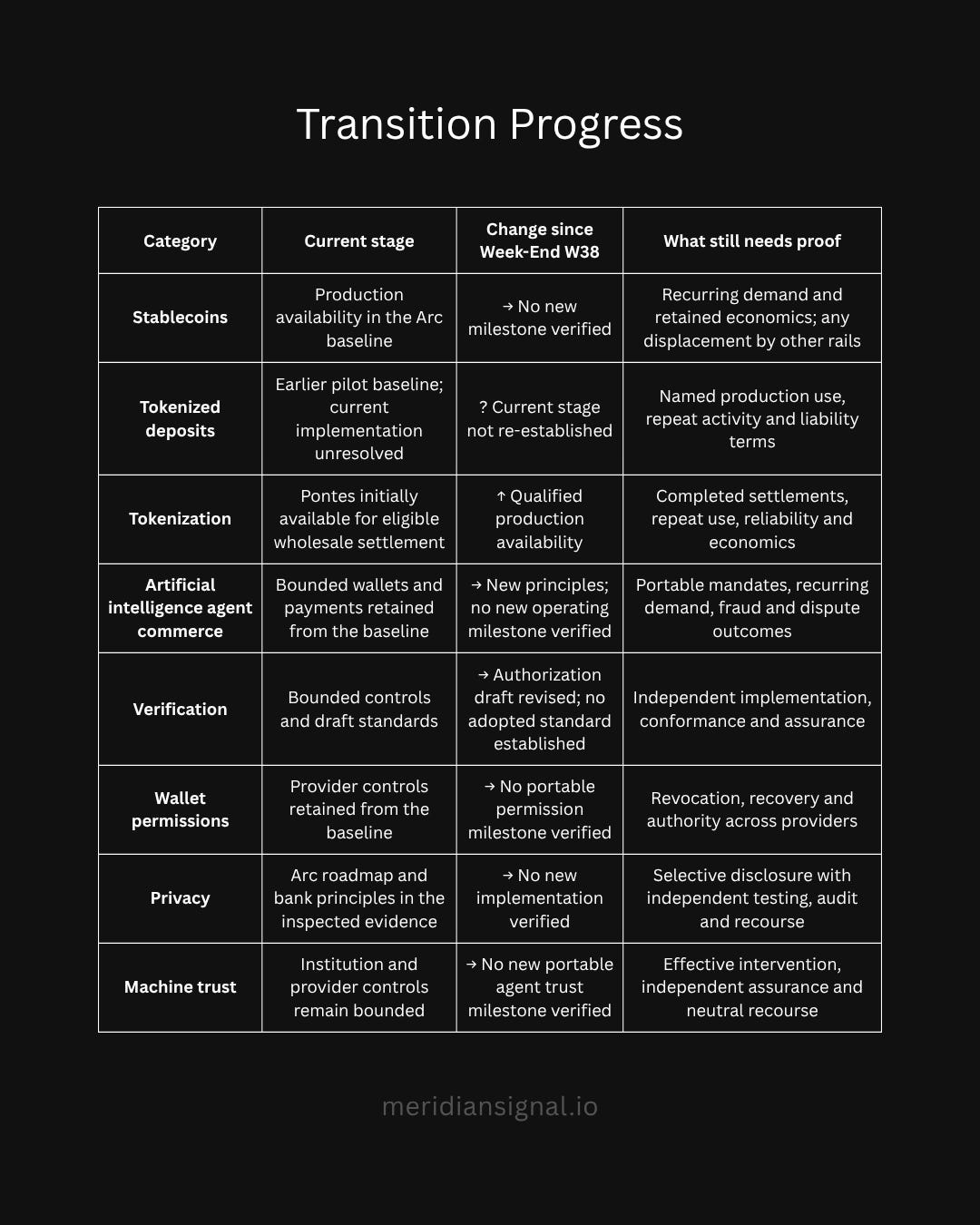
Reading the tracker: ↑ means a verified advance in the stated area. → means no new milestone was verified within this review, not proof that nothing changed anywhere. ? means the current stage could not be established. Prior capabilities remain a baseline, not a fresh certification of continued operation. Pontes is counted once under tokenization; settlement finality does not establish a machine’s mandate.
The baseline capability boundaries come from Arc’s launch documentation and Portal documentation. No category receives new recurring or scaled production credit in this edition.
Meridian consensus and readings
Signal Stability: 95 out of 100, Thesis unchanged.
Unchanged from Week-End W38. This is the approved representative point for the unchanged band, not a probability or a precision estimate. Historical readings under the earlier convention are not numerically comparable.
The core interpretation still holds: institutional access and operating rails can advance before portable authority, independent assurance, neutral recourse and recurring economics.
Pontes does not weaken that interpretation. It makes the sequence easier to see.
Signal-to-Noise: High Signal, unchanged.
The European Central Bank confirms the initial launch. The bank consortium confirms its own principles. The standards registry confirms the document remains an individual draft. The unresolved outcome data can be separated from those facts.
Transition confidence: Supported, unchanged. The launch supports institutional implementation; adoption and economic inevitability remain unproven.
Sequence confidence: Supported, unchanged. The inspected settlement route has launched while the cited portable authority work remains at principles and draft stages. This is a comparison of these initiatives, not proof of one universal sequence.
Transition progress: Qualified production availability crossing. Week-End W38 added conditional permission; this edition adds Pontes availability. No recurring or scaled production crossing is claimed.
Publication delta: Material, unchanged category. This edition contributes a new settlement milestone and a clearer comparison with unfinished portable authority work.
Near-term investability: Mixed within restrictive conditions, unchanged category. The effective federal funds rate remained 3.88 percent on September 22. The ten-year nominal Treasury yield rose to 4.96 percent and the ten-year real yield to 2.63 percent, both two basis points above September 17. Capital remains expensive. Federal Reserve, September 23 release with September 22 observations.
System integrity: Qualified, unchanged. No public Pontes transaction series, operating error rate or retained economics were verified. Those gaps prevent a higher production classification, but they do not negate the initial launch.
Meridian positioning
Do not value the transition as one undifferentiated market.
Track four layers separately:
Settlement: Did value move with legal finality?
Authority: Was the action permitted for this machine, amount, recipient and moment?
Recourse: Can a harmed party challenge, reverse or recover from the result?
Economics: Who retains revenue after compliance, security and operating costs?
The strongest positions may belong to institutions that connect these layers without forcing users into one closed system. That remains an analytical possibility, not a verified winner list. No new public digital asset qualification follows from this edition.
What would change our view
The thesis would require a bounded adjustment if portable authorization and recourse worked across providers without depending on one institutional control point.
Pontes would advance beyond production availability if official or independently verifiable data showed completed settlements, repeat participants, reliable delivery versus payment and sustained volume.
The bank consortium’s initiative would advance beyond principles if its members implemented shared mandates, revocation, liability and dispute handling in live transactions.
Digital asset value capture would require enforceable holder rights, transparent fee routing, retained economics and evidence that alternative rails could not bypass the asset.
One core takeaway
Settlement finality and machine authority require separate proof.
Pontes has launched. Portable machine authority still needs an operating record.
Sources: European Central Bank, Bank of America consortium release, Agent Action Decision Protocol draft, Federal Reserve H.15 and Reuters launch reporting.
Evidence cutoff: September 23, 2026, 6:55:19 p.m. Pacific / September 24, 2026, 01:55:19 UTC.