

It is getting easier to enter the next financial system. It is not yet clear who will absorb the cost when something goes wrong.
That distinction matters more now. A regulator has opened a conditional route for certain tokenized stocks. Financial interfaces are making it easier to connect wallets and delegate tasks to artificial intelligence agents. But easier access can leave the responsibilities underneath largely unchanged.
Our assessment: the next advantage may belong to the firms that make these systems dependable, not simply accessible.
Three developments worth separating
A regulatory path opened. On September 17, the Securities and Exchange Commission announced temporary, conditional relief for certain tokenized-stock trading venues and liquidity providers. That is a meaningful development after the congressional setback. It is not proof that a particular venue qualifies or that a new market is already operating successfully. Commission announcement.
The operating boundary became clearer. Arc’s September 18 Portal documentation describes how users connect wallet permissions to independently operated agents. Portal does not create those agents or custody the funds. Users remain responsible for configuring permissions and monitoring activity. This clarifies an existing service; it is not another mainnet launch. Arc Portal.
Financing moved in different directions. The Federal Reserve’s September 18 release records a higher effective overnight rate but lower longer-term Treasury yields than the observations used in our internal Mid-Week assessment. Higher short funding costs and some long-rate relief can coexist. Federal Reserve rates.
What the regulatory change does and does not tell us
Congress is not the only route through which financial rules can evolve.
The Commission’s stated conditions retain permissioned access and shareholder protections. Its chair describes the exemption as an interim step that still needs durable rulemaking. This is a route within a regulated structure, not the disappearance of that structure. Commission chair’s statement, September 17.
The useful implication is narrower than a claim that tokenization has been solved. Legal access may improve before broad legislation is complete. Actual trading, reliable settlement, enforceable rights and profitable operation still have to be demonstrated.
We have verified the official announcement and accompanying statement, not completed a legal review of the full order or any venue’s eligibility. No conclusion here establishes that Arc or another platform qualifies under the exemption.
A simpler interface can conceal a complicated responsibility chain
Imagine approving a task, setting a spending limit and letting an agent proceed. The interface can make that feel like one action. Underneath it sit several separate questions.
Did the action match your purpose? Were the permissions narrow enough? Can you stop a task already in motion? Is the transaction reversible? Which party must help if it fails?
A balance display and a limit setting are useful. They do not answer every one of those questions.
Arc Studio illustrates another boundary. Its documentation says generated code can be exported, but the user remains responsible for independent review and mainnet deployment. Easier software creation does not transfer the duty to verify it. Arc Studio.
This also limits the opposite argument. Exportable code and independently operated agents mean we should not assume complete provider lock-in. Some control points may be valuable precisely because users can choose among them. The evidence does not yet identify the durable winner.
The hidden transition
As access improves, the economic question moves downstream.
Who verifies the rights attached to an asset? Who makes delegated authority understandable? Who can show that a system behaves correctly under stress? Who provides a workable route to recovery?
Meridian’s interpretation is that these functions may become more important as participation grows. That is a thesis to test, not a claim that every compliance provider, wallet or verification network will earn attractive returns.
Usage alone will not settle the investment question either. A required settlement asset can have clear utility without giving its holder a claim on the operator’s profits. Distribution can be valuable without producing durable margins. We need to identify who gets paid, what costs they bear and whether customers can leave.
Capital remains part of the test
The financing picture deserves a qualification.
The latest inspected rate release ends with September 17 observations. It shows the effective federal funds rate at 3.88 percent, while the ten year Treasury yield was 4.94 percent and its inflation adjusted counterpart 2.61 percent. Those longer yields were modestly below September 15 levels. This is mixed movement within a still demanding funding environment, not a broad easing signal. Federal Reserve rates.
Initial unemployment claims also fell to 196,000 in the September 17 release. That argues against calling a labor break from this evidence. One advance weekly observation cannot establish the whole economic trajectory. Labor Department claims.
For businesses, the question is practical: can the service support its operating and financing costs before the market gives it easier conditions?
Transition tracker
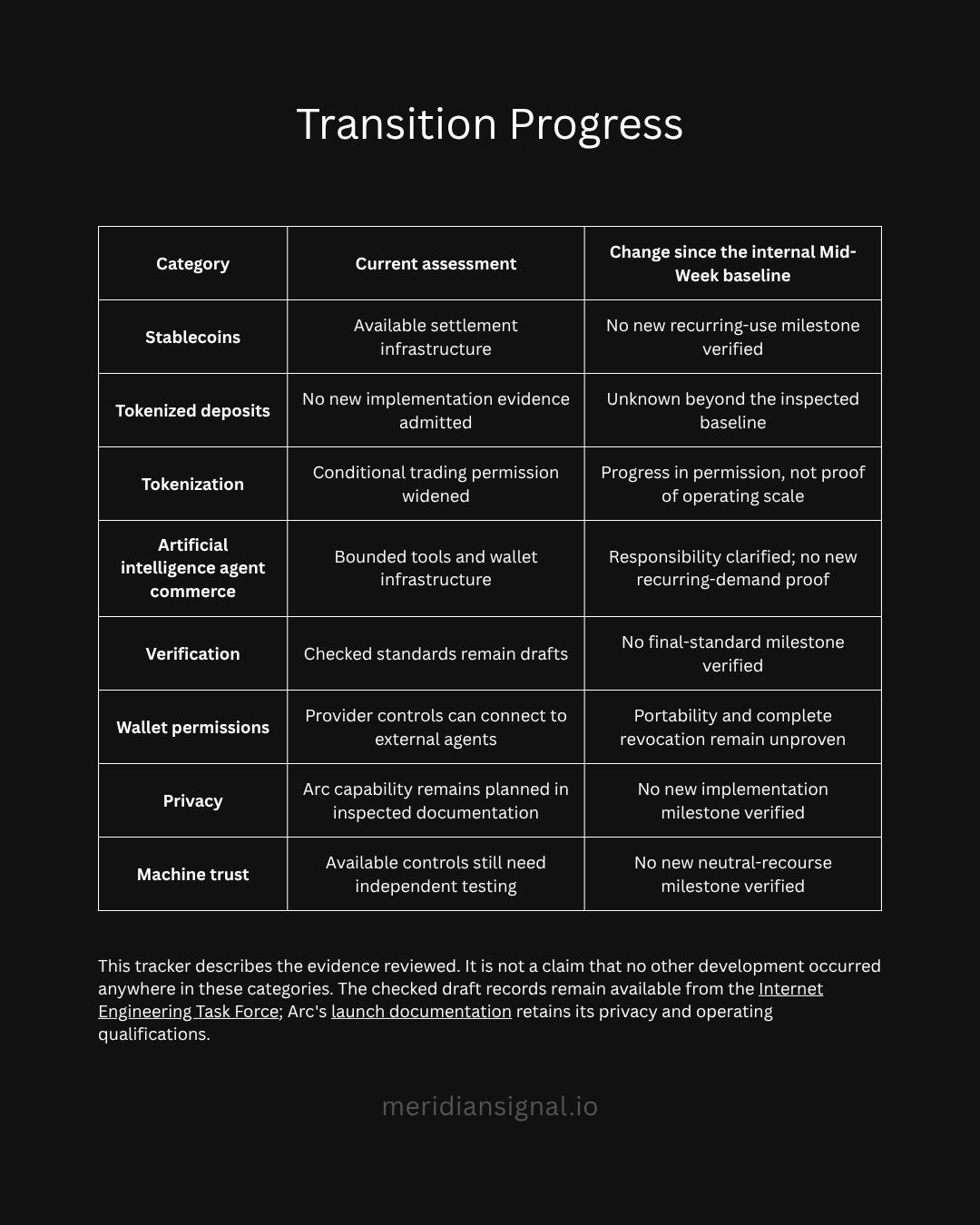
This tracker describes the evidence reviewed. It is not a claim that no other development occurred anywhere in these categories. The checked draft records remain available from the Internet Engineering Task Force; Arc’s launch documentation retains its privacy and operating qualifications.
Meridian consensus
The structural thesis is unchanged: implementation is advancing through bounded controls and institutional access, while portable authority, independent assurance and recurring economics still need proof.
Our legal assessment is now more differentiated. A legislative setback does not close every regulatory path. Our financing assessment is mixed rather than uniformly tightening.
Signal Stability: 95 / 100 | Thesis unchanged. This is the approved representative point for the unchanged band, not a probability or an investment rating. It is unchanged from the latest internal master. Earlier historical point conventions are not numerically comparable; the old reading of 99 is not treated as a four point decline.
Signal-to-Noise: High Signal. Official policy, explicit operating boundaries and observed funding conditions support the conclusion. Unverified adoption and return claims do not carry it.
How we are positioning the analysis
Separate five tests: permission, authority, reliability, recovery and economics.
Passing the first does not establish the other four. Nor should incomplete evidence in one area erase genuine progress in another.
For now, focus on systems that can show clear responsibilities, controllable permissions, repeat customers and revenue after the costs of operating safely. This edition establishes no new public digital asset qualification.
What would change our view? Independent evidence of controls and recovery working across providers. Verified repeat use without dependence on launch incentives. Clear retained economics. Or failures that show the current operating model cannot carry the responsibilities placed on it.
Easier access becomes durable progress only when responsibility and economics can hold up in use.
Evidence cutoff: September 19, 2026, 1:56:22 p.m. Pacific / 20:56:22 UTC.
Meridian Signal
Bold clarity at the right time.
AI-assisted. Human-directed. Source-verified.
This publication provides general informational analysis only. This is not individualized financial, investment, legal, tax, accounting, or custody advice.