

Some weeks move the technology forward and make the business case harder at the same time.
This is one of them.
Arc went live on September 16. It brought stablecoin settlement, institutional validators, programmable applications and policy controlled agent wallets into one operating environment.
That is a real production crossing.
On the same day, the Federal Reserve raised its policy range to 3.75 percent to 4.00 percent. Its September projections also placed the median policy rate at 4.1 percent at the end of both 2026 and 2027.
The infrastructure advanced.
The price of patience rose with it.
Since our last Signal
Three developments matter.
Arc mainnet is live. USDC is required for network fees, known institutions operate the permissioned validator set and policy controlled agent wallets are available inside the platform.
The financing horizon became more demanding. The Federal Reserve raised rates and moved its median projected policy path higher than it was in June.
United States market structure legislation stalled. The Senate failed to advance the Clarity Act at a procedural vote. That was not final rejection, but it extended the timing uncertainty.
These developments point in different directions only if we treat transition progress as one thing.
It is not.
Technology can enter production while capital and law become less forgiving.
The current assessment
The structural transition advanced this week.
But the next question is no longer whether the pieces can be assembled. Arc shows that settlement, assets, wallets, agent tools and institutional validation can operate inside one stack.
The question is whether that stack can produce recurring demand, survive operating stress and retain economics after the issuer, validators, distribution partners, compliance providers and application owners are paid.
That is a harder test.
It is also the one that matters now.
What is really happening
Arc’s launch is important because it turns a scheduled architecture into an available network.
The platform uses USDC for network fees. It connects to Circle’s broader payment and cross network infrastructure. Users can create agent wallets, set spending limits and approve financial tasks. A known institutional validator set operates the network.
Those are not demonstrations.
They are operating components.
But the boundaries matter.
The validator set is permissioned. The controls remain inside the provider environment. Arc’s own terms say recourse for transaction errors or losses can be absent. Its privacy features are still future work. The public ARC token has not launched, and network fees remain payable in USDC.
So the launch proves availability.
It does not yet prove broad adoption, independent reliability, neutral recourse or durable value capture.
The Federal Reserve decision raises the standard further.
The quarter point increase changes the current cost of money. The higher projected path changes the planning horizon. In June, the median participant projected 3.6 percent for the end of 2027. In September, that median moved to 4.1 percent.
Those projections can change. They are not promises.
But a business that depends on rapid relief now has a weaker planning assumption.
The hidden transition
The quiet change is not simply that financial infrastructure is moving onchain.
It is that infrastructure, control and distribution are being bundled together.
Arc combines the settlement asset, fee mechanism, validator relationships, wallet interface, compliance perimeter and application access in one environment.
That can make adoption easier.
It can also concentrate value and authority around the firms that control those access points.
This is why a technical dependency is not automatically an investment conclusion.
USDC is required for fees on Arc. That creates real routing dependency. It does not tell us how much revenue Circle retains, whether usage becomes recurring or whether a separate public asset captures the economics.
The Clarity Act delay adds another layer. Firms can keep building under current arrangements, but plans that require a future law still need a delay scenario.
Implementation is moving ahead of complete legal certainty.
Transition progress
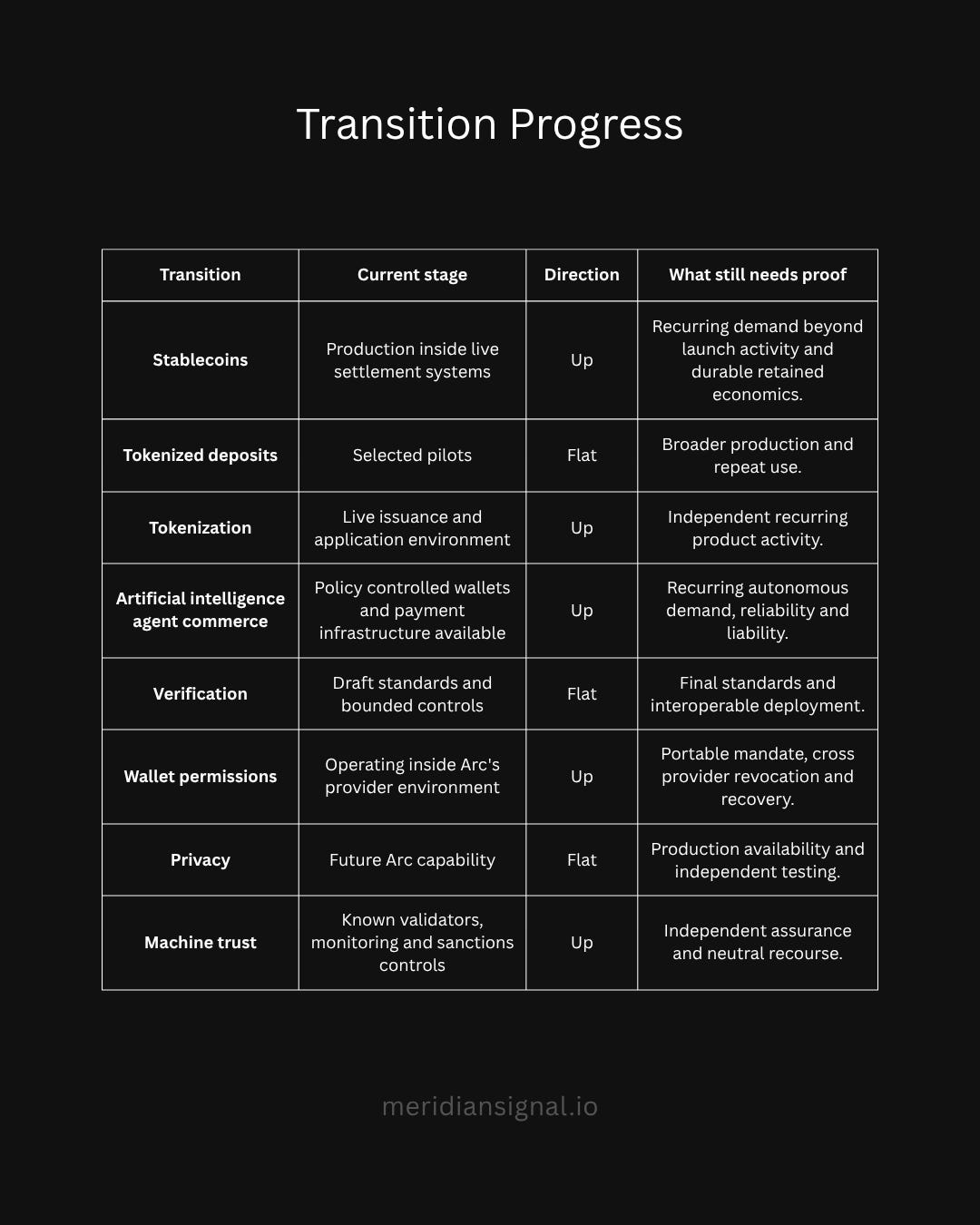
No category crossed into recurring or scaled production in this edition.
Meridian consensus
Our thesis did not change.
The evidence still points toward a financial system built around programmable settlement, controlled access, verifiable action and institutional distribution.
What changed is the stage.
One important stack moved from scheduled launch into production availability.
What also changed is the burden.
Capital became more expensive. Legislative timing became less certain. Launch evidence is no longer enough.
Signal Stability
95 / 100 | Thesis unchanged
This is the representative point for the unchanged band under Meridian’s approved convention. It is not a probability.
The core interpretation and its dependencies remain intact. Arc strengthens the implementation record. Federal Reserve policy and the Senate vote make execution more demanding, but they do not replace the organizing thesis.
Signal-to-Noise
High Signal
The central facts come from the Federal Reserve, the United States Senate and Arc’s live product documentation.
The unresolved claims are separated from the conclusion.
We give production availability credit to Arc. We do not give it recurring use, scaled adoption, independent reliability or public token value capture credit.
Meridian positioning
Follow the parts of the system that can keep working when money stays expensive.
That means paying attention to:
live settlement and distribution
explicit permissions and observable records
resilient balance sheets
known paying customers
revenue that remains after distribution and compliance costs
practical recovery when something fails
Do not confuse an ecosystem logo with active use.
Do not confuse a required asset with captured economics.
Do not build a launch plan around a law that has not passed.
What confirms next
The next evidence should be operational.
Does Arc remain stable after launch?
Do institutions and applications use it repeatedly?
Can independent observers verify performance and failure rates?
Can human authority and revocation travel outside one provider?
Who retains the fees and margins?
Does the Clarity Act or a replacement framework move forward?
Do inflation and policy data validate the higher rate path?
The transition is live.
The proof now has to survive real conditions.
One core takeaway
Infrastructure can go live before financing gets easier or law becomes clearer. The advantage belongs to systems that can keep operating anyway.
Sources
Evidence cutoff: September 16, 2026, 6:09:23 p.m. Pacific / September 17, 2026, 1:09:23 a.m. UTC
Meridian Signal
Bold clarity at the right time.
AI-assisted. Human-directed. Source-verified.
This publication provides general informational analysis only. This is not individualized financial, investment, legal, tax, accounting, or custody advice.