
Getting into a financial service is becoming easier. Knowing what happens to your money, your instructions and your personal information still takes more work. The useful test is whether those protections remain effective throughout the service.
This week’s evidence makes that distinction concrete. New stablecoin routes widen access. New site controls make some agent activity more manageable. A separate customer-data breach shows why protection cannot be reduced to whether funds were stolen.
Three changes worth separating
More routes into stablecoins. Stripe, November 5, 2026 says eligible US users can now buy USDC through Samsung Wallet using familiar payment methods. Its 82 million compatible-device figure describes potential reach, not active customers. BVNK, November 6, 2026 reports Open USD available for eligible business customers outside the European Economic Area, including minting, redemption and transfers across four networks. These are two access developments. Neither release supplies independent recurring-use measurements.
More specific controls for agents. Cloudflare, November 5, 2026 describes agent traffic analytics and site-access policies. Account-level attribution and mitigation sit within an early-access product. The company reports production building blocks while also acknowledging unfinished work for chains of intermediaries. Its new Trusted Agent Delegation coalition is an organizing effort, not proof of universal delegated authority or financial recourse.
An adverse result for customer information. Gnosis Pay, November 6, 2026 disclosed unauthorized access detected on November 3 in the system behind its branded cards. It says customer information was exposed while funds and its separate enterprise platform were unaffected. This is an operator account of a named system. It does not establish a defect in Samsung, BVNK, Cloudflare or a particular privacy protocol.
Our assessment is constructive on useful access and selective about the broader claims. These services address different jobs. Adoption, effective control and economic benefit require evidence at the level of each job.
The customer relationship survives the new interface
The hidden transition is a redistribution of responsibilities. A familiar wallet can make a new balance easier to obtain. A website can recognize an agent more clearly. A credential can move into a wallet with fewer custom steps. Behind each improvement, someone still needs to establish what the customer authorized, retain only appropriate information and respond when the result is wrong.
Those responsibilities create costs as well as business opportunities. Distribution may reduce acquisition friction. More usable controls may help a service accept legitimate activity. But extra integrations, compliance checks and incident response can absorb the benefit. A service can become useful while suppliers compete away much of its margin.
The strongest competing interpretation is straightforward: existing bank, card and security systems may already provide much of what customers need. New interfaces may complement them, with little displacement and no inevitable investment winner. Repeated use after incentives, measurable savings and recoverable failures would distinguish durable benefit from a convenient demonstration.
An older implementation belongs in the picture
Chrome for Developers, October 23, 2026 documents credential issuance enabled by default in Chrome 155 and later, connecting websites with compatible mobile wallet applications. This October evidence is newly incorporated here, not a launch this week.
A standards document can remain a draft while a browser ships an implementation. Both facts belong in the assessment. Credential transport and user consent still do not establish permission for an agent to spend money or resolve a disputed purchase. This adds implementation scope without turning the broader authority question into a completed capability.
Transition progress
Comparison: Mid-Week Signal W45, evidence through November 5, 2026 at 02:51:56 UTC. Retained stages keep their original measurement vintages.
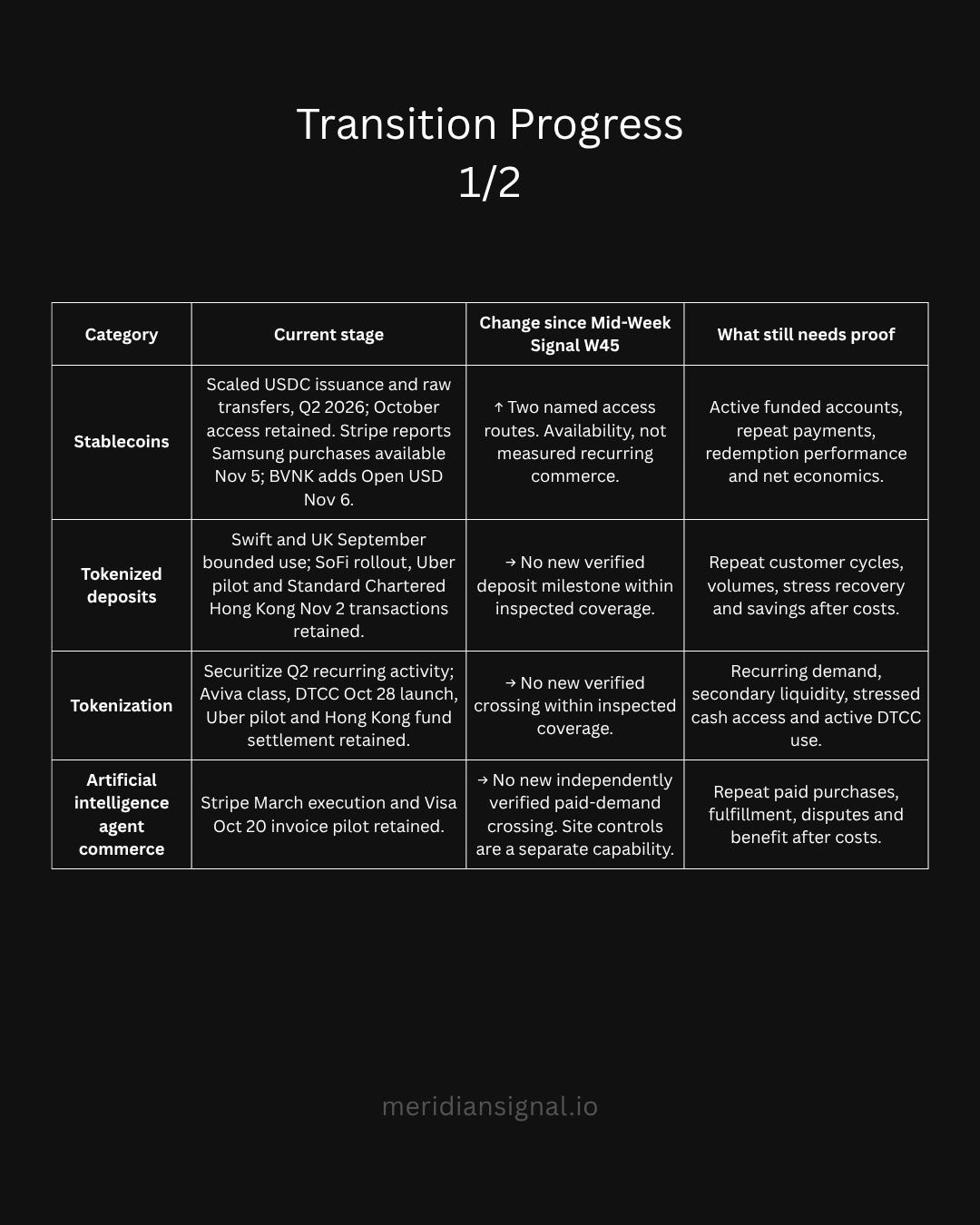
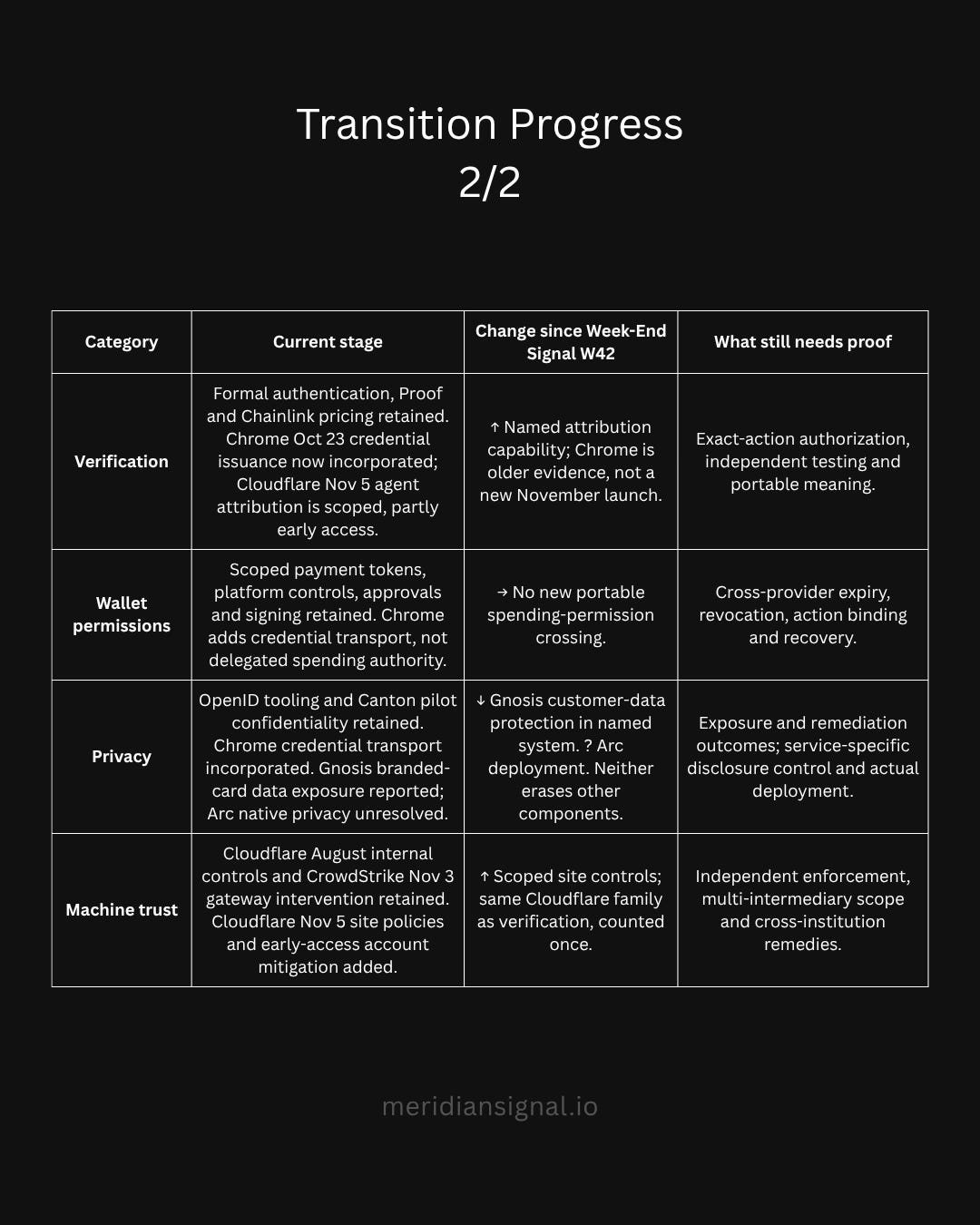
↑ Supported named advance · → No new verified milestone within inspected coverage · ↓ Evidenced deterioration · ? Unresolved current status. Retained stages are dated history, not current uptime certification. One family can inform several rows without becoming several launches.
USDC is Circle’s dollar stablecoin. Open USD is the stablecoin named in BVNK’s release. WebAuthn is a user-authentication standard; OpenID supplies identity protocols and conformance tooling. DTCC is the Depository Trust & Clearing Corporation. These named capabilities do not transfer automatically to every service in their category.
Meridian assessment
Signal Stability: 95 / Thesis unchanged. The same representative point as the preceding Signal, because the causal interpretation persists: useful services must connect funding, authority, execution, records and remedies. This is a coarse judgment within the 90 to 100 unchanged band, not a probability, confidence estimate, investment rating or percentage complete. The representative-point convention replaced older point selection in September; historical values under different conventions are not directly comparable.
Signal-to-Noise: High Signal. Attributable disclosures support specific conclusions. Independent demand and performance remain open, without being necessary to establish the narrower availability and incident findings.
Transition confidence: Supported. Named distribution and control capabilities advance. The Gnosis disclosure warrants a specific adverse reading for data protection.
Sequence confidence: Supported. Useful authority, execution and recovery remain relevant dependencies, but they can overlap and be supplied by different systems. There is no universal order.
Transition progress: Two named stablecoin access routes and one scoped agent-control family advance. Older Chrome implementation is incorporated separately. No new recurring-production, scaled-use or enforceable-value-capture milestone is established.
Publication delta: Material. Access, authority and protection of personal information require separate operating tests.
Near-term investability: Mixed. Federal Reserve H.15, November 6, 2026 reports November 5 nominal and real ten-year yields of 4.84% and 2.60%, down 11 and 5 basis points from the November 3 observations used previously. Federal Reserve H.4.1, November 5, 2026 shows weekly average reserve balances up $36.318 billion to $2.930088 trillion in the week ended November 4. These are easing observations in different windows. Bureau of Labor Statistics, November 6, 2026 at 08:30 ET reports October payroll growth of 165,000 and unemployment of 4.1%, alongside increased part-time work for economic reasons. That combination and the operating risks do not establish broad improvement in every financing or business condition, or attractive valuation for a particular asset.
System integrity: Qualified. Core sources support the stated scopes. Independent operating outcomes and some historical publication and tokenization-source coverage remain incomplete.
What to watch next
For the new access routes, look for active funded accounts, repeat transactions and dependable redemption. For agent controls, test whether the correct person and action remain linked across intermediaries, including revocation and recovery. For the data breach, follow remediation and actual customer outcomes rather than equating an unaffected balance with an unaffected customer.
Measured benefit after costs would strengthen the case. Repeated failure, persistent low demand or cheaper substitutes would weaken it. Meridian’s positioning remains selective: assess the complete customer outcome before deciding which supplier or instrument captures value.
Related reading: Week-End Signal W44, published November 3, examines why longer access still needs dependable cash. This is context for the same customer-outcome question, not a prediction result.
The next meaningful advance is a service people repeatedly choose, with responsibilities that remain clear when something goes wrong.
Evidence behind retained stages
Historical references below retain their stated vintage; they do not certify present uptime. Additional November sources are linked above.
Evidence through November 7, 2026, 1:17:21 p.m. America/Los_Angeles / 21:17:21 UTC.
Meridian Signal
Bold clarity at the right time.
Independent strategic intelligence on capital regimes, digital infrastructure and systemic risk.
AI-assisted. Human-directed. Source-verified.
General informational and educational research. Not personalized investment, legal or tax advice. Assessments involve uncertainty, and investments can lose value.
Questions or corrections: contact@meridiansignal.io