
A business can keep an investment earning for longer and still need cash at a very inconvenient time. Extending the hours of a financial service is useful only if the parts needed to complete that payment are available together.
That is the practical issue connecting this week’s treasury pilot, pricing service and collateral consultation. Each addresses a different part of the problem. None alone establishes a market that can reliably turn every asset into spendable cash at any hour.
Three different kinds of progress
HSBC and its partners report an Uber treasury pilot on October 30. It connected tokenized deposits with fund investment and included a weekend liquidation. This is a named pilot, with recurring use and performance under stress still unproven.
Chainlink announced continuous market data on October 29. Its off-hours reference draws on derivatives venues when traditional markets are closed. A continuously updated price is useful information; it is not a promise that an investor can sell the underlying asset at that price.
The Bank of England opened a consultation on October 29 concerning tokenized collateral. Proposed supervisory expectations are distinct from approval of a particular service or evidence of operating demand.
Our reading is constructive but specific. These developments address practical constraints. Their maturity differs, and the useful outcome depends on the complete service.
The handoff matters
Consider the treasury decision. A finance team wants investment income, enough cash for obligations and predictable control over both. Extending access can reduce the need to choose between those aims. The economic test is whether the benefit survives the full cost of delivering it.
That requires more than faster records. Who supplies liquidity when the investment must be sold? Which price can actually be executed? Who can stop an unauthorized instruction? How does the customer recover when a transfer fails?
These are Meridian’s diligence questions, not allegations that the named services have failed. A working pilot can demonstrate a useful connection without establishing every answer. Equally, the absence of a new recurring-use milestone does not erase recurring activity already established elsewhere.
There is a credible competing case. Familiar cash-management tools and credit facilities may already meet many customer needs. New arrangements may add integration, custody or operating costs. Even if customers benefit, competition can leave suppliers with modest margins. Technical progress and attractive investment returns remain separate conclusions.
A dated update on DTCC
DTCC’s October 28 release reports the launch of its tokenization service. This updates our earlier verification status. The release is October 28 evidence newly incorporated here, not a new October 31 launch. Reported service availability deserves credit; participant agreements and total custody assets do not establish recurring tokenized volume.
What is changing underneath
Financial institutions are combining existing claims with new records, access routes and service hours. The transition can preserve the bank, fund manager or custodian while changing how a customer uses their service.
Our Week-End Signal W43, published October 25, examined why an interface can contain different financial claims. The connection here is practical: the claim and its responsibilities still matter when an investment is converted into cash. This is related context, not a prediction result.
Transition progress
Comparison: Mid-Week Signal W44, evidence through October 29 at 01:57:42 UTC. Historical stages retain their own measurement vintages and do not certify current uptime.
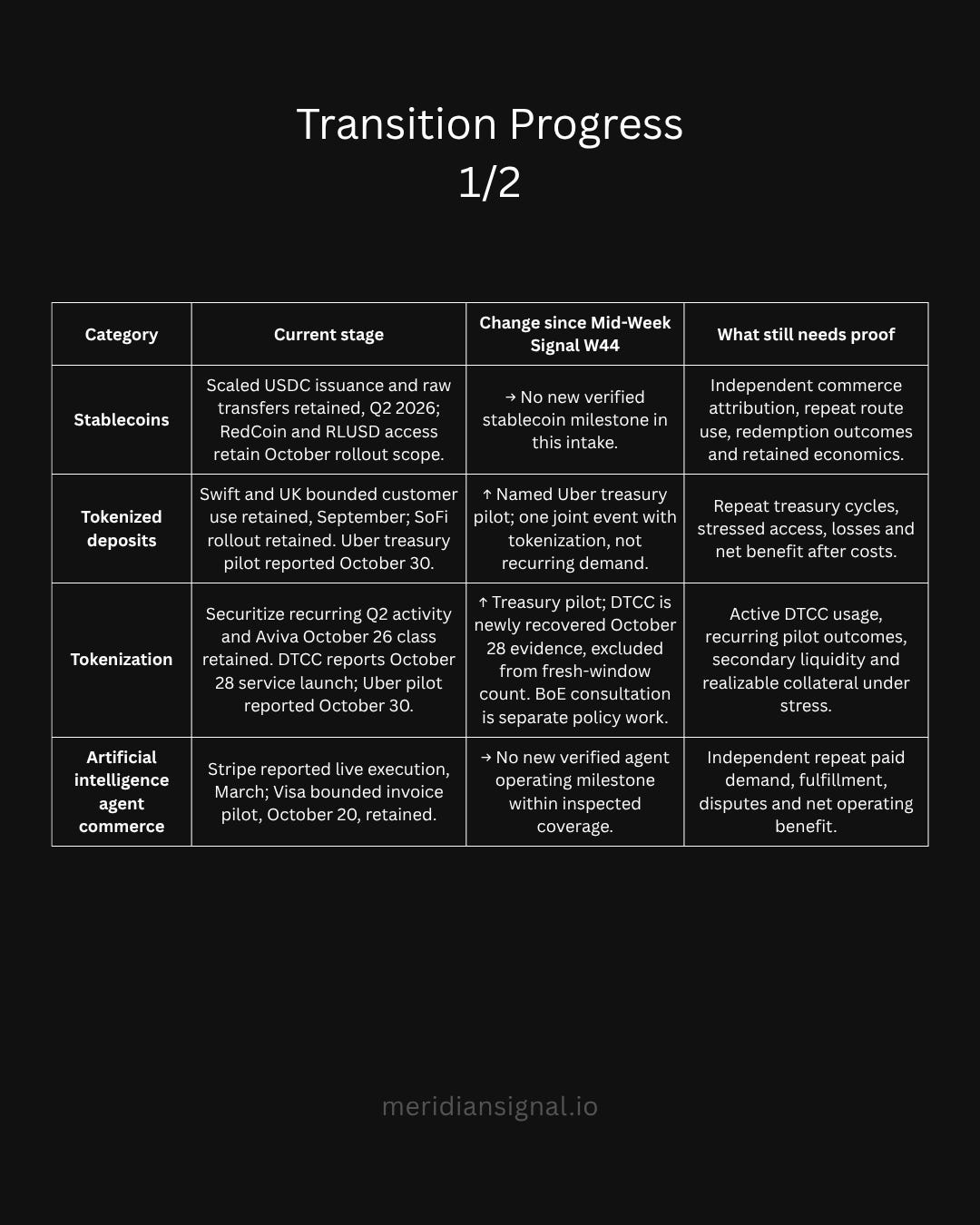
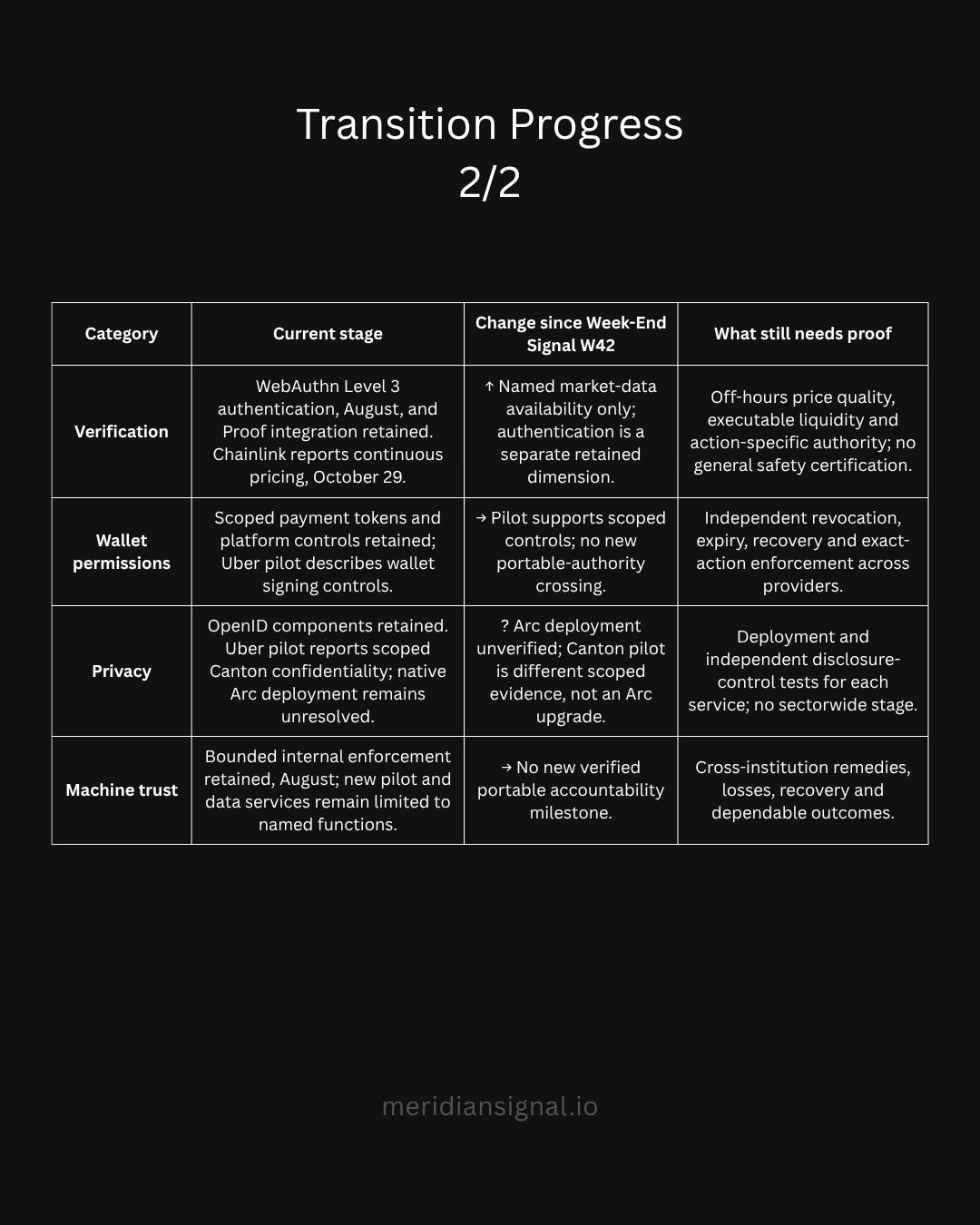
↑ Supported advance in the named dimension. → No new verified milestone within inspected coverage. ↓ Evidenced deterioration. ? Unresolved current status. One joint event can inform several rows without becoming several launches.
The retained evidence includes scaled USDC issuance and raw transfers, recurring Securitize platform activity and bounded bank customer use. Commerce attribution, universal secondary liquidity and institutional dependency are separate questions. Formal authentication, scoped wallet controls and privacy components also retain their actual scope.
Meridian assessment
Signal Stability: 95 / Thesis unchanged, the same representative point as the preceding Signal. The core interpretation persists: useful financial services must connect funding, authority, execution, records and remedies. The 90–100 band means the thesis is unchanged. This coarse judgment is not a probability, confidence estimate, investment rating or percentage of transition complete. Older point conventions are not directly comparable.
Signal-to-Noise: High Signal. Attributable sources support the bounded conclusions above. Independent operating outcomes remain open. This is an editorial evidence judgment.
Transition confidence: Supported. Named implementation evidence supports the direction without establishing inevitable adoption.
Sequence confidence: Supported. Dependencies can overlap or be supplied by substitutes. There is no universal order.
Transition progress: A reported treasury pilot and pricing-service availability, a separate consultation, and a dated DTCC verification update. No new recurring-use, scale or enforceable value-capture crossing is claimed.
Publication delta: Material. Longer access, usable pricing and realizable cash require different evidence.
Near-term investability: Mixed. The Federal Reserve’s October 30 release puts October 29 nominal and real ten-year yields at 4.98% and 2.63%, each one basis point below the October 27 observations used previously. Its October 29 balance-sheet release reports weekly average reserve balances down $68.837 billion to $2.893770 trillion. Small endpoint yield relief and falling reserves do not establish broad financing improvement. These are different observation windows, not an asset valuation. Rates; reserves.
System integrity: Qualified. Sources support the stated scopes. Independent outcomes, exact event clocks and parts of the public revision history remain unverified.
What would change the assessment
The next useful evidence is repeated customer use, realized savings after costs, and reliable recovery when something goes wrong. For collateral, look for the ability to obtain cash during stress, not simply a displayed value. For data services, compare the reference with executable prices and the losses that follow when they diverge.
Measured benefits would strengthen the service case. Repeated failure or persistent lack of advantage over familiar alternatives would weaken it. Neither outcome should be inferred from a launch count.
Meridian’s posture remains selective: follow the complete customer outcome, then ask who retains the economic benefit.
Longer hours create an opportunity. Dependable access to cash determines its practical value.
Retained-stage source references
Evidence through October 31, 2026, 1:54:30 p.m. America/Los_Angeles / 2026-10-31T20:54:30Z.
Meridian Signal
Bold clarity at the right time.
Independent strategic intelligence on capital regimes, digital infrastructure and systemic risk.
AI-assisted. Human-directed. Source-verified.
General informational and educational research. Not personalized investment, legal or tax advice. Assessments involve uncertainty, and investments can lose value.
Questions or corrections: contact@meridiansignal.io