
Evidence through October 24, 2026, 1:40:55 p.m. America/Los_Angeles / 2026-10-24T20:40:55Z.
Moving money inside a familiar app can feel like one continuous service. The financial claim can change along the way. A bank deposit, a stablecoin and a balance shown in a wallet can come with different protection, redemption access and responsibilities.
Two consumer rollouts make that distinction practical this week. SoFi is adding a tokenized deposit with a route into its separate stablecoin. HSBC is bringing its Hong Kong dollar stablecoin to PayMe. They expand access through existing customer interfaces. They do not establish the same rights or prove that customers will use the new routes repeatedly.
Meridian’s assessment is that useful digital finance is advancing through specific services. The next test is whether the whole service delivers reliable benefits, including when a transfer, conversion or redemption goes wrong.
Two rollouts, two different claims
SoFi adds a consumer deposit route. Its October 22 announcement says SoFi Earn, or SOFIE, is rolling out to members through November. It represents a deposit at SoFi Bank and can be converted into the separate SoFiUSD stablecoin. The advertised annual percentage yield is variable, with an October 20 rate vintage. This is reported availability during rollout, not evidence of recurring consumer demand. SoFi’s dated release.
SoFi’s product disclosure distinguishes deposit insurance eligibility, subject to applicable rules and limits, from the stablecoin’s lack of deposit insurance. The distinction survives conversion inside the same app. Its older stablecoin terms also distinguish holding a token from having direct issuer redemption rights under a separate customer agreement. Those terms are context, not a newly introduced restriction this week. SoFi product disclosures; stablecoin terms effective June 22.
HSBC adds a PayMe stablecoin route. Its October 23 release reports RedCoin availability beginning on PayMe, with wallet activation rolling out in the coming days. The existing PayMe audience is a distribution opportunity, not a count of active RedCoin users. Tokenized investments and wider institutional uses remain prospective. HSBC’s dated release.
HSBC’s inspected product terms say RedCoin is not a protected bank deposit. They also describe custody and channel boundaries. A bank’s involvement therefore does not make every balance in its applications the same financial product. That is a scope distinction, not an allegation of a defect or a comparison of the two banks’ safety. HSBC RedCoin terms.
Distribution is becoming part of the infrastructure
The less visible transition is the use of existing customer relationships to bring new money instruments into ordinary interfaces. A provider does not have to replace a bank to change how a customer stores or moves value. A bank can adopt a new representation while retaining responsibility for important parts of the service.
That creates a more demanding test than counting launches. What does the customer hold before and after conversion? Which institution owes what? Can the customer redeem through the route they actually use? What happens when a record is wrong or a transfer cannot complete?
These questions connect the payment mechanism to its practical value. A simpler interface can help customers while leaving meaningful obligations distributed across the bank, wallet, network and service provider. Conversely, a complicated underlying arrangement need not prevent a useful service if those responsibilities are clear and work in practice.
The strongest competing interpretation is that familiar bank and payment services already meet many of these needs. New products may gain initial attention through incentives without sustaining an advantage after those incentives end. Even sustained use would not by itself establish extra profit for a specialist supplier or a claim on that profit for a token holder.
Transition progress
The comparison is Mid-Week Signal W43, with evidence through October 22 at 01:19:39 UTC. Established stages below retain their named scope and measurement vintage. They are not a fresh certification of uptime. One launch is credited once, even when it informs several categories.
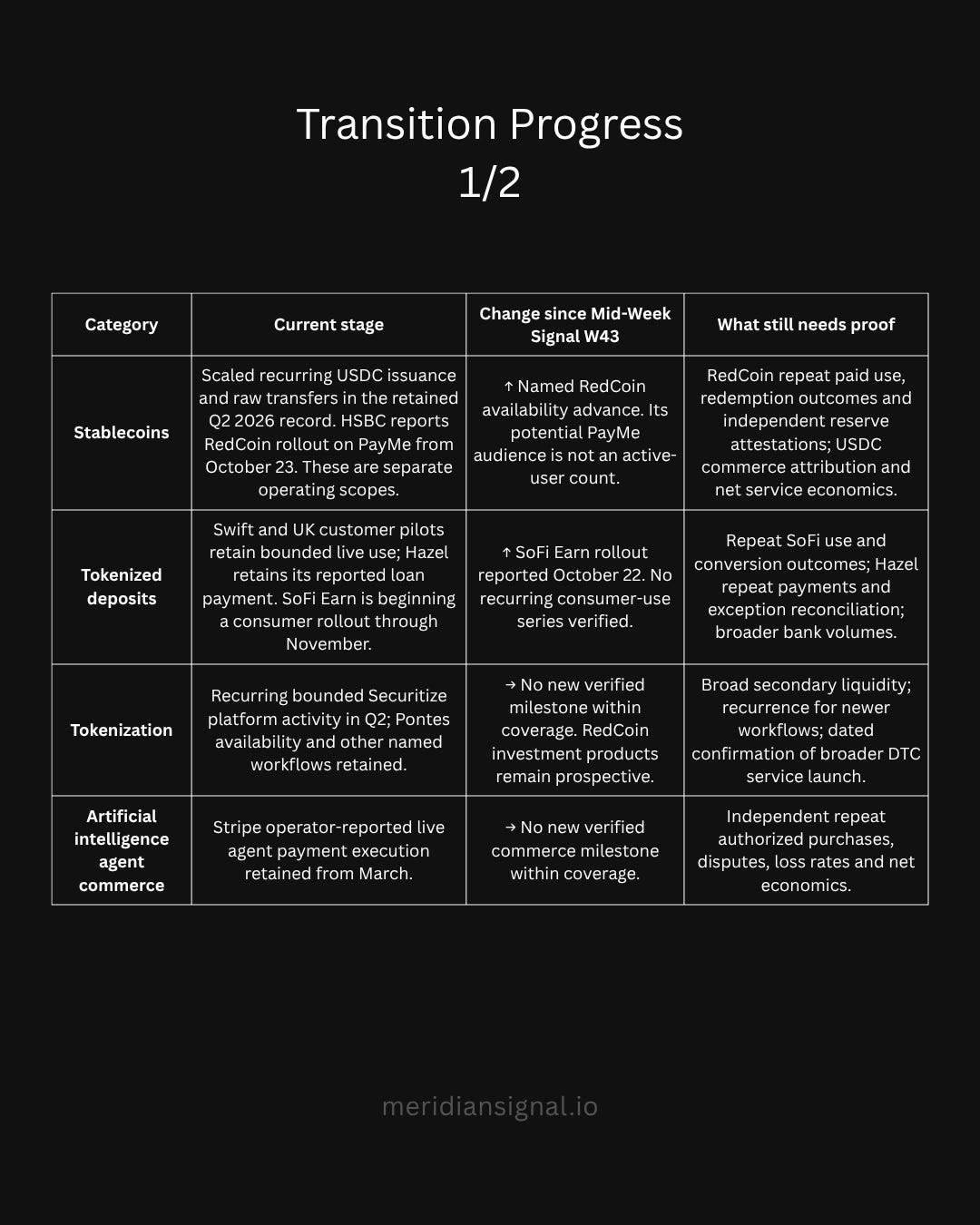
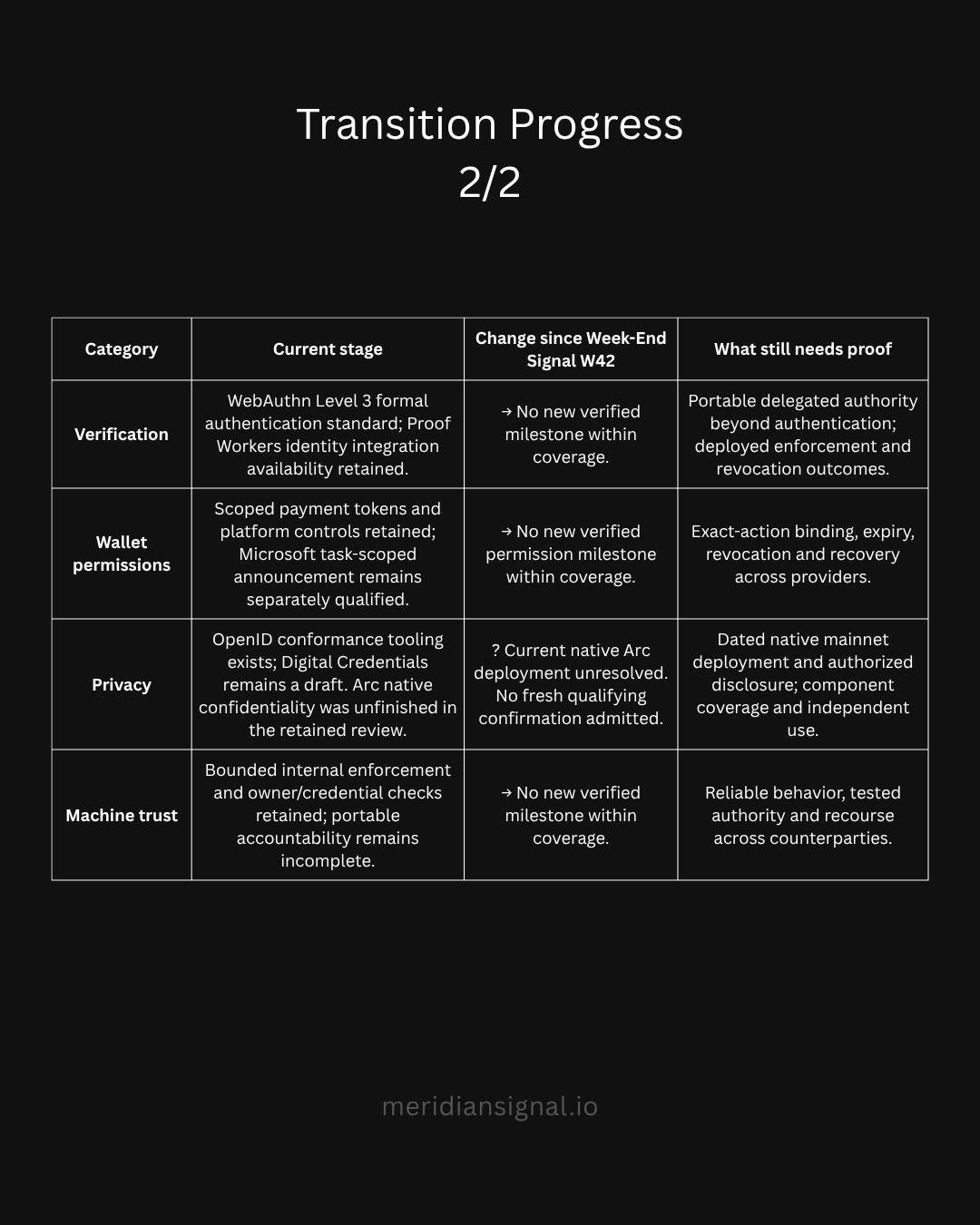
Legend: ↑ supported advance in the named dimension; → no new verified milestone within inspected coverage; ↓ evidenced deterioration; ? unresolved current status. Missing evidence does not establish no change.
Existing production has not disappeared because a new product is still rolling out. Circle’s Q2 disclosure supports scaled USDC issuance and raw transfers, while the share attributable to commerce remains a different question. Securitize’s Q2 filing supports recurring activity on its bounded platform, without establishing universal secondary liquidity. Stripe’s earlier disclosure retains reported live agent execution. These historical measurements are not new October growth. Circle, August 5; Securitize filing, August 12; Stripe, March 3.
The remaining components also keep their scope: formal authentication under WebAuthn Level 3, scoped payment tokens, OpenID conformance tooling, the Digital Credentials draft and bounded internal controls. Arc’s June privacy explanation describes future features; this review did not establish a dated current native deployment. That uncertainty does not erase functioning privacy components elsewhere.
Meridian consensus
The evidence supports broader consumer access through established institutions. It does not yet support recurring demand for these new products, universal interoperability or a settled division of economic gains.
Our Mid-Week Signal W43, published October 23, examined a reported bank payment that coordinated money with loan records. These new consumer routes add support to the same institutional mechanism: the surrounding responsibilities remain part of the service. They do not confirm a prediction about adoption or investment returns.
Stability and conditions
Signal Stability: 95 / Thesis unchanged. The previous completed Signal also read 95. The core interpretation and dependencies persist. This representative point sits in the 90–100 band; it is a coarse editorial judgment, not a probability, confidence score, investment rating or percent transition complete. The approved convention uses fixed representative points, and older numerical conventions are not treated as directly comparable.
Signal-to-Noise: High Signal. Dated issuer disclosures and product terms support a useful, bounded assessment. Unverified demand and operating outcomes can be separated from it. This is an editorial evidence judgment, not a computed percentage.
Transition confidence: Supported. The two rollouts add implementation evidence without establishing inevitable adoption or winners.
Sequence confidence: Supported. Funding, authority, execution, records and remedies remain relevant dependencies. They can overlap or be supplied by different institutions; there is no universal timetable.
Transition progress: Two named availability advances, with established scoped activity retained across the tracker. No new recurring-use or value-capture milestone is claimed for the consumer rollouts.
Publication delta: Material. The issue connects new access to the exact financial claim and responsibility that accompany it.
Near-term investability: Mixed. The Federal Reserve’s October 23 release shows October 22 ten-year nominal and real Treasury yields at 4.96% and 2.64%, down from 5.12% and 2.77% on the October 20 observations used in the preceding Signal. Its October 22 balance-sheet release also shows lower weekly average reserve balances. These have different observation windows and do not establish broad financing relief or any asset’s valuation. Federal Reserve H.15; H.4.1.
System integrity: Qualified. The core sources and completed comparison were verified. Independent operating outcomes, some source revision details and complete public archive coverage remain unresolved. These qualifications limit the claims above.
Positioning and forward proof
Meridian’s research posture remains selective. Evaluate the complete customer outcome and the costs of delivering it. A bank relationship, a distribution network or a payment token can be useful without granting an unavoidable claim on the resulting surplus.
The next evidence should show repeated use after incentives, successful conversion and redemption, recovery when something fails, and economics after funding, compliance and operating costs. For the wider transition, seek independently tested delegated authority and portable remedies as well as functioning components.
Repeated failures or no measurable advantage over familiar alternatives would challenge the service case. Reliable use with a clear benefit would strengthen it, while leaving the allocation of profit open.
The takeaway: Follow the claim through the transaction. A familiar app can make access easier while the underlying rights remain different.
Meridian Signal
Bold clarity at the right time.
Independent strategic intelligence on capital regimes, digital infrastructure and systemic risk.
AI-assisted. Human-directed. Source-verified.
General informational and educational research. Not personalized investment, legal or tax advice. Assessments involve uncertainty, and investments can lose value.
Questions or corrections: contact@meridiansignal.io