
Evidence through October 21, 2026, 6:19:39 p.m. America/Los_Angeles / 2026-10-22T01:19:39Z.
When two banks share a loan, receiving a payment is only part of the job. They also need to agree on which principal and interest were paid, what remains outstanding and which records need updating. A faster transfer helps most when the surrounding work keeps up.
That is the useful idea in this week’s reported bank-payment workflow. The advance is specific: money and loan records were coordinated in one process. The harder questions come next. Does it work repeatedly? What happens when a payment fails? Who keeps the savings after funding, compliance and operating costs?
Meridian’s assessment remains that useful digital finance is developing through bounded services. Their value depends on the complete result. A new interface, a valid credential or a regulatory milestone answers only part of that question.
Three changes, at different stages
A reported payment connects the money with the records. On October 19, Participate said a loan principal-and-interest payment between Vantage Bank and Rio Bank used Hazel’s tokenized-deposit workflow, with loan balances and notices updating alongside the funds. This is an attributable report of a completed bounded implementation. The release does not provide the exact execution date, independent reconciliation evidence or a recurring-use series. Its wider distribution plan is prospective. Source: Participate announcement, October 19.
A stablecoin rule is final, with a future effective date. The US Office of the Comptroller of the Currency finalized its payment stablecoin framework on October 21. It takes effect January 18, 2027. That advances regulatory definition within its scope; it does not show that a particular issuer is newly operating today. Application acceptance and separate financial-crime requirements remain distinct matters. Source: OCC bulletin 2026-50, October 21.
An existing identity protocol gains a specific integration. Proof announced availability of its x401 integration for Cloudflare Workers on October 20. It gives a service endpoint a way to request and verify an identity presentation. The protocol predates this week. Availability of this integration does not establish recurring agent purchases or prove that every resulting action stays within the user’s mandate. Source: Proof, October 20.
These developments belong to different categories: reported implementation, regulatory finalization and integration availability. Counting all three as equivalent production launches would obscure what changed.
The work between the components
Our interpretation is that coordination is becoming a more useful test of progress than component availability alone. For a bank, a payment that updates the right records could reduce reconciliation work. For an agent acting for a person, a verified credential could help establish who stands behind a request. Neither result makes the rest of the service automatic.
Funding must still be available. The action must stay within the authority granted. Records must reflect the outcome. Someone must handle mistakes and disputes. Those dependencies may be managed by different institutions, even when the customer sees one interface.
The bank-centered structure is important counterevidence to a simple displacement story. Existing institutions can adopt new methods while preserving their relationships and responsibilities. Customers may receive the benefit through lower friction or cost. Competition may prevent any single supplier from retaining much of it.
The same caution applies to agents. Microsoft’s October 19 security announcement describes task-scoped permissions and related controls, but the inspected announcement does not establish a new production-availability date. Proof and Circle announced a demonstration combining identity, approval and payment; a completed demonstration and recurring commerce were not independently verified in this review. Microsoft, October 19. Proof and Circle, October 19.
The most revealing technical detail is often the boundary of the claim. Proof’s integration documentation describes different replay-handling tradeoffs for two storage options. That is a reason to inspect configuration, rather than assume a protocol name guarantees identical behavior everywhere. Separately, Microsoft’s October 21 threat report describes misuse of stolen application credentials in earlier activity. It reinforces the general point that possession of a credential is not proof of legitimate intent. It is not evidence of a defect in the unrelated products discussed here. Proof implementation documentation, inspected October 21. Microsoft threat report, October 21.
Transition progress
The weekly change comparison remains Week-End Signal W42, with evidence through October 17 at 20:53:54 UTC. The current-stage column now makes established scope explicit, reconciled with Meridian’s October 17 Transition and Inevitability Monitor (TIM). This continuity clarification does not certify current uptime or add new weekly milestones. Read each row as established stage, this edition’s change, and the remaining proof for the named scope.
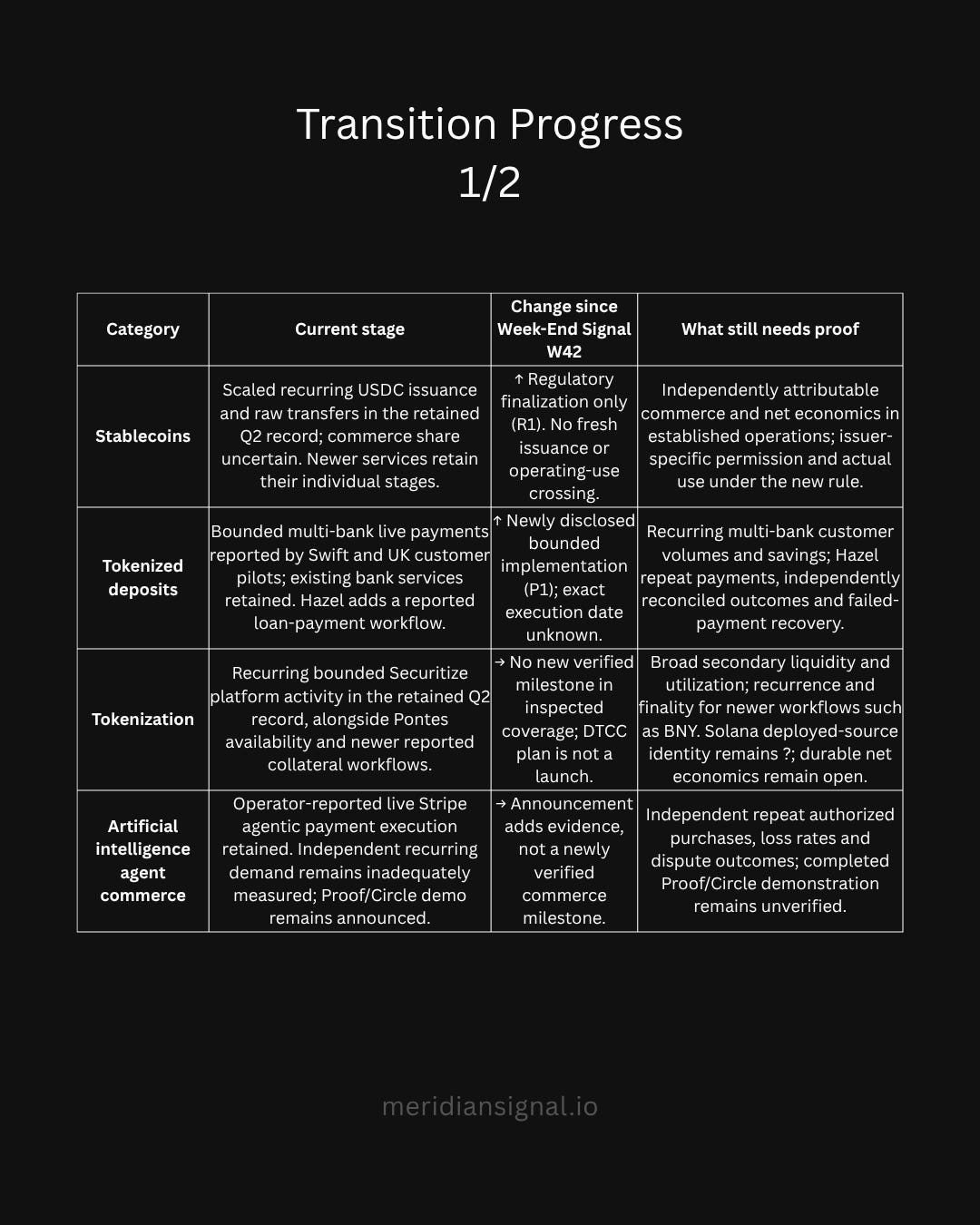
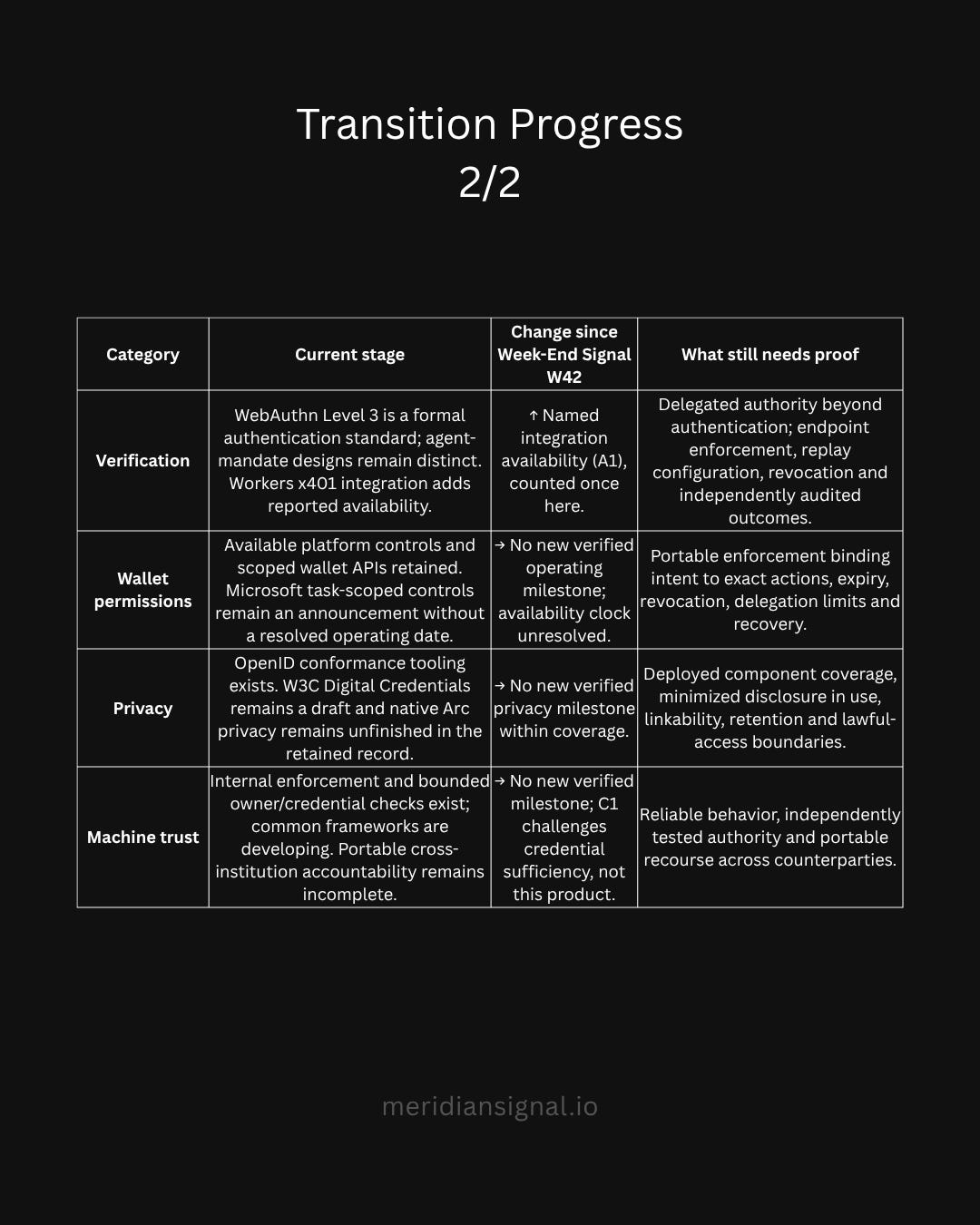
Legend: ↑ supported advance in the named dimension; → no new verified milestone within the inspected coverage; ↓ evidenced deterioration; ? unresolved current status. Missing evidence is not proof of no change. A single launch is counted once, even if it informs several rows.
Current additions are supported by the dated sources above. No new recurring-production milestone this week does not mean recurring production is absent from the sector. USDC issuance and transfers already operate at scale in the retained record; Securitize has recurring bounded platform activity. Those findings do not establish broad commerce attribution, universal secondary liquidity or profitable operation of newer workflows. TIM compares a broader period with its August baseline; W43 arrows measure the narrower change since Week-End W42. The score is not a transition-completion percentage, and the capabilities need not advance in one universal sequence.
Established-stage source trail
The retained stages are reconciled with Meridian’s October 17 TIM review. Its source trail is listed below for inspection; this editorial revision does not claim a new verification of every underlying source. Historical Q2 operations are not new October growth.
S13: Circle Q2 operations. Retained TIM October 17 evidence; scope and source vintage preserved.
S02: Swift live payments. Retained TIM October 17 evidence; scope and source vintage preserved.
S03: UK customer pilots. Retained TIM October 17 evidence; scope and source vintage preserved.
S15: Securitize recurring platform activity. Retained TIM October 17 evidence; scope and source vintage preserved.
S18: Stripe reported live processing. Retained TIM October 17 evidence; scope and source vintage preserved.
S21: WebAuthn authentication standard. Retained TIM October 17 evidence; scope and source vintage preserved.
S19: Scoped payment tokens. Retained TIM October 17 evidence; scope and source vintage preserved.
S23: OpenID conformance. Retained TIM October 17 evidence; scope and source vintage preserved.
S22: Digital Credentials draft. Retained TIM October 17 evidence; scope and source vintage preserved.
S01: Arc privacy feature state. Retained TIM October 17 evidence; scope and source vintage preserved.
S25: Bounded internal controls. Retained TIM October 17 evidence; scope and source vintage preserved.
S20: Agent mandate designs. Retained TIM October 17 evidence; scope and source vintage preserved.
Meridian consensus
The combined assessment is straightforward: practical coordination is advancing, while evidence of repeatability and retained economics is thinner. The reported payment workflow is a useful example of institutions connecting tasks that previously required separate handling. It is not a general adoption rate.
The strongest alternative interpretation is that conventional rails, established banks and large software providers will supply enough of these functions to limit specialist pricing power. That outcome would still be compatible with useful digital-finance adoption. It would change who benefits, especially if customer savings exceed supplier margins.
In Week-End Signal W42, published October 18, we separated the fact a verification check establishes from the result a complete service must deliver. This week’s reported workflow adds an example of payment-and-record coordination. It supports that mechanism without proving a forecast of universal adoption or economic capture.
Stability, evidence and conditions
Signal Stability: 95 / Thesis unchanged. The core interpretation and its dependencies persist. The same reading was 95 in Week-End W42. This is a coarse editorial anchor within the 90–100 band, not a probability, a confidence score or a measure of investment attractiveness. The approved convention uses representative points rather than fine numerical distinctions. Older historical point conventions are not treated as numerically comparable.
Signal-to-Noise: High Signal. Official rule and rate releases, attributable issuer reporting and technical documentation support a useful reading. The operating and timing gaps can be separated from that conclusion. This category is an evidence judgment, not a computed percentage.
Transition confidence: Supported. The evidence supports useful scoped services; it does not establish inevitable adoption or winners.
Sequence confidence: Supported. Funding, authority, execution, records and remedies remain necessary dependencies. This reading concerns their relationship, not a claim that every initiative follows one timetable.
Transition progress: The tracker records regulatory finalization, reported implementation and integration availability separately. The loan-payment execution date remains unknown. There is no aggregate completion percentage.
Publication delta: Material. The report adds a concrete coordination case and clarifies what the accompanying legal and technical developments establish.
Near-term investability: Mixed. The Federal Reserve’s October 21 release shows October 20 ten-year nominal and real Treasury yields at 5.12% and 2.77%, respectively. Compared with the October 15 observations used in W42, the nominal yield rose two basis points and the real yield fell one. Those small, divergent moves do not establish general financing relief or the valuation of an asset. Source: Federal Reserve H.15, October 21.
System integrity: Qualified. The core sources and completed comparison baseline were verified. Independent operating outcomes, some event clocks and portions of the public archive remain unresolved. These limits constrain the claims; they do not prevent the scoped assessment above.
Positioning and the next test
Meridian’s research posture remains selective. Look for a demonstrated customer outcome, then inspect who supplies it, who bears the cost of failure and who has a defensible claim on any surplus. Infrastructure affiliation and transaction activity alone do not answer those questions.
Three kinds of evidence would advance this assessment:
Repeated bank payments with independently reconciled records and evidence of how exceptions were resolved.
Deployed agent controls that bind a person’s approval to the exact action, with usable expiry, revocation and recovery.
Measured customer savings and supplier economics after compliance, funding, operating and liability costs.
Evidence that a workflow cannot deliver those outcomes reliably would challenge the claimed advantage. Evidence that customers or incumbents retain most of the benefit would challenge narrow supplier-winner narratives, even if the service itself succeeds.
The takeaway: A coordinated payment is a useful step. Repeatable outcomes determine whether it becomes a durable service.
Meridian Signal
Bold clarity at the right time.
Independent strategic intelligence on capital regimes, digital infrastructure and systemic risk.
AI-assisted. Human-directed. Source-verified.
General informational and educational research. Not personalized investment, legal or tax advice. Assessments involve uncertainty, and investments can lose value.
Questions or corrections: contact@meridiansignal.io