
A finance team may be able to check a token’s recorded backing, identify the owner of an artificial intelligence agent or verify a signed payment instruction. Each check answers a different question. Treating any one of them as approval of the whole transaction can leave the most consequential decision unexamined.
This week’s disclosures make those distinctions concrete. They show more ways to put verification inside financial workflows, while leaving reserve quality, effective spending powers, execution and remedies as separate responsibilities.
What the new evidence establishes
A check against the issuer’s records. Episode Six, October 15 says Verified Backing is available to its customers for supported tokens issued through its ledger. This earns a qualified availability advance for Episode Six (E6). The function checks recorded backing and token status at issuance and redemption. Its Episode Six product scope expressly excludes holding, safeguarding or attesting reserves. Meridian has not independently verified customer production outcomes. The useful advance is a specific control, with the quality and availability of the underlying assets still requiring their own evidence.
Evidence of the person’s approved instructions. Proof issuer release, October 15, 09:00 ET describes a wallet and service that let a person sign transaction terms for an agent to carry. A receiving service can check that evidence. Its payment example is illustrative, not a verified customer transfer.
The chronology matters. Proof’s Proof original x401 announcement, June 25 already described x401 and available tools. The October release also references a September implementation. We therefore count this as a fresh disclosure of capabilities and access, not the first launch of x401 or newly verified production. Claims about enforceable authority still need to be tested in the service that executes the instruction.
An owner behind an agent. Concordium, dated October 15 reports that its owner-verification integration is live on XDC AI. That is a bounded availability claim. The announcement carries a date but no precise clock or timezone; its placement against the early-UTC baseline boundary is unresolved, so it receives no fresh-window milestone count here. A verified owner does not by itself establish the agent’s behavior or every permission it can exercise.
Check the authority that actually executes
The hidden transition is verification becoming part of the operating workflow. Meridian’s interpretation is that the important question moves from whether a credential exists to what the executing system does with it.
Concordium’s Concordium XDC wallet verification documentation requires current wallet ownership and threshold checks. It also describes spending modules that can act within their limits without an owner signature. Those are documented design boundaries, not evidence of a security defect. A counterparty needs the relevant current permissions, not only an ownership badge.
Proof’s Proof technical overview, current inspection describes exchanging satisfied evidence for a reusable access token. That makes application enforcement, expiration and revocation important questions when judging action-level protection. This review did not test a deployed integration or establish an exploitable bypass.
The practical implication is to match each assurance to the decision it supports. Ledger consistency does not settle reserve quality. Owner attribution does not inventory all spending authority. Signed instructions still need to match the transaction executed and the remedy available after a failure.
The prevailing promise in these announcements is easier assurance at the point of use. The strongest competing interpretation is that familiar institutions and interchangeable providers may supply enough of it. Customers could capture savings while suppliers compete away additional profit. A universal independent trust provider may never be necessary.
Our Week-End Signal W41, published October 10 made institutional responsibility part of the service assessment. The current evidence gives that mechanism more specific examples; it does not confirm an investment outcome. Earlier tracker statements about no verified new portable-control milestone were scoped to those reviews. The June x401 material expands named coverage now, without pretending that the capability began this week.
Where the transition stands
The comparison is with the completed Mid-Week Signal W42 master. The table preserves prior documented capabilities; it does not freshly certify the uptime of every retained service.
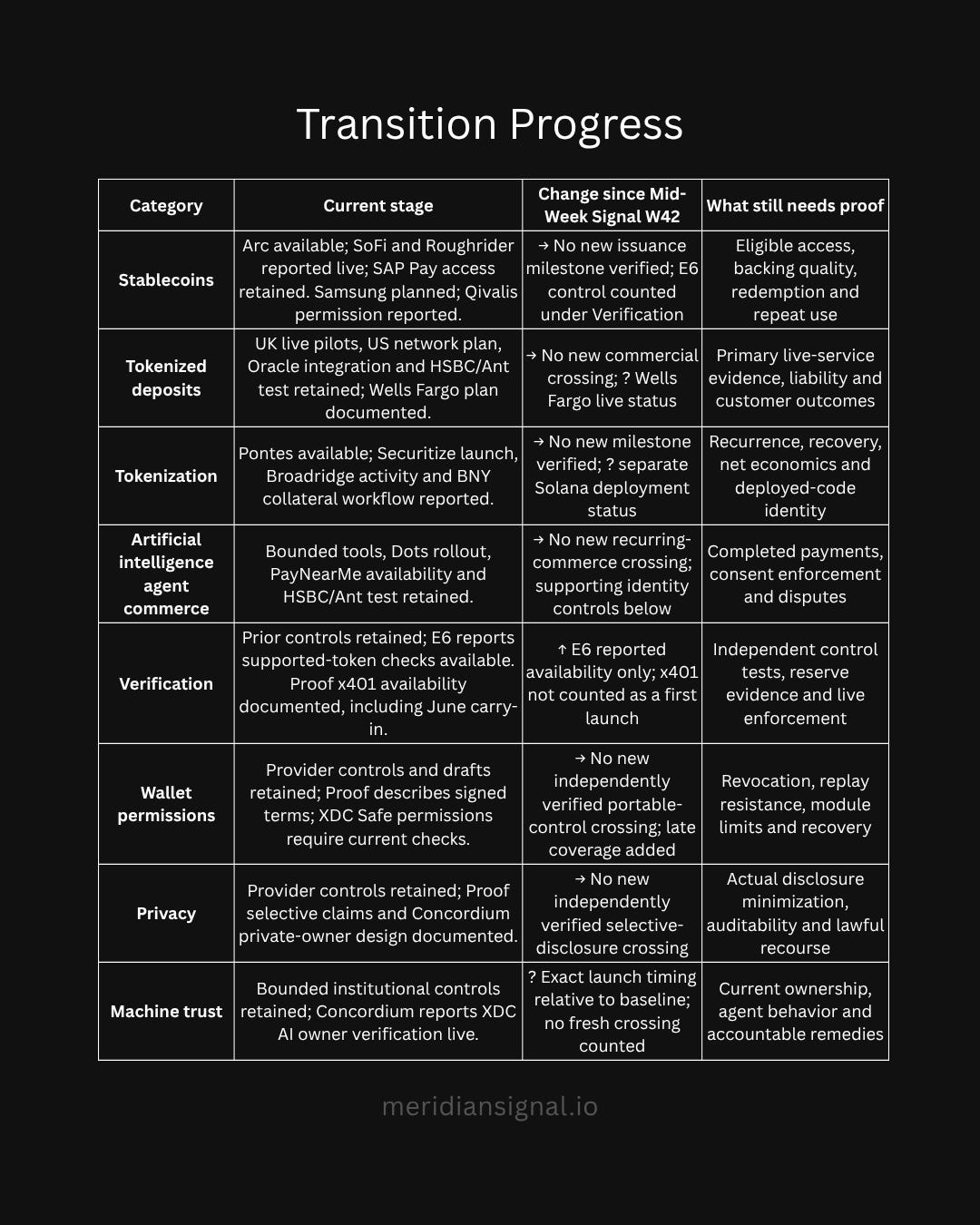
↑ Supported named advance. → No new verified milestone in the stated dimension within inspected coverage. ↓ Evidenced deterioration. ? Unresolved timing or current status, as named. Missing evidence is not proof of no change. Retained capabilities are prior documented stages, not fresh uptime certification.
Wells Fargo’s earlier Wells Fargo issuer announcement, August 4 is planning evidence; the later live-service claim remains unresolved in this review. The separate Solana settlement-program question concerns reconciling release and deployment records, not a judgment about the security of another initiative. Existing capabilities remain visible while these questions stay open.
Meridian’s current assessment
Signal Stability: 95, Thesis unchanged. The core interpretation remains that useful bounded services require accountable operation, while adoption and retained economics need separate proof. This is the same anchor as Mid-Week W42, selected again from the current evidence. Under September’s convention, 95 represents the 90–100 “Thesis unchanged” band. It is a coarse editorial judgment, not a probability, investment rating or measure of completeness. Historical points from the older convention are not numerically comparable.
Signal-to-Noise: High Signal. Primary sources let us distinguish the claims these controls check. Unknown outcomes and the isolated timing gap remain separable from the conclusion.
Transition confidence: Supported. Reported availability adds support for implementation, with uptake and effectiveness unverified. Sequence confidence: Supported. Authority, execution, recovery and durable economics remain distinct dependencies, even when they develop together. This is not a forecast of speed.
Transition progress: one qualified E6 availability advance, plus named coverage additions. No new independently verified production, recurrence, scale or value-capture milestone. Publication delta: Material. The contribution is a clearer test of what verification does and what responsibility remains outside it.
Near-term investability: Mixed. The Federal Reserve H.15, October 16 release puts October 15 ten-year nominal and real Treasury yields at 5.10% and 2.78%, respectively, down 11 and 10 basis points from the baseline’s October 13 observations. That is selective financing relief. The Federal Reserve H.4.1, October 15 release shows average bank reserves falling $7.519 billion in the week ended October 14. Its observation period precedes the current window; the release is new. These measures do not establish broad easing or the attractiveness of a particular asset.
System integrity: Qualified. The completed internal comparison report and governing sources were recovered. Vendor availability is distinguished from independent operating verification. Precise Concordium timing, some prior deployment questions and access to the latest published article’s subscriber-only body remain gaps. None determines this issue’s scoped conclusion.
The next evidence that would matter
Our research posture is selective: inspect the assurance, the actual authority to act and the obligation to remedy a failure. Then examine who pays and who retains revenue after costs.
The next useful records are named production users, repeated successful and failed transactions, enforced spending limits, revocation and recovery tests, and economics after integration and compliance costs. A demonstration can explain a design; it cannot establish recurring production. Sponsored network fees simplify access without proving a durable return to holders of a network’s digital asset.
We would revise the structural interpretation if verified operation removed a dependency we treat as necessary, or sustained economic evidence required a different account of who benefits. More product detail alone is insufficient to make that change.
Meridian Strategic Conclusion: Read “verified” as the beginning of a precise question: which claim was checked, by whom, and what decision can safely rely on it? Current evidence supports more bounded controls, with no newly verified unavoidable economic winner.
Evidence through October 17, 2026, 1:53:54 p.m. America/Los_Angeles / 20:53:54 UTC. Comparison cutoff: October 15, 2026, 01:41:59 UTC. E6’s October 15 date is interpreted in its Austin dateline; no exact release time is asserted. Earlier evidence discovered during this review is labeled above.
Meridian Signal
Bold clarity at the right time.
Independent strategic intelligence on capital regimes, digital infrastructure and systemic risk.
AI-assisted. Human-directed. Source-verified.
General informational and educational research. Not personalized investment, legal or tax advice. Assessments involve uncertainty, and investments can lose value.
Questions or corrections: contact@meridiansignal.io