
A familiar screen can make a new financial service easier to use. It can also make the institutions behind that service harder to see. Someone still holds the money, defines the investor’s claim and decides whether a payment is authorized.
This week’s evidence puts those responsibilities in view. Samsung’s planned wallet service, Securitize’s reported stock offering and a bank payment test for artificial intelligence agents advance different parts of the transition. They do not have the same operating status. Understanding that difference is essential to judging what a customer can actually do today.
Three developments, three stages
A planned consumer route. Samsung says eligible US customers will gain access to USDC, a dollar stablecoin, in the last week of October. Its page carries an October 8 header and an October 7 dateline. We treat the original announcement conservatively as earlier evidence discovered late; the October 8 partner disclosures add fresh detail. Availability was still future at this Signal’s cutoff.
Coinbase describes custody through Prime Vault, while Samsung identifies licensed partners for accounts and money movement. Samsung itself is not the bank or custodian. Sui describes a supported route that does not require the sender to hold SUI for network fees. That simplifies the intended user experience. It does not establish live access, remove system costs or identify who will retain the eventual profit. The cited 82 million compatible US devices represent potential reach, not active customers.
A reported investment offering. Securitize announced on October 8 that eligible investors can trade stock exposure represented by security entitlements. This earns a qualified availability advance. The issuer reports the offering; we have not independently observed customer trades or their execution quality.
The entitlement is backed by underlying shares held through the broker. Holders are not registered shareholders unless they convert, and conversion is conditional. The underlying companies have not endorsed these products. Planned future venues and continuous trading remain separate from the reported initial service. These distinctions change what an investor owns and can demand, even when the interface looks like ordinary stock trading.
A bank payment test. In an October 9 release, Ant Digital Technologies and HSBC reported a successful technical verification test linking agent service use with tokenized bank deposits and bank risk checks. The release explicitly says this is not a commercial launch or a live customer proposition. It supports one named test advance in agent commerce. The same test is not counted again as a commercial advance in deposits.
The institution remains part of the product
The hidden transition is the packaging of digital money inside recognizable services. A wallet can simplify transfers while custody remains with a specialist provider. An investment platform can change the trading route while a broker continues to define the holder’s claim. An agent can request and pay for a service while a bank checks the transaction.
Meridian’s interpretation is that useful execution and institutional responsibility are developing together. A smoother interface does not tell us whether authority can move between providers, how a mistaken transaction is resolved or which participant earns a durable return.
The strongest competing interpretation deserves weight: established institutions may already provide enough assurance for many customers. A universal independent trust layer may never be necessary. Customers could gain from lower costs while competing suppliers retain little extra profit.
There is also operating evidence beyond pilots. Broadridge reported on October 8 that its existing repo platform processed $7.5 trillion during September, averaging $359 billion a day. That is attributable evidence of recurring activity. It is a fresh disclosure about an earlier period, not a new October launch. Gross transaction totals do not establish net savings, earnings or a right to those earnings for holders of a network’s digital asset.
Our October 8 Mid-Week Signal separated access from responsibility and retained value. These disclosures add support to that mechanism. They do not confirm an investment outcome or turn a general observation into a successful forecast.
Where the transition stands
The tracker retains previously documented capabilities. Its arrows describe the named dimension since Mid-Week Signal W41, not an aggregate maturity score or a new certification that every retained service remains operational.
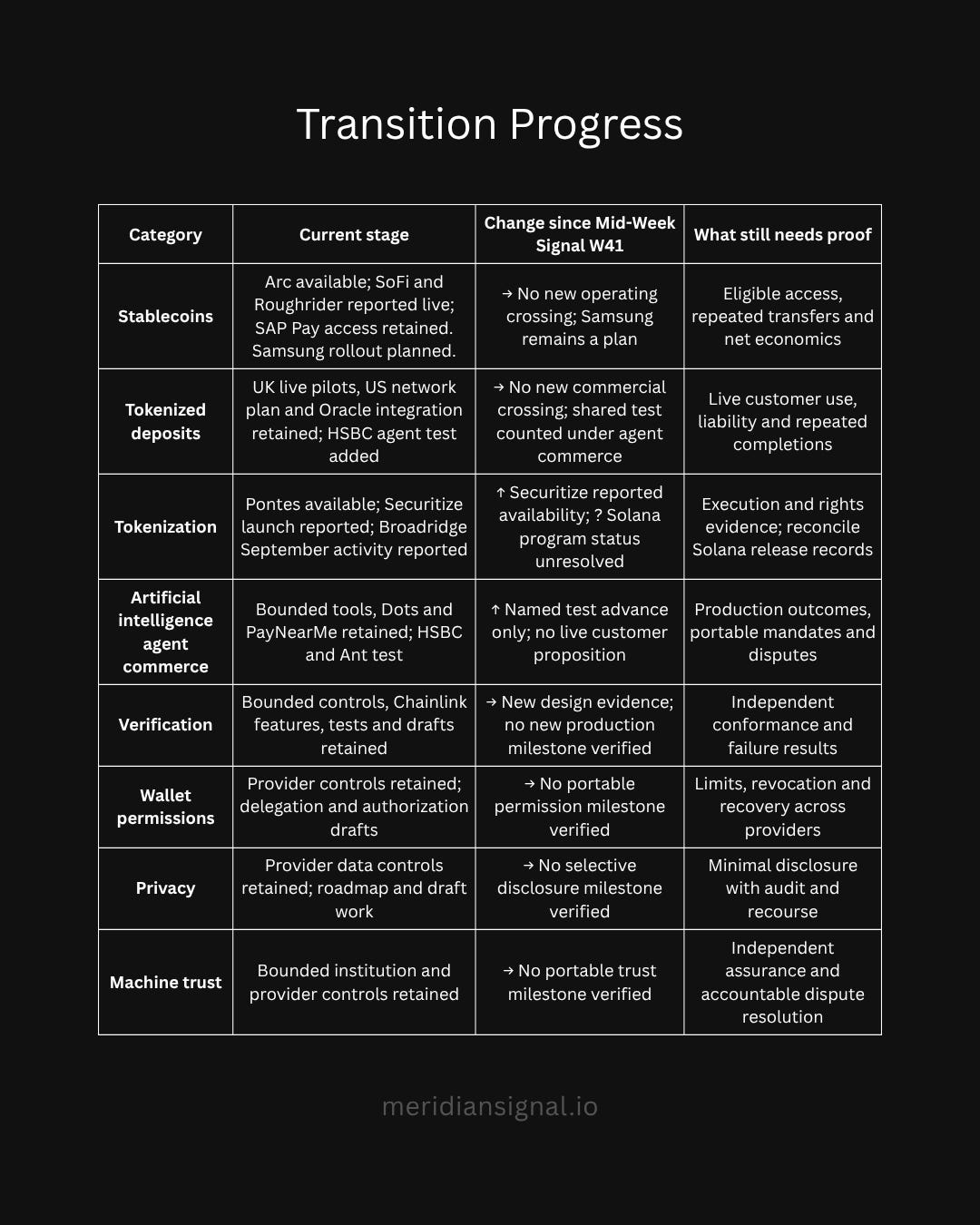
↑ Supported named advance. → No new verified milestone in the stated dimension within inspected coverage. ↓ Evidenced deterioration. ? Unresolved current status. Missing evidence is not proof of no change. Retained capabilities are prior documented stages, not fresh uptime certification.
The unresolved Solana status concerns a particular settlement program’s release records. Securitize’s separate use of Solana does not resolve that question and is not evidence of a security defect. Verification, wallet permissions, privacy and machine trust keep their existing bounded capabilities; no new portable-control or selective-disclosure production milestone was verified in this review. An individual delegation-receipt draft dated October 9 remains a proposal without formal standards endorsement.
Meridian’s current assessment
Signal Stability: 95, Thesis unchanged. The causal interpretation and core dependencies persist. This is the same representative anchor as Mid-Week W41. Under the convention adopted in September, 95 denotes the 90–100 “Thesis unchanged” band. It is a coarse editorial judgment, not a probability, investment rating or measure of research completeness. Older point values used a different convention and should not be subtracted from these anchors.
Signal-to-Noise: High Signal. Attributable disclosures let us separate a plan, a reported offering and a test. The unresolved deployment claim does not determine this issue’s conclusion.
Transition confidence: Supported. The reported offering and bank test support the structural direction; adoption remains uncertain. Sequence confidence: Supported. Bounded services can precede portability and recurring economics. This describes dependencies, not a universal timetable.
Transition progress: one qualified reported availability advance and one named test advance. Samsung receives no operating milestone. Publication delta: Material. The new evidence clarifies how consumer custody, securities rights and bank authorization remain part of apparently simpler services.
Near-term investability: Mixed. Selected financing indicators eased. In the Federal Reserve’s October 9 release, October 8 ten-year nominal and real Treasury yields were 5.22% and 2.87%, down from the baseline’s October 6 readings of 5.27% and 2.91%. The October 8 balance-sheet release showed average bank reserves rising $81.569 billion for the week ended October 7. That observation period predates this issue’s window; its publication is new. A falling Treasury balance contributed to the reserve movement, which is not itself a new monetary easing decision. Financing costs and energy delivery remain constraints. October 9 US diesel-related sanctions permission is subject to exclusions and does not prove completed deliveries or lower consumer prices.
System integrity: Qualified. The completed comparison report and governing sources were retrieved and reconciled. Independent customer outcomes, parts of the rights and economics assessment, and the named Solana deployment status remain unverified. Those limits are explicit and separable from the conclusion.
What deserves attention next
Our research posture remains selective. Examine the necessary service, the entity responsible for it and the economics after operating costs. Compatible devices, trading access and test success answer useful questions, but none alone answers all three.
The next confirmations are concrete: actual Samsung availability and completed transfers; Securitize customer execution, usable rights and recovery; a live bank agent proposition with consent, limits and dispute handling. Across providers, recurring use and net retained revenue matter more than a launch headline. Competing suppliers and customer savings must remain in the beneficiary analysis.
We would change the interpretation if evidence showed that a dependency we treat as necessary had been removed, or that durable economic benefits accrue through a materially different mechanism. Until then, interface simplicity is progress in access. Dependable operation and enforceable rights determine the service delivered.
Meridian Strategic Conclusion: Follow the institution and obligation behind each new capability. Current evidence supports bounded implementation, with several possible beneficiaries and no newly verified unavoidable economic winner.
Evidence through October 10, 2026, 1:17:47 p.m. America/Los_Angeles, or 20:17:47 UTC. Compared with Mid-Week Signal W41, whose cutoff was October 8 at 05:06:10 UTC.
Meridian Signal
Bold clarity at the right time.
Independent strategic intelligence on capital regimes, digital infrastructure and systemic risk.
AI-assisted. Human-directed. Source-verified.
General informational and educational research. Not personalized investment, legal or tax advice. Assessments involve uncertainty, and investments can lose value.
Questions or corrections: contact@meridiansignal.io