
A payment option inside familiar business software can remove a practical obstacle to adoption. It does not answer who must approve the payment, handle a failed transfer or absorb the cost of making the service dependable.
This week brings that distinction into sharper view. Circle reports a new route into enterprise workflows. Solana has published open settlement software with useful technical boundaries, alongside release descriptions that still need reconciliation.
Our assessment is that access and reusable execution are advancing while responsibility remains distributed among institutions, issuers and operators. That supports Meridian’s structural thesis. It leaves the durable economic winner unresolved.
What changed
Enterprise distribution gained a reported access route. On October 7, Circle said its USDC and EURC stablecoins were available to eligible SAP customers through Tereina and SAP Pay. The same disclosure places customer proof programs in the months ahead. We record an attributed access advance, not a verified record of repeat business payments. Circle and Tereina, October 7
Open settlement code made the operating boundary clearer. Solana Foundation’s October 6 announcement concerns software for exchanging two assets together. Its technical documentation identifies a settlement authority and asset controls that remain consequential. The release state is less clear: the announcement anticipates production release, an October 2 documentation snapshot lists a mainnet deployment, and the repository describes a placeholder program identity. We retain the software evidence and leave current production status unresolved. Solana Foundation announcement, October 6; Solana settlement documentation; Solana Foundation code repository
Financing and operating conditions still require selectivity. The Federal Reserve’s October 7 release puts October 6 nominal and real ten year Treasury yields at 5.27 and 2.91 percent. Both are three basis points above the October 1 observations used in Week-End W40, although both eased from October 5. The International Energy Agency’s October 7 statement calls for faster delivery of existing oil commitments, with diesel a priority. This is a delivery response to continuing pressure, not evidence that all pledged supply has arrived. Federal Reserve H.15, October 7 release; International Energy Agency, October 7
The exchange is only one part of the service
A finance team needs several things to be true before a payment becomes routine. It must know that the instruction is authorized, that the assets can move, that accounting records reconcile and that someone can resolve a failed or disputed result.
Software can make one of those steps easier without eliminating the others. An atomic exchange means the two transfer legs execute together. It does not, by itself, decide the legal rights attached to an asset or make every institution accept the same customer instruction.
The practical consequence is that the boundary of the service matters as much as the transfer mechanism. A company can obtain a new payment option while continuing to rely on its enterprise platform, asset issuer and operating partners. An open implementation can make exchange easier to reproduce while leaving those relationships economically important.
That is also the strongest alternative to a simple infrastructure investment story. Existing institutions may already provide enough control and recourse for customers. Open software may increase competition among suppliers. More use can coexist with lower prices for the technical function that enables it.
Our Week-End Signal W40, published October 4, separated familiar distribution from repeat use. The new access disclosure adds support to that mechanism; it does not fulfill an investment forecast. The next question is whether the resulting service is dependable, repeatedly used and economically worthwhile after its operating costs.
Transition progress
Comparison: Week-End Signal W40, cutoff October 3, 2026, 20:25:11 UTC. Stages apply to the named capabilities within the inspected coverage.
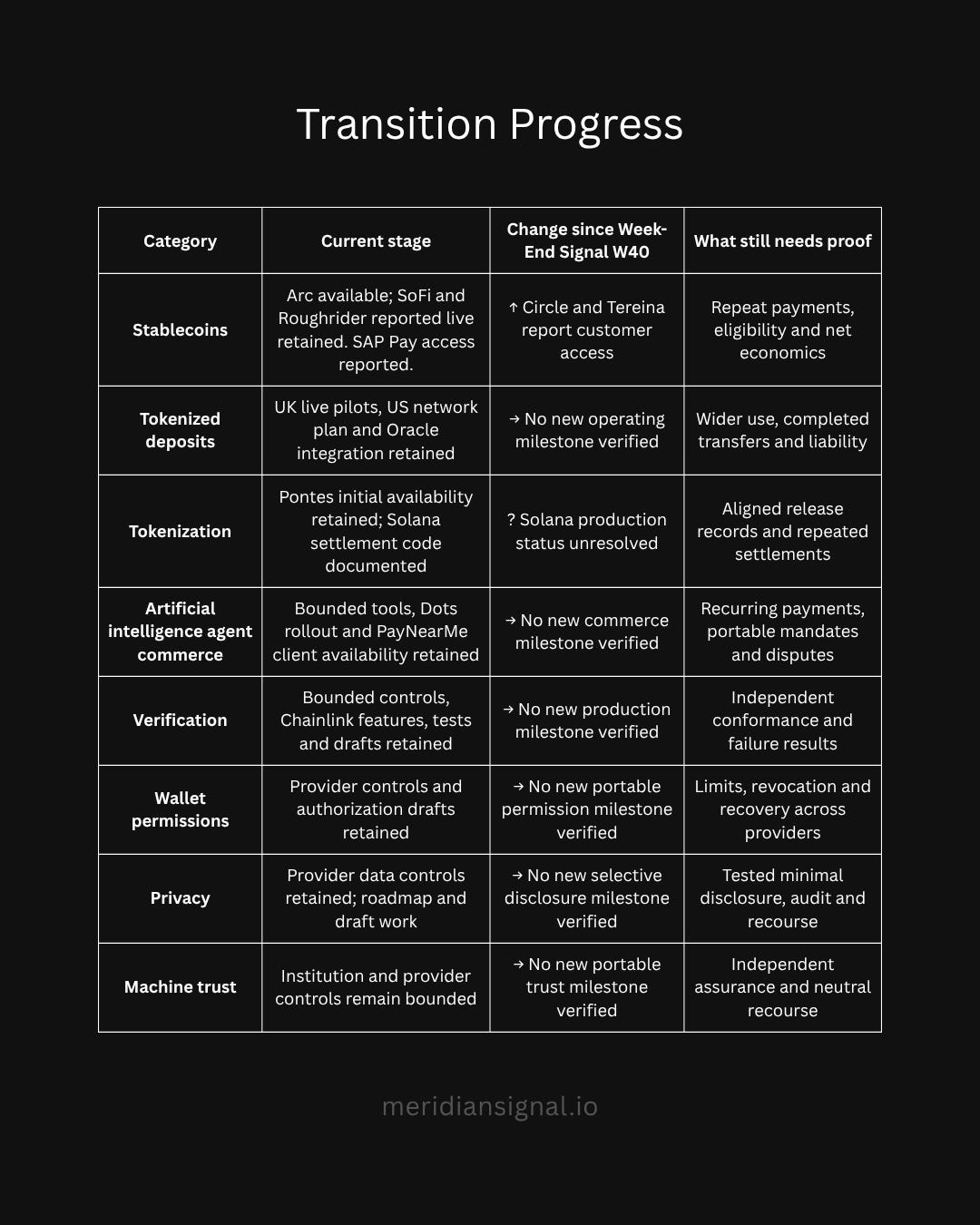
↑ Supported named advance. → No new verified milestone within inspected coverage. ↓ Evidenced deterioration. ? Unresolved current status. Missing evidence is not proof of no change. Retained capabilities are not fresh uptime certification.
Circle and Tereina receive one access advance under Stablecoins. Solana’s unresolved release status does not reduce Pontes’ retained availability or establish a new production crossing. No new recurring production, scaled production or enforceable value capture is verified.
Retained capability references: Fiserv live platform disclosure; PayNearMe servicing agent disclosure; ECB Pontes launch, September 21; Arc launch, September 16; Arc Portal, September 18; UK Finance tokenized deposits; Chainlink September 28 feature release; OpenAI Dots, September 29.
Meridian consensus and readings
Signal Stability: 95 out of 100, Thesis unchanged. The same representative anchor as Week-End W40. Useful implementation continues to advance before portable authority, neutral recourse and recurring economics are established. This is a coarse judgment anchor, not a probability or an assessment of investment attractiveness. The earlier numerical convention is not directly comparable; changing conventions did not constitute a historical decline.
Signal-to-Noise: High Signal. Attributable evidence supports a useful distinction between access, exchange and responsibility. Unresolved production claims are separated from that conclusion.
Transition confidence: Supported. The direction has implementation support. Adoption and returns are not inevitable.
Sequence confidence: Supported. Useful execution and bounded controls can develop together while wider authority and economic durability remain separate tests. This is an ordering judgment, not a timetable.
Transition progress: One qualified access advance. The tracker retains prior live and available capabilities and keeps Solana’s production status unresolved.
Publication delta: Material. The contribution is identifying how reusable exchange can coexist with persistent issuer and operator responsibilities, and what that means for economic capture.
Near-term investability: Mixed. Duration financing benchmarks remain demanding. Their modest increase from the baseline and continuing energy pressure support caution; recent yield easing and existing policy buffers argue against treating every financing channel as distressed. The September Federal Reserve minutes, published October 7, describe resilient funding conditions at that earlier meeting. They are not a fresh October rate decision or a substitute for later economic data. Federal Reserve September minutes, published October 7
System integrity: Qualified. The comparison uses the explicitly approved reconstruction of the prior internal baseline. Source and timing checks support these scoped claims; Solana’s production identity and independent operating and economic results remain unresolved.
Meridian Strategic Conclusion
The useful place to focus is where a required service meets an accountable operator and retained economics.
Distribution can make a new payment option easier to reach. Reusable software can make an exchange easier to implement. Neither alone establishes durable pricing power. Follow who controls admission, who bears the cost of failure and who retains revenue after funding, compliance, security and losses.
This remains a posture of defensive selectivity. No new digital asset qualification or individualized investment instruction follows from the edition.
What would change the reading
Three conditions would improve the evidence: repeated customer payments with a usable failure record; authority, revocation and recovery recognized across providers; and disclosed net economics tied to an essential service.
For Solana specifically, deployment identity, released code and operating records must reconcile before production receives credit. Its historical security review is relevant assurance context, not proof of a new incident or certification of the currently deployed build. Cantina review, May 21 to 28
The thesis would need adjustment if verified recurring operation removed an important dependency assumed here, or if durable economics demonstrably accrued to a different layer. Strong evidence of failed controls would require narrowing the affected capability, even if the wider direction remained supported.
The takeaway
Easier access and exchange can move the transition forward. The decisive business question remains who makes the service dependable and who keeps the value after doing so.
Evidence cutoff: October 7, 2026, 10:06:10 p.m. America/Los_Angeles / October 8, 2026, 05:06:10 UTC.
Meridian Signal
Bold clarity at the right time.
Independent strategic intelligence on capital regimes, digital infrastructure and systemic risk.
AI-assisted. Human-directed. Source-verified.
General informational and educational research. Not personalized investment, legal or tax advice. Assessments involve uncertainty, and investments can lose value.
Questions or corrections: contact@meridiansignal.io