
The most useful payment innovation may arrive inside software people already use. That lowers one barrier to adoption. It leaves a harder question: does the new capability keep solving a customer problem after the launch?
Meridian’s assessment is that established banking and servicing relationships are providing a practical route into programmable payments. The evidence has become more concrete in two bounded settings. Portable authority, independent assurance and durable economics still require their own proof.
Three changes worth separating
Another institutional payment application is reported live. Fiserv and VersaBank said on October 1 that Roughrider Coin is live on Fiserv’s digital asset platform for North Dakota bank to bank payments. The issuer identifies its US bank subsidiary’s role. This is attributable evidence of a bounded launch, with no independently verified series of completed transactions. The announced participating network is not a count of active transacting institutions. Fiserv, October 1; VersaBank, October 1.
There is a terminology qualification. Bank of North Dakota calls the product a “token deposit,” while Fiserv and VersaBank call it a stablecoin. We retain it in the stablecoin row on the dated issuer description; that does not settle the holder’s legal claim or deposit insurance treatment. The bank’s undated page also retains pilot language. Those limits prevent an upgrade to broad recurring production. Bank of North Dakota product description, undated.
A servicing agent became available to existing clients. PayNearMe’s October 1 release makes its agent available within PayXM, with payment servicing and human handoff. Its customer evidence comes from a pilot campaign. Outreach activity does not establish collections success, lasting savings or recurring autonomous payments. Some channel continuity remains phased. PayNearMe, October 1.
Financing stopped moving uniformly in one direction. The October 2 Federal Reserve release puts October 1 ten year nominal and real Treasury yields at 5.24 percent and 2.88 percent, slightly below the 5.26 percent and 2.91 percent observations in our Mid-Week baseline. Weekly average reserve balances rose by $17.897 billion in the October 1 balance sheet release. September payroll growth was only 29,000, and July and August were revised down by a combined 60,000. The unemployment rate was 4.2 percent. That supports a Mixed financing reading, with weak operating demand a counterweight to modest rate relief. Federal Reserve H.15, October 2 release; Federal Reserve H.4.1, October 1 release; Bureau of Labor Statistics, October 2 employment release.
The relationship is part of the infrastructure
These initiatives can use existing customer access, operational habits and accountable institutions. A bank may adopt a new settlement route through familiar banking software. A servicer may add an agent to an existing payment workflow. Customers do not necessarily need to assemble an entirely new financial relationship first.
That is a commercial advantage to test, not a demonstrated profit margin. Integration expense, customer consent, exception handling and the cost of keeping the service reliable still matter. A larger reachable network can coexist with limited active use.
The strongest alternative to a universal new trust layer is already visible: providers may solve enough of the problem inside their own systems. If those arrangements satisfy customers reliably, independent infrastructure suppliers may have less pricing power than a broad transition narrative implies.
Our Mid-Week Signal W40, published September 30 described configurable control inside provider and institution boundaries. The new releases give that mechanism additional support. They do not confirm a forecast of widespread adoption or investment returns.
The hidden transition is responsibility for the whole task
Recognizing an agent, accepting its authority and establishing that the requested work was completed are separate questions. The distinction matters when money moves on the strength of a machine’s action.
An earlier announcement helps explain the boundary. Mastercard’s September 30 release describes a US test of a score estimating whether an agent initiated a transaction. We discovered it in this review and treat it as earlier context, not a fresh October 1 launch. It adds risk information; the release does not establish universal spending authority or general availability of all planned signals. Mastercard, September 30, French regional release.
An October 2 individual Internet Draft on consuming KYAPay Tokens likewise separates authenticated identity context from the receiving site’s admission decision. It is work in progress, not an approved standard or proof of deployed interoperability. Using KYAPay Tokens, individual Internet Draft 01, October 2.
Meridian’s inference is practical: a useful operating record must connect the instruction, the permitted action, the outcome and the route to resolve a dispute. Comparing these separate initiatives does not establish a security defect in any of them.
Transition progress
Comparison: Mid-Week Signal W40, evidence cutoff October 1, 2026, 01:04:30 UTC, corresponding to September 30 at 6:04:30 p.m. America/Los_Angeles. Coverage concerns named systems and retained capabilities.
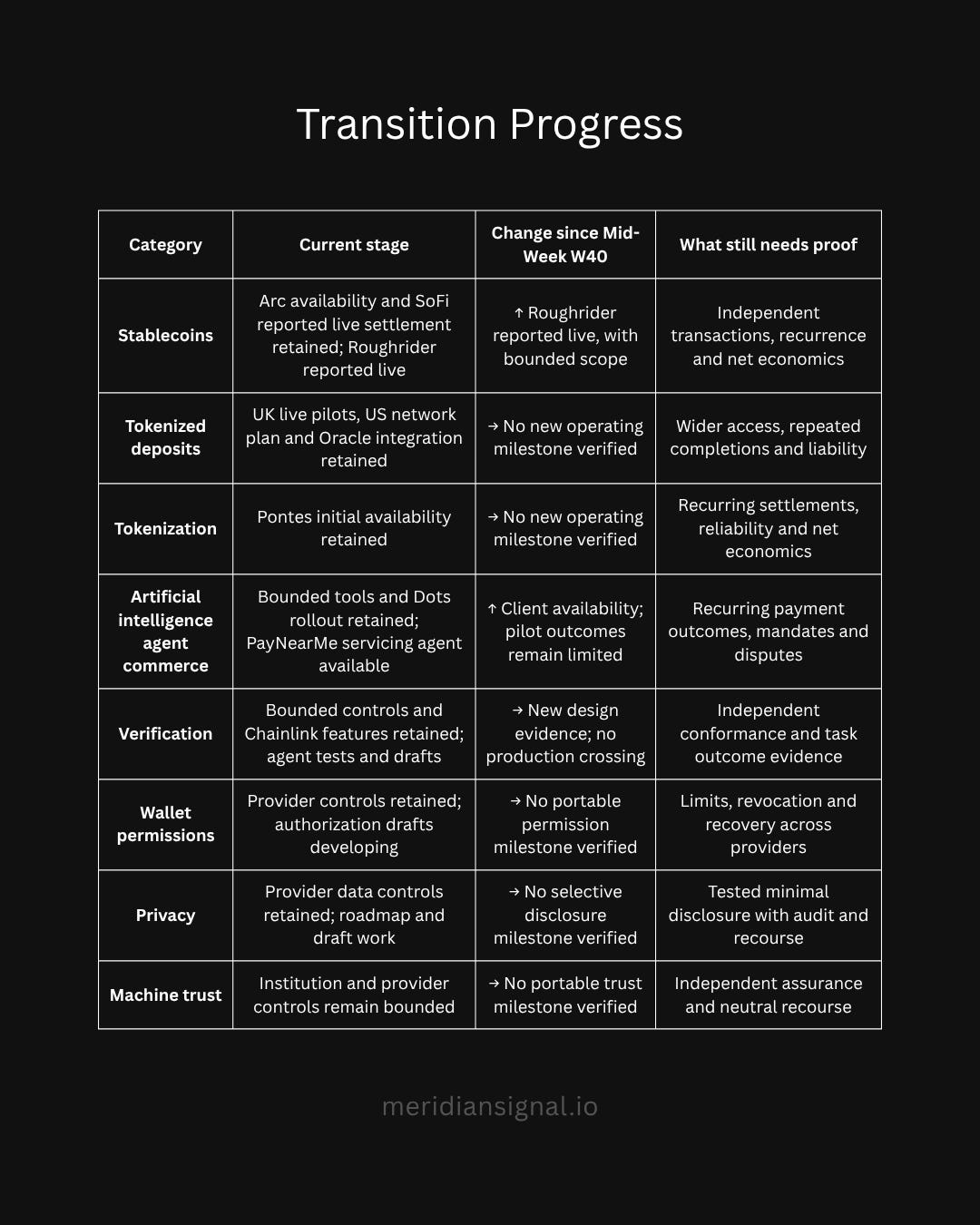
↑ Supported named advance. → No new verified milestone in the stated dimension within inspected coverage. ↓ Evidenced deterioration. ? Unresolved current status. Missing evidence is not proof of no change. Retained stages are prior documented capabilities, not fresh uptime certification.
Roughrider receives one qualified reported live advance under Stablecoins. PayNearMe receives one client availability advance under Artificial intelligence agent commerce. Neither is counted again in another row. No new independently verified recurring production, scaled production or enforceable value capture is established. Earlier Pontes, Arc and UK pilot capabilities remain credited at their prior scope. European Central Bank Pontes launch, September 21; Arc launch, September 16; UK Finance live pilot description.
Meridian consensus and readings
Signal Stability: 95 out of 100, Thesis unchanged. The same anchor as Mid-Week W40. Bounded execution can advance through existing institutions while portable authority, independent assurance, recourse and durable economics remain distinct dependencies. This is a coarse representative judgment, not a probability or investment rating. The earlier numerical convention is not directly comparable, and its historical points remain unchanged.
Signal-to-Noise: High Signal, unchanged. Dated primary releases support a useful bounded interpretation. The missing operating and economic results limit its scope without determining it.
Transition confidence: Supported, unchanged. New client availability and a reported institutional launch strengthen the implementation evidence. Adoption is not inevitable.
Sequence confidence: Supported, unchanged. Useful bounded applications can precede demonstrated portability and recurring economics. This describes dependencies in the inspected systems, not a universal timetable.
Transition progress: Two qualified advances. Roughrider adds reported live evidence; PayNearMe adds client availability. The tracker preserves existing capabilities and the narrower stages of tests and drafts.
Publication delta: Material, unchanged category. Existing distribution is becoming a more concrete path to use, with responsibility and retained economics still open.
Near-term investability: Mixed, previously Tightening. Small declines in long yields and higher weekly average reserves provide counterevidence to continued uniform tightening. High financing benchmarks and weak payroll growth restrain the improvement. This is a judgment about general financing and operating conditions, not the value of an asset.
System integrity: Qualified, unchanged. The scoped source, timing and comparison checks passed. Independent transactions, complete product legal terms, repeat outcomes and net economics remain incomplete. These limits are reflected in the claims above.
Meridian positioning
Give weight to access to customers, reliable execution and responsibility when things go wrong. Then examine revenue after funding, integration, compliance, security and losses.
An infrastructure affiliation is not an enforceable economic right. Processing transactions on a public network does not, by itself, quantify demand for its asset or the value retained by holders. This edition makes no new asset qualification or individualized investment recommendation.
Meridian Strategic Conclusion
Established providers are using familiar workflows to bring new payment capabilities closer to customers. That supports the structural transition while leaving its eventual beneficiaries open. The next decisive evidence is repeated successful use with usable recovery and disclosed economics.
For bank payments, look for an ongoing flow of completed customer transactions across institutions, with failures and recovery reported. For remortgages, that means a lender’s continuing pipeline of new completions. For servicing agents, look for payment resolution and customer outcomes beyond call activity. Across both, require evidence of who retains the savings after the full cost of operation.
Our interpretation would change if portable mandates and neutral recourse removed a dependency we currently regard as important, or if recurring economics demonstrably accrued to a different layer. Evidence that current controls fail materially would require revising the affected capability, even if the wider direction remained intact.
The next milestone is a service customers can rely on repeatedly, with someone accountable for the result.
Evidence cutoff: October 3, 2026, 1:25:11 p.m. America/Los_Angeles / 20:25:11 UTC.
Meridian Signal
Bold clarity at the right time.
Independent strategic intelligence on capital regimes, digital infrastructure and systemic risk.
AI-assisted. Human-directed. Source-verified.
General informational and educational research. Not personalized investment, legal or tax advice. Assessments involve uncertainty, and investments can lose value.
Questions or corrections: contact@meridiansignal.io