
Giving a machine more work makes the limits on that work more consequential. This week, those limits became more visible in released products and bank integration plans.
Our assessment is that useful execution is advancing inside defined institutional and provider boundaries. The evidence supports more configurable control. Portable authority, independent assurance and durable economics still need their own operating record.
What changed
Payment infrastructure gained more configurable verification. Chainlink’s September 28 release of its Cross Chain Interoperability Protocol, CCIP 2.0, adds optional verification and execution choices. The important distinction is between delivering a message and satisfying its required checks. A replaceable executor does not make those checks optional. This is a documented feature release, not an independently verified record of recurring use. Chainlink release, September 28; Chainlink architecture.
Ongoing agents became available within provider controls. OpenAI announced Dots on September 29 with availability depending on plan and market. Its proactive research is read only; requested work can take actions under applicable authorization and review. Those are different modes. This adds enabling agent capability, not verified payment volume or a mandate another institution must accept. OpenAI introduction, September 29; OpenAI safety and permissions, September 29.
Bank integration work retained bank control. Oracle’s September 28 announcement describes integration with Swift’s ledger to connect tokenized deposit systems. The work leaves each bank responsible for its own money and infrastructure. The announcement establishes integration activity; it does not establish a completed customer transaction. Oracle integration announcement, September 28.
Swift’s July 9 readiness disclosure is earlier context newly inspected for this edition. It described initial controlled readiness and banks preparing pilots. It is not a September launch. Swift readiness disclosure, July 9.
Control is becoming part of the product
The structural change is easier to understand through a practical question: who can decide how an instruction is executed?
A payment service can let an institution choose additional verification. An agent provider can separate background research from actions requiring permission. A bank can connect to another institution while retaining responsibility for its own deposit claim.
These arrangements give operators more ways to configure useful work. They also make the location of authority more important. A control that works within one service does not automatically travel with the customer to another service.
There is a strong alternative reading worth taking seriously. Existing institutions may be able to deliver much of the benefit through their current relationships and liability arrangements. A universal new trust layer may never be necessary for every use case. That possibility limits the rents independent infrastructure can assume it will collect.
Our Week-End Signal W39, published September 26, separated a working payment from a durable business. This week’s releases add detail to that distinction: control can become more configurable while the evidence for portability and retained economics remains incomplete. This is continuing analysis, not a claim that an earlier forecast has been fulfilled.
Transition progress
Comparison: Week-End Signal W39, cutoff September 26, 2026, 20:13:46 UTC. Stages refer to the named systems inspected and explicitly retained capabilities.
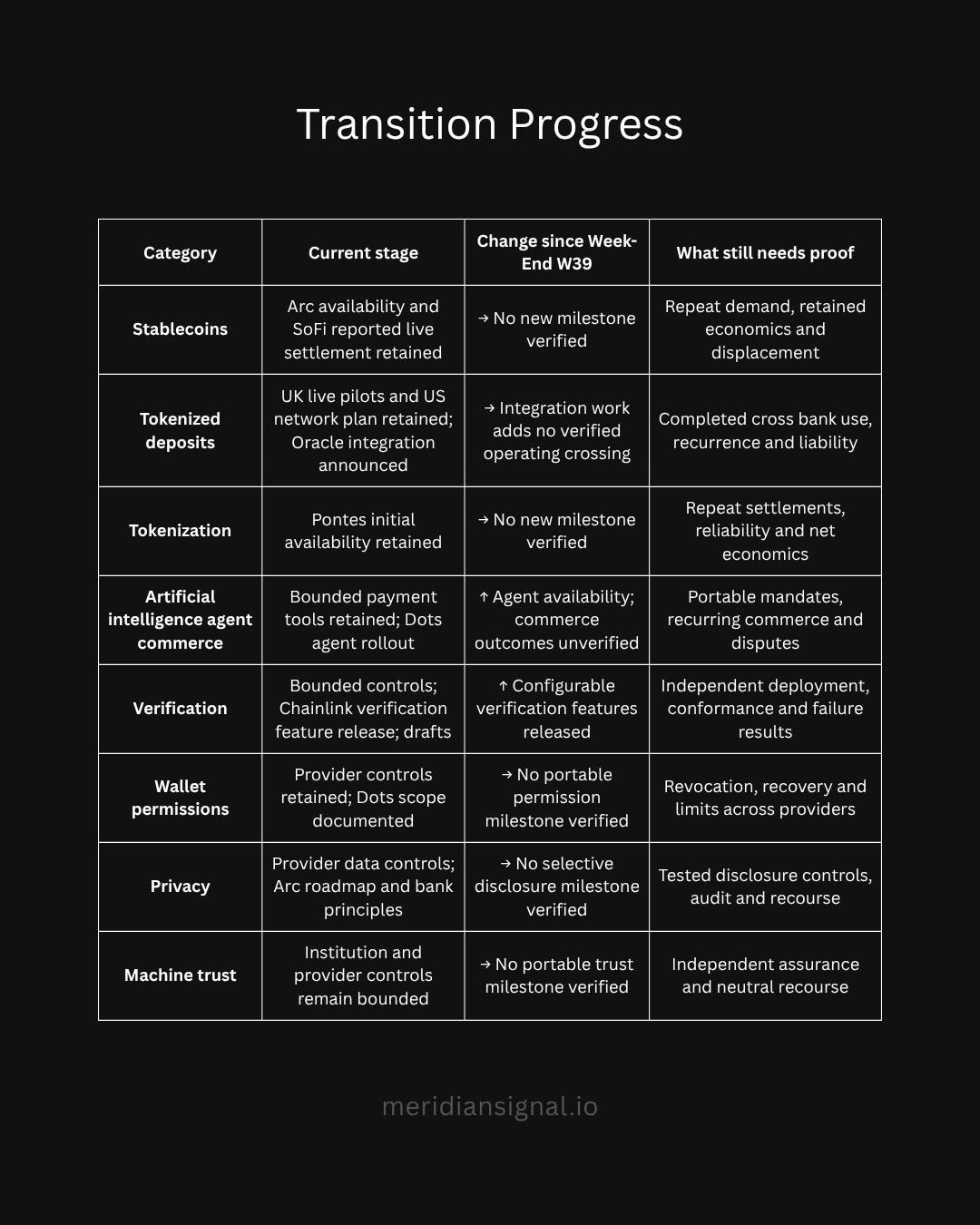
↑ Supported named advance. → No new verified milestone within inspected coverage. ↓ Evidenced deterioration. ? Unresolved current status. Missing evidence is not proof of no change. Carried capabilities are not fresh uptime certification.
Dots is counted once in the agent category as enabling availability, not as a commerce production crossing. CCIP is counted once under Verification. Its relevance elsewhere does not create additional launches. No new recurring production, scaled production or enforceable value capture is established. Baseline capability sources include European Central Bank Pontes launch, September 21, Arc launch, September 16, Arc Portal, September 18, SoFi September 22 disclosure, retained from verified W39 baseline and The Clearing House September 24 procurement, retained from W39. The Clearing House’s supplier selection and planned network remain at their prior stage.
Meridian consensus and readings
Signal Stability: 95 out of 100, Thesis unchanged. Unchanged from Week-End W39. The core interpretation remains that bounded execution can advance before portable authority, independent assurance, neutral recourse and recurring economics. The approved representative point is a coarse judgment anchor, not a probability. The earlier numerical convention is not directly comparable; no historical decline is inferred from changing conventions.
Signal-to-Noise: High Signal. The relevant releases identify what is available, what is being integrated and what remains unfinished. Their operating and economic gaps can be stated without deciding the conclusion for them.
Transition confidence: Supported. More implementation detail supports the structural direction. It does not make adoption inevitable.
Sequence confidence: Supported. Execution and provider controls can develop together. The evidence does not establish one timetable or universal ordering for every institution.
Transition progress: Qualified feature and agent availability advances. The tracker preserves prior capabilities and names the two narrower advances.
Publication delta: Material. The contribution is the distinction between configurable execution and authority that another provider can recognize and enforce.
Near-term investability: Tightening. The Federal Reserve’s September 30 release shows September 29 ten year nominal and real Treasury yields of 5.26 percent and 2.91 percent, respectively. These are eight and six basis points above the September 24 observations used in Week-End W39. They raise the financing hurdle, without establishing distress across every borrower. Federal Reserve H.15, September 30 release.
There is counterevidence to a blanket stress reading. The Bank of England’s September 30 record describes resilient markets and well capitalized UK banks alongside interconnected risks. The Bureau of Economic Analysis reported second quarter real growth at a 2.2 percent annual rate in its September 30 third estimate. The data concern an earlier quarter and include revisions. Bank of England Financial Policy Committee record, September 30; BEA economy at a glance, September 30 releases.
System integrity: Qualified. The scoped source and timing checks passed. Independent operating results, cross provider recourse and retained economics remain incomplete. A qualification limits the conclusion; it does not erase the documented releases.
Where to stay selective
Follow who controls admission, execution and the customer relationship. Then ask who retains revenue after funding, security, compliance and losses.
More ways to connect may increase use while reducing a supplier’s pricing power. A named infrastructure role does not establish unavoidable demand for a public digital asset or an enforceable claim on profits. No new asset qualification follows from this edition.
Three tests would materially improve the evidence: repeated customer use with measurable failure outcomes; mandates and revocation that work across providers with usable recourse; and disclosed net economics tied to an unavoidable economic role.
Our structural reading would need adjustment if recurring cross institution use removed an important dependency on the control points assumed here, or if durable economics demonstrably accrued elsewhere. A central premise being contradicted would require a deeper reassessment.
The takeaway
Configurable control is becoming a more concrete product capability. Its economic value will depend on which controls customers need, which providers they can replace and who remains accountable when execution fails.
Evidence cutoff: September 30, 2026, 6:04:30 p.m. America/Los_Angeles / October 1, 2026, 01:04:30 UTC.
Meridian Signal
Bold clarity at the right time.
Independent strategic intelligence on capital regimes, digital infrastructure and systemic risk.
General informational and educational research. Not personalized investment, legal or tax advice. Assessments involve uncertainty, and investments can lose value.
Questions or corrections: contact@meridiansignal.io