
A customer needs more than a service that can complete a transaction. They need a way to stop an unwanted action and recover access when something breaks. Those jobs can mature at different speeds.
This week offers three useful tests of that distinction. A bank reports live transactions in a new Hong Kong service. A security provider adds an intervention tool. An exchange reports progress replenishing stolen assets while recovery continues. These are separate systems, not evidence that one caused or could have prevented another’s problems.
Three changes since our last Signal
A named bank workflow advances. Standard Chartered’s November 2 release reports its Hong Kong tokenized-deposit launch and live client transactions, including tokenized money-market-fund settlement. Its description includes transfers between participating banks. This supports a bounded operating finding, not independently measured recurring demand across the market. Standard Chartered.
Intervention becomes available within a stated boundary. CrowdStrike’s November 3 disclosures describe the AI Kill Switch as available first at the gateway, with endpoint termination still forthcoming. The company also describes administrator control and logging. This is useful scoped availability; it does not establish universal coverage, independent effectiveness or recovery from an action already completed. Kill Switch release; availability details.
Recovery remains a live operating task. On November 4, Binance says it has replenished approximately 98% of the impacted amount. It says the remaining tokens are less liquid, withdrawals are reopening in phases and the full proof for its new reserve snapshot is still being generated. These are operator claims of progress, not a completed independent audit or proof that every customer route is restored. Binance update.
Meridian’s assessment is constructive on the named capabilities and demanding about outcomes. A system can improve access while still needing better intervention and recovery evidence.
The work around the transaction
The practical distinction is between three questions: can the system perform the intended job, can an accountable person interrupt it, and can the customer obtain a remedy afterward?
Those capabilities can overlap, but they are not interchangeable. A stop command cannot undo a completed transfer by itself. A reserve snapshot does not demonstrate every withdrawal route. A successful settlement does not measure performance during stress. These are analytical limits, not allegations of an undisclosed defect in the named services.
The strongest countercase is that familiar banking controls, payment approvals and existing security tools may already solve many customer needs. New infrastructure can add integration costs or concentrate dependence on a provider. Even a useful service may leave most of the benefit with customers rather than investors.
Our Week-End Signal W44, published November 3, examined the difference between longer access, useful prices and realizable cash. The present evidence adds a different dimension: who can intervene, and what remains available during recovery. That is related context, not a prediction result.
What is changing underneath
The transition is becoming a problem of complete operating responsibility. Banks can retain the deposit relationship while changing its technical delivery. Security providers can extend existing enterprise distribution into agent controls. Custodians and exchanges still have to manage access, inventories and remedies when a service is disrupted.
Meridian’s inference is that reliable control and credible recovery can influence adoption and bargaining power. Neither establishes an inevitable winner. A provider needs evidence that customers keep using the service, that the full cost is justified and that its contracts or assets actually capture part of the benefit.
Transition progress
Comparison: Week-End Signal W44, evidence through October 31, 2026, 20:54:30 UTC. Existing capabilities retain their original measurement vintages. No fresh recurring-production milestone does not mean recurring production is absent.
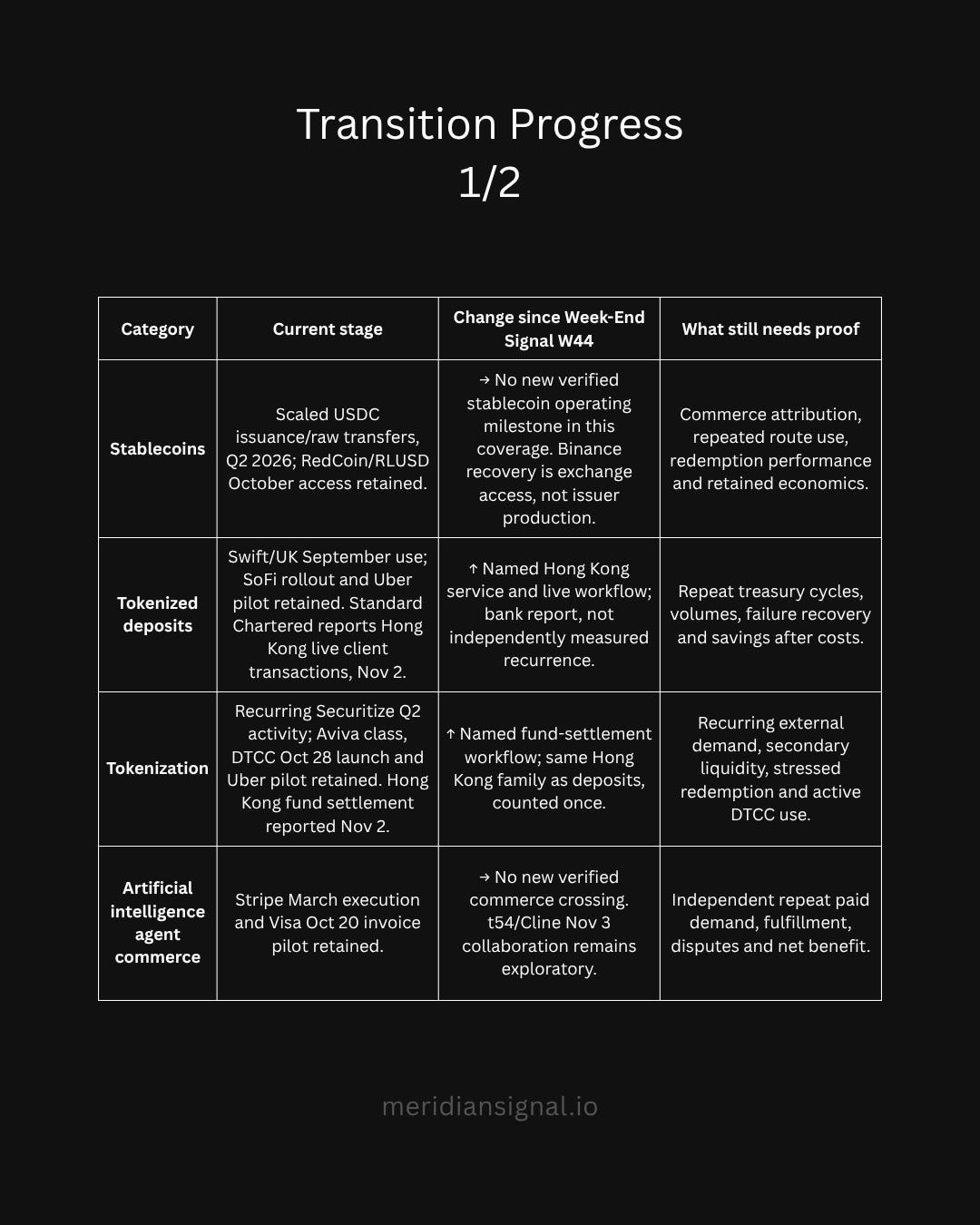
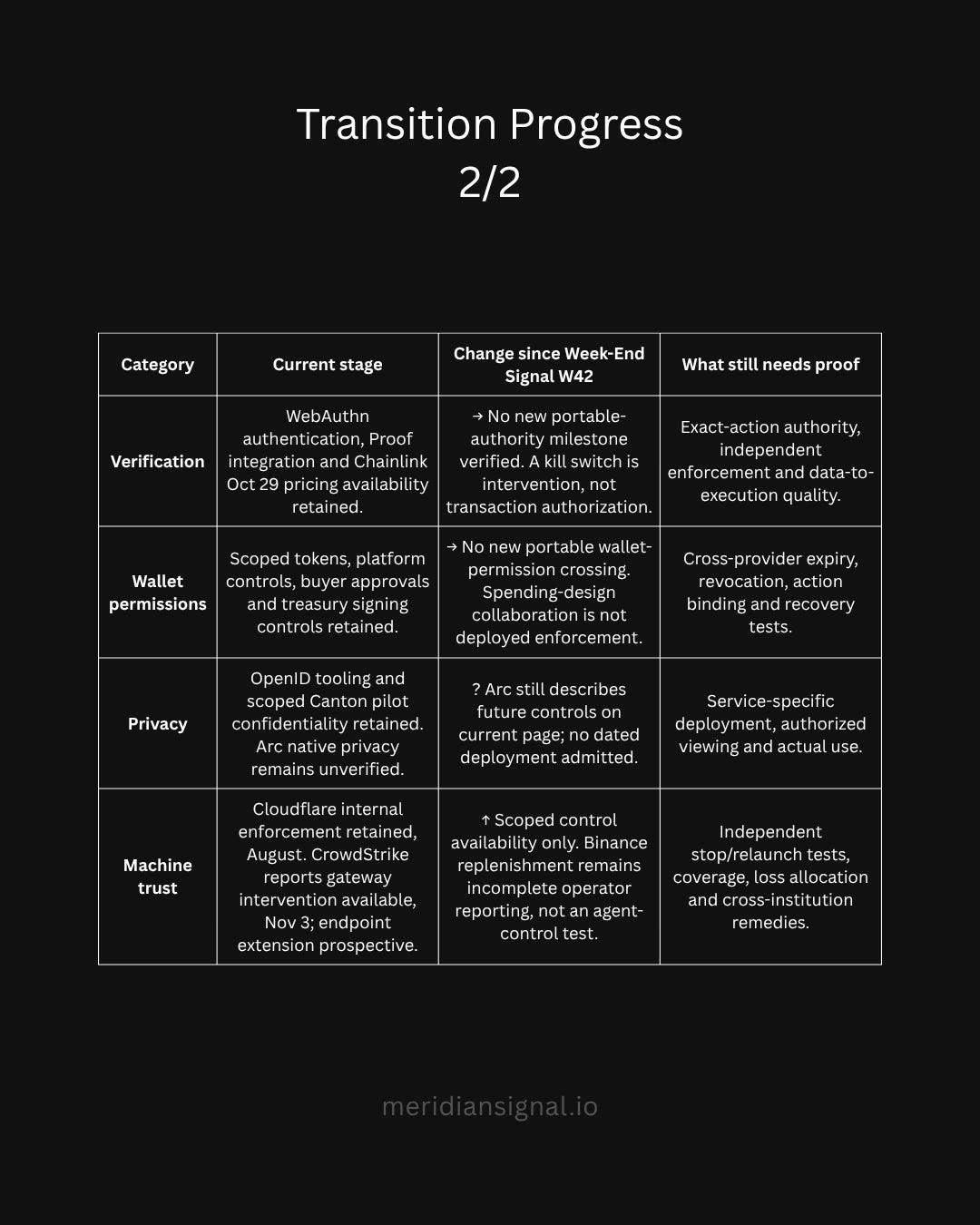
↑ Supported named advance · → No new verified milestone within inspected coverage · ↓ Evidenced deterioration · ? Unresolved current status. Retained stages preserve scope and vintage, not current uptime. One event may inform several rows without becoming several launches.
The retained evidence includes USDC issuance and raw transfers, Securitize lifecycle activity, bounded bank use and operator-reported agent execution. Raw transfer activity is not independently attributed commerce; aggregate lifecycle flows are not universal secondary liquidity. Authentication, authority, privacy and remedies each retain their own scope.
Meridian assessment
Signal Stability: 95 / Thesis unchanged, matching the preceding completed Signal. Funding, authority, execution, records and remedies remain central to the interpretation. The 90 to 100 band means the structural thesis is unchanged; 95 is its approved coarse anchor. It is not a probability, investment rating or percentage of transition complete. Earlier numerical conventions are not directly comparable.
Signal-to-Noise: High Signal, unchanged. The sources support specific operating and availability claims. Independent performance is still unproven and can be separated from those claims. This is an editorial evidence judgment.
Transition confidence: Supported, unchanged. Sequence confidence: Supported, unchanged for the scoped dependencies, which can overlap or be supplied through substitutes. There is no universal sequence.
Transition progress: a named Hong Kong operating workflow and scoped gateway-control availability advance. No new recurring-use, scaled-production or enforceable value-capture crossing is established. Publication delta: Material, unchanged in category, because intervention and recovery deserve separate tests from transaction capability.
Near-term investability: Mixed, unchanged. The Federal Reserve’s November 4 release puts November 3 nominal and real ten-year yields at 4.95% and 2.65%, compared with October 29’s 4.98% and 2.63%. Nominal rates eased slightly while real rates rose. These lagged daily observations do not establish broad financing relief or value any particular asset. Federal Reserve.
System integrity: Qualified, unchanged. Named sources support these scopes. Independent outcome measurement remains incomplete. The Hong Kong bank release was readable; direct retrieval of the related monetary-authority release failed, so its additional details are not relied upon here.
Positioning and the next test
For a new financial workflow, seek repeated independent use, reliable conversion into usable funds and net benefit after operating costs. For an intervention tool, test what it can stop today, how quickly it acts, whether it prevents relaunch and what it cannot reach. For recovery, examine completed customer access, remaining inventory needs and the scope of independently checkable evidence.
Measured failure or an inability to deliver incremental benefit would weaken the service case. Dependable outcomes across repeated use would strengthen it. Investment conclusions require another step: enforceable rights to earnings, realistic costs, competitive durability and a price that reflects the risks.
A service earns trust through the work it completes and the failures it can contain. Watch whether customers can rely on both.
Dated sources and retained scope
New evidence: Standard Chartered, November 2; CrowdStrike, November 3; Binance, November 4. Each operator’s disclosures are one evidence family, not independent corroboration of itself. Exact transaction clocks and independently audited outcomes are not supplied.
Retained-stage references:
Circle, 2026-08-05: Quarter ending June 30, not an October quote; raw transfers and annualized run rates are not commerce or realized annual volume.
Securitize SEC exhibit, 2026-08-12: Aggregate volume includes investments, redemptions, dividends and cross-chain movements; serviced fund count is broader than tokenized products.
Swift, 2026-09-28: Live payments supported; recurring volume and institutional dependency not established by the cited release.
UK Finance, 2026-09-24: Retrieved page displays September 24; some listings display September 23. Real customer pilots do not establish scale.
Stripe, 2026-03-03: Operator reports processing through network tokens; no comparable agent-specific customer or value denominator.
Stripe, None: Documented controls and state transitions; examples use 2026-09-30.preview, not evidence of general availability or measured enforcement outcomes.
W3C, 2026-08-25: User authentication standard, not an autonomous spending mandate or post-quantum migration report.
W3C, 2026-10-15: A dated revision of a Working Draft; revision publication does not imply Recommendation or adoption.
OpenID Foundation, 2026-08-07: Test service and self-certification availability, not universal deployed credential portability.
Cloudflare, 2026-08-05: Internal deployment and external private beta are distinct; no current general availability inferred.
DTCC, October 28: reported launch retained from the preceding Signal, not a new W45 milestone.
Arc, current inspection: native privacy remains described as future; no dated deployment established.
Evidence through November 4, 2026, 6:51:56 p.m. America/Los_Angeles / 2026-11-05T02:51:56Z.
Meridian Signal
Bold clarity at the right time.
Independent strategic intelligence on capital regimes, digital infrastructure and systemic risk.
AI-assisted. Human-directed. Source-verified.
General informational and educational research. Not personalized investment, legal or tax advice. Assessments involve uncertainty, and investments can lose value.
Questions or corrections: contact@meridiansignal.io