
A new route into a financial product changes who can reach it. The next question is what they can reliably do once they arrive.
This week brings more access to a dollar stablecoin, a new tokenized fund share class and expanded institutional custody. Those are useful advances with different meanings. Buying access, an invested balance and custody support each answer one part of the service question. They leave repeat demand, failure handling and the division of economic gains open.
Meridian’s assessment remains constructive on specific operating progress and selective about beneficiaries. The evidence supports additional routes into existing financial structures. It does not establish that those routes have become indispensable.
Three advances, with different boundaries
Coinbase’s October 28 release reports Ripple USD, or RLUSD, availability through Prime, Exchange and its app in supported regions, including deposits and withdrawals on three networks. Its separate Global Exchange availability and collateral use remain future plans. This expands distribution; it does not report a new recurring payments series. Coinbase; Ripple.
Aviva Investors reports an October 26 sterling fund share-class launch on the XRP Ledger. The approximately £22 billion figure describes the underlying fund, not the amount tokenized. Aviva reports £50 million of its own investment in the new class and more than £86 million across two tokenized classes. Its digital-twin structure retains the existing off-chain fund. Own capital is different from independently demonstrated external demand. Aviva Investors.
BNY’s October 27 announcement reports custody support for XRP and RLUSD. Direct RLUSD minting and redemption through BNY, broader investment-product support and tokenized trade finance remain intended developments, subject to approvals. Custody availability therefore receives credit without promoting the planned financing service into operation. BNY.
The institution remains inside the service
The quieter transition is the combination of new access routes with existing obligations. A fund can add a digital representation while preserving its legal structure. A distributor can add another issuer’s dollar token. A custodian can support an asset before a proposed financing workflow is ready.
These combinations can reduce friction for customers. They may also strengthen the bargaining position of firms that already control distribution, servicing and institutional relationships. That is a beneficiary hypothesis, not proof of durable profits.
Our Week-End Signal W43, published October 25, examined the rights that survive a change of financial format. This week adds further support for that distinction. It does not settle which provider retains the savings or confirm an investment prediction.
The strongest countercase deserves equal attention: familiar payment and fund services may already deliver enough utility. A new digital representation can attract initial investment while adding integration and operating costs. Even sustained use can leave most of the benefit with customers.
Transition progress
The comparison is Week-End Signal W43, with evidence through October 24 at 20:40:55 UTC. Established capabilities retain their scope and vintage. No fresh recurring-production milestone does not mean recurring production is absent.
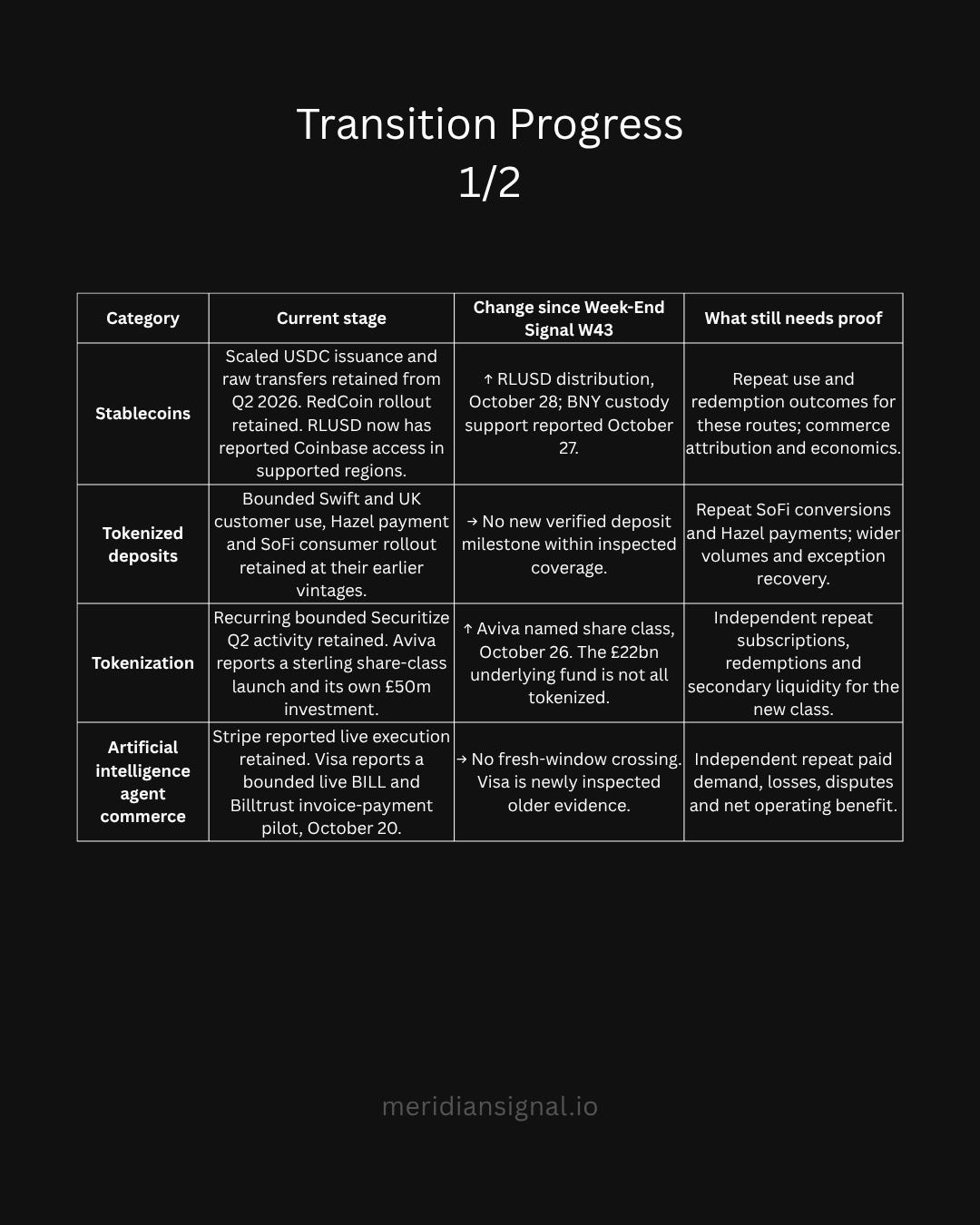
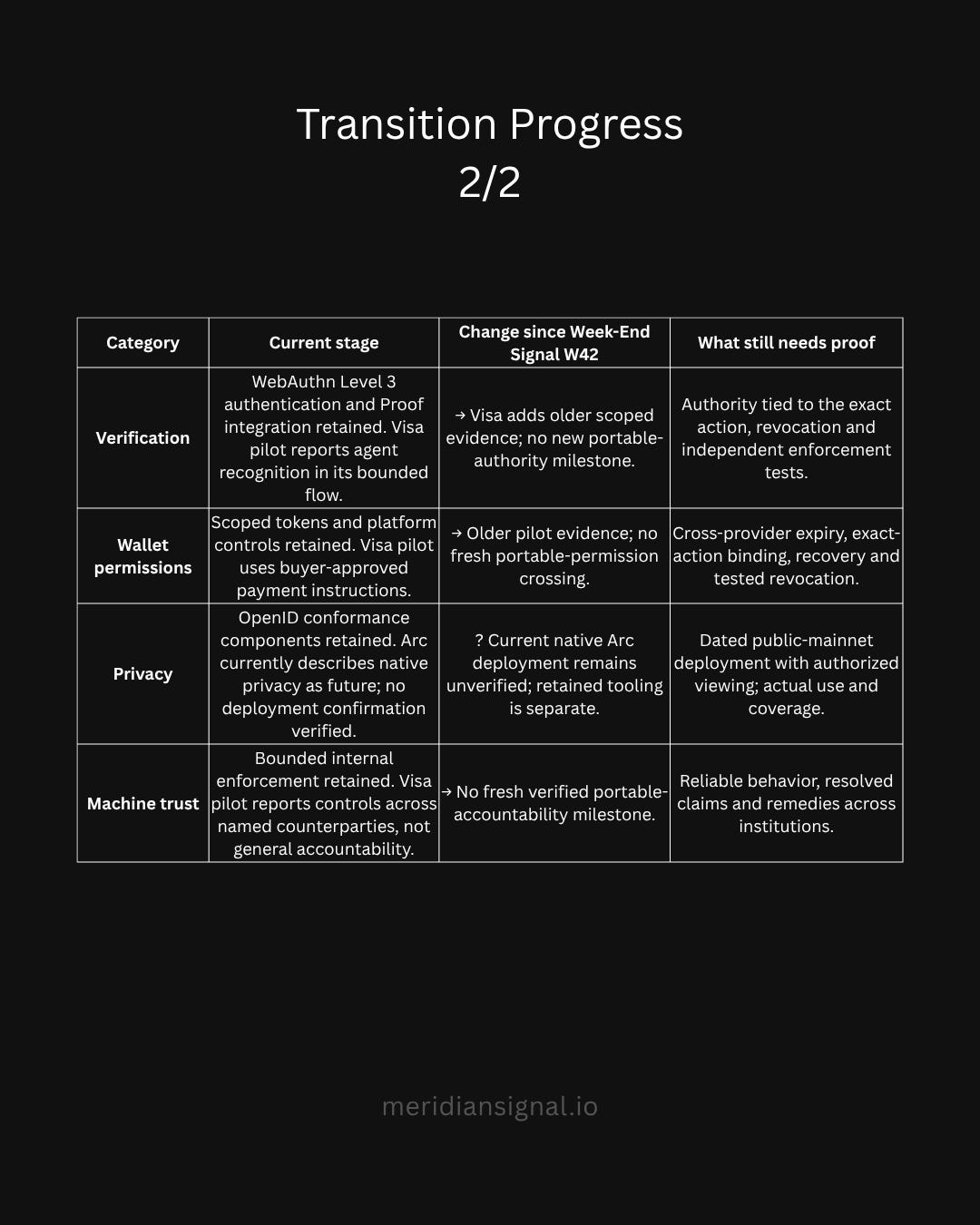
↑ supported named advance; → no new verified milestone within inspected coverage; ↓ evidenced deterioration; ? unresolved current status. Missing evidence is not no change. Retained history does not certify current uptime or sectorwide maturity. A new initiative awaiting proof does not erase existing recurring production.
Visa’s October 20 disclosure is older evidence newly included here. It reports a live invoice-payment pilot involving BILL and Billtrust, with approved payment instructions and agent recognition. This adds a bounded operating example, not a new milestone in this edition’s window or independent proof of repeated demand. Its card-based route also shows why agent commerce need not require a public investment token. Visa.
Retained stages draw on Circle’s Q2 issuance and raw-transfer record, Securitize’s Q2 platform activity, earlier bank customer use and Stripe’s March execution disclosure. These observations do not certify current uptime, universal liquidity or October growth. Formal authentication, scoped wallet controls, privacy components and internal enforcement remain different capabilities. The full source links and measurement vintages appear below.
Meridian consensus and conditions
Signal Stability: 95 / Thesis unchanged, matching the preceding completed Signal. Funding, authority, execution, records and remedies remain central to useful services. The representative point is a coarse judgment within the 90–100 band, not a probability, confidence score, investment rating or transition-completion percentage. Historical point conventions are not directly comparable.
Signal-to-Noise: High Signal. Attributable disclosures support specific availability findings. The unresolved outcomes can be separated from that conclusion. This is an editorial evidence judgment.
Transition confidence: Supported, with implementation still uneven. Sequence confidence: Supported for the stated dependencies, which may overlap or be met through substitutes; there is no universal timetable.
Transition progress: Two named category advances, plus reported custody support. No new recurring-use, scale or enforceable value-capture crossing is awarded to these initiatives. Publication delta: Material, because the distinction between access, invested assets and complete service matters to interpreting adoption.
Near-term investability: Mixed. On October 28, the Federal Reserve held its target range at 3.75–4.00 percent; two dissenters preferred a rise. The October 28 rate release shows October 27 ten-year nominal and real yields of 4.99 and 2.64 percent. The comparable October 22 readings were 4.96 and 2.64 percent. These are lagged daily observations, not an October 28 market close or a valuation of any asset. Policy statement; rate release.
System integrity: Qualified. Sources support reported availability within named scopes. Independent operating audits, exact transaction clocks and comprehensive public-history coverage remain incomplete. No outcome is assumed from a missing observation.
What earns the next step
Follow independent subscriptions and redemptions for the new share class, actual use of the new stablecoin routes and executed services behind future custody and financing plans. Compare the customer’s full cost with the conventional alternative. Seek clear recovery when a transaction fails, as well as a successful first transaction.
For agent commerce, the useful next evidence includes repeated authorized purchases, tested revocation, disputes and losses. For privacy, demand dated feature deployment with authorized disclosure, rather than treating a network launch as proof of every planned component.
The positioning remains selective: distinguish a service worth using from an instrument entitled to its economic gains. Repeated failure or no incremental benefit after incentives would weaken the service case; dependable use with measured savings would strengthen it.
Access opens the route. Repeated, recoverable outcomes determine its value. Watch what customers keep using when the launch is over.
Established evidence and scope
Circle: Q2 results, August 5, measurements through June 30. Raw transfers are not independently attributed commerce.
Securitize: Q2 filing, August 12. Aggregate lifecycle flows are not pure secondary trading.
Swift, September 28 and UK Finance, September 24: bounded bank/customer activity.
Stripe, March 3: operator-reported execution; scoped payment-token documentation, retained October 17 inspection.
WebAuthn Level 3, August 25: authentication; Digital Credentials, October 15: draft.
OpenID tooling, August 7; Cloudflare internal controls and private beta, August 5. Each retains its specific scope.
Arc current network description still describes native privacy as future. DTCC’s hub retains the July event; this inspection did not verify a new dated broader launch.
Evidence through October 28, 2026, 6:57:42 p.m. America/Los_Angeles / 2026-10-29T01:57:42Z.
Meridian Signal
Bold clarity at the right time.
Independent strategic intelligence on capital regimes, digital infrastructure and systemic risk.
AI-assisted. Human-directed. Source-verified.
General informational and educational research. Not personalized investment, legal or tax advice. Assessments involve uncertainty, and investments can lose value.
Questions or corrections: contact@meridiansignal.io