
A payment that waits for the right condition can be useful long before it becomes a large business.
That is the distinction worth watching now. Banks are finding ways to make familiar money perform new tasks. The practical opportunity is becoming clearer. So are the questions about reliability, responsibility and who gets paid.
Meridian’s assessment: programmable payments can strengthen established financial institutions as well as create opportunities for new providers. Useful execution is advancing. Durable economics remains a separate test.
Three developments that change the assessment
Live use has a firmer place in the deposit evidence. In a September 24 release, UK Finance reported completed customer transactions using tokenized sterling deposits, including two remortgages. These were live pilots, not evidence of a widely available recurring service. The disclosure does not provide exact transaction timestamps. UK Finance release.
The U.S. build has a selected supplier. The Clearing House chose Quant for its planned tokenized-deposit network. Its September 24 announcement targets availability in the first half of 2027. Supplier selection is an implementation commitment, not a launched payment network. The Clearing House announcement.
The financing hurdle rose. Between September 22 and September 24, the ten year nominal Treasury yield increased from 4.96% to 5.18%, and the real yield from 2.63% to 2.85%. The effective federal funds rate remained 3.88%. Our financing reading moves to Tightening. Federal Reserve rates, September 25 release.
An earlier development belongs in the picture
SoFi and Mastercard reported live SoFiUSD card settlement on September 22. We verified that announcement during this review. It predates the Mid-Week cutoff and should have been included in the evidence set. We are adding it now, not presenting it as a new event since Wednesday.
The announced annualized program expectation above $25 billion is not measured cumulative stablecoin settlement. SoFi also states that SoFiUSD is not a deposit and is not federally deposit insured. Bank issuance does not make a stablecoin and a bank deposit the same instrument. SoFi announcement and product disclosure.
What is really happening
The transition is creating choices about how money moves while leaving many familiar responsibilities in place.
A bank can retain the customer relationship. A payment network can retain distribution. A technology provider can coordinate execution. The balance being moved may be a deposit, a stablecoin or central bank money. Those differences affect the user’s claim and the institution responsible for it.
The useful question is becoming more specific: what customer problem does the new arrangement solve, and does it solve it well enough to cover its full cost?
For a conditional payment, someone must establish whether the condition was met. That introduces a dependency on evidence outside the payment record. A disputed delivery or mistaken completion signal still needs an accountable decision and a route to recovery.
This is Meridian’s interpretation of the operating problem, not a reported defect in the cited pilots. The separate UK, U.S. and SoFi initiatives are not one integrated system.
The hidden transition
The potential advantage is moving toward firms that can carry a customer’s purpose through execution and recovery.
That may favor institutions with existing distribution, trusted records and clear responsibilities. It may also favor independent providers that help several institutions work together. Neither outcome is automatic.
Large customers can negotiate lower prices. Competing suppliers can reduce margins. A technically necessary service can become a commodity. A useful network can grow while a related public digital asset receives little or no economic benefit.
We therefore separate the operating accomplishment from the ownership claim. What works? Who depends on it? Who receives revenue? What remains after funding, security, compliance and losses?
Transition tracker
Comparison: the completed Mid-Week W39 assessment, evidence through September 23. The table covers named systems and retained baseline capabilities, not every provider in each category.
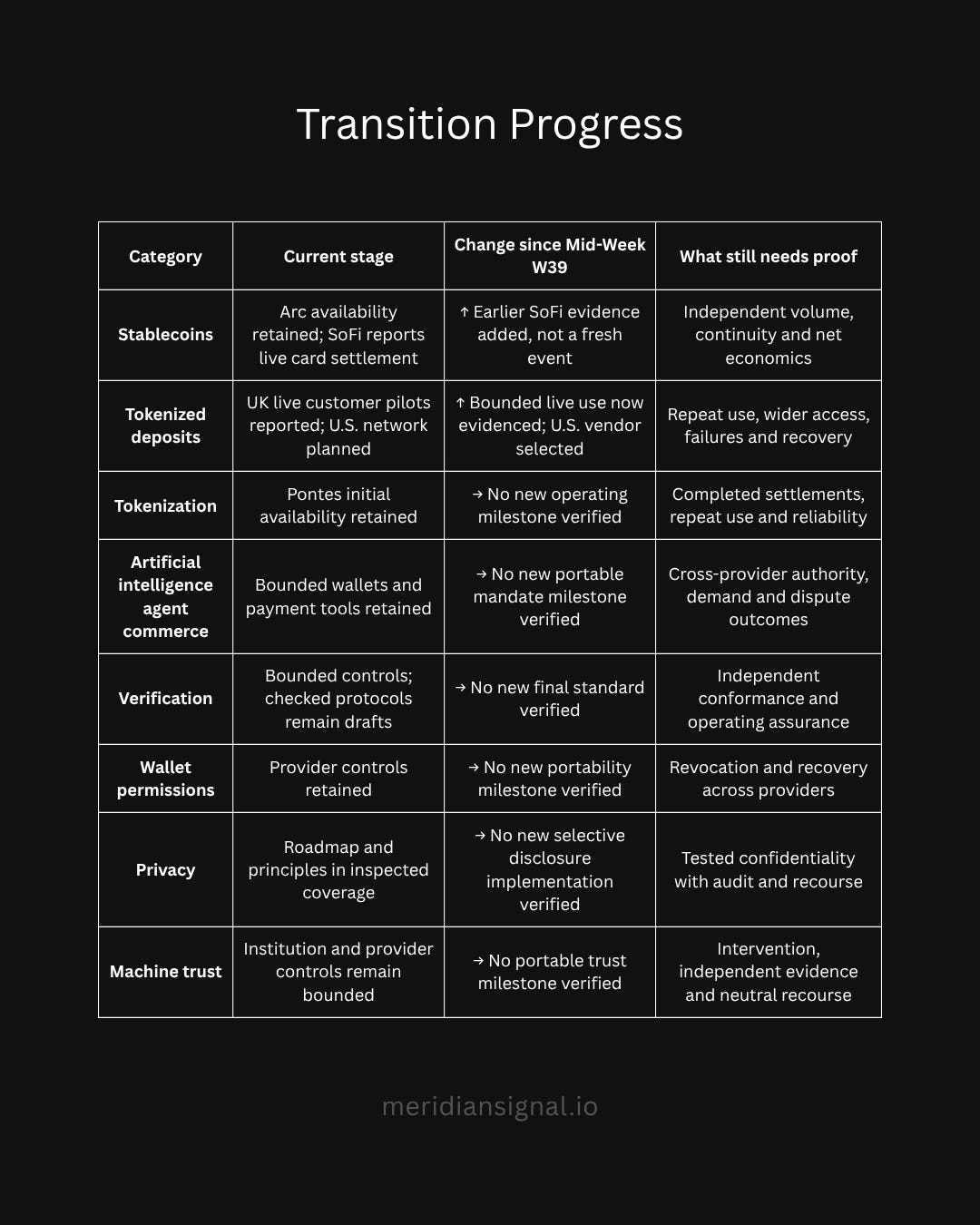
↑ identifies a supported named advance in the evidence, including a labeled earlier discovery. → means no new milestone verified within this review. ↓ would mean evidenced deterioration. ? would mean unresolved current status. These symbols do not measure adoption or returns. Prior availability is retained as a documented baseline, not a fresh uptime certification.
Source boundaries: UK pilot description; Pontes launch; Arc launch; Portal controls; individual authorization draft; client attestation draft history. The SoFi addition is earlier evidence. Pontes receives no second launch credit.
Meridian consensus and readings
Signal Stability: 95 out of 100, Thesis unchanged. The same representative anchor as Mid-Week W39. The new evidence strengthens bounded implementation without replacing the core interpretation: authority, assurance, recovery and economic durability still require their own proof. This is an editorial judgment anchor, not a probability, investment rating or precise measurement. Historical points under the earlier convention are not numerically comparable.
Signal-to-Noise: High Signal, unchanged. Attributable operating reports, a dated infrastructure commitment and official financing observations support a useful conclusion. Missing scale and earnings evidence limits the claims rather than supplying them.
Transition confidence: Supported, unchanged. Practical implementation supports the direction. It does not make adoption inevitable.
Sequence confidence: Supported, unchanged. In the inspected initiatives, bounded operation precedes demonstrated portable authority and retained economics. This is not a universal sequence for every payment system.
Transition progress: Bounded live-use evidence added. The deposit row moves from unresolved current implementation to documented live pilots. Existing availability remains credited. No new recurring or scaled-production classification is awarded.
Publication delta: Material, unchanged category. This edition resolves an important evidence gap, admits an earlier omission and separates delivery progress from a higher financing hurdle.
Near-term investability: Tightening, previously Mixed. The rate movement is reinforced by lower weekly average reserve balances. This describes general financing conditions, not the valuation of any asset. Federal Reserve balance sheet, September 24.
System integrity: Qualified, unchanged. Core source and comparison checks support the bounded assessment. Transaction-level independent verification, recurring economics and current public archive access remain incomplete.
How we are positioning the analysis
Remain selective. Give more weight to demonstrated customer utility, clear responsibility and sustainable revenue than to the size of a launch announcement.
The financing evidence does not establish an economic collapse. Initial unemployment claims were 197,000 in the September 24 release, down 1,000 from the revised prior week. That is a counterweight to a broad distress narrative. Labor Department claims.
For now, the stronger conclusion is that operating progress must clear a more demanding capital hurdle. No new public digital asset qualifies from this edition. Naming a technology supplier does not establish unavoidable token demand or enforceable holder rights.
What would change our view
Repeat customers and comparable operating records would support a higher implementation stage. Independent tests of failed conditions, refunds and recovery would strengthen the control assessment. Shared authority that works across institutions could require a structural adjustment.
The economic test is revenue after the full cost of reliable operation. Evidence of lasting savings and retained margins would matter more than a projected volume figure. Falling real financing costs could also improve the environment; persistent increases would strengthen caution.
A working payment proves a capability. A durable business needs a longer record.
Evidence cutoff: September 26, 2026, 1:13:46 p.m. Pacific / 20:13:46 UTC.
Meridian Signal
Bold clarity at the right time.
Independent strategic intelligence on capital regimes, digital infrastructure and systemic risk.
General informational and educational research. Not personalized investment, legal or tax advice. Assessments involve uncertainty, and investments can lose value.
Questions or corrections: contact@meridiansignal.io