

Damage to alternative export infrastructure deepens regional risk. Restored physical flows will be the clearest test of stabilization.
Reporting window: 8–16 September 2026. Evidence cutoff: 16 September, 02:12 UTC. Outlook: the following 30 days.
AI-assisted. Human-directed. Source-verified.
Executive assessment
The infrastructure meant to help the world absorb an energy disruption is now part of the vulnerability.
Saudi oil cargo cancellations following pipeline damage make that risk concrete. An alternative export route can provide resilience only while it remains available. Its impairment adds another constraint to an already stressed regional energy system. Reuters, 15 September.
Meridian’s current assessment is Critical regional risk, with deteriorating energy-route resilience and limited evidence of durable stabilization.
The central concern is the economic reach of a persistent regional conflict. Repeated disruption can affect costs, delivery schedules and policy choices well beyond the countries directly involved. The reviewed evidence does not establish a transition to global systemic war.
This edition therefore focuses on whether disruption is becoming harder to contain and what would demonstrate a durable recovery. The distinction matters for planning: a prolonged regional shock can carry global costs without becoming a global war. We will revise the assessment when repeated operational improvements, rather than isolated announcements, support that change.
Executive snapshot
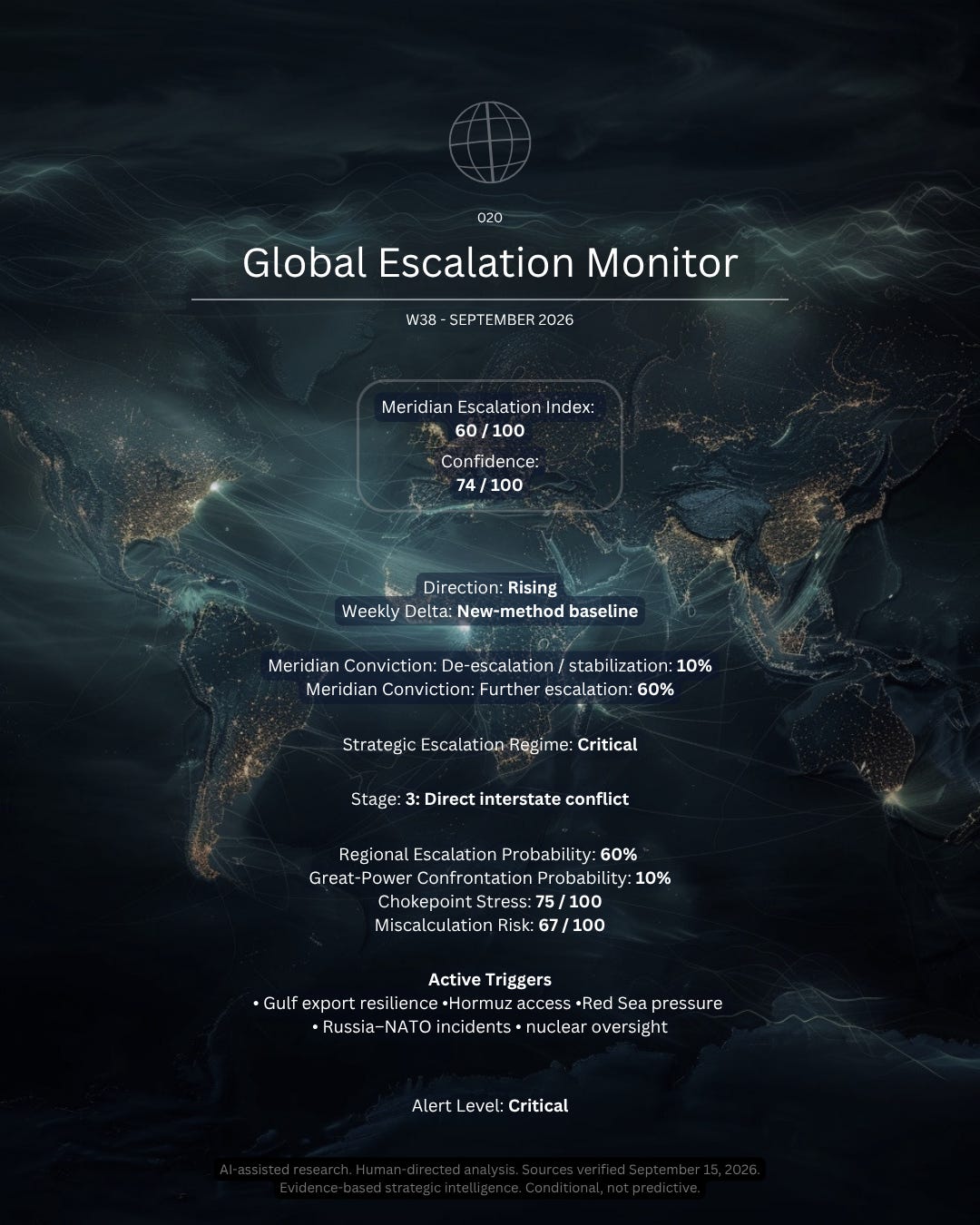
The new index is a weighted structural score, not a war probability. Its Critical regime reflects a documented acute-event override. This is the first reading under the new method, so comparison with the previous 82/100 would be misleading. The evidence-confidence score measures source quality, not predictive accuracy. Forecast percentages below are judgment-based and not empirically calibrated.
What changed
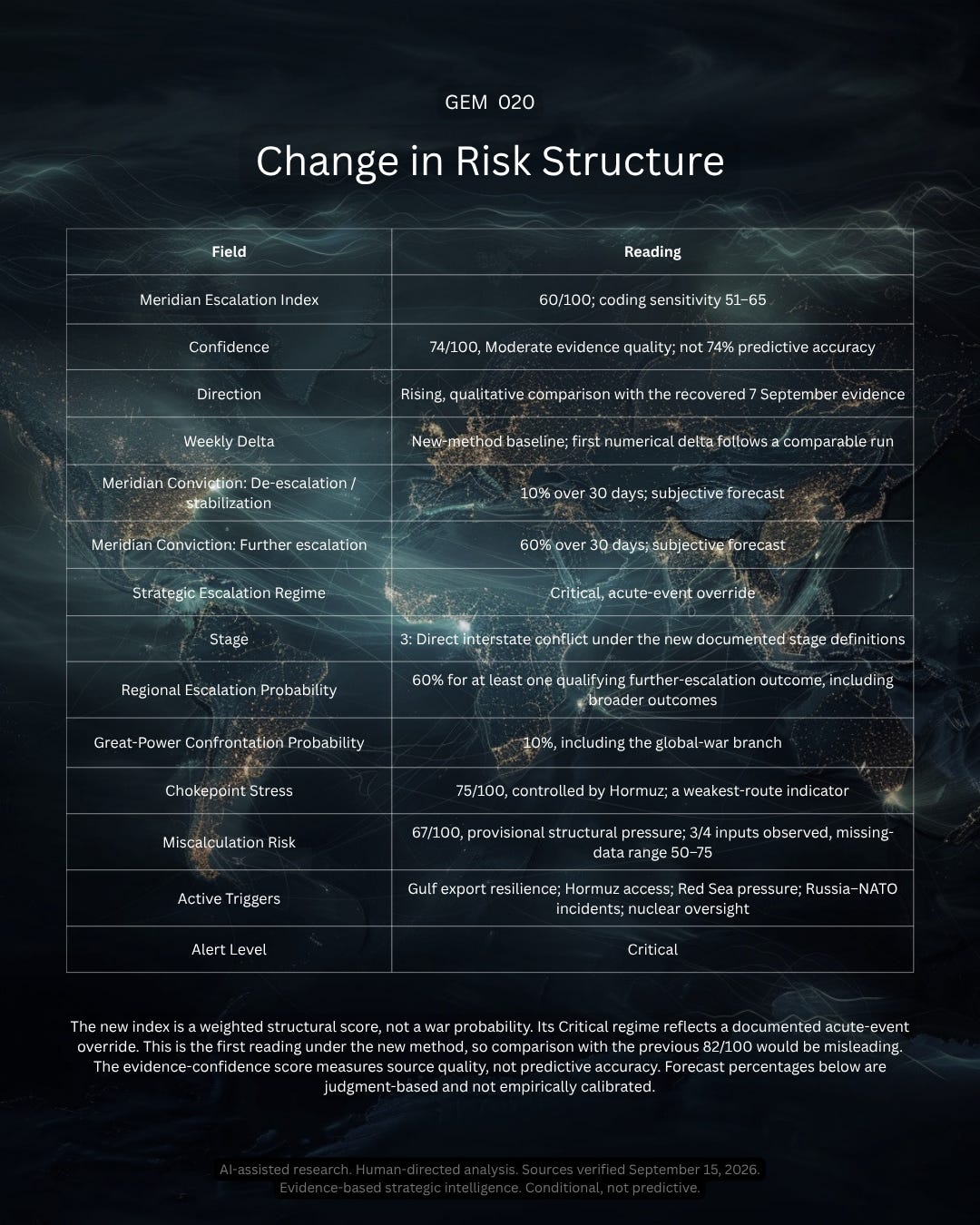
The previous release asked whether the Critical environment would persist. This update finds a more tangible threat to the infrastructure that helps contain its economic effects. Global Escalation Monitor 019.
The important question is how many usable alternatives remain when a route is disrupted. Resilience depends on spare capacity, reliable loadings, acceptable insurance and safe onward passage. A route on a map provides less protection when operators cannot depend on it.
The duration of the disruption remains uncertain. Public estimates of pipeline restoration differ substantially. That uncertainty limits any confident estimate of the eventual supply impact. Reuters, 15 September.
For the next update, confirmed throughput and sustained loadings will matter more than a repair announcement alone.
Hormuz requires careful measurement
The available evidence supports severe commercial disruption, but the traffic datasets do not describe the same population. The latest maritime advisory distinguishes tracking-based observations from facilitated movements. Those counts cannot simply be added or treated as interchangeable. Joint Maritime Information Center, 13 September.
That distinction matters for the assessment. Incomplete tracking cannot establish that every ship has stopped. Continued passage does not establish that normal commercial access has returned.
The useful test is repeatable movement of actual cargo under conditions operators and insurers can sustain. Meridian will assess each route separately, including the difference between a functioning canal and a reliable voyage through the wider region.
Stabilization must appear in operations
Diplomatic contact remains relevant, but evidence of implementation is more consequential. The postponement of Gulf–Iran talks weakens the immediate case for a durable improvement. It does not eliminate the possibility of a negotiated outcome. Reuters, 13 September.
A more constructive assessment would require several observations to agree: restraint that persists, reliable repairs, safer commercial passage and fewer disruptions to physical supply.
This is also why one quieter day or a lower oil quotation should carry limited weight. A durable change should survive beyond a single market session or announcement.
Other theaters still require separate judgments
In Europe, NATO aircraft intercepted a drone over Lithuania while its origin remained under investigation. The incident illustrates the importance of separating a verified interception from a conclusion about intent or responsibility. Associated Press.
The escalation pathway would become more serious if an attributed incident caused casualties and prompted repeated direct retaliation. An ambiguous incident alone does not establish that threshold.
Around Taiwan, the verified daily military report supports continued pressure. One day’s observations do not establish a new blockade or a sustained acceleration. Commercial restrictions, operational mobilization and direct engagements would carry greater weight. Taiwan Ministry of National Defense, 15 September.
Nuclear oversight presents a separate concern. The International Atomic Energy Agency describes major verification limitations in Iran and fragile nuclear safety conditions in Ukraine. These require close attention while preserving the distinction between safeguards uncertainty, reactor safety and evidence of weapons use. IAEA, 14 September.
Several serious pressures can exist simultaneously. Establishing a coordinated offensive or an imminent global war requires additional evidence.
Escalation migration
The reviewed record does not establish that a reduction in one theater caused escalation in another. Continued pressure across several regions creates a monitoring burden, but shared timing alone does not prove coordination, resource exhaustion or a single campaign. Future evidence of force transfers, binding commitments or operational dependence would strengthen a claim that the theaters are becoming more connected.
The economic transmission channel
The economic concern is persistence. Repeated interruptions can make energy and logistics less predictable, complicate production decisions and reduce the capacity of households and governments to absorb another shock.
Those consequences remain conditional. Repairs, substitution, inventories, weaker demand and negotiated restraint can interrupt the chain. The assessment should change when those buffers demonstrably work.
The current financial evidence is also mixed. The available corporate-credit observation does not establish a generalized credit crisis. Geopolitical severity and financial-market stress need to be assessed independently before drawing a systemic conclusion. Federal Reserve Bank of St. Louis, ICE BofA high-yield spread series.
Our separate 30-day working estimate for a global economic supply shock is 25%. Here that means new, conflict-driven emergency energy-supply measures implemented in at least two major economic jurisdictions for seven days or more. It is a judgment-based forecast, not a recession probability, and it overlaps with the conflict scenarios rather than adding another outcome to their distribution.
Delta from the previous assessment
Increased: Concern about the reliability of alternative export infrastructure.
Decreased: No major conflict driver is verified as resolved.
Unchanged: Global systemic war remains outside the base case.
New unknowns: Repair duration, sustained throughput and attribution of individual incidents.
The next 30 days
The scenarios below describe alternative outcomes through 16 October. They are single-analyst judgment probabilities, not empirically calibrated estimates. Regional escalation is the modal branch; strategic stalemate is the principal alternative.
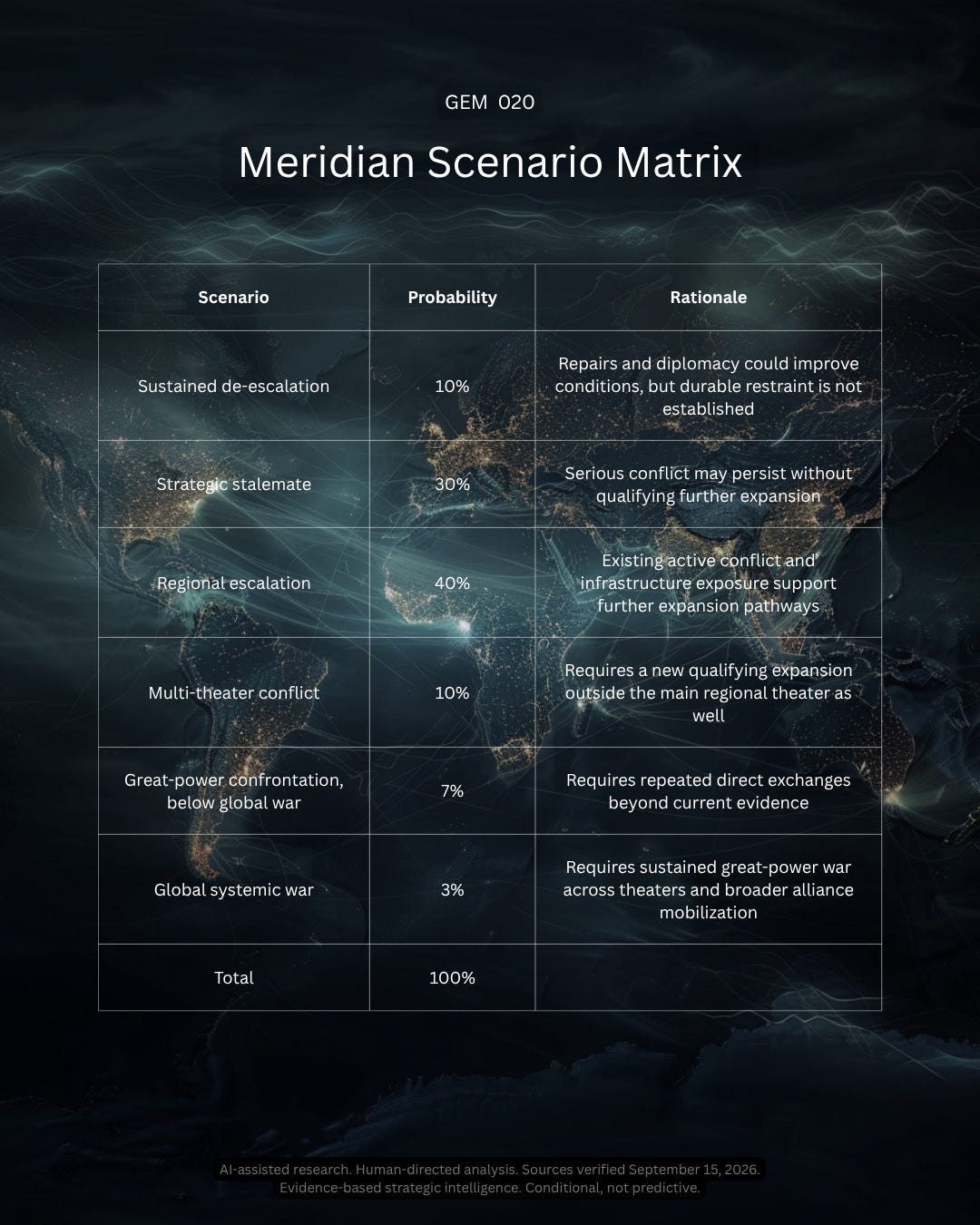
The chance of any qualifying further escalation is 60%; that of great-power confrontation including global war is 10%. Alternative stabilization-favoring and escalation-favoring allocations put those estimates at 40–75% and 7–15%, respectively. These are judgment sensitivity ranges, not statistical confidence intervals.
What would change our view
The most consequential upward triggers are prolonged loss of export capacity, wider attacks on commercial infrastructure, major casualties followed by expanded retaliation, or a new direct confrontation involving great powers.
The clearest downward triggers are verified export restoration, sustained safe passage, implemented restraint and functioning crisis communication. Improvements should be repeatable before they change the overall regime assessment.
What we are watching next
Verified Saudi export restoration and sustained loadings.
Comparable Hormuz traffic and actual cargo movement.
Safe passage and commercial access through the Red Sea.
Implemented restraint in the Gulf and containment of incidents near NATO territory.
Taiwan commercial access and changes in nuclear verification or safety.
Meridian strategic conclusion
The next meaningful improvement should be visible in the physical system: oil moving reliably, infrastructure remaining operational and restraint surviving beyond an announcement.
Until that evidence strengthens, Meridian retains a posture of Strategic Caution. For planning purposes, prolonged energy costs, logistics interruptions and repeated repair setbacks deserve attention. The assessment remains open to revision as operational evidence changes.
The next Global Escalation Monitor will test whether the alternative routes are recovering and whether that recovery is durable.
Subscribe to Meridian Signal to follow the evidence with us.
Strategic posture: Strategic Caution.
Editorial note: The Global Escalation Monitor assesses geopolitical and macroeconomic risk for strategic decision-making. Its conclusions are conditional analytical judgments, not certain predictions of conflict or recommendations to buy or sell assets.
Research disclosure: Meridian Signal uses artificial intelligence assisted research and synthesis under human-directed editorial priorities. Material claims are linked to their sources. Observations use different reporting cutoffs, and limitations are stated where they affect the assessment. This edition uses a documented structural index and judgment-based scenario probabilities. It does not claim empirical forecast calibration. The numerical method begins a new series; previous index readings are not directly comparable.
AI-assisted. Human-directed. Source-verified.
Meridian Signal
Independent Strategic Intelligence Desk
General informational analysis only. This is not individualized financial, investment, legal, or tax advice.