

Reporting Period: Week 37, September 2026
Intelligence Cutoff: August 31, 2026
AI-assisted. Human-directed. Source-verified.
Executive Assessment
Last week, the question was whether the global escalation system would cross Meridian’s Critical threshold.
This week, it did.
The Meridian Escalation Index rises from 77 to 82 out of 100, marking the first confirmed transition into the Criticalregime during the current escalation cycle.
But that sentence needs context.
Critical does not mean global war has become the base case.
It means the international system has crossed a level of simultaneous military, economic and alliance pressure where additional shocks have a greater probability of propagating between theaters.
The immediate driver remains the U.S.–Iran confrontation.
What began as a renewed direct exchange has become more persistent. U.S. and Iranian forces have attacked vessels around Iran. U.S. forces reportedly struck Iranian oil carriers after Iranian forces targeted U.S. Navy ships. Iran has attacked commercial tankers using routes it considers unauthorized and is preparing another restricted maritime zone in the Gulf.
At the same time, commercial traffic through the Strait of Hormuz has deteriorated further.
Energy markets are beginning to transmit the consequences more broadly, with Brent approaching $100 and refined-fuel pressure becoming increasingly visible.
Outside the Middle East, the picture is also becoming more difficult.
Russia continues its high-intensity war against Ukraine. Hybrid activity attributed to Russia is increasingly testing the boundary between gray-zone operations and alliance response. Taiwan continues hardening against blockade risk. Russia and North Korea are deepening their security relationship.
These are still separate conflicts.
But the barriers keeping them separate are becoming thinner.
That is the defining signal of Global Escalation Monitor 019.
Executive Snapshot
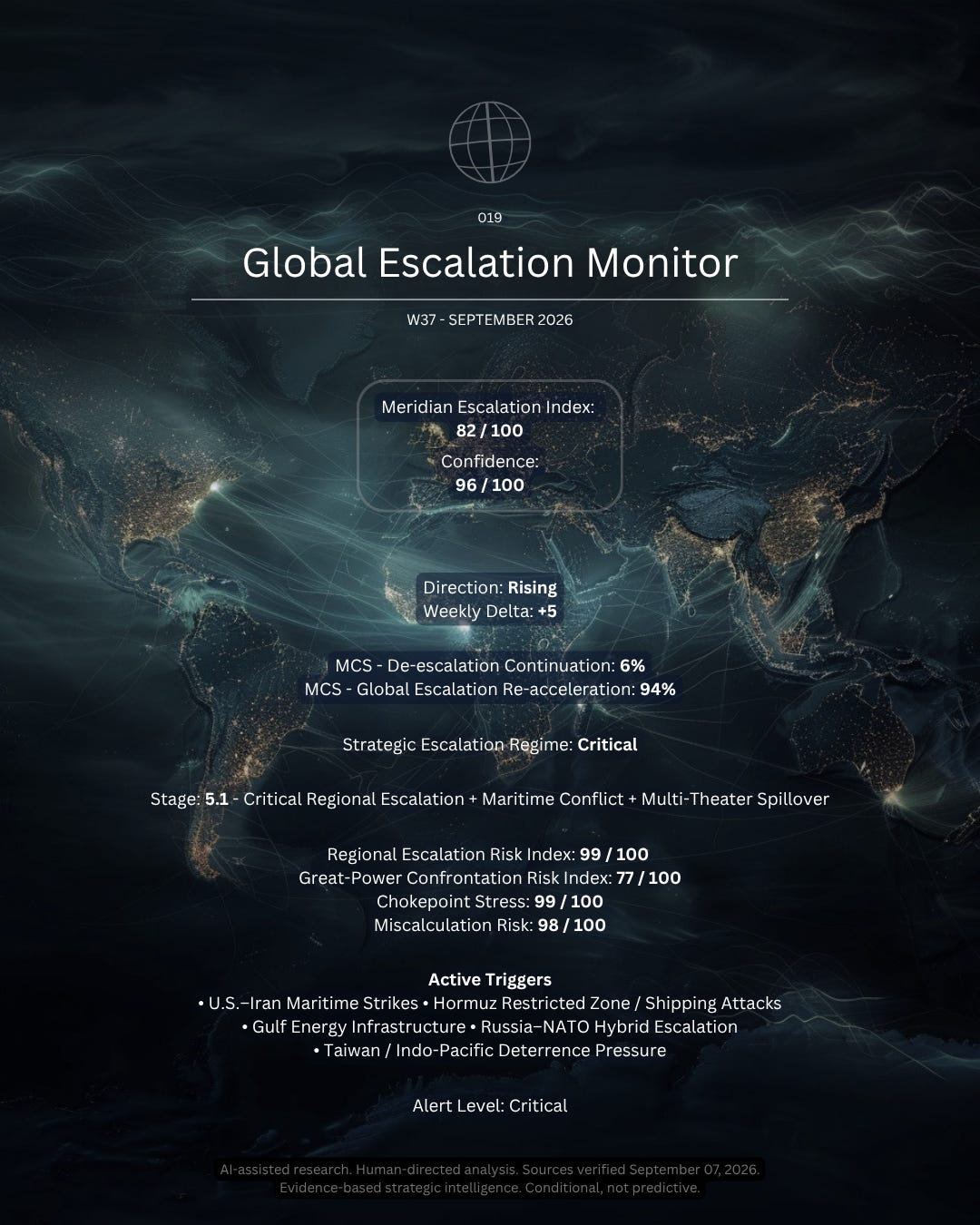
Stage
5.1 — Critical Regional Escalation + Maritime Conflict + Multi-Theater Spillover
Active Triggers
U.S.–Iran Maritime Strikes
Hormuz Restricted Zone / Shipping Attacks
Gulf Energy Infrastructure
Russia–NATO Hybrid Escalation
Taiwan / Indo-Pacific Deterrence Pressure
Strategic Posture
Critical Vigilance · Escalation Containment
What Changed Since Global Escalation Monitor 018
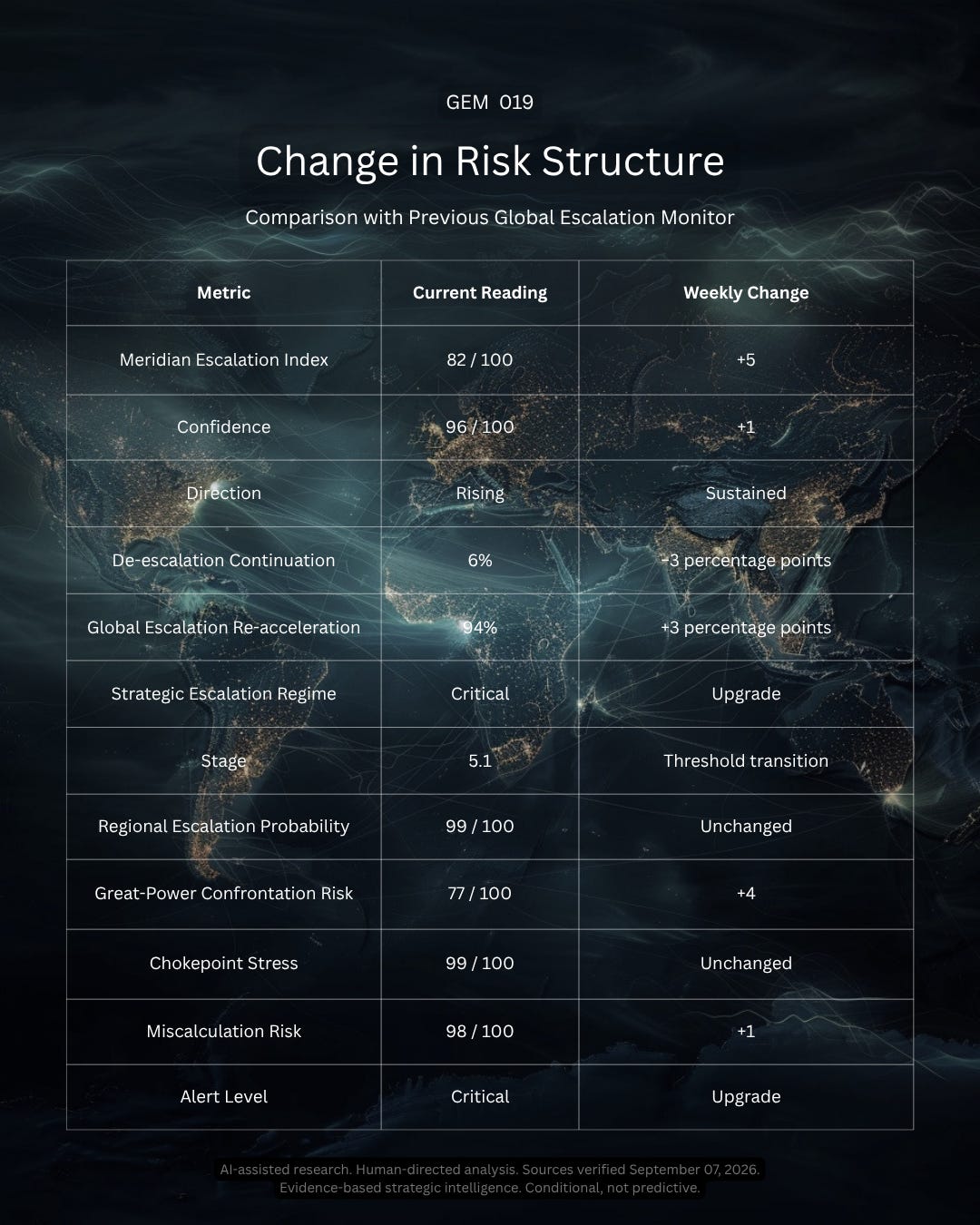
The difference between GEM 018 and GEM 019 is not simply another five points.
It is persistence.
GEM 018 found that direct U.S.–Iran military confrontation had returned.
The critical question was whether that exchange would remain limited.
This week, the evidence increasingly suggests a recurrent confrontation rather than a one-off incident.
That matters because repeated direct exchanges change the operating assumptions of every actor involved.
Military forces remain at higher readiness.
Commercial operators price greater risk.
Energy infrastructure becomes more exposed.
Political leaders have less room to interpret the previous incident as exceptional.
And each subsequent exchange begins from a higher baseline of tension.
That is why the system has crossed the threshold.
Hormuz Is Now Part of the Active Battlefield
Hormuz Normalization Score: 3 / 100
The Strait of Hormuz is still not literally closed.
Some traffic continues.
But its normal commercial character has effectively disappeared.
Commercial-vessel crossings have fallen to their weakest sustained level since May. U.S. and Iranian forces are attacking vessels around the strait. Iran is introducing additional restricted areas and continuing to assert control over which routes commercial traffic may use.
This is no longer simply a dispute over maritime rules.
Commercial energy flows themselves are becoming part of the confrontation.
The progression has been important:
Open international passage
became
Restricted passage
then
Permissioned passage
and is now becoming
Militarized commercial passage
That is a structural escalation.
The Middle East Has Reached the Ceiling of the Current Risk Scale
Middle East Theater Score: 100 / 100
This does not mean every imaginable Middle East escalation has already occurred.
It means the theater has reached the ceiling of the current scoring regime.
The system now contains simultaneously:
recurrent U.S.–Iran direct attacks
attacks against military vessels
attacks against commercial tankers
heavily restricted Hormuz passage
additional maritime exclusion zones
economic blockade
threats against Gulf energy infrastructure
continuing proxy pressure
severe oil and refined-fuel disruption
The dominant escalation chain is now:
Maritime strike → retaliation against shipping → additional restricted zones → energy infrastructure attack → broader Gulf involvement
The final steps have not occurred.
But the pathway is increasingly visible.
De-escalation Durability Is Near the Floor
De-escalation Durability Score: 5 / 100
There is still a diplomatic pathway.
But operational behavior is moving in the opposite direction.
Iran’s worsening economic position may eventually increase its incentive to negotiate.
That is important.
But economic pressure can produce two very different responses.
It can force compromise.
Or it can encourage escalation before compromise.
Right now, the short-term evidence favors the second pathway.
That creates an unstable contradiction:
The economic incentive to de-escalate is increasing at the same time that military behavior is becoming more escalatory.
Until those forces converge, durable normalization remains highly unlikely.
Energy Is Becoming Part of the Escalation Feedback Loop
Oil approaching $100 matters for more than markets.
Energy disruption is increasingly transmitting the regional war into the global macroeconomic system.
The chain is becoming clearer:
Maritime conflict
→ reduced energy flows
→ higher oil and refined-fuel prices
→ inflation persistence
→ less central-bank flexibility
→ weaker growth
→ lower capacity to absorb another geopolitical shock
Global Economic Shock Risk: 96 / 100
This is one of the most important developments in GEM 019.
The conflict is no longer merely producing an energy risk premium.
It is increasingly affecting the policy environment.
That makes the geopolitical system harder to stabilize because governments have fewer economic buffers available at precisely the moment strategic pressure is increasing.
Russia–Ukraine Remains at Extreme Intensity
Theater Score: 96 / 100
The Russia–Ukraine conflict remains exceptionally intense.
Russian attacks continue targeting Ukrainian infrastructure, ports and export systems.
Ukraine continues its own deep-strike campaign.
At the same time, diplomatic contact involving the United States and Russia remains active.
That contradiction matters.
The battlefield remains extreme.
The diplomatic channel is not dead.
For now, neither has displaced the other.
That is why the theater remains at 96 rather than moving higher.
The NATO–Russia Gray Zone Is Becoming Less Gray
NATO-Edge Structural Risk: 81 / 100
One of the most consequential European developments this week is not conventional combat.
It is attribution.
Germany has formally attributed an attempted drone attack at Leipzig/Halle airport to Russia.
NATO has subsequently hardened its public language around deliberate hybrid actions against member states.
This raises an important question:
At what point does repeated, attributable hybrid activity stop being treated as gray-zone behavior and begin requiring collective-defense responses?
The alliance is not at that threshold yet.
But attribution makes the boundary easier to see.
And therefore easier to cross.
Taiwan: Blockade Risk Continues to Matter More Than Invasion Headlines
Taiwan / Indo-Pacific Theater Score: 81 / 100
The strongest structural signal around Taiwan remains blockade and isolation capability.
Taiwan continues increasing defense spending.
China continues expanding its understanding and control of the maritime environment around the island.
There is still no confirmed invasion activation sequence.
That distinction should remain explicit.
The nearer-term concern is that a future Taiwan crisis could begin through:
maritime control
selective blockade
customs enforcement
air and sea exclusion
pressure on external supply lines
rather than an immediate amphibious assault.
That pathway may have a lower threshold for great-power involvement.
Russia and North Korea Are Becoming Less Separate
Korean Peninsula Theater Score: 68 / 100
North Korea continues expanding its nuclear and naval capabilities.
Its relationship with Russia is also becoming more institutionalized.
The strategic implication is not that war on the Korean Peninsula is imminent.
It is that the European and Korean security systems are becoming less independent.
Military cooperation, infrastructure and political alignment increasingly connect the two.
That matters in a world already experiencing strategic saturation.
Multi-Theater Saturation Is Now Near Maximum
Secondary Theater Rotation Score: 98 / 100
The current pressure architecture looks like this:
U.S.–Iran maritime confrontation
→ Hormuz restricted access
→ Gulf energy vulnerability
→ Russia–Ukraine saturation warfare
→ NATO hybrid confrontation
→ Taiwan blockade deterrence
→ Russia–North Korea security integration
These are not one global war.
But they increasingly draw from overlapping pools of:
air defense
naval assets
intelligence
munitions
logistics
energy buffers
industrial capacity
political attention
That creates a different kind of systemic risk.
The international system becomes vulnerable not because every conflict merges.
It becomes vulnerable because each conflict reduces the resources available to contain the others.
Great-Power Confrontation Risk
Structural Risk Index: 77 / 100
This is not a 77% probability of direct great-power war.
The Scenario Matrix estimate for direct Great-Power Confrontation is 10%.
The structural index measures how favorable the underlying conditions have become for a great-power confrontation to emerge.
Those conditions are worsening because:
attributable Russian hybrid activity is testing NATO boundaries
NATO language is hardening
Russia–Ukraine warfare remains intense
Chinese blockade-oriented pressure continues
Russia–North Korea security integration is deepening
U.S. military resources remain committed to direct confrontation with Iran
The important development is that the direct-war probability has now reached double digits.
Still not the base case.
No longer negligible.
Miscalculation Risk
98 / 100
This is effectively at the operational ceiling.
The system now contains simultaneous situations in which decision-makers may need to respond before attribution, intent or consequences are fully understood.
That includes:
missiles directed at military vessels
attacks on commercial tankers
maritime exclusion zones
autonomous systems near European infrastructure
hybrid operations
mass drone warfare
blockade-oriented military activity
nuclear naval expansion
The most dangerous feature of the current environment is therefore not necessarily deliberate escalation.
It is decision compression.
The amount of time available to understand an event may now be shorter than the amount of time required to prevent its consequences.
That is the condition Meridian’s Miscalculation Risk is designed to capture.
Scenario Matrix
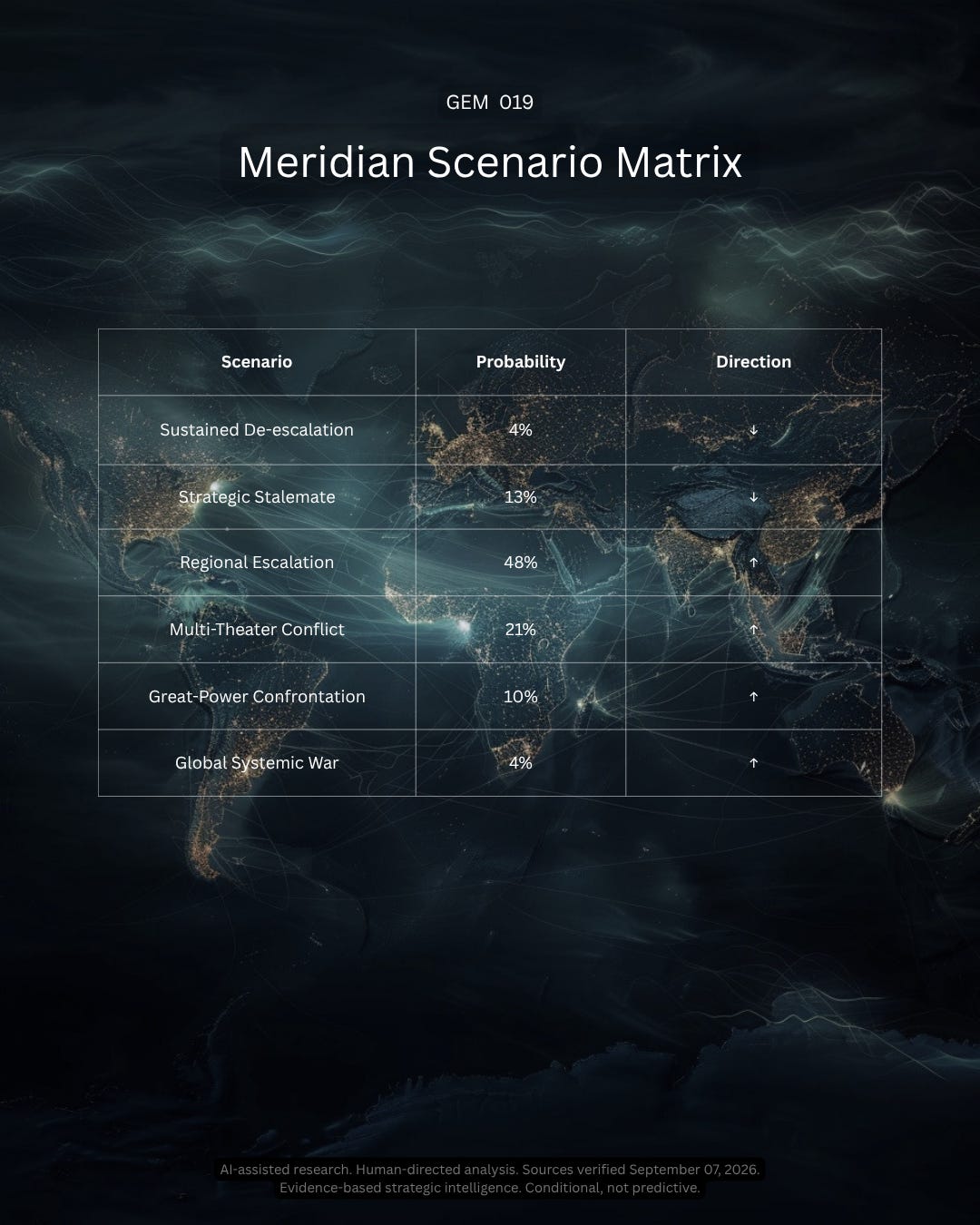
Base Case: Regional Escalation — 48%
Regional escalation remains the dominant scenario.
The likely environment includes:
recurring U.S.–Iran maritime attacks
continued Hormuz restrictions
commercial-vessel risk
elevated oil and diesel prices
threats against Gulf infrastructure
sustained Russia–Ukraine warfare
NATO hybrid escalation below conventional war
continued Indo-Pacific military buildup
Multi-Theater Conflict — 21%
This rises above one-fifth for the first time in the recent GEM sequence.
That is arguably the most important secondary development.
The global system is increasingly reaching a point where several theaters cannot be treated independently for strategic planning.
Great-Power Confrontation — 10%
Direct great-power confrontation moves into double digits.
That does not make it likely.
It makes it material.
The principal pathways remain:
repeated attributable Russian hybrid operations producing NATO retaliation
Chinese blockade operations around Taiwan producing U.S. intervention
a major-power vessel becoming involved in the Gulf confrontation
further integration of Russian and North Korean military systems
Global Systemic War — 4%
This remains a tail scenario.
That point matters especially now that the Strategic Escalation Regime is Critical.
Critical does not mean World War III is likely.
Critical means the system has reached a level where escalation can propagate between theaters more easily.
Those are very different statements.
Meridian Conviction Scores
De-escalation Continuation
6%
A diplomatic pathway remains, but it is increasingly driven by economic necessity rather than operational restraint.
Global Escalation Re-acceleration
94%
This does not mean a 94% probability of global war.
It means Meridian assesses a 94% probability that the broader escalation environment remains materially elevated or worsens again before durable normalization is achieved.
What Would Push the System Higher?
The Meridian Escalation Index could move above 88 if:
U.S.–Iran attacks expand into sustained strategic bombing
major U.S. military casualties occur
Iran disables significant Gulf energy infrastructure
Hormuz traffic approaches zero
mine warfare produces a major tanker loss
Saudi Arabia or the United Arab Emirates enters sustained direct combat
another attributed Russian operation causes casualties on NATO territory
NATO retaliates directly against Russian state assets
China initiates operational blockade measures against Taiwan
North Korea attacks South Korea or Japan
Several of those occurring together would represent a materially different regime.
What Would Lower the Risk?
The index could fall below 75 if:
U.S.–Iran attacks stop for several consecutive weeks
Hormuz restrictions are relaxed
commercial tanker attacks cease
physical oil supply improves materially
Iran and the United States resume structured negotiations
attributable Russian hybrid activity against NATO countries stops
Russia–Ukraine talks produce verifiable military restraint
China remains below blockade activation
secondary-theater resource demands begin declining
At this point, rhetoric alone is insufficient.
The physical system must confirm de-escalation.
What We Are Watching Next
The next run matters more than usual.
One-week threshold crossings can reverse.
Persistence is more consequential.
The highest-priority signals are:
Another U.S.–Iran maritime strike cycle
Iranian attacks on Gulf energy infrastructure
Hormuz traffic and new restricted zones
Oil and refined-fuel persistence
U.S. or Iranian military casualties
Additional attributable Russian hybrid activity in NATO territory
NATO response thresholds
Russia–Ukraine diplomatic progress versus battlefield intensity
Chinese operational activity around Taiwan
Further Russia–North Korea military integration
The central question for GEM 020 will be:
Does Critical persist?
If the answer is yes, the significance is greater than today’s 82/100 reading alone.
Meridian Strategic Conclusion
GEM 018 asked whether the system would cross Meridian’s Critical threshold.
GEM 019 finds that it has.
Not because of one dramatic headline.
Because of persistence and interaction.
U.S. and Iranian forces are exchanging attacks again.
Commercial energy shipping has become part of the confrontation.
Hormuz traffic has fallen to its weakest sustained level since May.
Iran is expanding restricted maritime access.
Oil is approaching $100.
Russian warfare against Ukraine remains extreme while attributable hybrid activity is increasingly testing NATO boundaries.
Taiwan continues hardening against blockade risk.
North Korea is integrating more deeply with Russia.
These developments do not constitute one unified global war.
But the international system is now carrying enough simultaneous military, economic and alliance pressure that the barriers preventing one crisis from affecting another have weakened materially.
Meridian Escalation Index
82 / 100
Confidence
96 / 100
Direction
Rising
Weekly Delta
+5
Strategic Escalation Regime
Critical
Stage
5.1 — Critical Regional Escalation + Maritime Conflict + Multi-Theater Spillover
MCS — De-escalation Continuation
6%
MCS — Global Escalation Re-acceleration
94%
Alert Level
Critical
Strategic Posture
Critical Vigilance — Escalation Containment
Bottom Line
The system has crossed Meridian’s Critical threshold, but it has not crossed into global systemic war. The defining risk is now propagation: sustained U.S.–Iran maritime conflict, extreme energy stress, increasingly attributable Russia–NATO hybrid confrontation, and rising Indo-Pacific pressure are reducing the barriers that keep separate crises separate.
The next execution carries unusual importance.
A one-week threshold crossing can reverse.
If the Critical regime persists for a second consecutive week, that would represent stronger evidence that the international system has entered a durable higher-risk state rather than experiencing a temporary escalation spike.
The next question is therefore no longer:
Will the system cross Critical?
It is:
Will Critical persist?
Editorial Note
The Global Escalation Monitor is a strategic intelligence publication designed to assess systemic geopolitical and macroeconomic risk. It does not predict conflict with certainty or advocate any investment action. Its purpose is to track changes in probability, identify structural shifts, and provide context for long term strategic decision making.
Research Disclosure
Meridian Signal uses artificial intelligence assisted research and data synthesis under human directed editorial judgment. Material claims are source validated before publication. Proprietary formulas, weights, normalization rules, private thresholds and calculation mechanics are not disclosed. Governed readings publish only after their data, source quality and internal consistency satisfy Meridian standards.
AI-assisted. Human-directed. Source-verified.
Meridian Signal
Independent Strategic Intelligence Desk
General informational analysis only. This is not individualized financial, investment, legal, or tax advice.