
Executive assessment
A recovery in crude supply can leave fuel buyers exposed. The International Energy Agency’s October report describes a September supply rebound alongside persistent product constraints and costly delivery. Meridian’s assessment is that resilience must be judged at the customer’s end of the route, not only where barrels leave an exporter. International Energy Agency
The distinction became more tangible this week. Singapore’s maritime authority reported that two registered container ships were struck while transiting Hormuz, with one subsequently sinking and the crews safe. Its report identifies unknown projectiles; it does not establish that the casualty was caused by a mine. Maritime and Port Authority of Singapore
The Meridian Escalation Index remains 56. Alternatives are still demonstrably usable, while the reviewed evidence does not establish a fresh collapse in export substitutes or direct combat between the defined opposing great powers. Strategic Stalemate becomes the largest individual scenario at 43%. Further Escalation is 53%, the combined probability of four worsening branches, not a contradiction of that ranking.
These judgments concern new developments after this cutoff. Severe attacks already present in the baseline do not become new forecast successes when they recur.
Executive snapshot
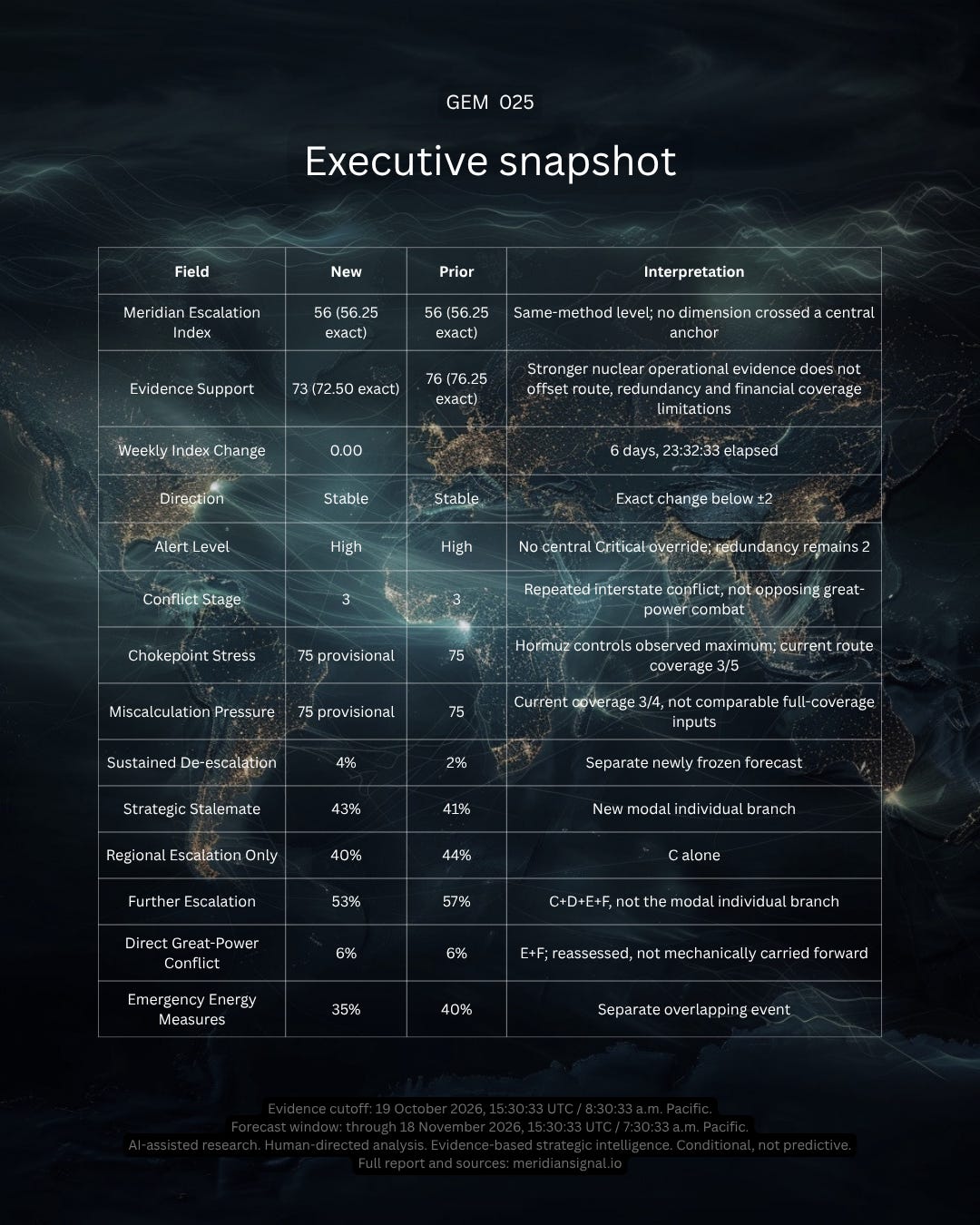
Conflict Stage 3 means repeated direct interstate conflict below principal great-power confrontation. Weekly Index Change compares 12 October, 15:58 UTC with this cutoff, an elapsed 6 days, 23 hours, 32 minutes and 33 seconds. The exact index remains 56.25. Evidence Support assesses index evidence, not forecast accuracy.
Meridian Conviction Score
30-day scenario probabilities through 18 November 2026, 15:30:33 UTC
The two additional forecasts use the same 30-day endpoint above. Further Escalation is displayed twice for layout continuity, not as independent evidence. Hormuz controls the observed chokepoint score; three of five routes have usable current or qualified evidence. Miscalculation Pressure has three of four inputs observed. Neither score is an event probability.
Active Triggers: Hormuz vessel safety • Saudi export alternatives • Egyptian operational entry • Implemented US-Iran agreement • Nuclear-site power resilience
What changed, and what did not
Egypt declared readiness to support Saudi Arabia and sought parliamentary backing. This is an important potential entry pathway, but authorization, defensive assistance and direct combat are different stages. No new Egyptian kinetic participation was verified in this review. Reuters
A reported Aramco administrative-building strike produced a limited fire according to the Saudi energy ministry. Office damage is not evidence that an export pipeline or loading terminal stopped operating. Associated Press
Iran’s foreign minister reiterated a conditional reopening proposal. The disagreement over sequencing maritime access and nuclear concessions remains material; an offer is not implemented safe passage. Reuters
GEM 024, published on 14 October using a 12 October evidence cutoff, emphasized regional infrastructure exposure. This edition adds confirmed shipping-loss evidence and a potential state-entry pathway without declaring either a new world war or the failure of every export alternative.
Theater assessment and migration
Middle East: Maritime coercion and the Saudi-Houthi conflict remain the main expansion mechanisms. Reuters reported officials describing changed targeting tactics, including exposure beyond the strait. These accounts inform the risk assessment; anonymous statements do not independently prove every attributed operation or private intention. Reuters
Europe: Ukraine’s president reported 76 energy-sector attacks after the announced energy ceasefire. That count remains attributed. It supports caution about implementation, not a finding of reciprocal NATO-Russia combat. Reuters
Taiwan and Korea: Taiwan reported five aircraft sorties, six naval ships and nine official ships during its latest daily observation window. This is military pressure, not established commercial closure. North Korea said it was considering additional tactical deployments; this is not confirmation they occurred. Taiwan Ministry of National Defense Reuters
Migration remains clearest through regional military participation and shared energy costs. Concurrent activity in Europe and East Asia does not itself satisfy the multi-theater escalation contract.
Restraint can work locally without resolving the conflict
The International Atomic Energy Agency confirmed a localized ceasefire permitting transformer repairs near Zaporizhzhya. That is concrete cooperation. The same statement described reliance on one external power line and limited diesel resilience. Repair access is a positive operational development, not a general end to energy attacks or proof of nuclear safety normalization. International Atomic Energy Agency
There is also a genuine analytical disagreement. Ali Vaez emphasizes incentives for costly deadlock, while Mohammad Ayatollahi Tabaar emphasizes incentives to escalate. Both mechanisms are plausible; neither supplies a matched numerical 30-day forecast. Foreign Affairs interview
Allison Minor’s analysis stresses the limits of airstrikes without a political strategy in Yemen. Meridian treats that as a reason to distinguish sustained costly conflict from successful coercion, rather than assume greater force produces either victory or restraint. CSIS
Thirty-day scenario matrix
These are uncalibrated analyst judgments. Resolve the highest qualifying branch first. Continuing baseline violence alone does not qualify as new escalation.
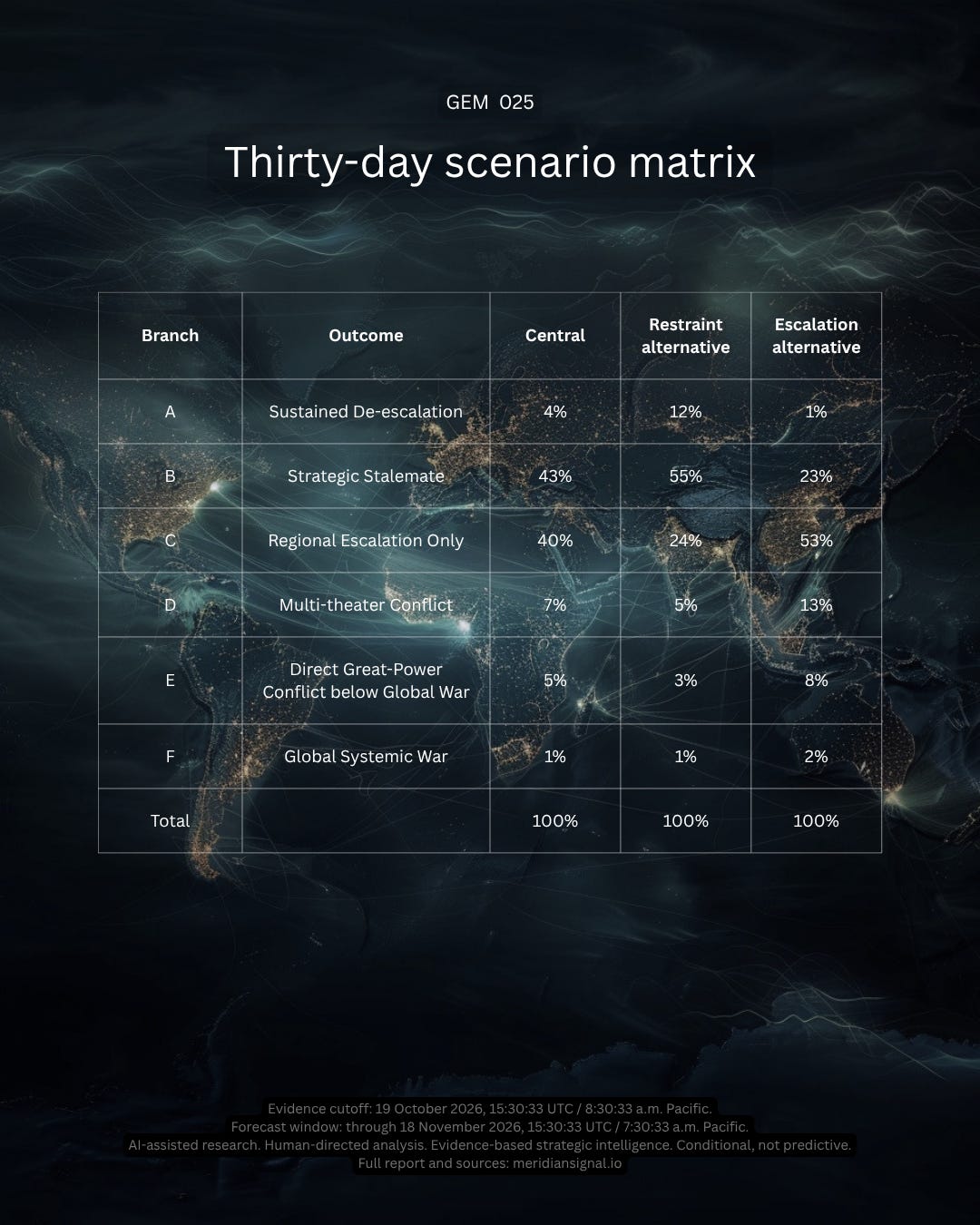
Further Escalation is C+D+E+F = 53%. Direct Great-Power Conflict is E+F = 6%. Stalemate is modal individually, while the four adverse branches collectively remain slightly more likely.
Compared with GEM 024, A and B gain two percentage points each and C loses four. This small reallocation reflects the expanded baseline and uncertain implementation of possible new participation, not an assertion that shipping is safer. The alternatives show how strongly the estimates depend on assumptions.
A requires 14 qualifying days plus comparable traffic improvement. Its complete seven-day pre-cutoff vessel-count baseline remains unavailable, so its eventual traffic test may be unresolved. Missing observations do not prove either de-escalation or stalemate.
The full country and strategic-target baseline is also incomplete. A later claim of new expansion will require verification of that earlier configuration, not an assumption that an unobserved target was previously untouched.
Strategic implications and next tests
Keep physical supply, safe delivery, fuel availability and financial transmission separate. The reviewed record does not establish systemic funding or payment breakdown. Current market breadth is incomplete.
The central index has no missing dimension, but defensible coding and explicit coverage bounds span 51.25 to 65.00. These are not statistical confidence intervals. A fresh loss of usable bypass capacity could activate the Critical alert override even below an index of 70.
The next meaningful tests are:
Verified new Egyptian direct operations, not statements alone.
Sustained export-pipeline or loading-terminal impairment.
Comparable daily Hormuz passage and safe-voyage evidence.
An implemented maritime agreement with observable compliance.
Repair completion, external-power resilience and diesel delivery at nuclear sites.
A qualifying expansion in a second theater.
Reciprocal regular-force combat in a defined opposing great-power pairing.
New qualifying emergency energy instruments in two specified jurisdictions.
The separate Meridian Conviction Score: Emergency Energy Measures is 35%, over the same 30-day window. It requires new conflict-caused official reserve releases, mandatory rationing or emergency import allocation in at least two of the United States, European Union, China, India or Japan, each implemented for seven consecutive days within the window. Existing programs and announcements alone do not qualify.
Meridian Strategic Conclusion
Maintain Strategic Caution. The central stress reading remains high, and the cost of persistence is substantial even without another structural threshold being crossed.
The assessment would worsen with verified loss of export alternatives or new qualifying combat participation. It would improve with implemented restraint and sustained comparable delivery recovery. A stable index is not a declaration that fuel security has returned.
Editorial note: The Global Escalation Monitor assesses geopolitical and macroeconomic risk for strategic decision-making. It is general informational analysis and does not constitute individualized financial, investment, legal or tax advice.
Research disclosure: Meridian Signal uses AI-assisted research and synthesis under human-directed analytical and editorial priorities. Material factual claims are supported by cited sources, with attribution, access limitations, source conflicts and material evidence gaps disclosed where they affect the assessment. Each edition states its evidence cutoff; individual sources may reflect different publication dates, event dates and observation periods.
The Meridian Escalation Index measures current structural system stress on a 0–100 scale. Meridian Conviction Scores express judgment-based probabilities of specifically defined outcomes over a stated forecast window. Evidence Support measures the quality and coverage of evidence supporting the index inputs; it does not measure forecasting accuracy or certainty about future outcomes.
Scenario probabilities are analytical judgments and have not been empirically calibrated. Resolution criteria, forecast horizons, material methodology changes and resulting breaks in comparability are disclosed where applicable.
Meridian Signal
Bold clarity at the right time.
Independent strategic intelligence on capital regimes, digital infrastructure and systemic risk.
AI-assisted. Human-directed.
Evidence-based strategic intelligence. Conditional, not predictive.
Questions or corrections: contact@meridiansignal.io