
Executive assessment
The Meridian Escalation Index remains 56, unchanged from last week. That stable reading should not be mistaken for a stable operating environment.
Hormuz traffic weakened again. Kpler counted seven commodity-vessel passages on 6 October, the lowest daily total since 23 July. Crude moving through the strait fell 27% from the prior wartime high. Alternative exports through the Gulf of Oman and Red Sea still offset enough lost volume to keep aggregate Middle East crude near pre-war levels, so the central redundancy score does not worsen. The system is still adapting. It is doing so under greater pressure. Reuters
The more important change occurred beyond the strait. Houthi missile and drone attacks struck Saudi airports and threatened oil infrastructure. Riyadh airport remained closed after a deadly attack, while Saudi airstrikes continued in Yemen. Russia hit Ukrainian energy targets after a ceasefire announcement. China scheduled coastal live-fire drills, and North Korea launched multiple ballistic missiles after South Korea tested a hypersonic weapon. Reuters on Saudi ArabiaReuters on Ukraine
The index is unchanged because no central structural input crossed a scoring boundary. Miscalculation Pressure rises from 69 to 75 because armed proximity intensified. The 30-day Meridian Conviction Score for Further Escalation rises to 57%. Regional Escalation Only is now the largest individual scenario at 44%.
Executive snapshot
Evidence cutoff: 12 October 2026, 15:58 UTC / 8:58 a.m. Pacific
Forecast window: through 11 November 2026, 15:58 UTC / 7:58 a.m. Pacific
Core readings
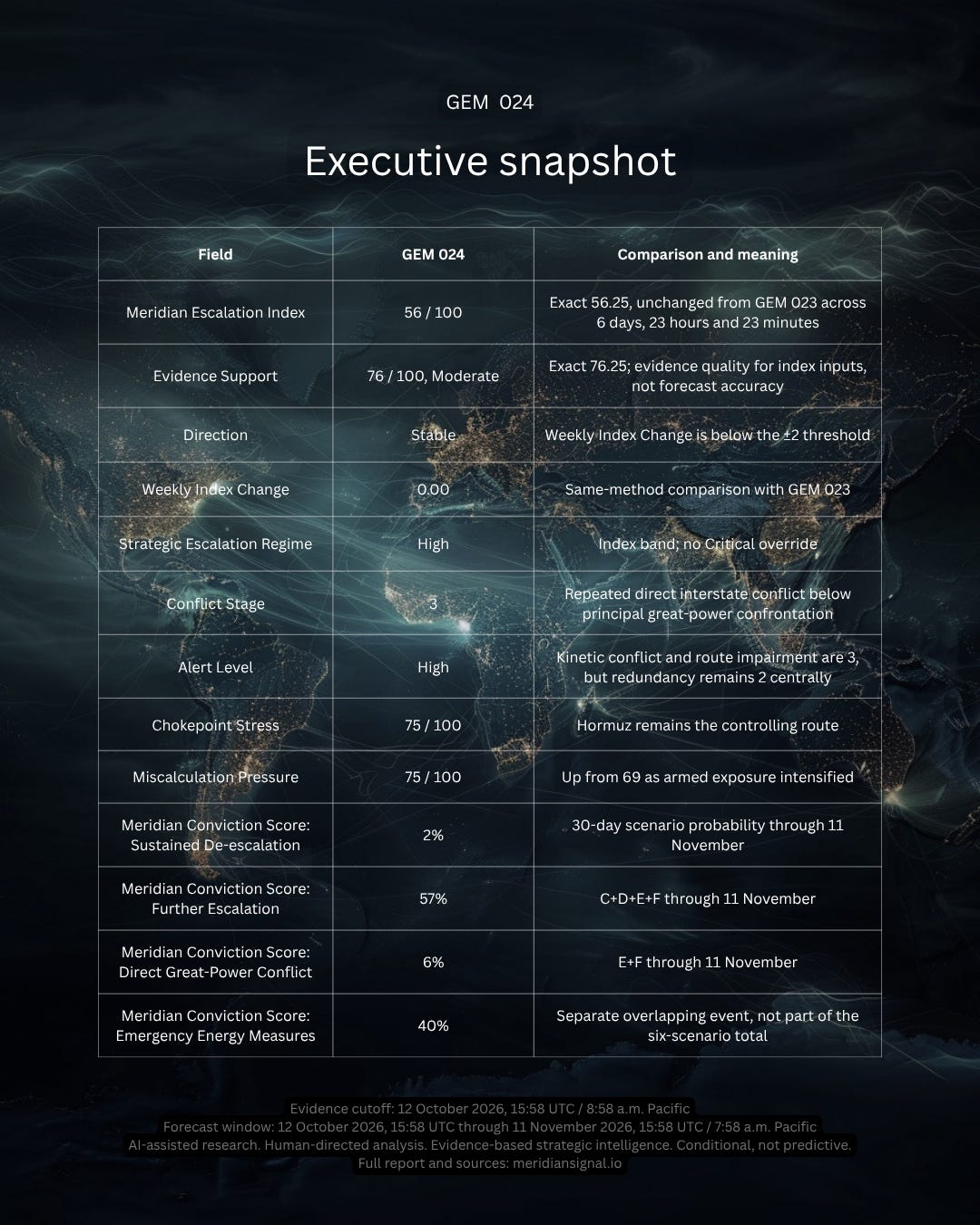
Active Triggers: Saudi-Houthi infrastructure attacks • Hormuz attack and traffic volatility • US-Iran conditions and regional mediation • Russia-Ukraine energy strikes • Taiwan and Korean military signaling
What changed this week
Hormuz recovery reversed at the route level. Kpler reported seven commodity-vessel transits on 6 October, followed by ten on 7 October. LSEG counted eight all-vessel crossings on 6 October. These populations are not interchangeable, and neither captures vessels operating without Automatic Identification System signals. They still point in the same direction: passage continued, but at materially reduced and unstable levels. Reuters
The offset remained important. Gulf of Oman and Red Sea exports rose to 6.7 million barrels per day in Kpler’s reporting. That kept total Middle East crude exports near the pre-war level. This is why energy-export redundancy remains at level 2 rather than returning to level 3. Availability has not collapsed. Reliability remains poor.
Regional conflict widened. The Houthis continued missile and drone attacks against Saudi aviation and economic infrastructure after Saudi-backed forces expanded operations in Yemen. Iran offered to facilitate dialogue, but no operational ceasefire or implemented maritime agreement was verified. The combination raises the probability of a qualifying regional expansion while leaving a restraint channel open. Reuters
The International Energy Agency agreed to accelerate delivery of oil stocks already authorized in March and to prioritize diesel. This confirms acute product stress, but it is not clearly a new 100 million-barrel intervention. Because the decision predates this forecast cutoff, it is part of GEM 024’s baseline and cannot later count as a new outcome. Reuters
The signal beneath the headline
GEM 023 concluded that the system could move more energy without moving it safely or predictably. The latest evidence challenges the strength of the flow recovery but not the distinction itself.
Then, exports had recovered while shipping security deteriorated. Now, Hormuz traffic has fallen again, alternatives are still carrying much of the load, and violence has expanded into Saudi aviation and infrastructure. The implication is not a higher central index yet. It is a more fragile version of the same high-stress regime.
That is why the Meridian Escalation Index remains 56 while the scenario distribution moves toward escalation. Current system stress and future event probability answer different questions.
Theater assessment
Middle East
The Middle East is the decisive theater. Hormuz remains severely restricted but usable. Saudi-Houthi conflict has moved from route competition into repeated attacks on airports and threats to oil facilities. Riyadh airport remained closed after the 10 October strike, and the Saudi-led coalition reported new incoming drones and missiles on 12 October. The United States was considering support for Saudi strikes, but no US action had occurred by the cutoff. Reuters
The central watch is whether attacks reach a frozen strategic target class on at least three distinct days spanning seven days, or whether a new state enters direct combat. Airport attacks alone do not automatically satisfy GEM’s target-class contract.
Russia and Ukraine
An announced energy ceasefire did not produce verified restraint. Ukraine reported at least six energy targets hit on 12 October. Russia said talks continued while rejecting the short-ceasefire framing. Direct NATO-Russia combat remains unverified. Stronger NATO warnings and additional European sanctions raise pressure but do not cross the great-power combat threshold. Reuters
Taiwan and the Indo-Pacific
China announced live-fire drills across five coastal areas beginning later in the week. None was around Taiwan, according to the published notices. Taiwan is monitoring the activity, and US officials criticized separate Chinese maritime actions east of the island. The evidence supports higher coercive pressure, not a blockade or reciprocal US-China combat. Reuters
Korean Peninsula
North Korea fired multiple ballistic missiles after South Korea’s public hypersonic-missile test. One missile type flew more than 900 kilometers. The exchange raises theater activity and response compression, but isolated tests do not meet the seven-day sustained-campaign threshold. Reuters
Escalation migration
The risk center is migrating from a single chokepoint problem toward a broader regional infrastructure problem. Hormuz remains the controlling route, but Saudi airports, oil facilities and airspace now sit closer to the conflict’s operational edge. Energy policy is also becoming part of the transmission mechanism as governments accelerate stock releases and debate supply interventions.
Outside the Middle East, Europe and East Asia show higher activity without qualifying conflict migration. Concurrent pressure is not proof of coordination. It increases planning burden and the chance of resource competition, but not the direct great-power score.
De-escalation durability
Durability remains weak. Iran-Saudi communication is meaningful because it preserves a regional channel. The Russia-Ukraine energy-ceasefire discussion also shows that governments are searching for narrower restraint mechanisms.
Neither channel produced verified implementation by the cutoff. Fresh attacks continued in both theaters. Scenario A is also evidence-limited because the complete 5 to 11 October daily Hormuz baseline was not recovered on one consistent Kpler convention. If that series remains unavailable, the traffic condition must resolve as unscorable, not false.
Thirty-day scenario matrix
These probabilities are analytical judgments, not calibrated forecasts. The six branches are mutually exclusive and sum to 100.
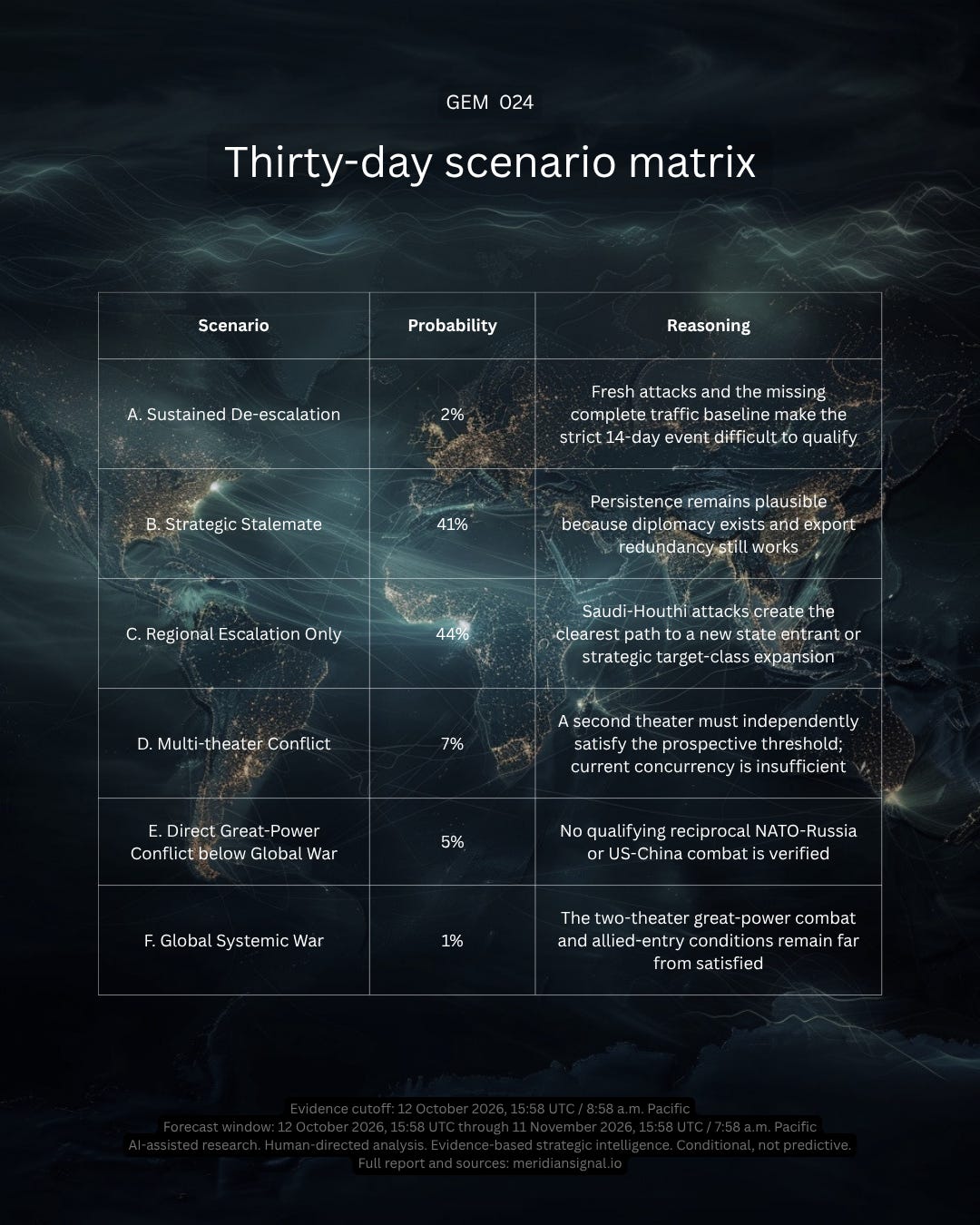
Modal individual scenario: C, Regional Escalation Only, 44%
Meridian Conviction Score: Further Escalation: C+D+E+F = 57%
Meridian Conviction Score: Direct Great-Power Conflict: E+F = 6%
Global systemic war branch: F = 1%
Alternative complete distributions
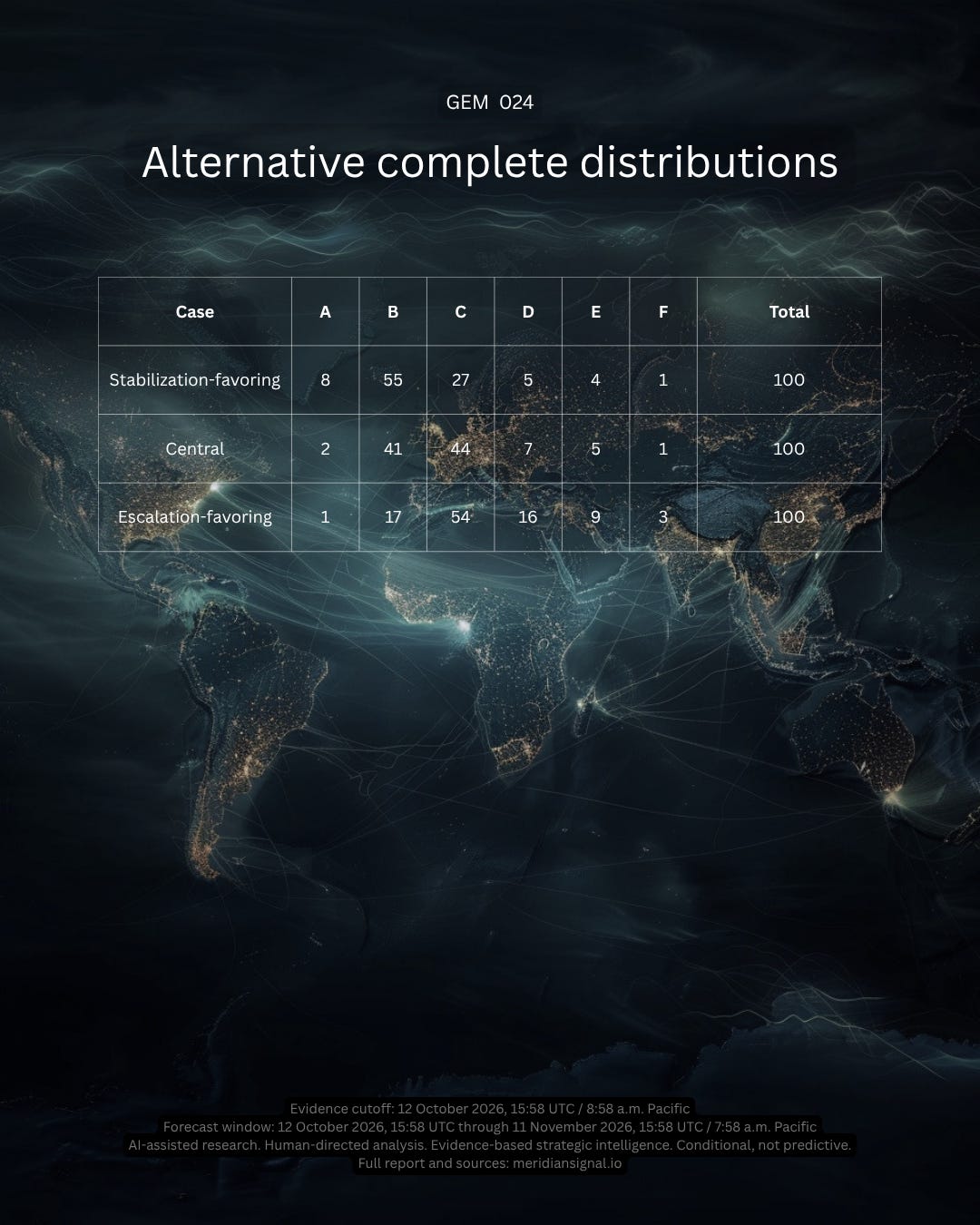
The distribution is most sensitive to Saudi-Houthi strike persistence, verified damage to oil-export infrastructure, US operational entry, a workable US-Iran sequence, and whether Europe or East Asia crosses the prospective threshold.
Strategic implications
Energy planners should treat route redundancy as usable but fragile. Aggregate barrels can remain available even while individual voyages, insurance and schedules become less dependable. Inventory and sourcing decisions should test both volume loss and delivery unreliability.
Security planners should treat Saudi infrastructure as the immediate regional expansion channel. The next material change is more likely to emerge from repeated attacks on a strategic target class than from a sudden transition to direct great-power war.
Investors should separate concentrated energy stress from a broad financial crisis. Oil and diesel remain acute channels. The reviewed evidence did not establish systemic credit or payment dysfunction.
What would change the assessment
The index would rise if Saudi export pipelines, loading terminals or other alternatives suffer sustained impairment, if Hormuz becomes functionally closed, or if a fresh nuclear-safety development raises the nuclear dimension. The Critical override would reactivate if redundancy returns to level 3 while kinetic conflict and route impairment remain at level 3.
The forecast would move toward de-escalation only after implemented restraint and comparable flow improvement. It would move further toward escalation after qualifying strategic-infrastructure attacks on three days spanning seven days, a new state entering combat, or a second theater meeting the same expansion test.
Watch list through 11 November
Saudi airport, oil-facility and airspace attacks, including verified target class and dates.
US military entry into Saudi-Houthi operations.
Daily Hormuz attack notices and comparable Kpler transit counts.
Iran’s conditions for maritime access and any implemented agreement.
Saudi-Iran mediation and operational follow-through.
Russia-Ukraine energy targets and any enforced bilateral restraint.
China coastal drills, Taiwan commercial access and militia-vessel activity.
Korean missile testing and any transition from tests to sustained operations.
IAEA access and site-level safety reporting for Iran.
New emergency energy measures in at least two defined jurisdictions after the cutoff.
Strategic posture
Maintain Strategic Caution. Do not interpret an unchanged index as an all-clear. The central stress architecture has not crossed a new threshold, but regional pathways have become more active and Miscalculation Pressure is higher.
The separate Meridian Conviction Score for Emergency Energy Measures is 40%. It requires a new post-cutoff conflict-driven reserve release, mandatory rationing or emergency import allocation in at least two of the United States, European Union, China, India or Japan, each implemented for seven consecutive days inside the window. The IEA acceleration announced before the cutoff cannot qualify by itself.
Meridian Strategic Conclusion
The risk is spreading beyond the strait before the index has broken higher.
Hormuz remains impaired, but alternative routes still prevent a central redundancy downgrade. The more important change is the expansion of attacks into Saudi aviation and infrastructure while restraint signals weaken in Ukraine and military signaling intensifies in East Asia.
The Meridian Escalation Index therefore remains 56. Miscalculation Pressure rises to 75. Regional Escalation Only becomes the largest individual 30-day scenario at 44%, and Further Escalation rises to 57%.
The central judgment is not that global war is imminent. It is that the next material deterioration is more likely to be regional, operational and infrastructure-focused.
Editorial note: The Global Escalation Monitor assesses geopolitical and macroeconomic risk for strategic decision-making. It is general informational analysis and does not constitute individualized financial, investment, legal or tax advice.
Research disclosure: Meridian Signal uses AI-assisted research and synthesis under human-directed analytical and editorial priorities. Material factual claims are supported by cited sources, with attribution, access limitations, source conflicts and material evidence gaps disclosed where they affect the assessment. Each edition states its evidence cutoff; individual sources may reflect different publication dates, event dates and observation periods.
The Meridian Escalation Index measures current structural system stress on a 0–100 scale. Meridian Conviction Scores express judgment-based probabilities of specifically defined outcomes over a stated forecast window. Evidence Support measures the quality and coverage of evidence supporting the index inputs; it does not measure forecasting accuracy or certainty about future outcomes.
Scenario probabilities are analytical judgments and have not been empirically calibrated. Resolution criteria, forecast horizons, material methodology changes and resulting breaks in comparability are disclosed where applicable.
Meridian Signal
Bold clarity at the right time.
Independent strategic intelligence on capital regimes, digital infrastructure and systemic risk.
AI-assisted. Human-directed.
Evidence-based strategic intelligence. Conditional, not predictive.
Questions or corrections: contact@meridiansignal.io