
Executive assessment
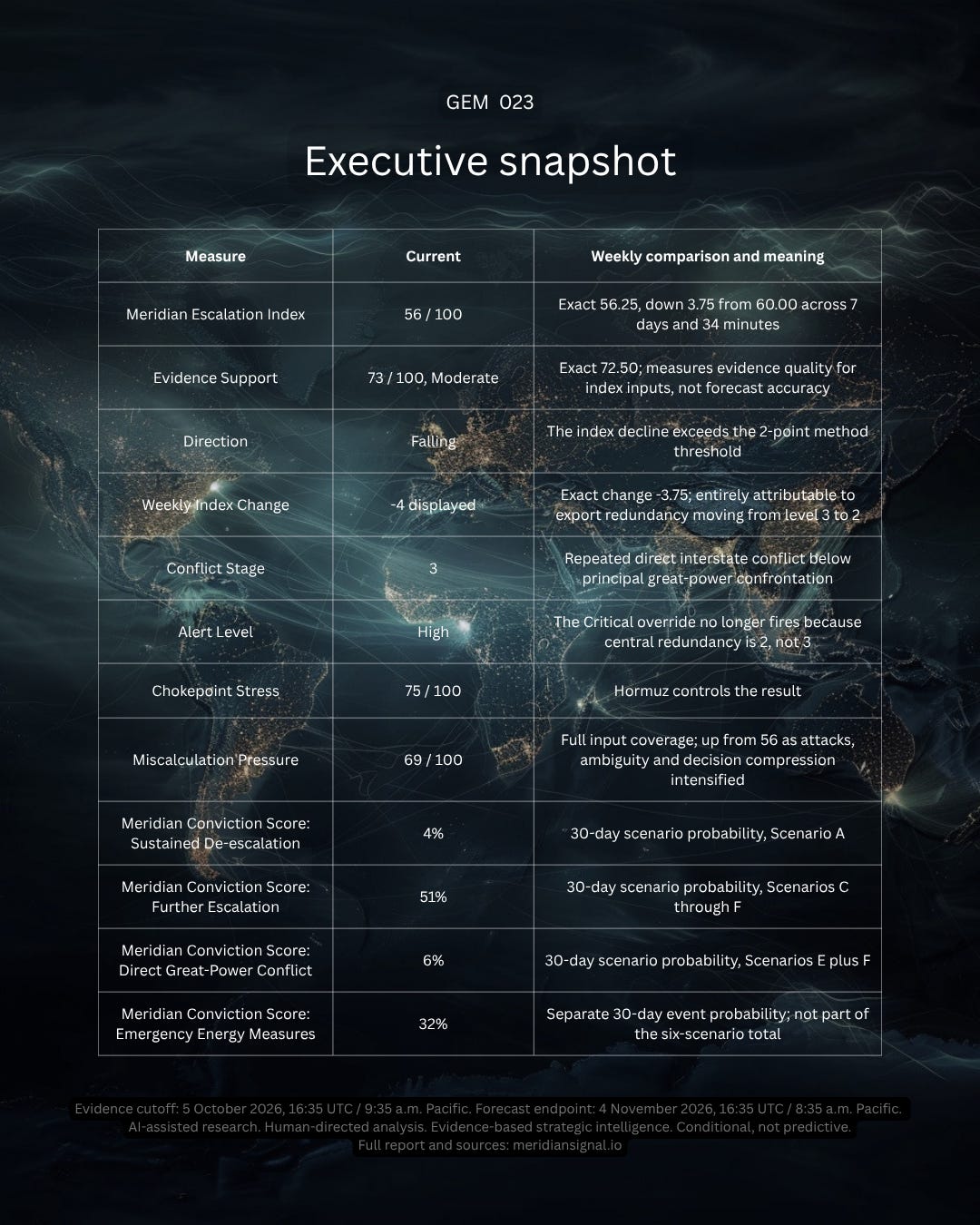
The Meridian Escalation Index falls to 56, down 3.75 points from last week. That decline comes from one specific change: export redundancy improved. Middle East crude exports reached pre-war levels on multiple September days, Saudi Arabia loaded through Gulf and Red Sea routes, and more Qatari liquefied natural gas cargoes crossed Hormuz. The physical system can move more energy than it could one week ago.
The route itself became more dangerous. Reuters reported at least seven tanker incidents in the week before the cutoff, while United Kingdom Maritime Trade Operations recorded a tanker being ordered to turn back north of Khasab on 5 October. Iran still conditions full reopening on a seven-point agreement with the United States. In Yemen, Saudi-backed forces launched a major offensive near Bab el-Mandeb while Houthi gains and threats continued. Reuters on Gulf exports and attacks UKMTO incident record Reuters on Yemen
That divergence matters. The index is lower because substitution works better. Miscalculation Pressure rises to 69because armed proximity, ambiguous attacks and compressed response windows are worse. The 30-day Meridian Conviction Score for Further Escalation is 51%. Strategic stalemate remains the largest individual scenario at 45%.
Executive snapshot
Evidence cutoff: 5 October 2026, 16:35 UTC / 9:35 a.m. Pacific
Forecast window: through 4 November 2026, 16:35 UTC / 8:35 a.m. Pacific
Core readings
Active Triggers: Hormuz tanker attacks and turn-backs • US-Iran proposal sequencing • Yemen and Bab el-Mandeb fighting • G7 emergency stock releases • Russia-Ukraine maritime and energy strikes
What changed this week
Kpler data reported by Reuters put the seven-day moving average for regional crude exports at 18.3 million barrels per day on 30 September. Vortexa placed the 14-day crude and condensate average at 18.6 million barrels per day. Both readings were at or above pre-war references, though they combine several routes and transfer methods. Reuters
Four loaded Qatari liquefied natural gas vessels reappeared outside Hormuz around 2-3 October. Dark transits still limit visibility, and several cargoes do not prove that contracts, schedules or insurance normalized. Reuters
The security trend moved the other way. At least seven tanker incidents were reported in the prior week. On the cutoff date, a tanker north of Khasab complied after the Islamic Revolutionary Guard Corps ordered it to turn back or face targeting. These events support a severe route-impairment reading even as aggregate exports recover. UKMTO
The Group of Seven also announced a 100 million-barrel coordinated reserve release over four months. It confirms product-market pressure, but it predates this forecast cutoff and cannot later count as a new GEM 023 outcome. ReutersIEA
The signal beneath the headline
Last week’s monitor concluded that adaptation was moving faster than stabilization. This week’s evidence sharpens that distinction. Volume recovery asks whether cargo can move. Reliability recovery asks whether operators can plan safe passage, price insurance and meet schedules. The first improved. The second did not.
That is why the Meridian Escalation Index falls while Miscalculation Pressure rises. The central redundancy code moves from severe impairment to partial impairment with usable substitution. That subtracts 3.75 points from the index and removes the Critical override. No other index dimension changes. Yet the concentration of attacks, uncertain attribution and rapid military warnings raises the structural conditions for mistakes.
The system became better at operating inside risk. The risk did not disappear.
Theater assessment
Middle East
Hormuz carries more oil and some additional gas, but vessel safety is worse and Iran still ties reopening to unresolved conditions. Qatar-mediated communication preserves a restraint channel, but no implemented ceasefire or maritime-security agreement was verified. Reuters
Yemen adds a second route mechanism. Saudi-backed forces claimed effective control near Bab el-Mandeb after an offensive supported by Saudi airstrikes. Houthi forces disputed the gains and retained inland strike capacity. This escalation is inside the frozen baseline, not a new forecast outcome. Reuters
Russia and Ukraine
Russia said it struck two Ukrainian cargo vessels, fuel storage at Chornomorsk and an electrical substation in Kharkiv. Reuters did not independently confirm the military cargo or damage claims, so they remain participant-reported. The targeting pattern nevertheless keeps maritime and energy infrastructure exposed. Reuters
Direct NATO-Russia combat is not established. NATO Secretary General Mark Rutte said on 30 September that the alliance saw no imminent threat to NATO territory and had not changed its assessment. That is meaningful counterevidence, not a guarantee. Reuters
Taiwan and the Indo-Pacific
Taiwan reported eight People’s Liberation Army Navy ships and nine official ships around the island in the 24 hours ending at 6 a.m. local time on 5 October, with no PLA aircraft detected. That is continued pressure, but not a blockade or reciprocal US-China combat. Taiwan Ministry of National Defense
Reuters also reported that US officials increasingly view a Chinese invasion before 2028 as unlikely because of readiness delays and political timing. The assessment lowers the near-term invasion tail, but it does not exclude coercive quarantine, blockade pressure or a shorter-warning incident. Reuters
Korean Peninsula
North Korea tested what it described as a hypersonic intermediate-range strategic missile. South Korea said it tracked the launch and assessed the weapon as detectable and interceptable. The event raises theater activity but does not meet the GEM threshold for a new sustained campaign. Reuters
Thirty-day scenario matrix
These probabilities are analytical judgments, not calibrated forecasts. The six branches are mutually exclusive and sum to 100.
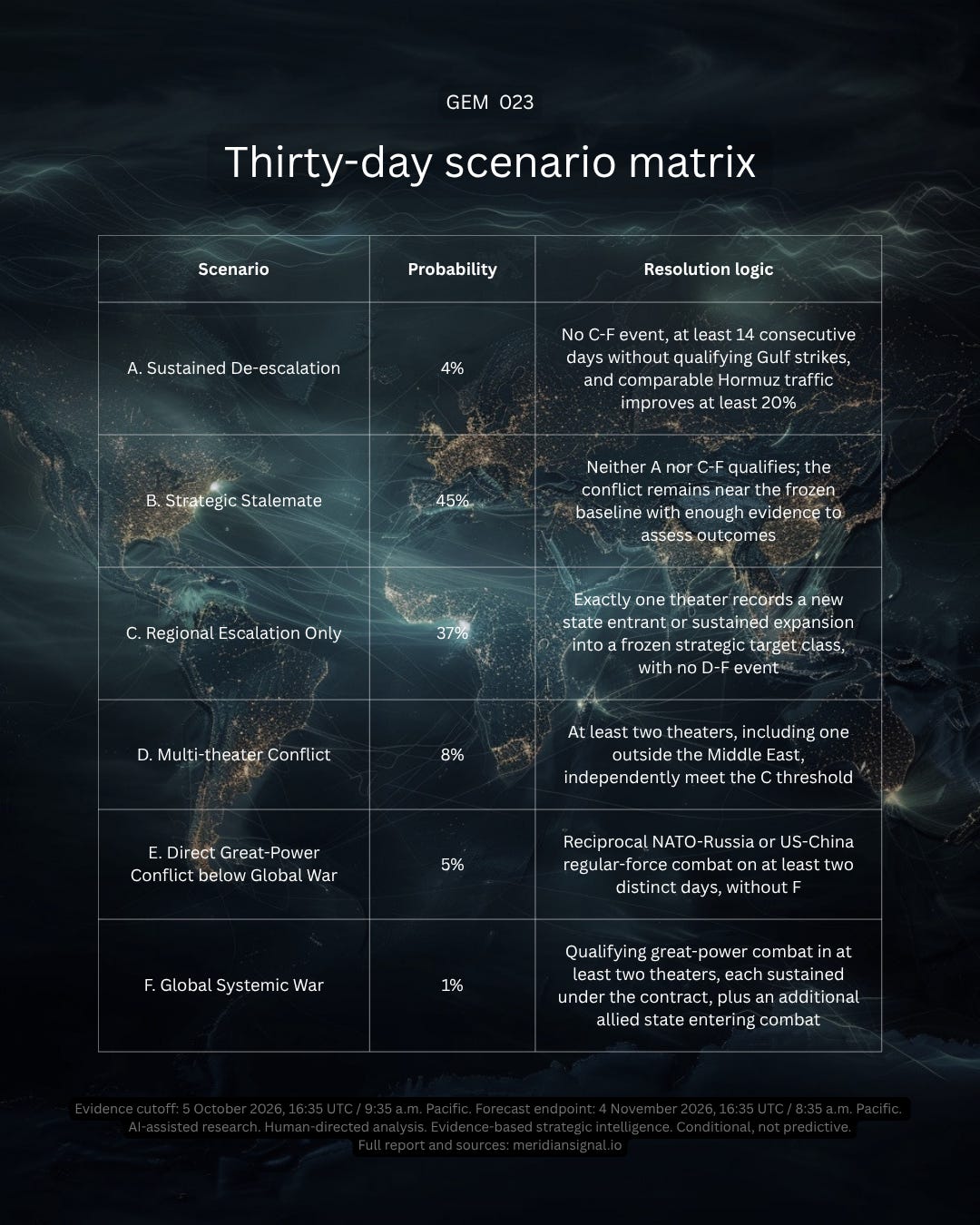
Modal individual scenario: B, Strategic Stalemate, 45%
Meridian Conviction Score: Further Escalation: C+D+E+F = 51%
Meridian Conviction Score: Direct Great-Power Conflict: E+F = 6%
Global systemic war branch: F = 1%
The 51% aggregate is not a separate seventh scenario and is not compared as though it were independent evidence. The largest individual branch remains stalemate.
Alternative complete distributions
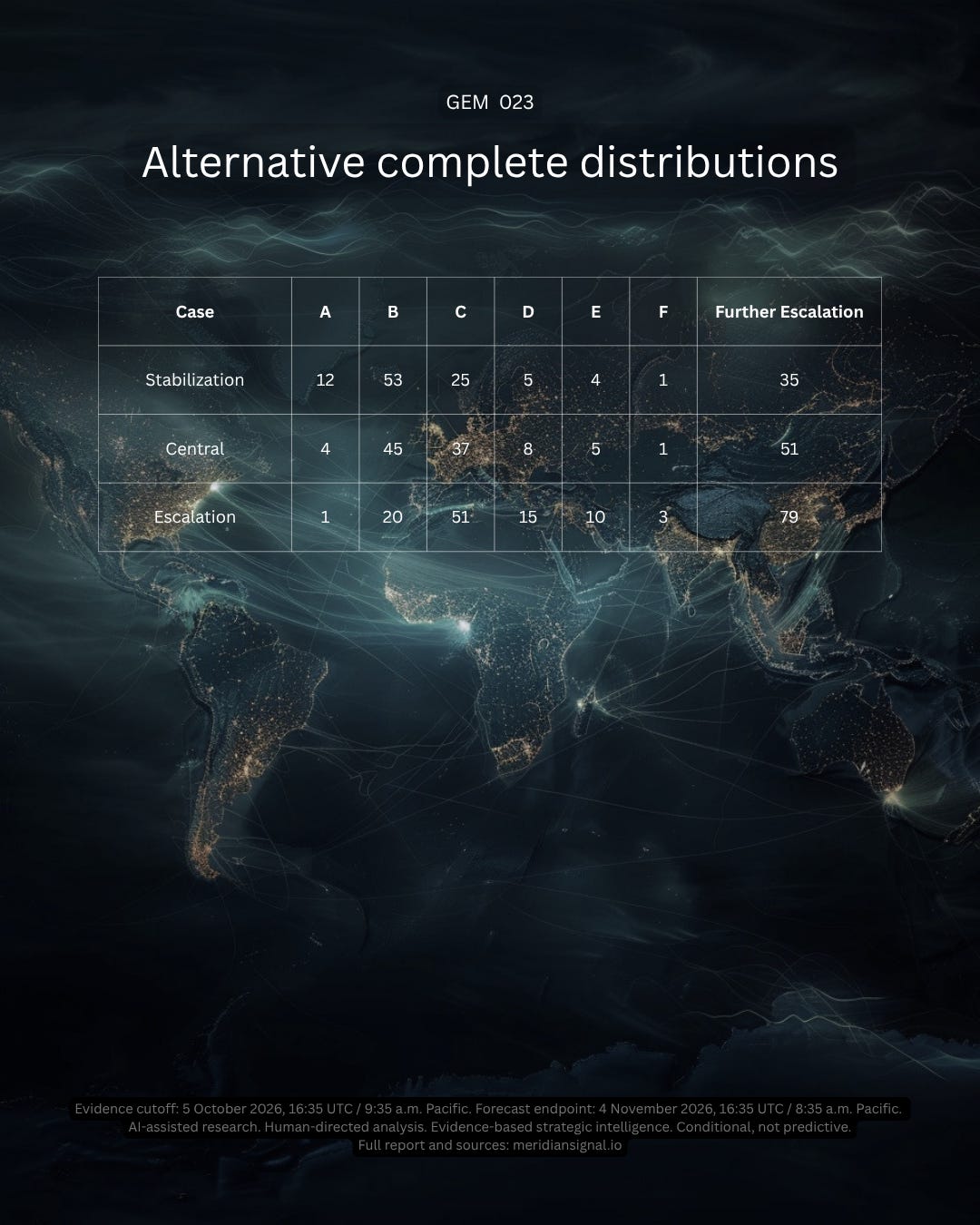
The distribution is most sensitive to verified implementation of the US-Iran proposal, the persistence of tanker attacks, whether Yemen expands to new strategic target classes, and whether a second theater crosses the prospective threshold.
Scenario A remains evidence-limited. Its tracking convention is Kpler data as reported by Reuters for AIS-visible large commercial commodity vessels crossing Hormuz in either direction, counted by UTC day. A complete daily series for the required 28 September through 4 October baseline was not recovered. If it remains unavailable, the traffic condition must resolve as unscorable, not false.
What would change the assessment
The index would fall further if Hormuz moves from severe restriction to substantial usable access, or if repeated safe passage and dependable contract performance make redundancy fully reliable. The current central index would rise if renewed attacks disable alternatives, if nuclear safeguards or reactor conditions materially deteriorate, or if broad financial stress appears beyond energy and freight.
The forecast would move toward de-escalation only after operational restraint begins. A proposal, message exchange or announced release does not satisfy the contract. The escalation distribution would rise after new post-cutoff targeting of a commercial port, export terminal, national power system, nuclear facility or national military command facility on at least three days spanning seven days, or after a new state enters direct combat.
Watch list through 4 November
Implementation, delay or rejection of the seven-point US-Iran proposal.
Daily Hormuz attacks, coercive hails, vessel turn-backs and independently verified transit counts.
Whether Gulf crude recovery persists without expanding dark transits or unsustainable shuttle costs.
QatarEnergy force majeure, actual cargo arrivals and contract performance.
Yemen frontlines near Dhubab, Taiz and Bab el-Mandeb, including any new strategic target class.
New attacks on Saudi export infrastructure or the East-West route.
Black Sea commercial-vessel strikes and any verified NATO military response.
Taiwan commercial access, maritime exclusion measures and changes in PLA operating tempo.
Korean missile deployment signals beyond isolated testing.
New emergency energy measures after the cutoff in at least two defined jurisdictions.
Strategic posture
Operators should distinguish availability from reliability. Higher export volume justifies less severe central redundancy coding, but it does not justify treating Hormuz as normal. Inventory, insurance, routing and delivery planning should remain stress-tested against repeated attacks and sudden denial.
Security planners should treat maritime attribution and warning compression as immediate problems. The main deterioration this week is not a new great-power front. It is a denser environment of armed contacts and uncertain intent around critical trade routes.
The separate Meridian Conviction Score for Emergency Energy Measures is 32%. This event requires a new post-cutoff conflict-driven reserve release, mandatory rationing or emergency import allocation in at least two of the United States, European Union, China, India or Japan, each implemented for seven consecutive days inside the window. The 2 October G7 action is already in the baseline and cannot qualify by itself.
Meridian Strategic Conclusion
The system can move more energy, but it cannot yet move it safely or predictably. That distinction lowers the current stress index while leaving the forward escalation balance almost even. The index falls to 56 because redundancy improved. Miscalculation Pressure rises to 69 because attacks, ambiguity and compressed decision time intensified.
The strongest 30-day judgment is therefore a dangerous stalemate, not normalization. Physical adaptation is containing the supply shock. It is not resolving the conflict that created it.
Editorial note: The Global Escalation Monitor assesses geopolitical and macroeconomic risk for strategic decision-making. It is general informational analysis and does not constitute individualized financial, investment, legal or tax advice.
Research disclosure: Meridian Signal uses AI-assisted research and synthesis under human-directed analytical and editorial priorities. Material factual claims are supported by cited sources, with attribution, access limitations, source conflicts and material evidence gaps disclosed where they affect the assessment. Each edition states its evidence cutoff; individual sources may reflect different publication dates, event dates and observation periods.
The Meridian Escalation Index measures current structural system stress on a 0–100 scale. Meridian Conviction Scores express judgment-based probabilities of specifically defined outcomes over a stated forecast window. Evidence Support measures the quality and coverage of evidence supporting the index inputs; it does not measure forecasting accuracy or certainty about future outcomes.
Scenario probabilities are analytical judgments and have not been empirically calibrated. Resolution criteria, forecast horizons, material methodology changes and resulting breaks in comparability are disclosed where applicable.
Meridian Signal
Bold clarity at the right time.
Independent strategic intelligence on capital regimes, digital infrastructure and systemic risk.
AI-assisted. Human-directed.
Evidence-based strategic intelligence. Conditional, not predictive.
Questions or corrections: contact@meridiansignal.io