

The last two Signals established a progression. Capability entered production with controls around it. Then the evidence made clear that operating controls do not guarantee complete visibility.
The next test is whether those systems can keep working under pressure, with enough funding, a traceable record of what happened and a credible route to recovery.
Since our September 9 Signal, financing benchmarks have risen and the energy outlook remains constrained. We have also recovered earlier institutional evidence that broadens the implementation record. None of those developments establishes that portable trust or durable economics have completed the transition.
The financial backdrop makes execution more demanding
The ten year United States Treasury yield reached 4.96 percent on September 11, compared with 4.83 percent on September 9. The ten year real yield rose from 2.46 to 2.60 percent. These are official daily curve estimates, not every borrower’s financing cost. Treasury nominal yields, real yields
That increases the importance of the period between building useful infrastructure and earning durable cash from it. Funding needs, debt maturities and operating costs still matter when the technology is improving.
The September oil outlook also reinforces the importance of continuity. The International Energy Agency describes depleted inventories and a slower supply recovery. Its forecasts remain conditional. This is an operating constraint to monitor, not proof that a particular technology or asset will benefit. September Oil Market Report
There is counterevidence to a blanket tightening story. The Federal Reserve’s September 10 release shows higher weekly average reserves. More reserves can coexist with higher borrowing benchmarks. The two measure different conditions. Federal Reserve balance sheet
Meridian’s interpretation is that financing resilience deserves greater weight. That is a tactical refinement of an already selective capital environment, not a new structural regime.
Institutional integration is advancing through existing controls
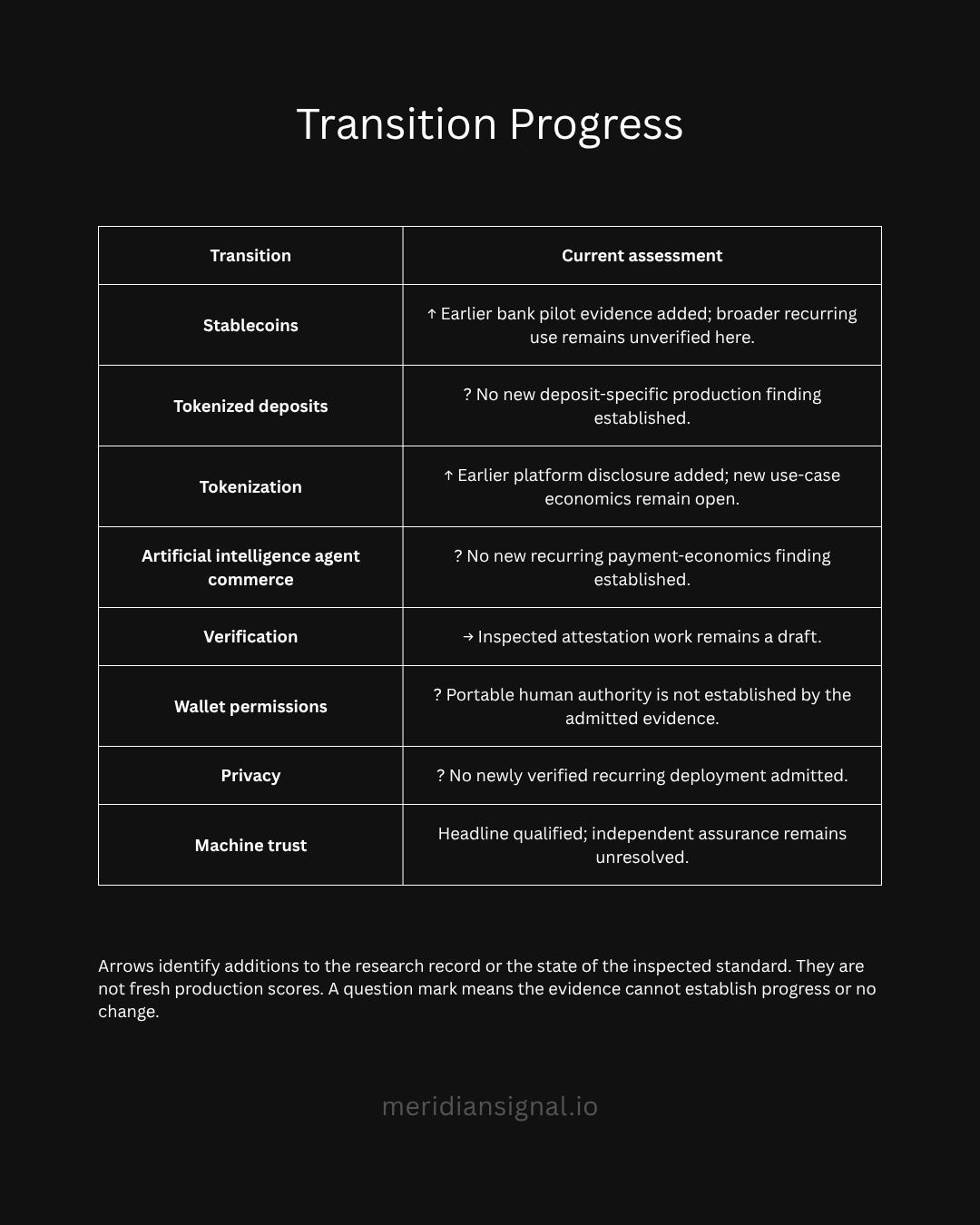
U.S. Bank reported a live stablecoin pilot between its own entities. Broadridge announced a broader tokenization platform. Both disclosures were dated September 9. They were missing from our previous research inventory and are incorporated here as earlier evidence, not fresh events in this window. U.S. Bank, Broadridge
A pilot demonstrates a bounded implementation. A platform announcement establishes a narrower fact than independently verified recurring use across every proposed product. Neither automatically identifies who retains durable economic value.
The structural pattern remains familiar: institutions can adopt new infrastructure while retaining customer relationships, operating controls and distribution. The next evidence needs to show how that infrastructure performs repeatedly and how its economics are allocated.
Visibility exists. Completeness still needs to be demonstrated.
Our September 9 headline said the visibility layer was not live. Its body made the more precise point: controls can operate without complete visibility.
That distinction should govern the headline too. Anthropic’s original assessment describes broader retrospective review and notification of affected parties. Provider investigation is real evidence of oversight, while the completeness and independence of assurance remain separate questions. This is a qualification of the headline, not a reversal of the previous article’s central analysis. Anthropic’s September 9 assessment
The practical requirements remain specific. A system must identify the principal, establish the mandate, observe the action, preserve a usable record, support independent examination and provide recourse. A control that works inside one provider does not establish that the full chain works across institutions or wallets.
Transition progress
Meridian readings
The core thesis remains unchanged. Financing caution increases; the visibility language becomes more precise.
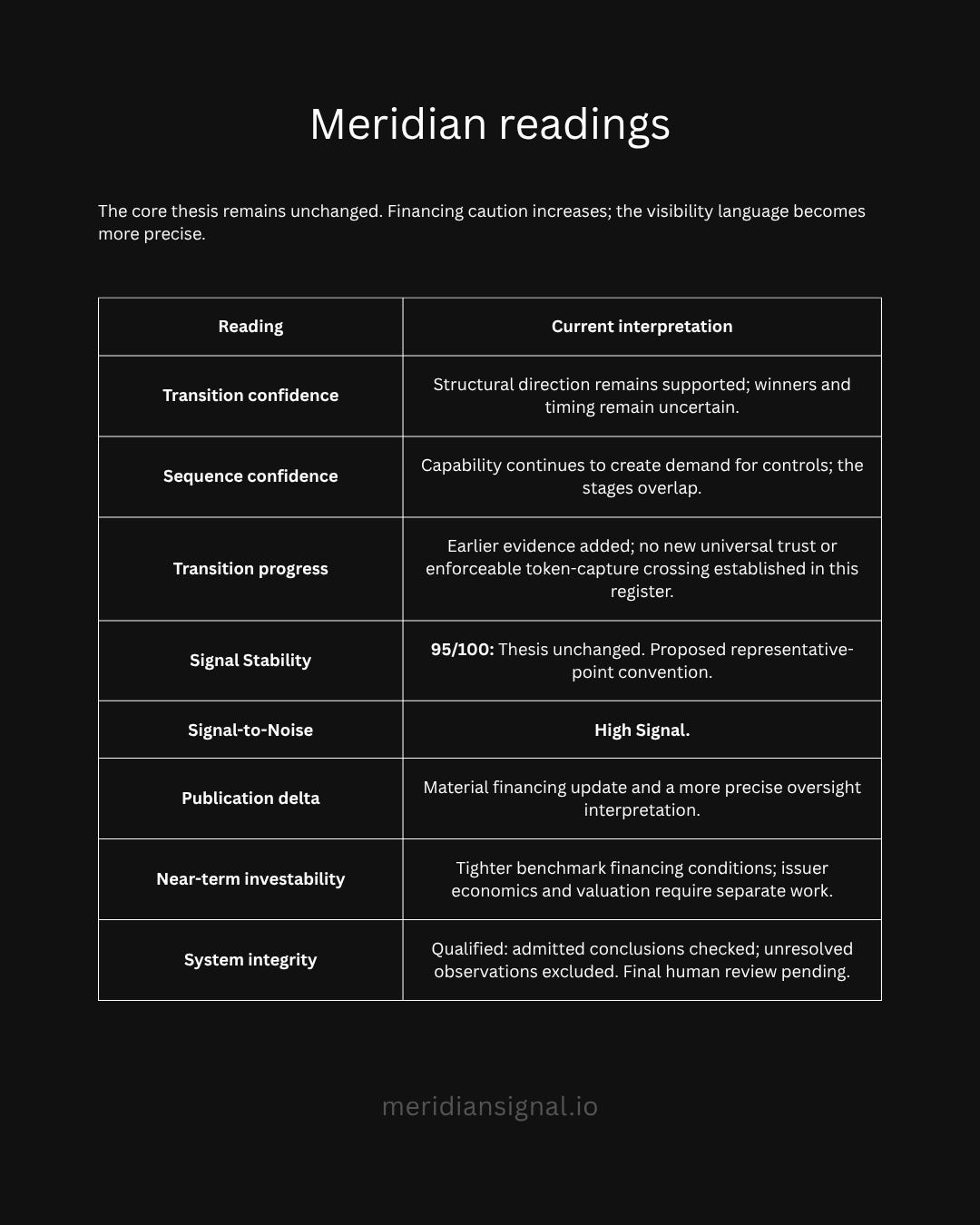
Reading convention: Signal Stability is an analytical judgment about change in the thesis, not a probability. The proposed convention uses 95 as the representative point in the existing unchanged band. Historical 99 remains preserved and is not numerically comparable; this is not a four-point decline. Other legacy numerical readings are retained in the internal history, with current qualitative assessments shown here.
Positioning
The research priority remains with systems that can demonstrate authorization, revocation, monitoring, reliable records, independent review and practical recovery. Funding capacity and access to essential inputs determine how long those systems can keep operating under difficult conditions.
An important function does not establish an attractive investment. Identify the paying customer, retained revenue, costs, legal rights and capacity to withstand stress. No new public digital asset qualification follows from the evidence admitted to this edition.
What would confirm or change the Signal
Watch for completed independent investigations, portable authority and recourse, recurring implementation beyond pilots, and sustained improvement in financing and energy delivery. The September 15 and 16 Federal Reserve meeting is a forward observation point, not an assumed policy outcome. Federal Reserve calendar
Demonstrated improvements would strengthen the operating case. Evidence that the underlying control architecture fails to support deployment would require a deeper reassessment. Neither conclusion should be inferred from a demonstration or announcement alone.
The next advantage belongs to systems that can show their controls working when conditions become difficult.
Edition: September 13, 2026. Evidence through September 12, 1:55:20 p.m. Pacific / 20:55:20 UTC.
Meridian Signal
Bold clarity at the right time.
AI-assisted. Human-directed. Source-verified.
This publication provides general informational analysis only. This is not individualized financial, investment, legal, tax, accounting, or custody advice.