

Publication date: August 29, 2026
System state: Scaled artificial-intelligence production inside a two-speed capital regime, with machine trust advancing through bounded institutional control
Here is the simplest way to understand this week-end signal.
Artificial intelligence is no longer advancing through capability alone.
It is producing revenue, operating inside live enterprise systems, and beginning to complete bounded work.
NVIDIA reported scaled revenue, margins, income, and direct shareholder returns. Coinbase disclosed an internal agent that can remember, investigate, act proactively, help mitigate an incident, and open code for human review. Visa expanded an agentic security workflow from vulnerability discovery through remediation and validation.
These are different forms of production.
They share one condition.
The systems work because identity, memory, permissions, logs, limits, validation, and final responsibility remain inside controlled institutions.
Artificial intelligence is scaling.
Trust is still local.
Since Our Mid-Week Signal
Here is what materially changed:
Coinbase disclosed CEEcil, a continuously operating internal engineering agent with approved channels, durable memory, deterministic routing, live lookups, rate limits, spend limits, audit records, kill switches, and human-only merge authority. Coinbase says it helped triage and mitigate a low-severity production incident and independently fixed a bug, wrote tests, and opened a pull request for review. This is verified bounded production. It is not portable identity, a universal human mandate, or an autonomous legal principal. Coinbase CEEcil
Visa enhanced its open-source Vulnerability Agentic Harness so security teams can move from discovery and triage through remediation and validation. Visa also expanded related advisory services and cited existing client work. This supports production availability with bounded operating evidence. It does not prove universal machine trust, independent outcome verification, or disclosed unit economics. Visa Vulnerability Agentic Harness
Four new individual Internet-Drafts described execution finality, certificate-based agent identity, signed delegation chains, and multi-source registry corroboration. The proposals matter because they make the missing trust architecture more explicit. None is an adopted standard or production system. Tool Execution Finality, Agent PKI, A2A Trust, Registry Corroboration
Composite ML-KEM advanced procedurally and is scheduled for the September 3 IESG telechat. At the cutoff, it remained a Working Group Internet-Draft in IESG Evaluation with an unresolved DISCUSS. It receives standards-progress credit, not RFC or deployment credit. Composite ML-KEM status
Newly incorporated NVIDIA results confirmed a scaled-production and value-capture threshold that the August 26 report omitted. NVIDIA reported $96.2 billion in quarterly revenue, $89.0 billion in data-center revenue, a 75.0% GAAP gross margin, $59.7 billion in GAAP net income, and approximately $26.0 billion returned to shareholders. The results were public before the Mid-Week cutoff, so they are a late carry-in, not a fresh August 26 through August 29 event. NVIDIA financial results
Federal Reserve Chair Kevin Warsh described strong artificial-intelligence investment, corporate profits, credit availability, and capital-market conditions while keeping price stability as the predominant near-term focus. This confirms a two-speed regime: strong incumbent corporate finance inside expensive sovereign duration and sticky inflation. Federal Reserve remarks
Average reserve balances declined $10.4 billion to $2.925 trillion. From August 26 to August 28, the ten-year Treasury yield rose from 4.66% to 4.73%, while the ten-year real yield rose from 2.34% to 2.42%. Long-duration capital remains expensive. Federal Reserve H.4.1, Treasury nominal yield curve, Treasury real yield curve
July household data were weaker than the prior report captured. Real personal consumption was nearly flat, twelve-month PCE inflation was 3.7%, core PCE inflation was 3.3%, and the personal saving rate was 3.0%. This release was also available before the Mid-Week cutoff and is reconciled as a late carry-in. Bureau of Economic Analysis
No universal wallet, portable human mandate, broad selective-disclosure layer, neutral recourse system, Arc public mainnet, or qualifying public token crossed into production.
Executive Assessment
The production question changed this week.
The trust question did not disappear.
Artificial-intelligence infrastructure now shows reported operating economics at extraordinary scale. A bounded internal agent can operate continuously, retain relevant memory, use live tools, help resolve an incident, and prepare a code change for review. An agentic security system can move beyond finding a vulnerability and help validate the fix.
That is real progress.
But none of these systems is trusted everywhere.
They are trusted somewhere.
Coinbase defines where its agent may observe, which tools it may use, how much it may spend, what it may publish, and which actions still require a human. Visa closes a specific security workflow around discovery, remediation, and validation. NVIDIA captures value through scarce hardware, software, systems, distribution, and capital ownership.
The operating model is becoming visible:
Models reason.
Deterministic services hold authoritative state.
Institutions define identity and authority.
Logs and validation preserve evidence.
Humans and legal entities retain liability and recourse.
This is why artificial intelligence can become useful before universal machine trust exists.
It is also why value remains concentrated.
The institutions that own the hardware, power, customer relationship, records, permissions, capital, and right to approve or reverse action retain the strongest economic claims.
What Is Actually Happening
Artificial-intelligence production is no longer a narrative proxy
NVIDIA’s results provide the clearest form of evidence in the current transition.
Revenue, margin, operating income, net income, production systems, and capital returns are visible in one operating chain.
That matters because the market often treats capital expenditure, transaction volume, developer activity, or model capability as if each were equivalent to value capture.
They are not.
Reported retained economics are stronger evidence than proximity to a popular technology.
The results also sharpen the ownership hierarchy. The direct claim sits with the company, its shareholders, employees, suppliers, and creditors. No public token is required to access the production system or receive its economics.
Bounded autonomy is entering live operations
CEEcil is important because it is neither a simple chatbot nor an unrestricted autonomous system.
It operates inside a carefully defined environment.
The agent can observe approved channels, retrieve durable context, use authorized tools, route actions through deterministic services, and act proactively within limits. Tool calls are logged. Private messages are excluded. Spending is capped. The system can be stopped. A human retains the right to merge code.
The lesson is not that enterprises no longer need control.
The lesson is that useful autonomy depends on control.
This is the first production form likely to scale: domain-specific agents with memory, narrow authority, visible logs, reversible action, and a responsible institution around them.
Validation is becoming part of machine action
Visa’s security workflow shows a second production pattern.
Finding a problem is not enough.
A trusted system needs to propose a change, apply the change within scope, and verify that the intended result occurred without creating another failure.
That moves artificial-intelligence security from discovery toward a closed operational loop.
The important missing evidence is independent performance: customer adoption, remediation success, false positives, failure rates, override rates, and recurring economics.
Production availability has advanced.
Universal assurance has not.
The missing trust primitives are becoming explicit
This week’s technical drafts break the trust gap into recognizable components:
identity that binds an agent to a verifiable principal
delegation that proves where authority came from
corroboration that prevents one registry from becoming the only source of truth
finality that distinguishes a proposed action from an effect that actually occurred
These are meaningful discoveries because they explain why discovery alone cannot create trustworthy autonomy.
But the documents remain individual submissions.
They do not yet provide formal standards, interoperable deployment, independent adoption, or neutral recourse.
The architecture is becoming clearer before the infrastructure becomes universal.
The capital regime is separating incumbents from everyone else
Artificial-intelligence investment, corporate profits, credit availability, and capital-goods absorption remain strong.
Household conditions are less forgiving.
Inflation remains elevated. Real consumption was nearly flat. The saving rate was thin. Reserve balances declined, and long real yields rose again.
This is not a uniform easing cycle.
It is a two-speed regime.
Large profitable incumbents can self-finance, borrow, issue, and return capital. Smaller operators, households, and long-duration projects face a much higher burden.
That is why transition progress rose while near-term investability fell.
The Hidden Transition
The hidden transition is from intelligent output to enforceable action.
Artificial intelligence can already generate, investigate, recommend, and act inside bounded environments.
The harder problem is making those actions trustworthy across organizations.
That requires:
identity that can be verified outside one platform
authority that is specific, revocable, and attributable to a human or legal principal
privacy rules that reveal only what the transaction requires
evidence that records both the request and the final effect
independent validation that the result occurred as intended
recourse that assigns responsibility and absorbs loss when it did not
Until those layers become portable, the most capable agents will remain institutionally local.
That may be enough for substantial production.
It is not enough for a universal machine economy.
Transition Progress Tracker
93 out of 100
Direction: Advancing through scaled artificial-intelligence economics and bounded agent production, with universal trust still incomplete
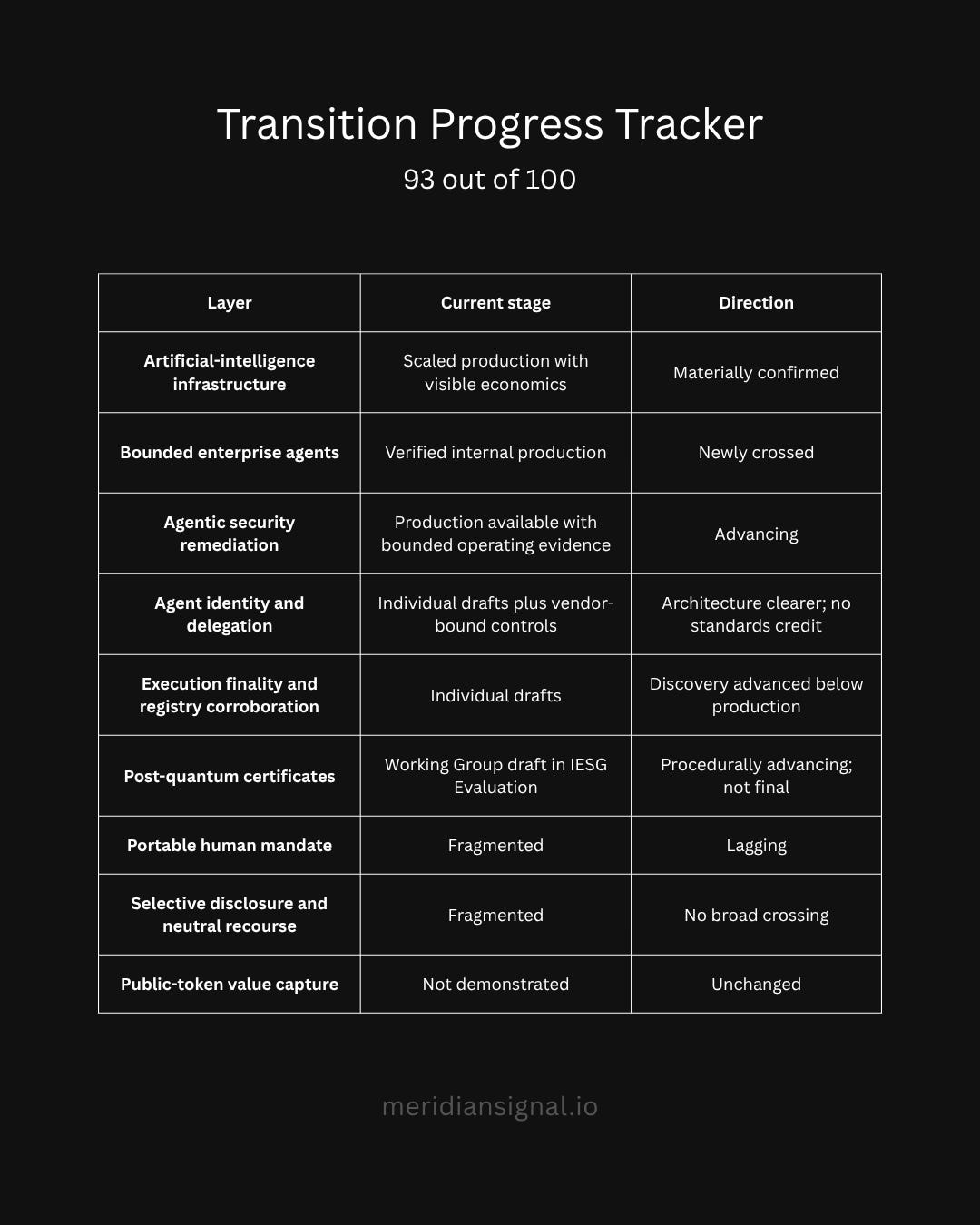
This score measures verified structural progress. It does not mean the transition is 93% complete.
Meridian Consensus
Here is what changed in our thinking:
Production confidence increased: Artificial-intelligence infrastructure now has unmistakable reported scale, and a bounded enterprise agent crossed into verified internal operation.
Machine-trust maturity increased: Memory, policy, logs, kill switches, human approval, remediation, and validation are working inside controlled environments.
Portability remains the dividing line: Enterprise-specific identity and authority do not create a cross-platform human mandate, standardized receipt, or neutral recourse layer.
Value-concentration conviction increased: Hardware owners, cloud platforms, enterprises, regulated networks, creditors, and shareholders retain the strongest claims.
The capital regime became more visibly bifurcated: Strong corporate profits and credit coexist with sticky inflation, thin household saving, lower reserves, and expensive real duration.
Near-term investability declined: The new production evidence is powerful, but the entry environment did not become broadly forgiving.
Public-token conclusion remains unchanged: No public token qualifies.
Structural reassessment: Not triggered.
The transition became more operational.
The control remained concentrated.
Signal Stability
99 out of 100 | Thesis unchanged
The new evidence strengthens the existing thesis.
Artificial intelligence and digital finance are advancing through scarce physical systems, regulated institutions, enterprise control planes, authoritative records, cryptographic security, and bounded responsibility.
The transition is moving forward without proving universal openness, portable machine authority, or broad public-token capture.
Signal Quality
98 out of 100 | Exceptional signal
Here is the evidence we trust most:
filed operating revenue, margins, income, and capital returns
first-party production architecture with explicit controls and limits
first-party product and client evidence with stage restrictions
official Federal Reserve, Treasury, and economic data
technical records with explicit draft and process status
timing labels that separate fresh events from late carry-ins
Here is what we continue to discount:
planned capacity presented as commissioned production
one internal agent presented as universal adoption
product availability presented as independent operating scale
individual drafts presented as formal standards
standards progress presented as deployed infrastructure
gross activity presented as retained economics
technological proximity presented as public-token value capture
Our filter remains simple.
Capability is not authority.
Action is not finality.
Activity is not ownership.
Meridian Positioning
Defensive selectivity with regulated-trust, sovereign-bottleneck, and incumbent-cash-flow bias
Near-term investability: 56 out of 100
We prefer infrastructure and businesses that already control or are positioned to control:
current revenue, net income, and free cash flow
scarce compute, power, interconnection, networking, memory, land, and cooling
regulated custody, settlement, distribution, and loss absorption
authoritative identity, account, certificate, and transaction records
enterprise policy, audit, validation, security, and lifecycle control
customer relationships and switching costs
contractual claims, balance-sheet capacity, and credible recourse
We continue to discount:
leverage against uncertain long-duration assets
future capacity without power, customers, financing, or commissioning
drafts and previews marketed as adoption
internal production generalized into market scale
agent activity without override, loss, fraud, dispute, and recourse data
transaction volume without margins or retention
public tokens without forced, material, recurring value routing
Strategic Posture
Preserve liquidity. Avoid new leverage. Accumulate verified production and trust-layer evidence selectively.
Increase conviction when:
bounded enterprise agents demonstrate recurring results across independent organizations
identity, delegation, receipts, revocation, and recourse become interoperable
remediation and validation produce independent operating metrics
post-quantum standards become final and enter production migration
announced capacity secures power, customers, financing, and commissioning
activity produces durable retained economics
The most valuable positions are likely to be the ones that are difficult to bypass and expensive to reproduce:
profitable compute and systems
connected power and physical capacity
regulated distribution and custody
authoritative records
identity, policy, audit, validation, and recovery
balance sheets capable of absorbing risk
The transition is investable selectively.
It is not investable indiscriminately.
What Would Confirm This Signal
CEEcil-like agents demonstrate recurring production across independent enterprises.
Standardized identity, delegation, authorization, receipts, revocation, and loss data enter cross-platform operation.
Visa or another operator publishes independently verifiable remediation outcomes and recurring economics.
Composite ML-KEM clears IESG review, becomes an RFC, and enters production certificate profiles.
Agent identity, delegation, corroboration, and finality work gains formal Working Group adoption and interoperable implementations.
Reserve balances rebuild while real yields and inflation decline without a funding break.
A public token proves unavoidable routing, recurring material capture, supply discipline, independent demand, and regulatory survivability.
What Would Weaken It
Artificial-intelligence infrastructure revenue or margins decelerate materially while capital commitments continue rising.
Announced compute capacity fails to secure power, customers, financing, or commissioning.
Production agents reveal that scopes, logs, kill switches, validation, or human gates fail under operating stress.
Standards fragmentation increases rather than converges.
Corporate credit weakens while reserve liquidity continues to decline.
Inflation pushes real yields higher and productive investment slows.
Inventory accumulation turns into cancellations, impairments, or margin compression.
Infrastructure adoption continues to bypass an associated public token.
One Core Takeaway
Artificial intelligence is scaling first where identity, authority, evidence, and responsibility remain institutionally bounded.
The next transition is not smarter machines alone.
It is trust that can travel with them.
Meridian Signal
Bold clarity at the right time.
AI-assisted. Human-directed. Source-verified.
This publication provides general informational analysis only. This is not individualized financial, investment, legal, tax, accounting, or custody advice.