

Publication date: August 22, 2026
System state: Rising sovereign coordination inside a restrictive but functioning financial regime
Here is the simplest way to understand this week-end signal.
The United States is beginning to describe the transition as one connected national-security system.
Autonomous agents need identity and authentication. Digital assets need authoritative records and regulated access. Both depend on secure communications, post-quantum protection, power, compute, and strategic materials.
This week, those layers appeared inside one sovereign technology map.
Federal capital also moved closer to the physical bottlenecks. The Department of Energy selected critical-mineral and battery projects, announced a major steel-modernization award, and used emergency authority to preserve existing power generation.
The architecture is becoming clearer.
Production has not caught up.
The projects still need funding execution, construction, commissioning, customers, and durable economics. The trust standards still need adoption. The financial environment became more restrictive, not less.
That distinction defines the signal.
Since Our Mid-Week Signal
Here is what materially changed:
The White House published a National Security Science and Technology Strategy that places autonomous-agent identification and authentication inside artificial intelligence and autonomy. It separately includes distributed-ledger technologies and digital assets, digital identity and biometrics, and post-quantum cryptography inside information management and cybersecurity. This is sovereign recognition of a connected dependency chain. It is not proof of deployment or commercial capture. White House strategy
The Department of Energy announced $500 million across seven selected critical-mineral, battery-processing, manufacturing, and recycling projects. Selection is more concrete than an open funding notice. It is still not cash disbursement, completed construction, or operating output. Department of Energy announcement
The Department of Energy announced a separate $500 million award supporting a $1 billion modernization of Cleveland-Cliffs’ Middletown Works. The plan includes furnace rebuilding, artificial intelligence optimization, and electricity generation from process gas. It links public capital to an existing industrial asset, but the modernization is not complete. Department of Energy steelmaking award
The Department of Energy directed PJM and Constellation to keep Eddystone Units 3 and 4 available from August 23 through November 20. The order preserves dispatchable capacity. It does not create new generation. Department of Energy emergency order
Reserve balances continued to decline even as Treasury cash eased. In the week ended August 19, average reserve balances fell $8.772 billion to $2.935 trillion. The correct reading is restrictive but functional liquidity, not fresh easing and not a funding break. Federal Reserve H.4.1
Long-duration financing tightened again. From August 19 to August 21, the ten-year nominal Treasury yield rose from 4.65% to 4.74%, while the thirty-year rose from 5.19% to 5.27%. The ten-year real yield rose to 2.40% and the thirty-year real yield reached 3.00%. Treasury nominal yield curve, Treasury real yield curve
Labor remained stable without becoming broadly strong. Initial unemployment claims declined to 206,000, but insured unemployment rose to 1.799 million. July payroll employment was essentially unchanged in 48 states and the District of Columbia. Firing remains low. Hiring breadth remains weak. Department of Labor weekly claims, Bureau of Labor Statistics state employment
No new machine-trust, wallet, disclosure, or public-token primitive crossed into broad production. Post-quantum certificate work remains under standards review. Agent-authorization and action-receipt work remains draft or bounded. Arc remains a scheduled launch, not verified production. Composite post-quantum certificate draft, authorization enforcement draft, agent action-receipt draft, Arc launch target
Executive Assessment
This week did not produce a universal machine economy.
It produced a clearer map of what that economy will require.
That matters because sovereign systems rarely begin by validating every commercial winner. They begin by identifying strategic dependencies, directing capital, preserving capacity, and establishing the standards that later become difficult to avoid.
The sequence is becoming more visible:
Autonomy raises demand for compute and power.
Compute and electrification raise demand for strategic materials and industrial capacity.
Consequential machine action raises demand for identity, authorization, evidence, security, and recourse.
Financial activity concentrates around regulated operators, authoritative records, and balance sheets able to carry liability.
The important change is sovereign alignment across these layers.
The important restraint is that alignment is still earlier than production.
A strategy document is not revenue. A project selection is not a disbursement. An award is not completed output. Preserved generation is not new capacity. A technical draft is not an adopted trust system.
The signal strengthened because the state is naming and funding the bottlenecks.
The investment standard became more demanding because real yields rose while reserves declined.
What Is Actually Happening
The state is beginning to see the full dependency chain
Autonomous systems cannot scale safely through software alone.
They need authenticated actors, bounded authority, secure credentials, tamper-resistant evidence, payment access, and a path to recovery when something fails.
Those trust layers depend on physical infrastructure. Data centers need power. Power systems need equipment, fuel, grid access, and permitting. Advanced manufacturing needs minerals, processing, steel, and reliable industrial sites.
This week’s strategy does not complete that system.
It makes the sovereign architecture more legible.
Public capital is moving toward scarce execution capacity
The critical-mineral selections and steel award point toward the same priority: reduce dependence on fragile or externally controlled supply chains by strengthening domestic production.
But capital announcements should be evaluated by stage.
The confirmation sequence is:
Signed agreements. Cash disbursement. Construction. Commissioning. Output. Customers. Recurring margins.
Until those stages arrive, the announcements improve category timing more than near-term earnings certainty.
Power is becoming a governing constraint
The Eddystone order is not a growth story by itself. It is a constraint signal.
Emergency authority was used to keep existing units available because reliability could not be treated as automatic.
That strengthens the case for assets with interconnection, dispatchability, permits, fuel access, and contracted demand. It also raises the standard for compute and industrial projects that assume power will simply be available when needed.
The cost of capital is separating the transition from the trade
The structural thesis strengthened this week.
Near-term investability weakened.
Higher nominal and real long-term yields increase the hurdle rate for projects whose economics sit far in the future. Falling reserve balances add another layer of restraint.
This favors existing productive assets, current cash flow, funded modernization, regulated necessity, and balance sheets that can survive expensive financing.
It punishes leverage, pre-revenue duration, unfunded construction, and narratives that depend on distant adoption.
Trust infrastructure remains below the production line
The government strategy now recognizes several required trust layers.
The operating system is still incomplete.
There is no universal portable human mandate for machines. There is no neutral recourse layer across wallets and platforms. Post-quantum identity migration remains partial. Action receipts and authorization rules remain fragmented. No public token demonstrated unavoidable economic routing.
Recognition advanced.
Deployment did not advance at the same speed.
The Hidden Transition
The hidden transition is from software capability to sovereignly supported control infrastructure.
The first question was whether machines could reason, act, and transact.
The next question is who supplies the power, materials, identity, authorization, records, capital, and liability that allow those actions to become economically trusted.
That is where durable value is likely to concentrate first.
The strongest positions are not necessarily the most visible technologies. They are the bottlenecks that counterparties, regulators, and operators cannot bypass:
connected power and grid infrastructure
strategic material processing and industrial sites
regulated issuance, custody, settlement, and distribution
authoritative ownership and transaction records
identity, credential, policy, audit, and security infrastructure
balance sheets capable of financing projects and absorbing losses
Broad usage can coexist with narrow ownership.
That concentration is both an opportunity and a risk. The same institutions that make the system deployable can also control access, extract rents, restrict portability, and weaken user bargaining power.
Transition Progress Tracker
91 out of 100
Direction: Advancing through sovereign alignment and selected capital, with production gates still incomplete
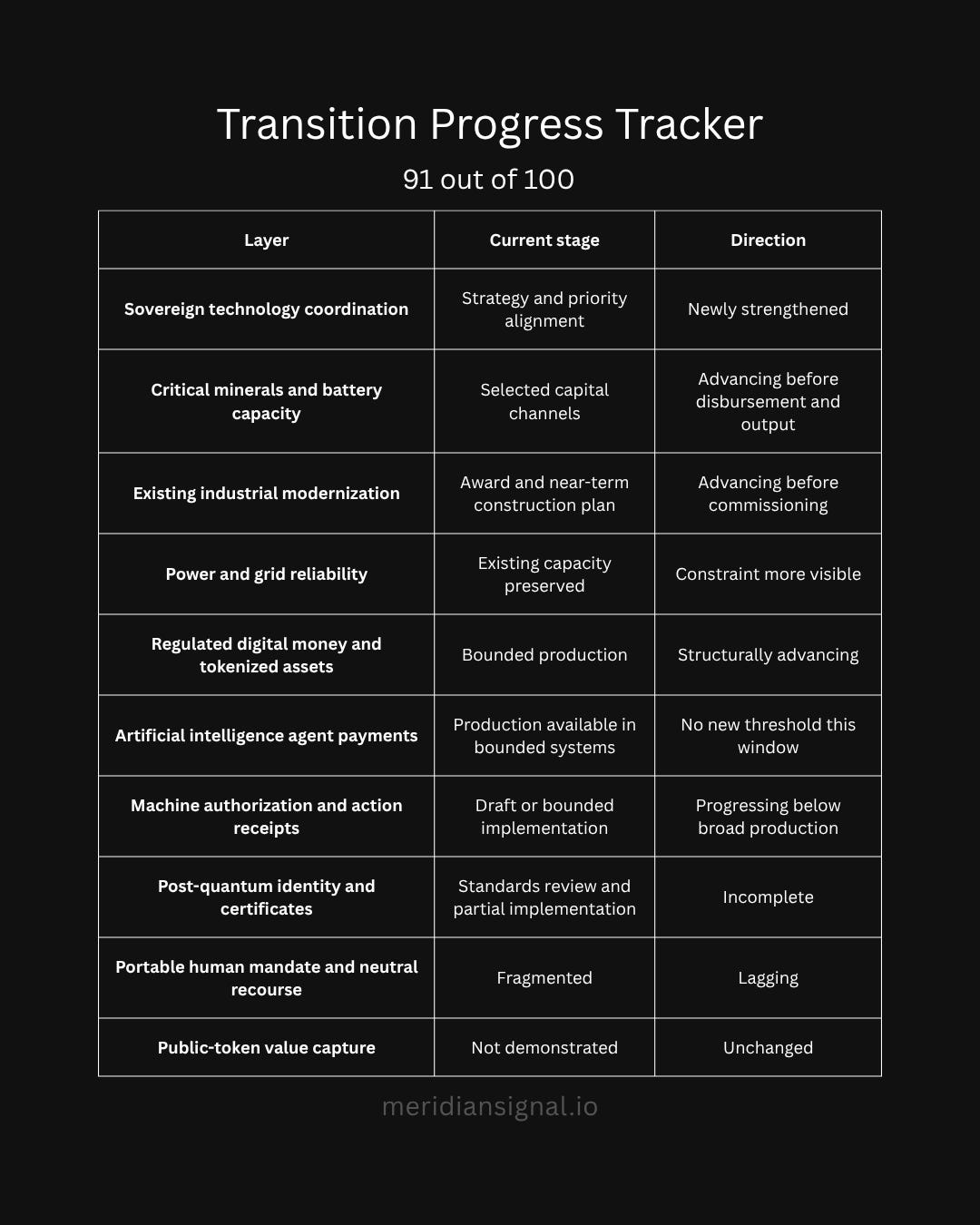
This score measures verified structural progress. It does not mean the transition is 91% complete.
Meridian Consensus
Here is what changed in our thinking:
Sovereign sequence confidence increased: One national-security strategy now places several previously separate dependency layers inside a coherent technology map.
Physical bottleneck conviction increased: Minerals, steel, and power received concrete policy or capital support.
Production discipline remains unchanged: Strategy, selections, awards, emergency orders, advisory meetings, and drafts are classified according to their actual stage.
Near-term investability declined: Higher real yields and falling reserves raised the burden on long-duration and leverage-dependent exposure.
Labor did not confirm a broad break: Firing remains low, but hiring breadth is weak.
Machine-trust conclusion remains incomplete: Identity, authorization, evidence, portability, and recourse are advancing unevenly.
Public-token conclusion remains unchanged: No public token qualifies.
Structural reassessment: Not triggered.
The transition gained sovereign intent.
The production burden remains.
Signal Stability
99 out of 100 | Thesis unchanged
The signal is stable because official strategy, energy policy, capital awards, central-bank data, Treasury yields, labor releases, and technical standards records reinforce the same direction.
The transition is becoming more institutional, more physical, and more concentrated around scarce control points.
The new evidence strengthens the sequence without proving that every announced layer will execute on time.
Signal Quality
97 out of 100 | Very high signal
Here is the evidence we trust most:
official national-security strategy
selected government capital and announced awards
emergency reliability orders
central-bank balance-sheet data
official nominal and real yield curves
official labor releases
standards records with explicit stage labels
Here is what we continue to discount:
strategy presented as deployment
awards presented as completed output
preserved generation presented as new capacity
meetings presented as adopted rules
drafts presented as universal infrastructure
network participation presented as mandatory token demand
Our filter remains simple.
Intent is not production.
Capital is not output.
Participation is not capture.
Meridian Positioning
Defensive selectivity with a sovereign-bottleneck bias
Near-term investability: 56 out of 100
The structural map improved.
The entry environment became less forgiving.
We prefer infrastructure that already controls or is positioned to control:
current revenue and free cash flow
contracted demand or regulated necessity
scarce power, interconnection, permits, processing, or industrial sites
funded modernization with credible execution capacity
regulated custody, settlement, identity, compliance, or recovery
authoritative records that counterparties cannot bypass
balance sheets capable of carrying expensive financing and losses
We remain cautious where the case depends on:
pre-revenue duration without funding certainty
leverage
construction values that ignore financing conditions
standards progress without production use
gross activity without retained economics
public tokens without mandatory, material, recurring value routing
The transition remains investable selectively.
It is not investable indiscriminately.
Strategic Posture
Here is how we are positioning from here:
Preserve liquidity while real yields and long-term funding costs remain elevated.
Avoid new leverage that depends on fast refinancing or distant cash flow.
Follow power, materials, industrial capacity, regulated distribution, identity, security, and authoritative records.
Treat project selections and awards as timing evidence until agreements, disbursements, construction, and output are verified.
Prefer existing assets with funded modernization over greenfield assumptions that still need financing, permits, interconnection, and customers.
Require artificial intelligence agent-specific payment volume, repeat use, fraud, refunds, disputes, and losses before upgrading agent-commerce economics.
Require deployed authorization, portable mandate, independent verification, and credible recourse before upgrading machine trust.
Keep Arc and every public-token candidate on the watchlist until production and unavoidable economic capture are verified.
We are not stepping away from the transition.
We are moving closer to the infrastructure that the transition cannot avoid.
What Would Confirm This Signal
Signed funding agreements and cash disbursement into the selected mineral and industrial projects
Visible construction milestones, commissioning dates, and incremental output
New power capacity or durable contracted supply, not only emergency preservation
Broad deployment of interoperable identity, authorization, and action-receipt standards
Stable or improving reserve conditions alongside lower real financing costs
Public-token demand that is mandatory, material, recurring, and difficult to bypass
What Would Weaken It
Material cancellation or delay of selected projects
Capital awards that fail to convert into construction and output
Grid constraints that materially slow compute or industrial deployment
Higher real yields without stronger cash generation
Closed control stacks that prevent portability and concentrate liability without credible recourse
Infrastructure adoption that continues to bypass the associated public token
One Core Takeaway
Sovereign intent is converging on power, materials, identity, security, and authoritative control. Production will determine who captures the value.
Meridian Signal
Bold clarity at the right time.
AI-assisted. Human-directed. Source-verified.
General informational analysis only. This is not individualized financial, investment, legal, tax, accounting, or custody advice.