

Publication date: August 15, 2026 | Reporting Period: Week 33
System state: Structural acceleration under restrictive but functional liquidity, with value concentrating in corporate and creditor claims
Here is the simplest way to understand this week-end signal.
The liquidity pressure we were watching arrived, but it did not become a funding break.
Treasury cash rose. Reserve balances fell. Long-term government borrowing remained expensive. Yet money markets continued to function normally.
At the same time, Figure disclosed billions of dollars in blockchain-integrated credit activity, along with material revenue, profit, and marketplace economics.
This is where the week became strategically important.
The financial infrastructure reached scaled production.
The associated public token did not capture the value.
The economics flowed primarily to the platform operator, creditors, concentrated loan purchasers, certificate issuer, and voting controllers.
The transition did not slow.
It became more economically legible.
Since Our Mid-Week Signal
Here is what materially changed:
The Treasury cash rebuild became an observed reserve drain. In the week ended August 12, the Treasury General Account increased by $56.626 billion on a weekly-average basis while reserve balances declined by $49.290 billion. The Treasury account then closed August 13 at $966.587 billion. The direction is restrictive, although one weekly balance-sheet release cannot assign every reserve movement to a single cause. Federal Reserve H.4.1, August 13, Daily Treasury Statement
Tighter liquidity did not become market dysfunction. The August 13 thirty-year Treasury auction cleared $25 billion at a 5.216% high yield and a 2.39 bid-to-cover ratio. The Secured Overnight Financing Rate remained 3.62% on $2.932 trillion of transaction volume, while the effective federal funds rate remained inside the Federal Reserve’s target range. Treasury auction result, August 13, New York Federal Reserve secured-rate data, New York Federal Reserve transaction volume, New York Federal Reserve effective federal funds rate
The economic data moved toward an uncomfortable slowdown, not a clean easing signal. July headline producer prices were unchanged from June, but the measure excluding food, energy, and trade services increased 0.4% for the month and 4.7% from a year earlier. July retail sales declined 0.6%, while initial unemployment claims remained low at 209,000. Demand softened, underlying producer pressure remained sticky, and labor did not confirm a recessionary break. Bureau of Labor Statistics producer prices, August 13, Census retail-sales archive, release CB26-131, Department of Labor claims archive
Figure disclosed scaled operating evidence. Its second-quarter results included $4.259 billion in Consumer Loan Marketplace volume, $2.773 billion through Figure Connect, $225.6 million in net revenue, $87.4 million in net income, and $119.4 million in adjusted earnings before interest, taxes, depreciation, and amortization. Figure Connect supplied 65% of marketplace volume. Figure earnings release, Figure second-quarter filing
World Liberty received preliminary conditional approval to organize a national trust bank. This is a sovereign launch enabler, not an operating bank. Final approval, capitalization, liquidity, and pre-opening conditions remain. The approved business plan expressly excludes issuing, custodying, or dealing in the WLFI token. Office of the Comptroller of the Currency decision, August 14
Machine-trust and post-quantum standards became more testable, but no production threshold was crossed. Composite post-quantum certificate work entered Internet Engineering Steering Group evaluation, while action-authorization and receipt drafts added executable enforcement and conformance tools. These remain draft or bounded implementations, not adopted universal standards, scaled deployments, or legal recourse systems. Composite post-quantum certificate draft, Authorization-token enforcement draft, Artificial intelligence agent action-receipt profile
Executive Assessment
Two things happened at the same time.
The structural transition became more proven.
The near-term investment environment became slightly less forgiving.
Figure supplied the strongest new production evidence. It showed that blockchain-integrated credit can support recurring marketplace activity, significant revenue, profitability, lender participation, and customer adoption.
But the filing also showed where the economics actually went.
Figure’s net take rate was 3.6%. Its top five loan purchasers acquired 54.4% of loans sold. Four customers represented 55% of trade receivables. Its dual-class structure gives Class B shares ten votes for every one vote attached to Class A shares.
Meanwhile, Figure reported only $1,000 of HASH gas expense for the quarter, reimbursed in cash.
That is unusually clear evidence.
The blockchain can support the operating system without making its public token the primary economic claim.
World Liberty reinforced the same principle from a different direction.
A regulated pathway can advance while the affiliated governance token remains outside the approved bank architecture.
The technical transition is real.
The ownership structure determines who gets paid.
What Is Actually Happening
1. Liquidity became tighter, but the system remained functional
The Treasury cash rebuild is no longer only a projected headwind.
It appeared in the Federal Reserve’s weekly balance sheet as Treasury cash increased and reserve balances declined.
That matters because fewer reserve balances can make liquidity more restrictive, particularly when long-term government yields and real yields remain high.
But we should not turn tighter liquidity into a crisis narrative.
The thirty-year auction cleared. Secured overnight markets processed nearly $3 trillion in transactions. The effective federal funds rate remained inside the policy range.
The correct reading is:
Expensive sovereign finance. Restrictive liquidity. Functioning market plumbing.
A functioning system can continue financing structural infrastructure while still punishing leverage, weak balance sheets, and assets dependent on distant future adoption.
2. Figure crossed the scaled-production evidence threshold
Figure’s results move blockchain-integrated credit beyond a pilot or availability claim.
The platform disclosed activity that had already occurred, with operating volume, revenue, income, take rate, creditor products, third-party borrowing, loan purchasers, and customer concentration.
That qualifies as scaled-production evidence.
It does not mean every part of the architecture deserves the same classification.
YLDS is a live unsecured certificate issued by a Figure entity. It is creditor exposure, not equity ownership in Figure or residual ownership of a protocol.
HASH is used for network execution, but the reported cost was economically negligible relative to the marketplace activity.
This is the key distinction:
The platform produced measurable economics.
The public token did not receive measurable material capture from that flow.
3. Scale is increasing concentration as well as adoption
Figure’s volume expanded rapidly, but its take rate declined from 4.0% to 3.6%.
At the same time, the top five loan purchasers acquired more than half of the loans sold.
This tells us that growth alone is not enough.
We also need to know:
Who controls the funding?
Who owns the customer relationship?
Who receives the spread?
Who can compress the platform’s pricing?
Who absorbs credit losses?
Who controls the voting rights?
Scaled production validates the category.
It does not remove capital-structure, concentration, credit, or governance risk.
4. World Liberty received permission, not production
The preliminary charter approval creates a legal pathway for a supervised stablecoin-focused national trust bank.
It does not mean the bank is open.
It does not prove customer activity, stablecoin volume, reserve economics, recurring revenue, or operating performance.
The institution must still satisfy capitalization, liquidity, operating, compliance, and final-approval conditions.
The decision also explicitly excludes the WLFI token from the approved bank plan.
This should prevent two common analytical errors:
Permission is not production.
Institutional affiliation is not public-token dependency.
5. Trust infrastructure advanced below the production line
The post-quantum certificate and machine-action receipt work became more concrete.
Drafts now describe more deterministic authorization, executor binding, replay controls, conformance tests, and clearer separation between prior approval, controller-reported outcome, and real-world effect.
That improves the architecture.
It does not create legal authority, universal adoption, neutral verification, insurance, liability allocation, or compelled recovery.
The receipt is becoming easier to test.
It is not yet universally authoritative.
The Hidden Transition
The hidden transition is from public rails to private control stacks.
The first phase of the market focused on whether assets, payments, or credit could move through blockchain infrastructure.
That question is increasingly being answered.
The more important questions now are:
Who owns the authoritative record?
Who controls customer access?
Who receives the take rate or spread?
Who provides custody and settlement?
Who supplies capital and absorbs losses?
Who has the legal right to enforce the claim?
Who carries responsibility when the system fails?
The open rail may remain important.
But the durable economics are concentrating above it, inside regulated institutions, customer relationships, credit agreements, custody systems, reserve accounts, servicing rights, and voting control.
This is not an argument against public tokens.
It is an evidence standard.
A public token qualifies only when production creates mandatory, material, recurring demand or value routing that cannot be bypassed.
This week’s evidence did not meet that standard.
Transition Progress Tracker
89 out of 100
Direction: Advancing, with liquidity, concentration, human mandate, and recourse constraints
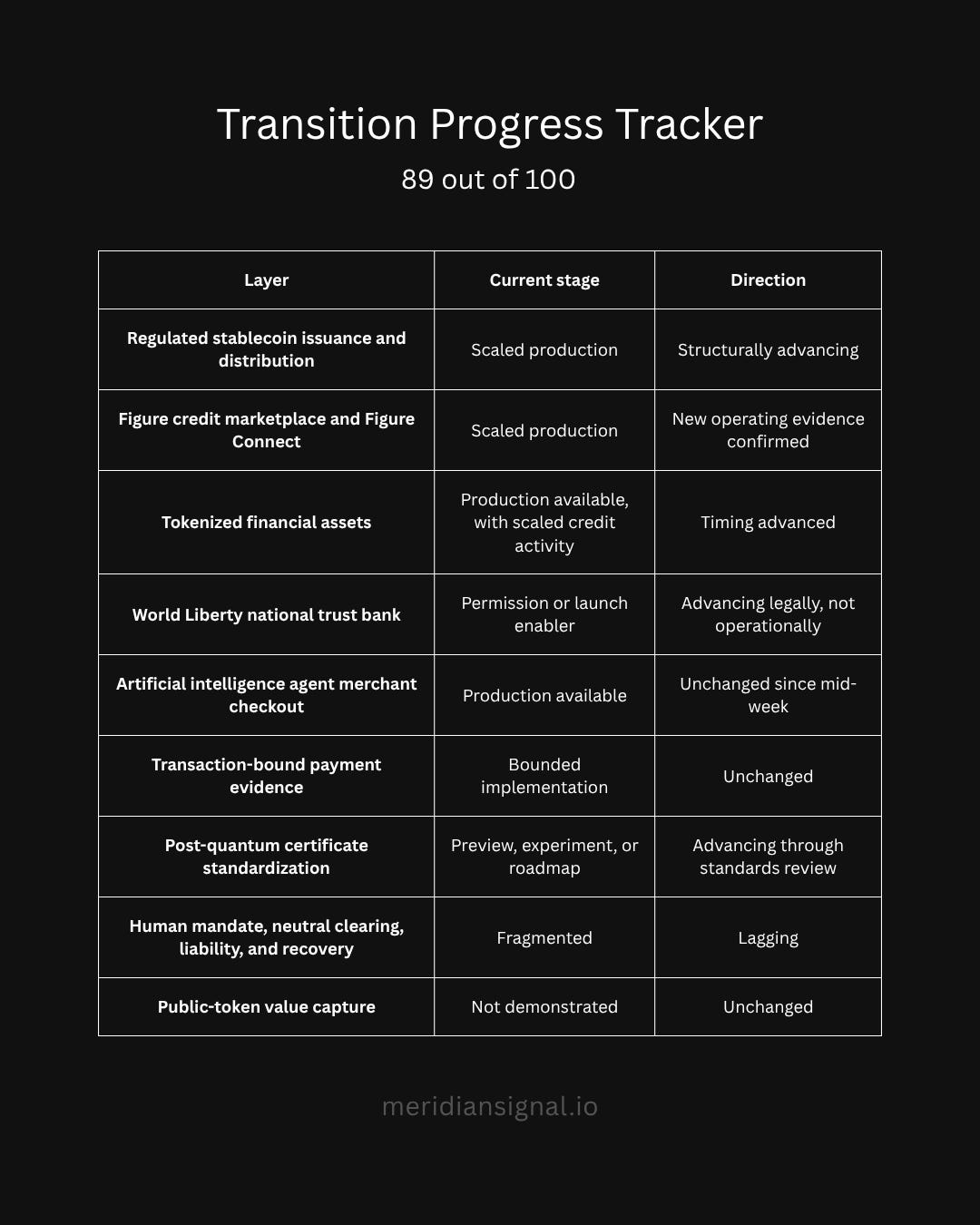
Two readiness readings continue to define the remaining gap:
Artificial intelligence agent clearing and recourse readiness: 42 out of 100
Cryptographic agility and post-quantum readiness: 59 out of 100
Neither changed this week.
The transition-progress reading increased because Figure supplied scaled financial-production evidence.
It did not increase because of charter permission, technical drafts, network affiliation, or token activity.
This score measures verified progress. It does not mean the transition is 89% complete.
Meridian Consensus
Here is what changed in our thinking:
Thesis unchanged: Regulated digital money, tokenized financial assets, artificial intelligence agents, wallets, verification, and trust infrastructure continue to converge.
Liquidity assessment confirmed: The Treasury cash rebuild is absorbing liquidity, but money markets remain functional.
Tokenized-financial-asset timing advanced: Figure supplied scaled operating and financial evidence, raising this layer’s timing reading from 98 to 99.
Value-capture conviction increased: Corporate equity, creditors, loan purchasers, certificate issuers, reserve managers, custodians, and legal controllers remain the stronger economic claims.
Near-term investability declined: Softer demand, sticky producer-price internals, reserve drainage, and elevated long-term yields reduced the reading from 58 to 57.
Stablecoin sovereign entry advanced: World Liberty received preliminary permission. No production, operating economics, or WLFI dependency was established.
Standards confidence improved: Post-quantum certificates, authorization enforcement, and action receipts became more testable. Their production classification did not change.
Public-token conclusion unchanged: No public token qualifies. Arc remains watchlist only.
Structural reassessment: Not triggered.
The infrastructure earned more credibility.
The entry environment became less forgiving.
Signal Stability
98 out of 100 | Thesis unchanged
Signal stability increased because multiple independent primary sources reinforced the same structural conclusion.
Federal Reserve and Treasury data confirmed restrictive but functioning liquidity.
Securities filings confirmed scaled operating activity and measurable corporate capture.
The banking regulator confirmed supervised entry while preserving capital and final-approval gates.
Technical standards records confirmed progress without supporting a production claim.
The signal became more stable because the evidence allowed us to separate:
Production from permission.
Operating economics from transaction volume.
Standards progress from adoption.
Blockchain use from public-token capture.
The transition remains structurally intact.
Signal to Noise Ratio
94 out of 100 | Very high signal
Here is the evidence we trust most:
central-bank balance-sheet data
executed Treasury auction results
transaction-based money-market benchmarks
official inflation, retail, and labor releases
securities filings with volume, revenue, income, take rate, costs, and concentration
regulator decisions with explicit conditions and exclusions
technical records that clearly identify their draft or implementation stage
Here is what we continue to discount:
transaction volume presented without net economics
charter approval presented as an operating bank
affiliation presented as token dependency
a draft presented as an adopted standard
a running reference implementation presented as scaled production
blockchain activity presented without mandatory token demand
platform-wide activity presented as artificial intelligence agent adoption
Our filter remains simple.
Volume is not value capture.
Permission is not production.
Testability is not adoption.
Use is not token demand.
Meridian Positioning
Defensive selectivity
Near-term investability: 57 out of 100
Our confidence in the transition increased.
Our willingness to chase it declined slightly.
The Treasury cash rebuild is absorbing liquidity. The ten-year real Treasury yield remained 2.41%, while the thirty-year nominal yield reached 5.25% in the Treasury’s August 14 observations. Retail demand weakened, but underlying producer-price pressure remained persistent. Treasury nominal yield curve, Treasury real yield curve
That combination favors strong balance sheets, short-duration liquidity, current cash generation, and enforceable claims.
We prefer infrastructure that already controls:
recurring net revenue
customer and merchant relationships
regulated issuance and custody
authoritative ownership and credit records
reserve management and conversion
legal servicing and recovery
identity, managed keys, policy, and secure execution
balance-sheet capacity and loss absorption
We remain cautious where the case depends on:
leverage
distant future adoption
gross transaction volume without margin
concentrated funding with weakening pricing power
permission without opening
technical standards without production use
public tokens without mandatory value routing
The transition remains investable selectively.
It is not investable indiscriminately.
Strategic Posture
Here is how we are positioning from here:
Preserve short-duration liquidity while Treasury cash, real yields, and long-term funding costs remain elevated.
Avoid new leverage. Flat headline producer prices do not create easy money when internal price pressure remains sticky.
Prefer net revenue, take rate, cash generation, and enforceable claims over gross transaction volume.
Treat Figure as evidence for scaled corporate platform economics, not as a HASH-token promotion.
Monitor Figure’s take rate, credit performance, cash conversion, purchaser concentration, and customer concentration before upgrading the investment conclusion.
Treat YLDS as unsecured issuer credit. Evaluate it through issuer assets, liquidity, losses, covenants, and recovery, not as protocol ownership.
Treat World Liberty as a conditional bank-formation event until final approval, opening, reserve transfer, customers, and audited economics are verified.
Require artificial intelligence agent-specific payment value, repeat use, transaction size, fraud, refunds, disputes, and losses before upgrading agent-commerce economics.
Treat machine-action receipts and post-quantum certificate work as evidence of category timing, not proof of universal adoption or legal completion.
Keep Arc on the watchlist until public production, independent fee-bearing activity, token delivery, and operating capture are verified. Circle Arc target
Do not promote HASH, WLFI, Arc, Solana, Chainlink, or another public token from integration, affiliation, permission, or transaction volume alone.
We are not stepping away from the transition.
We are moving closer to the claims that can prove who receives the cash, who controls the record, and who carries the loss.
One Core Takeaway
The transition is real. The durable value is concentrating in the corporate and creditor stack that owns the record, the spread, the customer, and the liability, not automatically in the public token.
Meridian Signal
Bold clarity at the right time.
AI-assisted. Human-directed. Source-verified.
General informational analysis only. Not individualized investment advice.