Meridian Signal | Weekly Conviction Intelligence Report (WCIR)
Executive Summary
Bitcoin has entered a more defensive phase.
After several weeks of fragile stabilization, the market has lost the $60,000–$62,000 support zone, while institutional demand has weakened materially through sustained ETF outflows. Liquidity conditions remain restrictive, risk appetite has deteriorated, and short-term momentum has shifted against Bitcoin.
Importantly, the long-term investment thesis has not been invalidated.
Network security remains near record highs, exchange balances continue to trend lower, and Bitcoin’s role as a scarce digital monetary asset remains intact. What has changed is the tactical environment.
This week’s report suggests that Bitcoin has transitioned from Fragile Repair back into Structural Stress, requiring patience rather than aggressive positioning.
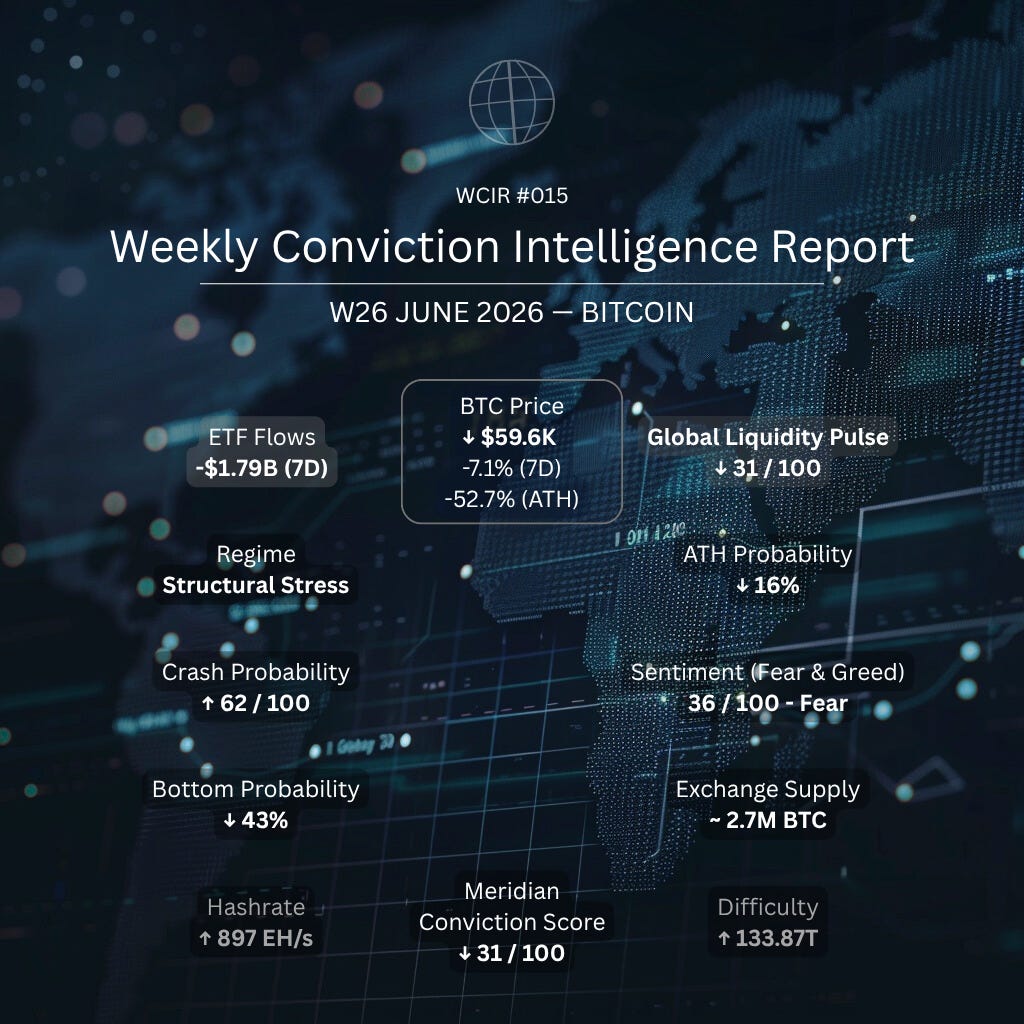
Meridian Conviction Score
31 / 100
Classification: Defensive
Conviction declined meaningfully this week as several important structural indicators weakened simultaneously.
The primary deterioration came from sustained institutional ETF outflows combined with Bitcoin losing one of its most important technical support zones near $60,000.
The score remains above crisis territory because the network itself continues to strengthen. Hashrate remains exceptionally high, mining security is robust, and exchange supply continues to contract.
The weakness is demand-driven rather than protocol-driven.
Fresh Intelligence
Several developments materially changed Bitcoin’s short-term outlook:
Bitcoin lost the $60,000–$62,000 support zone.
Spot Bitcoin ETFs recorded approximately $1.79 billion in net weekly outflows, marking one of the weakest institutional demand periods in recent months.
Global liquidity remains restrictive as financial conditions continue to pressure risk assets.
Exchange balances remain historically compressed, preventing the structural thesis from breaking despite weaker demand.
Bitcoin mining continues operating near record security levels, reinforcing long-term network resilience.
Structural Assessment: Liquidity
Liquidity remains the primary headwind.
Restrictive monetary conditions continue limiting capital flows into higher-risk assets, preventing Bitcoin from establishing sustained upside momentum.
Institutional Capital
Institutional demand deteriorated significantly.
ETF outflows indicate that large investors are currently reducing exposure rather than accumulating weakness.
This remains the single largest negative development during the week.
Supply Dynamics
Supply continues to support the long-term thesis.
Exchange balances remain historically low, suggesting long-term holders continue removing Bitcoin from liquid markets.
Should institutional demand recover, the available liquid supply remains structurally limited.
Network Security
Network fundamentals remain exceptionally strong.
Hashrate and mining difficulty continue operating near historical highs, demonstrating continued confidence from miners despite weaker market prices.
The protocol itself continues strengthening.
Regime Assessment
Current Regime: Structural Stress
The market is no longer in recovery.
Instead, Bitcoin has entered a period where capital preservation and confirmation become more important than aggressive accumulation.
This does not imply a long-term bearish thesis.
It reflects a deterioration in current market conditions while the underlying network remains healthy.
Risks
Current downside risks include:
Continued ETF outflows.
Additional tightening in global liquidity.
Failure to reclaim the $60,000–$62,000 range.
Broader weakness across global risk assets.
Opportunities
Despite the weaker environment, several structural positives remain intact:
Historically low exchange supply.
Record network security.
Strong long-term holder conviction.
Continued institutional infrastructure supporting Bitcoin.
These factors continue supporting the long-duration investment thesis.
Meridian Strategic Conclusion
If you only looked at Bitcoin’s network fundamentals, you would likely conclude that the long-term thesis continues strengthening.
If you only looked at price, you might conclude the opposite.
The truth currently sits between those two realities.
Bitcoin is experiencing a demand problem rather than a structural problem.
Institutional capital has stepped back temporarily, but the underlying monetary characteristics that make Bitcoin unique remain intact.
That distinction matters.
Markets often repair fundamentals before prices recover—or prices recover before narratives catch up. Today, neither has fully happened.
Until institutional demand stabilizes and Bitcoin successfully reclaims the $60,000–$62,000 range, patience remains the appropriate posture.
The long-term thesis remains constructive.
The short-term environment requires discipline.
Editorial Note
The Bitcoin Weekly Conviction Intelligence Report (WCIR) is a strategic intelligence publication by Meridian Signal designed to evaluate Bitcoin through the lens of market structure, institutional capital flows, liquidity conditions, supply dynamics, network security, and probabilistic regime analysis.
Its purpose is not to predict short-term price movements or provide investment recommendations, but to assess the quality of Bitcoin’s current structural position, identify meaningful shifts in conviction, and reduce uncertainty for long-term strategic decision-making.
The Meridian Conviction Score, regime classifications, probability framework, and strategic posture represent analytical judgments derived from the Meridian Signal intelligence framework. They are intended to help readers interpret evolving market conditions rather than forecast outcomes with certainty.
All assessments reflect the information available at the time of publication and may change as new evidence emerges.
Meridian Signal is committed to evaluating structure over price, probabilities over predictions, conviction over emotion, and signal over noise.
Meridian Signal
Independent Strategic Intelligence Desk
General informational analysis. Not financial advice