

Publication date: August 26, 2026
System state: Advancing trust coordination inside a restrictive but functioning financial regime
Here is the simplest way to understand this mid-week signal.
The next stage of artificial intelligence and digital finance is not being built through software capability alone.
It is being built through control.
The United States Treasury is organizing the financial sector around post-quantum security. Amazon Web Services has proposed an open way for artificial intelligence systems to discover agents, tools, and skills across registries. Bank-facing tokenized-deposit infrastructure can now preserve the legal account and customer relationship while adding programmable settlement interfaces.
These developments point in the same direction.
New technology is being absorbed through institutions that can identify actors, define authority, preserve records, migrate security, reconcile legal claims, and carry responsibility when something fails.
The control layer is taking shape.
The system is not yet open.
Since Our Week-End Signal
Here is what materially changed:
The United States Treasury launched a public-private Quantum-Readiness Task Force for the financial sector. Its work covers post-quantum transition, vendor readiness, digital assets, and emerging-technology risk. This is a real coordination structure. It is not a completed cryptographic inventory, funded migration, or production conversion. United States Treasury
Amazon Web Services published Agentic Resource Discovery, an open specification intended to help registries expose artificial intelligence agents, tools, Model Context Protocol servers, and skills across organizations and clouds. Reference implementations exist. Amazon Web Services Agent Registry remains in preview, and cross-registry federation is not yet established as recurring production. Agentic Resource Discovery, Agent Registry preview
A newly recovered Anchorage Digital disclosure shows a commercially available parallel-ledger path for banks to support tokenized deposits without replacing core systems. The architecture preserves the originating bank’s account, compliance perimeter, and reconciliation role. No named bank customer, transaction volume, revenue, or independently verified production use was disclosed. Anchorage Digital
July durable-goods orders rose 1.1 percent. Orders excluding transportation rose 0.4 percent. Core capital-goods shipments rose 1.4 percent, while unfilled core orders rose 0.5 percent. Productive demand remained resilient, although the survey is nominal and subject to revision. United States Census Bureau
Long-duration financing eased modestly. From August 21 to August 26, the ten-year Treasury yield declined from 4.74 percent to 4.66 percent. The thirty-year declined from 5.27 percent to 5.18 percent. Ten-year and thirty-year real yields fell to 2.34 percent and 2.92 percent. Capital became slightly less restrictive. It did not become cheap. Treasury nominal yield curve, Treasury real yield curve
Short-term corporate funding remained functional. Commercial-paper rates were stable and did not show a lower-quality funding break. Federal Reserve
No universal wallet, portable human mandate, selective-disclosure layer, neutral recourse system, or public-token gate crossed into broad production.
Executive Assessment
The transition is becoming more organized.
It is not becoming less dependent on institutions.
Artificial intelligence agents can discover more resources. That does not tell them which human or legal principal they represent, what authority was delegated, which policy applies, how authorization is revoked, or who bears the loss.
Tokenized deposits can add programmable interfaces. That does not remove the bank’s legal claim, customer relationship, compliance obligations, reconciliation role, or recovery responsibility.
Post-quantum coordination can accelerate security migration. That does not mean the financial sector has completed its inventories, budgets, procurement, testing, or production conversion.
The common pattern is not disintermediation.
It is recombination.
New technical layers are being joined to regulated balance sheets, authoritative records, enterprise policy, cryptographic continuity, and institutional recourse.
That is where responsibility sits.
It is also where value is most likely to concentrate.
What Is Actually Happening
Post-quantum security is moving from recognition toward coordination
The Treasury task force gives the financial sector a defined forum for dependency mapping, cryptographic agility, vendor readiness, and operational resilience.
That is more meaningful than a general policy statement because it begins to organize the actors that must execute the migration.
The next gates are concrete: membership, inventories, deadlines, budgets, procurement, testing, and adoption metrics.
Until those arrive, the correct label is coordination.
Artificial intelligence agents are gaining a discovery layer
Agentic Resource Discovery addresses a real problem. As agents, tools, servers, and skills multiply, systems need a common way to find and describe them across registries.
Discovery is necessary.
It is not sufficient.
A registry can identify a resource and record its owner, version, approval state, or revocation status. It does not automatically create portable identity, human authority, safe execution, liability, or recourse.
The open specification may reduce fragmentation. The economics are more likely to sit in registry operation, security, hosting, policy enforcement, audit, and adjacent enterprise services than in the specification itself.
Tokenized deposits preserve the regulated center
The Anchorage architecture is important because it does not require a bank to surrender its core account system.
The bank can retain the deposit claim, customer relationship, compliance perimeter, and authoritative reconciliation while adding wallet, custody, smart-contract, and mint-and-burn interfaces.
That is a practical adoption path.
It also shows why infrastructure activity does not automatically produce public-token value. Banks and providers can substitute rails, reimburse transaction costs, or retain the primary economics around the legal account.
The next proof is not another product announcement. It is a named bank, live settlement, recurring volume, reliable reconciliation, and disclosed economics.
The financing environment improved at the margin
Long nominal and real yields moved lower, productive investment data remained resilient, and short-term funding continued to function.
That supports a one-point improvement in near-term investability.
The restraint remains important. A ten-year real yield of 2.34 percent and a thirty-year real yield of 2.92 percent still impose a high burden on distant, uncertain cash flows.
The environment rewards current revenue, funded execution, and balance-sheet resilience more than narratives built around future adoption.
The Hidden Transition
The hidden transition is from visible capability to enforceable responsibility.
Artificial intelligence can reason and act. Digital money can move continuously. Registries can expose machines and tools across organizations.
But consequential activity still needs a control system:
identity that binds the actor to a principal
authority that defines what the actor may do
policy that limits assets, counterparties, amounts, time, and geography
cryptography that survives the next security regime
records that prove what was requested and executed
recovery and recourse when the outcome is wrong
regulated institutions able to carry legal and financial responsibility
The transition is not removing these functions.
It is making them more important.
Transition Progress Tracker
92 out of 100
Direction: Advancing through coordinated trust migration and discoverable agent infrastructure, with universal production still incomplete
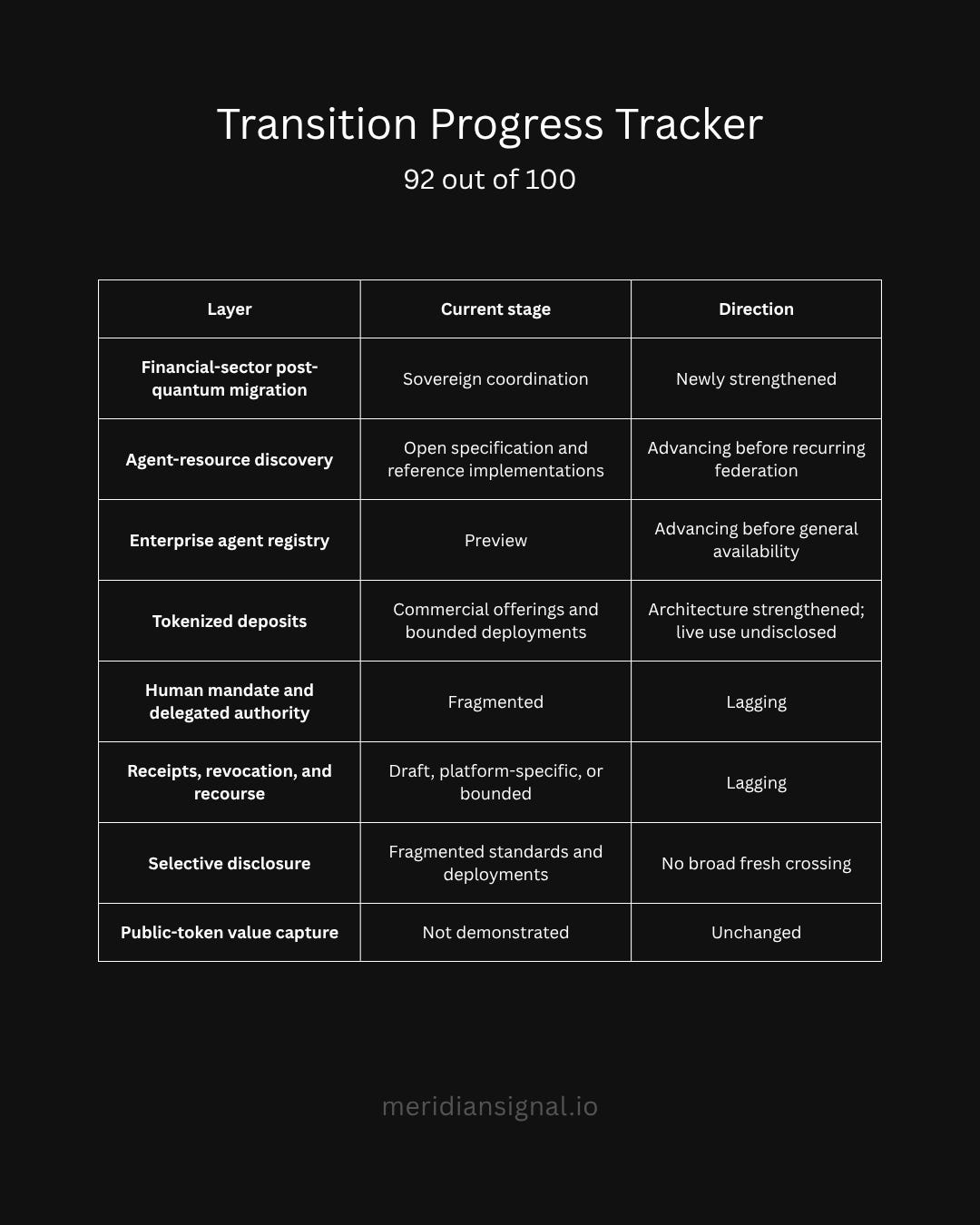
This score measures verified structural progress. It does not mean the transition is 92 percent complete.
Meridian Consensus
Here is what changed in our thinking:
Sequence confidence increased: Post-quantum coordination and agent-resource discovery reinforce the dependency chain beneath artificial intelligence and digital finance.
Trust-layer conviction increased: Cryptographic migration, registries, policy enforcement, custody, authoritative records, and reconciliation are becoming harder to avoid.
Production discipline remains unchanged: A task force is coordination. A specification is design. A preview is preview. Commercial availability is not scaled customer use.
Near-term investability improved modestly: Lower long yields and resilient capital-goods demand made the environment slightly less hostile.
Open-system conclusion remains incomplete: Discovery improved, but portable identity, mandate, authorization, receipts, revocation, and recourse remain fragmented.
Public-token conclusion remains unchanged: No public token qualifies.
Structural reassessment: Not triggered.
The system became more executable.
The economics remained concentrated around control.
Signal Stability
99 out of 100 | Thesis unchanged
The new evidence reinforces the existing thesis.
Artificial intelligence and digital finance are advancing through regulated institutions, sovereign coordination, enterprise registries, authoritative ledgers, security infrastructure, and policy controls.
The transition is moving forward without proving universal openness or broad public-token capture.
Signal Quality
97 out of 100 | Very high signal
Here is the evidence we trust most:
official Treasury coordination
official durable-goods and capital-goods data
official nominal and real yield curves
official commercial-paper data
first-party technical specifications with explicit stage labels
product disclosures separated from verified customer use
standards records separated from final adoption
Here is what we continue to discount:
task forces presented as completed migration
specifications presented as interoperability
previews presented as general production
product availability presented as customer scale
gross activity presented as retained economics
infrastructure affiliation presented as public-token dependency
Our filter remains simple.
Discovery is not authority.
Availability is not adoption.
Activity is not capture.
Meridian Positioning
Defensive selectivity with a regulated-trust and sovereign-bottleneck bias
Near-term investability: 57 out of 100
We prefer infrastructure that already controls or is positioned to control:
realized revenue and free cash flow
regulated deposits, custody, settlement, and distribution
authoritative account, identity, certificate, and transaction records
post-quantum inventory, testing, agility, and migration
enterprise agent registries, policy, security, audit, and lifecycle control
recovery, dispute resolution, and legal recourse
scarce power, industrial sites, materials, and productive capacity
We continue to discount:
long-duration exposure dependent on rapid yield declines
task-force participation marketed as revenue
open specifications marketed as adoption
preview services marketed as established production
vendor availability without named customers or operating evidence
transaction volume without margins, retention, losses, or concentration data
tokens whose networks can operate without mandatory token demand
Strategic Posture
Preserve liquidity. Avoid new leverage. Accumulate evidence before exposure.
Increase conviction when coordination becomes funded execution, specifications become independent interoperability, previews become recurring customer production, and activity produces durable retained economics.
The most valuable control points are likely to be the ones counterparties cannot bypass:
legal account and asset ownership
trusted identity and delegated authority
cryptographic continuity
policy enforcement and audit
custody and recovery
regulated distribution
scarce physical capacity
Open access can expand while ownership remains narrow.
What Would Confirm This Signal
Treasury publishes funded post-quantum milestones, sector inventories, procurement, or adoption measures.
Independent registries demonstrate recurring Agentic Resource Discovery federation across vendors.
Amazon Web Services Agent Registry reaches general availability with production metrics.
A named bank reports live tokenized-deposit settlement, reconciliation, volume, reliability, and retained economics.
Portable identity, human mandate, request-bound authorization, receipt, revocation, and recourse enter recurring cross-platform production.
Reserve balances rebuild while real yields decline and credit availability broadens.
What Would Weaken It
Post-quantum coordination produces no deadlines, budgets, or measurable migration.
Open discovery remains a specification without independent interoperability.
Agent registries deepen platform lock-in without portable mandates and recourse.
Tokenized deposits fail to produce credible bank adoption or prove inferior to conventional real-time rails.
Real yields return above recent highs or credit conditions fracture.
Productive investment weakens materially after revisions.
One Core Takeaway
The next stage of artificial intelligence and digital finance is being built through institutions that can preserve responsibility.
Follow the identity, authority, records, security, custody, and recourse that the system cannot operate without.
The control layer is taking shape.
The system is not yet open.
Meridian Signal
Bold clarity at the right time.
AI-assisted. Human-directed. Source-verified.
This publication provides general informational analysis only. This is not individualized financial, investment, legal, tax, accounting, or custody advice.