

Publication date: August 19, 2026 | Reporting Period: Week 34
System state: Selective productive strength inside an expensive but functioning sovereign system
Here is the simplest way to understand this mid-week signal.
The United States financial and industrial system is still functioning under pressure.
Productive investment strengthened in July. Foreign demand continued to absorb long-term United States assets. The Treasury also widened the market support it can provide to the longest parts of the government bond market.
Those are signs of resilience and coordination.
They are not signs of easy money.
Since Our Last Signal
Here is what materially changed:
• United States industrial production rose 0.2% in July and 1.1% from a year earlier. Business equipment increased 0.8% during the month and 6.6% from a year earlier. Construction supplies rose 0.8%, while defense and space equipment rose 1.8%. Consumer goods moved in the opposite direction, declining 0.4% in July and 1.8% from a year earlier. The productive side of the economy strengthened selectively. The consumer side did not. Federal Reserve industrial production
• The Treasury announced that it will at least double the maximum size of individual liquidity-support buybacks in two long-term government bond sectors, from $2 billion to at least $4 billion. The larger operations are scheduled to begin September 9. This increases the Treasury’s capacity to support market liquidity. It is not monetary easing, debt cancellation, or evidence that the bond market has failed. United States Treasury buyback announcement
• Foreign demand for long-term United States assets remained substantial. Treasury data released August 17 showed $133.5 billion of total net international capital inflows during June and $172.7 billion of adjusted net purchases of long-term securities. But foreign holdings of Treasury bills declined by $29.0 billion, while banks’ own net dollar liabilities to foreign residents declined by $34.4 billion. Demand remains deep, but it is not uniform across every instrument. United States Treasury international capital data
• Long-term borrowing costs rose early in the week and then partially retreated. The ten-year nominal Treasury yield reached 4.72% on August 17 before ending August 19 at 4.65%. The thirty-year yield reached 5.31% before ending at 5.19%. The ten-year real yield finished at 2.35%. The pressure eased. The cost of capital remained restrictive. United States Treasury nominal yield curve, United States Treasury real yield curve
• Our full reconciliation of BitGo’s second-quarter disclosure sharpened the value-capture map. The company reported $4.329 billion of revenue, but $4.287 billion of direct costs, a $19.0 million net loss, and a $4.2 million adjusted operating earnings loss. Its digital asset sales business retained approximately 17 basis points before other operating expenses. The infrastructure is real. The headline revenue greatly overstates the value retained by the company. BitGo second-quarter filing exhibit
No new public token qualified.
No new machine-trust production threshold crossed.
Executive Assessment
Here is our read.
The system is becoming more coordinated, not more permissive.
The Treasury is increasing its ability to support liquidity in the longest parts of the government bond market. Foreign investors are still absorbing substantial volumes of long-term United States assets. Industrial production is showing strength in business equipment, construction inputs, and defense-related output.
But none of this means that capital has become cheap.
Real yields remain high. Capacity utilization remains below its long-run average. Consumer-goods production is weakening. The Treasury’s larger buybacks have not begun, and their purpose is to support market function, not to create a broad monetary expansion.
This distinction matters.
A system can be supported without being stimulated.
A market can function while capital remains expensive.
Infrastructure can scale while the company operating it retains only a narrow share of the economics.
That is the current signal.
What Is Actually Happening
1. Productive investment is carrying more of the expansion
The strongest industrial categories are not broad consumer categories.
They are business equipment, construction supplies, and defense and space equipment.
This suggests that capital formation, strategic production, and long-cycle infrastructure are carrying more of the productive impulse than household-facing goods.
That is constructive for the physical transition.
It is not evidence of broad economic acceleration.
Total capacity utilization remained 76.3%, which is 3.1 percentage points below its long-run average. Manufacturing utilization remained 2.2 percentage points below its own long-run average.
The system has room to produce more.
It does not yet have uniform demand across the economy.
2. Sovereign support is moving toward market plumbing
The Treasury’s buyback decision is easy to misunderstand.
The government is not announcing a new program to eliminate debt or lower interest rates across the economy.
It is increasing the amount of older, less-liquid long-term securities it may repurchase during scheduled liquidity-support operations.
That can improve trading conditions and reduce fragmentation in the government bond market.
It does not remove the underlying duration cost.
The ten-year real Treasury yield at 2.35% still creates a demanding hurdle for businesses, long-duration assets, and projects whose economics depend on distant future cash flow.
The system is receiving stronger plumbing.
Investors are not receiving free capital.
3. Foreign demand remains strong, but the composition matters
The latest international capital data do not support the claim that foreign investors are abandoning United States assets.
Adjusted net purchases of long-term securities reached $172.7 billion in June.
But shorter Treasury bill holdings and bank dollar liabilities both declined.
This tells us that the aggregate number is not enough.
We have to track who is buying, what they are buying, which duration they prefer, and whether demand remains durable as sovereign financing needs grow.
The absorption system remains functional.
Its future cost is still unresolved.
4. Scale and value capture continue to separate
BitGo is useful because it shows the difference between activity and ownership economics.
The company operates real institutional custody, wallet, settlement, staking, financing, trading, and stablecoin services. It reported 5,833 clients, $159.0 million of cash, no corporate-level debt, and a treasury holding of 2,523 bitcoin at the end of June.
That is real production infrastructure.
But the company’s largest revenue category carried an extremely narrow spread, while staking and stablecoin-service economics were largely paid outward through direct fees.
The lesson is broader than BitGo.
The size of the activity does not tell us who keeps the value.
The durable opportunity belongs to the layer with customer control, unavoidable fees, authoritative records, legal protection, and operating leverage.
The Hidden Transition
The hidden transition is from open expansion to supervised coordination.
The emerging system is not becoming purely public or purely private.
It is becoming hybrid.
Sovereign institutions preserve liquidity, establish legal boundaries, supervise money, and protect strategic production.
Private institutions operate marketplaces, custody assets, control wallets, distribute regulated money, enforce policies, and retain the customer relationship.
Open networks can move information and value between these layers.
But the wealth is concentrating where movement can be authorized, recorded, financed, insured, or reversed.
That is why infrastructure importance does not automatically create public-token value.
The system needs the function.
The investment claim still has to prove that it captures the economics.
Transition Progress Tracker
90 out of 100
Direction: Advancing through productive and regulated infrastructure
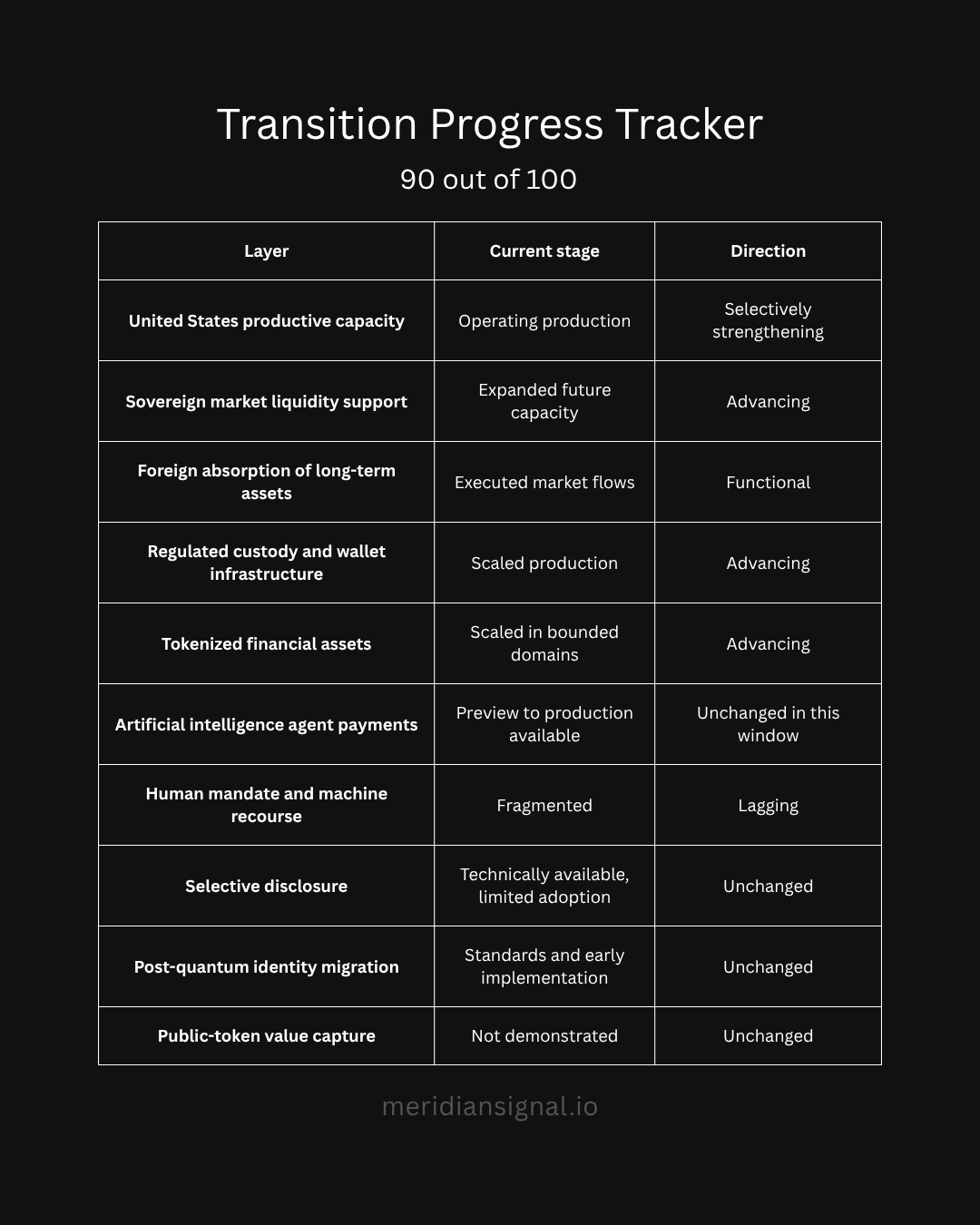
This score measures verified structural progress.
It does not mean the transition is 90% complete.
Meridian Consensus
Here is what changed in our thinking:
• Thesis unchanged: The transition continues to favor regulated money, productive infrastructure, authoritative records, policy-controlled wallets, security, and liability-capable institutions.
• Productive confidence increased: Business equipment and strategic industrial categories strengthened despite weaker consumer-goods production.
• Sovereign coordination became more visible: Treasury expanded its future ability to support liquidity in the long-term government bond market.
• Foreign-demand confidence held: Long-term inflows remained substantial, but the decline in bills and bank liabilities requires continued monitoring.
• Value-capture discipline strengthened: BitGo confirmed that enormous gross activity can coexist with thin retained economics and operating losses.
• Near-term investability improved only slightly: Long-term yields retreated from their weekly highs, but real yields remain restrictive.
• Public-token conclusion unchanged: No public token qualifies.
• Machine-trust conclusion unchanged: No new final standard, portable human mandate, or neutral recourse system crossed into production.
• Structural reassessment: Not triggered.
The system became more resilient.
The price of capital remained high.
Signal Stability
99 out of 100 | Thesis unchanged
The signal strengthened because official industrial data, Treasury market decisions, international capital records, yield curves, securities filings, and technical standards all reinforced the same direction.
The transition is becoming more institutional, more supervised, and more concentrated around hard-to-replicate control points.
The main uncertainty is no longer whether the system will modernize.
It is which claims will retain the economics after sponsors, counterparties, creditors, regulators, and infrastructure providers are paid.
Signal-to-Noise Ratio
96 out of 100 | High signal
Here is the evidence we trust most:
• Official industrial production and capacity data
• Official nominal and real government yield curves
• Executed international capital flows
• Treasury’s published buyback schedule and limits
• Securities filings separating revenue, direct costs, fees, cash, and losses
Here is what we are discounting:
• Liquidity support presented as monetary easing
• Gross revenue presented as retained value
• Foreign inflows presented as unlimited demand
• Production strength in selected categories presented as a broad boom
• Draft standards presented as universal infrastructure
• Network activity presented as mandatory token demand
Our filter remains simple.
Support is not stimulus.
Scale is not capture.
Integration is not ownership.
Meridian Positioning
Defensive selectivity
Near-term investability: 58 out of 100
The balance improved slightly.
Our positioning did not materially change.
Selective production strength and a retreat from the week’s highest long-term yields reduce immediate pressure.
But high real yields still punish leverage, weak balance sheets, and long-duration stories that depend on distant adoption.
We prefer:
• Businesses with visible retained earnings or cash flow
• Regulated marketplaces, custody, and wallet-control infrastructure
• Authoritative records and legally enforceable ownership systems
• Power, equipment, security, and strategic physical inputs
• Short-duration resilience while the real hurdle rate remains high
We remain cautious where the thesis depends on gross transaction flow, future token mechanics, unexecuted authorizations, preview-stage agent commerce, or permanent access to cheap capital.
The transition is advancing.
The ownership standard remains demanding.
Strategic Posture
Here is how we are positioning from here:
• Preserve liquidity while real yields remain restrictive.
• Avoid new leverage that depends on rapid monetary easing.
• Favor productive infrastructure already serving independent customers.
• Separate gross activity from contribution margin, operating income, and free cash flow.
• Track execution of the larger Treasury buybacks beginning September 9.
• Monitor whether foreign demand remains durable across maturities and buyer classes.
• Follow regulated custody, policy wallets, tokenized asset registries, security, and liability-capable institutions.
• Keep artificial intelligence agent-payment systems in the evidence-building stage until recurring economic activity, fraud, disputes, refunds, and liability become visible.
• Keep Arc on the watchlist until public production, independent fee-bearing demand, token delivery, and operating capture are verified.
• Do not promote a public token from institutional integration alone.
We are not waiting for the transition to begin.
We are waiting for the economics to become unavoidable.
One Core Takeaway
The system is receiving stronger support. Capital is not becoming cheap. Follow the infrastructure that keeps the value, not the activity that merely passes through it.
Meridian Signal
Bold clarity at the right time.
AI-assisted. Human-directed. Source-verified.
General informational analysis only. This is not individualized financial, investment, legal, tax, accounting, or custody advice.