

Publication date: August 12, 2026 | Reporting Period: Week 33
System state: Structural acceleration inside a restrictive and concentrated market.
Here is the simplest way to understand this mid-week signal.
Artificial intelligence agents are moving from payment experiments into live merchant checkout.
At the same time, the systems surrounding those payments are beginning to produce stronger evidence of what happened, which policy allowed it, and how the transaction settled.
That is a real threshold.
It is not yet trusted autonomous commerce.
Since Our Last Signal
Here is what materially changed:
Coinbase Business made artificial intelligence agent payments available through its live merchant checkout. An agent can receive a machine-readable payment request, authorize a gasless payment using USDC on Base, and complete settlement through Coinbase. Merchants can also issue full or partial refunds. Coinbase reports more than 5,000 companies and more than 100,000 acceptance payments across the wider platform, but those figures are not agent-specific volumes. Coinbase Business announcement, Coinbase agent-payment documentation, Coinbase refund documentation
Solv Labs, ICME Labs, and Amazon Web Services report a working but bounded payment-evidence implementation. Their case study describes a policy check before settlement, a privacy-preserving proof, a record signed inside a secure enclave, a transaction-specific risk price, and onchain settlement in less than four seconds. This is credible evidence that the missing receipt layer can be built. It is not independent verification, broad production, or proof of legal recourse. The underlying Amazon Bedrock AgentCore payments service remains in preview. Amazon Web Services governed-payment case study
Google Cloud newly disclosed or clarified that several post-quantum security components are already operating in production, including hybrid key exchange and generally available post-quantum algorithms in its key-management service. But identity, certificates, authentication, hardware security modules, and broad customer migration remain incomplete. The cryptographic base is moving. The full trust system is not there yet. Google Cloud post-quantum roadmap, Google Cloud key-management algorithms
The macro backdrop softened without becoming supportive. July inflation slowed, but the ten-year real Treasury rate remained 2.42%, the Treasury General Account reached $997.330 billion, and fiscal-year-to-date net interest reached $931.356 billion. Structural progress is continuing under an expensive cost of capital. Bureau of Labor Statistics consumer prices, United States Treasury real-yield curve, Daily Treasury Statement, July Monthly Treasury Statement
Executive Assessment
Here is our read.
The payment rail is no longer the most important part of the story.
The harder problem is proving that a machine was allowed to act, that its limits were checked, that the correct wallet signed, that settlement occurred, and that the evidence will survive a dispute.
This week, that stack became more visible.
Coinbase moved machine payment acceptance into a live commercial checkout. The Solv and ICME case study supplied credible bounded evidence that policy, privacy, secure execution, risk pricing, and settlement can be linked to one action. Google showed that part of the future cryptographic foundation is already operating.
But the legal and economic top layer still has to be built.
A merchant refund is useful. It is not a buyer chargeback.
A signed payment record is useful. It is not proof that the human principal understood or legally authorized the outcome.
Onchain settlement is useful. It does not identify who absorbs the loss when the machine is wrong.
The system can increasingly prove what happened.
It still cannot consistently guarantee who is responsible or compel recovery.
What Is Actually Happening
Artificial intelligence agent commerce crossed a merchant threshold
Until now, much of the agent-payment discussion centered on protocols, demonstrations, and activity counts that did not prove independent commercial demand.
Coinbase changes one part of that equation.
A production merchant checkout can now present an agent-readable payment request, receive a managed wallet authorization, settle a dollar stablecoin payment, return a completed status and transaction hash, and support a merchant-initiated refund.
That is real infrastructure.
What remains unproven is equally important.
Coinbase did not disclose agent-specific payment value, repeat merchants, average transaction size, fraud, refund rates, dispute outcomes, losses, or retention.
Availability has been demonstrated.
Independent economic adoption has not.
The action receipt is becoming the unit of machine trust
Traditional systems often reconstruct evidence after something fails.
The emerging model creates evidence before value moves.
The reported Solv and ICME implementation binds a policy result, selective proof, secure execution record, risk price, settlement artifacts, and onchain anchor to one payment.
If this pattern becomes portable, independently verified, and legally accepted, the action receipt could become a foundational layer for machine commerce.
But we should keep the evidence standard precise.
The implementation is vendor-reported, narrow, and dependent on a preview service. It has no disclosed production volume, neutral verifier network, open schema, service level, regulator acceptance, or liability framework.
The primitive became more credible.
It did not become complete.
Value is concentrating above the open payment protocol
The transport layer may become easier to copy.
The harder and more valuable layers are:
identity and delegated authority
merchant acceptance and distribution
managed keys and secure signing
policy enforcement and selective proof
custody and regulated settlement
audit and reconciliation
fraud allocation, liability, and recovery
cryptographic migration and long-term evidence integrity
This is why a live integration does not automatically create a public-token conclusion.
MoneyGram reports that its regulated cash interface is live on Solana, although it disclosed no usage volume. Coinbase reports receiving Abu Dhabi permission to arrange investments and provide custody for tokenized securities; the regulator’s approved-prospectus register corroborates product approval, not the permission or recurring market activity independently. BitGo’s securities filing discloses real institutional clients, assets, and stablecoin-service revenue. None of those developments disclosed economically mandatory token demand strong enough to qualify a public token. MoneyGram Ramps announcement, Coinbase Abu Dhabi announcement, Abu Dhabi Global Market approved-prospectus register, BitGo second-quarter filing exhibit
The value is still concentrating in the institutions that control access, evidence, settlement, and responsibility.
The Hidden Transition
The hidden transition is from moving money to proving machine authority.
The first generation of programmable payments answered:
Can software transfer value?
The next generation has to answer:
Who authorized the machine?
Which policy governed the action?
What evidence proves the limits were followed?
Who can stop, reverse, insure, or remedy the outcome?
This changes the role of the wallet.
It is becoming more than a place that stores and signs assets. It is becoming an identity, policy, payment, evidence, and recovery router.
The decisive infrastructure will not merely help a machine pay.
It will prove why the payment was allowed and carry responsibility when something goes wrong.
That final layer remains incomplete.
Transition Progress Tracker
88 out of 100
Direction: Advancing, with legal trust and recourse still behind
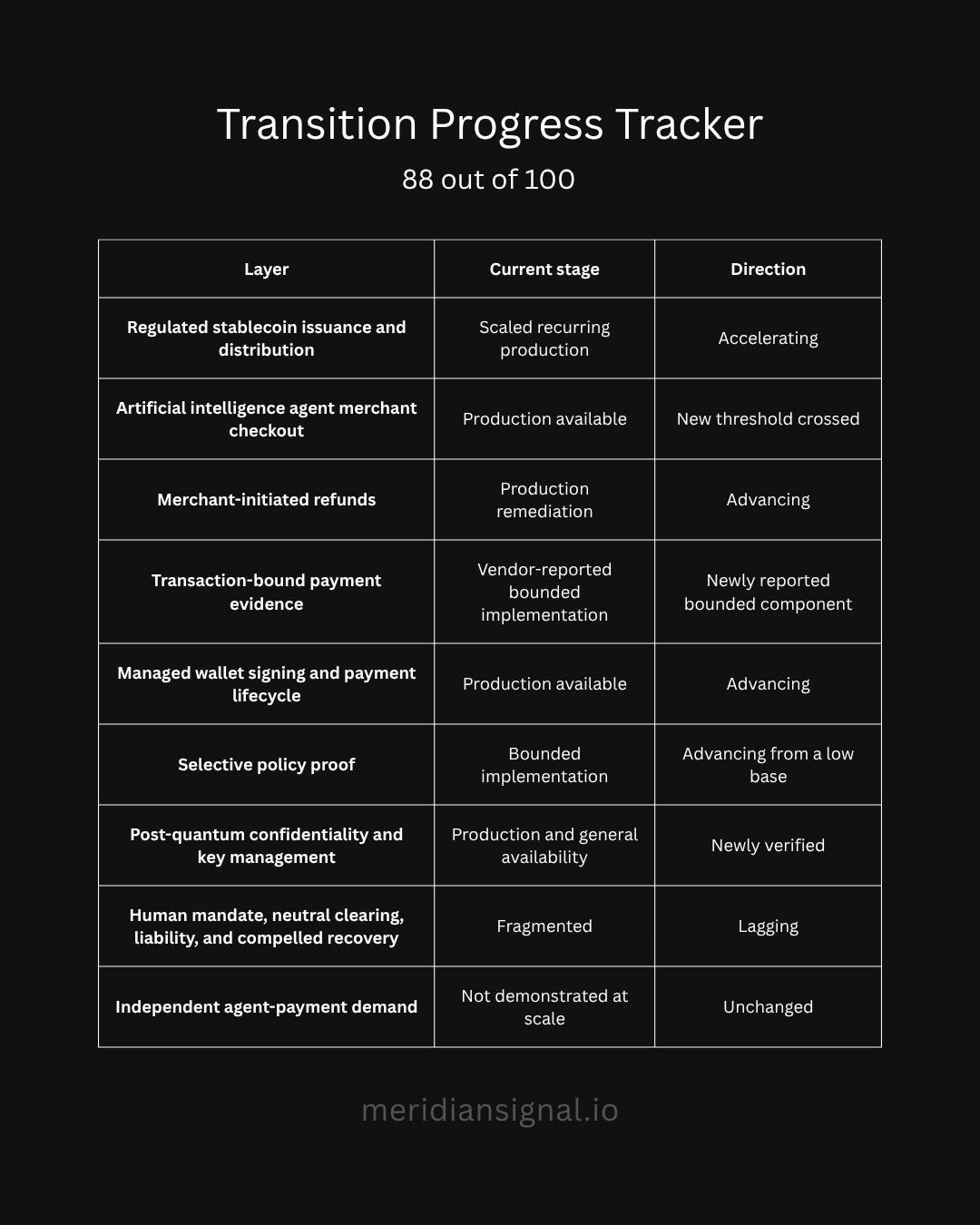
Two readiness readings show the remaining gap:
Artificial intelligence agent clearing and recourse readiness: 42 out of 100
Cryptographic agility and post-quantum readiness: 59 out of 100
The clearing and recourse score rose because action-specific evidence and merchant-initiated refunds improved operational handling.
It did not receive credit for neutral clearing, buyer-initiated recourse, liability allocation, arbitration, insurance, or compelled recovery. Those layers remain missing.
This score measures verified progress. It does not mean the transition is 88% complete.
Meridian Consensus
Here is what changed in our thinking:
Thesis unchanged: Regulated digital money, artificial intelligence agents, wallets, verification, and trust infrastructure continue to converge.
Timing advanced: Agent payments moved from technical rails into a production merchant checkout.
Conviction increased: Transaction-bound evidence and privacy-preserving policy proof now have a credible bounded implementation.
Recourse improved, but only operationally: Merchant refunds are real. Buyer rights, neutral adjudication, insurance, liability, and compelled recovery remain absent.
Cryptographic readiness improved: Google Cloud newly verified already-operating post-quantum foundations. Identity and long-term non-repudiation still lag.
Public-token conclusion unchanged: No public token qualifies. Arc remains watchlist only.
Structural reassessment: Not triggered.
The machine can increasingly execute, settle, and leave evidence.
The institution still carries the liability.
Signal Stability
97 out of 100 | Thesis unchanged
The signal became more stable because live merchant documentation, technical implementation evidence, official macro data, regulator actions, and securities filings all reinforced the same direction.
Machine commerce is moving toward a governed stack built around dollar stablecoin settlement, managed wallets, policy enforcement, secure execution, receipts, custody, and regulated distribution.
The central uncertainty is no longer whether these pieces can be assembled.
It is whether they can become portable, independently measured, legally recognized, and economically durable across institutions.
Signal-to-Noise Ratio
91 out of 100 | High signal, with adoption and liability noise contained
Here is the evidence we trust most:
production merchant checkout and refund documentation
official inflation, fiscal, auction, and Treasury cash data
securities filings with clients, assets, revenue, costs, and losses
live cryptographic components with disclosed migration roadmaps
accepted government deliveries rather than announced capacity
Here is what we are still discounting:
platform-wide payment totals presented as agent-payment adoption
vendor-reported implementation presented as independent production scale
merchant refunds presented as neutral recourse
integrations presented as mandatory public-token demand
permission, financing, commissioning, or targets presented as recurring output
usage telemetry presented as proven productivity
Our filter remains simple.
Execution is not authority.
Evidence is not liability.
Integration is not capture.
Meridian Positioning
Defensive selectivity
Near-term investability: 58 out of 100
Our confidence in the transition increased.
Our willingness to chase it did not.
Inflation softened, but the ten-year real Treasury rate remained 2.42%, Treasury cash approached $1 trillion, fiscal interest costs rose, and real hourly earnings declined from a year earlier. Bureau of Labor Statistics real earnings
That keeps the cost of capital restrictive and punishes leverage, weak balance sheets, and long-duration stories that depend on future adoption.
We prefer the layers already controlling real relationships or receiving recurring economics:
regulated stablecoin issuance and distribution
merchant acceptance
custody and authoritative records
identity and managed keys
policy enforcement and secure execution
audit, reconciliation, and remediation
cryptographic migration
liability-capable institutions
We remain cautious where the case depends on platform-wide activity presented as agent demand, future token mechanics, permission without usage, or evidence without responsibility.
The transition advanced.
The entry standard became more demanding.
Strategic Posture
Here is how we are positioning from here:
Preserve short-duration liquidity while real yields, Treasury cash, and sovereign interest costs remain high.
Avoid new leverage because one softer inflation report does not create easy money.
Favor recurring and contribution-margin revenue over gross transaction flow.
Follow merchant acceptance, identity, managed keys, custody, policy enforcement, secure execution, audit, and remediation where operating economics are visible.
Treat the Solv and ICME architecture as proof of category timing, not proof of investable scale.
Require agent-specific payment value, repeat use, transaction size, fraud, refunds, disputes, and loss data before upgrading the economic conclusion.
Watch for an open action-receipt schema, independent verification, cross-platform portability, regulator acceptance, buyer chargebacks, arbitration, insurance, and defined liability.
Favor post-quantum migration providers with production customers, tested interoperability, and durable key or identity relationships.
Keep Arc on the watchlist until public production, independent fee-bearing activity, token delivery, and operating capture mechanics are verified.
Do not promote Solana, Chainlink, Arc, or another public token from integration evidence alone.
We are not stepping away from machine commerce.
We are waiting for the systems that can prove authority, enforce limits, and absorb responsibility.
One Core Takeaway
Machines can increasingly complete the payment. The durable value will sit with the systems that can prove the authority and carry the liability.
Meridian Signal
Bold clarity at the right time.
AI-assisted. Human-directed. Source-verified.
General informational analysis only. Not individualized investment advice.