Intelligence Report 002 | Publication date: July 2026 | Time horizon: 2026–2035 | Meridian conviction: High
Executive Assessment
Money is becoming programmable.
That transition is no longer theoretical.
Stablecoins have demonstrated that regulated digital value can move globally, continuously, and increasingly outside traditional banking hours. Banks are responding by developing tokenized deposits that preserve the deposit relationship while introducing blockchain-based programmability. Central banks and international institutions are testing tokenized settlement architectures. Payment networks, wallets, asset managers, custodians, compliance providers, and public blockchains are positioning around the same transition.
The debate is often framed as a competition between stablecoin issuers.
Meridian Signal believes that framing is too narrow.
The more consequential contest is emerging across the entire monetary stack:
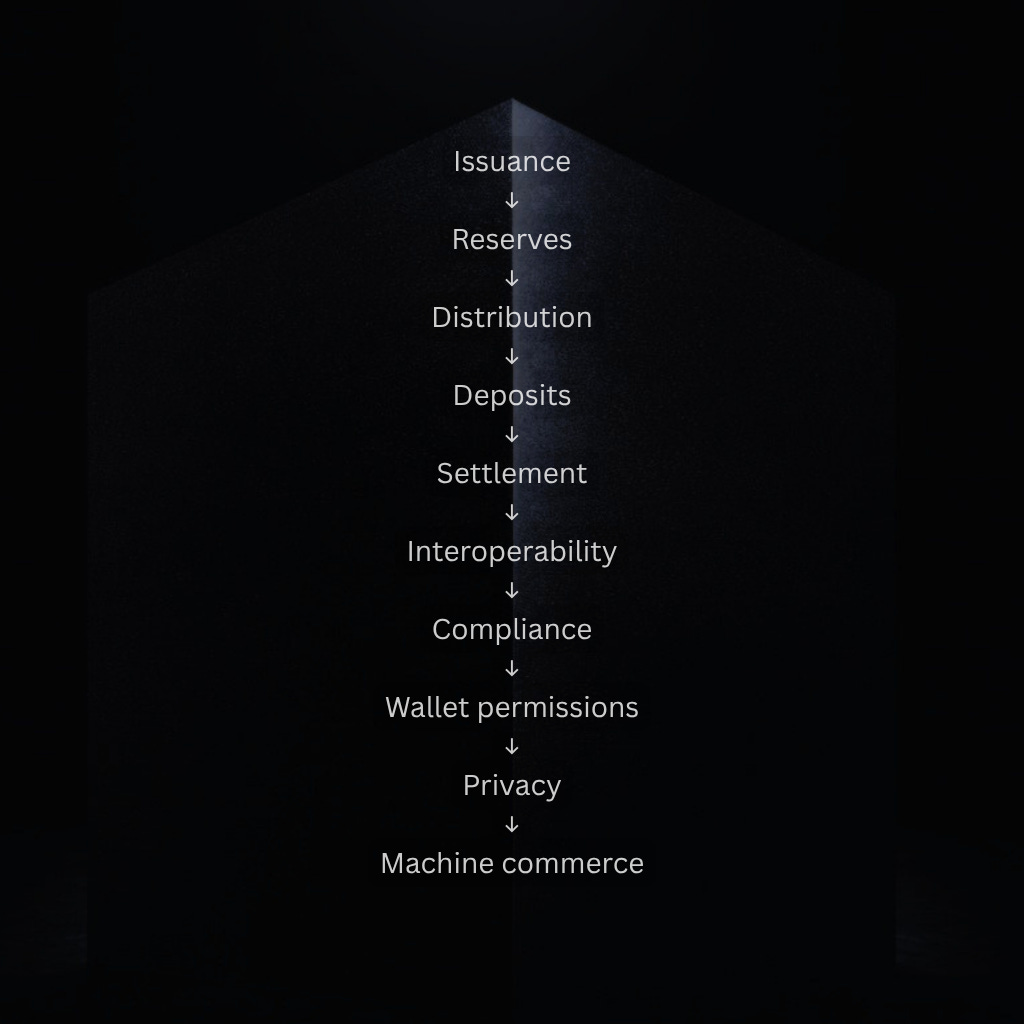
The future of money may not be controlled by one currency or one network.
It may be controlled by the institutions that own the interfaces, settlement pathways, regulatory permissions, deposit relationships, and distribution systems through which programmable money moves.
This creates a deeper strategic question:
Is the future of money being built outside the banking system, or is the banking system absorbing the technology before it can be displaced?
Our central conclusion is that neither outcome is sufficient by itself.
The highest-probability path is a hybrid, multi-rail monetary architecture in which stablecoins, tokenized deposits, tokenized central-bank money, and tokenized collateral coexist, but serve different users, jurisdictions, and economic functions.
The war for programmable money will therefore not be won only by whoever issues the most digital dollars.
It will be won across the architecture.
Why This Report Matters
Imagine asking someone in 1995 who would own the internet.
Most people would have answered:
Microsoft.
Cisco.
Intel.
Very few would have predicted:
Google.
Amazon.
Cloud platforms.
App stores.
The same mistake is happening today.
Most investors ask which stablecoin will dominate.
But history suggests that infrastructure revolutions rarely create value where the public initially expects.
The winners often emerge in the layers that connect the system rather than the products users see first.
This report is therefore not about predicting which stablecoin becomes largest.
It is about understanding how the next monetary operating system may be built.
The Central Question
Who will own the operating layer of programmable money?
Public attention is focused on individual stablecoins.
Markets compare:
supply
transaction volume
reserve yield
regulatory access
Those metrics matter.
But they do not fully describe the transition.
The more important question is:
When money becomes programmable, which institutions control its issuance, distribution, settlement, permissions, and economic capture?
Stablecoins are only one possible answer.
Banks are developing tokenized deposits, central banks are exploring programmable settlement, and asset managers are introducing tokenized government securities. Around them, payment networks, wallets, verification systems, compliance providers, and privacy infrastructure are competing to control how programmable value is distributed and used.
The monetary unit is therefore only one layer inside a much larger architecture.
PART I
MONEY IS BECOMING PROGRAMMABLE
The Historical Architecture of Money
Modern money appears digital already.
Balances are stored electronically.
Payments move through cards, bank transfers, clearing systems, and mobile applications.
But most digital money is not truly programmable.
It is digitized.
That distinction matters.
Digitized money represents conventional monetary claims recorded and transferred through electronic systems.
Programmable money allows value to interact directly with software-defined conditions.
A programmable monetary instrument can potentially:
settle automatically
interact with smart contracts
enforce transaction conditions
move continuously across networks
support automated treasury management
carry identity or compliance permissions
participate in machine-to-machine commerce
This changes money from a passive record of value into an active component of software systems.
That is not a minor payments upgrade.
It is a change in monetary architecture.
The Friction Embedded in Traditional Settlement
The existing financial system works.
But it remains fragmented.
Different functions operate through separate systems:
card networks
correspondent banking
domestic clearing
securities settlement
foreign exchange
compliance screening
collateral management
reconciliation
Each layer may have different operating hours, message formats, counterparties, permissions, and settlement processes.
A payment can appear instant to the user while final settlement occurs later through multiple institutions.
Cross-border payments may require correspondent banks, currency conversion, prefunding, and reconciliation.
Securities may trade quickly while ownership and cash settle on different systems.
Collateral may sit idle because it cannot move continuously between venues.
Programmable money offers a different possibility:
Value, ownership, conditions, and settlement can operate within the same digital environment.
That is the structural promise.
Whether that promise is achieved through open stablecoins, bank deposits, central-bank infrastructure, or hybrid systems remains unresolved.
Stablecoins Were the First Visible Breakthrough
Stablecoins demonstrated that dollar-denominated value could exist directly on programmable networks.
They allowed users to:
transfer value continuously
settle across borders
hold dollar exposure outside conventional bank accounts
trade and post collateral on digital markets
integrate payments into software
access digital-dollar functionality from jurisdictions with weaker banking systems
Their success proved something important:
There was genuine demand for digitally native money that could move at internet speed.
Stablecoins initially grew inside digital-asset markets.
They were used for trading, settlement, liquidity, and collateral.
But their relevance is expanding beyond those origins.
Businesses increasingly consider stablecoins for:
treasury operations
merchant settlement
cross-border payments
payroll
remittances
machine payments
The monetary transition has therefore moved beyond speculation.
It is entering infrastructure formation.
Why Now?
Structural transitions rarely occur because of one catalyst.
They emerge when multiple forces align.
Programmable money is accelerating because several pressures are converging.
Technology has matured
Public blockchains, permissioned ledgers, custody, compliance tooling, and wallet infrastructure have become more capable.
Regulation is becoming clearer
Jurisdictions are developing frameworks for payment stablecoins, tokenized securities, custody, and digital-asset infrastructure.
Rules remain incomplete, but institutional participation no longer operates within the same uncertainty that defined earlier cycles.
Institutions are entering production
Banks, payment networks, asset managers, custodians, and financial-market infrastructures are moving from isolated proofs of concept toward deployable systems.
Demand for continuous settlement is growing
Global commerce operates continuously.
Financial infrastructure still often does not.
Programmable money offers the possibility of near-continuous operation across payments, collateral, and treasury systems.
Tokenized assets require tokenized money
A tokenized security is less transformative when the cash side of the transaction remains on a separate legacy rail.
Tokenized assets become more useful when payment and settlement can occur inside the same programmable environment.
AI agents will require machine-native money
Autonomous economic systems cannot rely entirely on humans initiating every transaction through conventional banking interfaces.
AI agents will require:
spending permissions
transaction limits
authenticated wallets
automated settlement
verifiable authority
programmable compliance
Programmable money becomes more important as economic activity itself becomes increasingly automated.
PART II
THE MONETARY ARCHITECTURE IS SPLITTING
The transition is not producing one universal form of digital money.
It is producing several competing architectures.
Each solves a different problem.
Each protects different institutional interests.
Each concentrates value differently.
Payment Stablecoins
Payment stablecoins are digital monetary instruments issued against reserves and designed to maintain a stable value, typically relative to a national currency.
Their structural advantages include:
continuous settlement
global availability
software-native integration
reduced dependence on traditional banking hours
Stablecoins are strongest where conventional financial infrastructure is:
slow
expensive
geographically restricted
unavailable to digital-native applications
Their success has created a new class of monetary intermediary: the stablecoin issuer.
The issuer may capture value through:
reserve income
distribution partnerships
transaction infrastructure
liquidity advantages
But stablecoins also face structural limitations.
They depend on:
reserve quality
redemption credibility
banking access
regulatory permission
network liquidity
A stablecoin can circulate on a public blockchain while remaining deeply dependent on conventional financial institutions beneath the surface.
That creates an important contradiction:
Stablecoins may compete with banks at the interface while depending on banks and government securities at the reserve layer.
Business-Aligned Stablecoin Networks
The next stage of stablecoin competition may not be issuer versus issuer.
It may be distribution network versus distribution network.
Businesses care about more than the name printed on a digital dollar.
They care about:
merchant acceptance
settlement cost
redemption access
liquidity
payment-network compatibility
reserve economics
compliance support
This creates the possibility of business-aligned stablecoin standards supported by combinations of:
payment networks
technology companies
asset managers
banks
wallet providers
Under this model, the stablecoin becomes part of a broader commercial network.
Distribution may matter more than technical superiority.
A monetary instrument embedded by default into merchant platforms, payment APIs, enterprise software, and wallets can gain adoption even when competing instruments offer similar underlying functionality.
The strategic shift is clear:
Stablecoins are moving from issuer-led products toward distribution-led monetary networks.
Tokenized Deposits
Banks are unlikely to surrender their monetary role without responding.
Tokenized deposits are that response.
A tokenized deposit represents a commercial-bank deposit on programmable infrastructure.
Unlike many stablecoins, it remains a direct liability of a bank.
This preserves several features of the existing system:
the customer relationship
regulatory supervision
bank balance-sheet integration
credit creation
institutional compliance
Tokenized deposits allow banks to introduce programmability without abandoning the deposit model.
That matters because deposits are not merely payment instruments.
They are part of the banking system’s funding base.
Banks use deposits to support lending and broader balance-sheet activity.
A large-scale migration from bank deposits into nonbank stablecoins could therefore affect:
bank funding
credit creation
deposit competition
monetary transmission
financial stability
Tokenized deposits give banks a way to preserve these economic relationships while adopting new infrastructure.
The contest is therefore not simply technological.
It is institutional.
Stablecoins and Tokenized Deposits Are Not Identical
They may both represent digital dollars.
But they embody different claims.
A stablecoin is generally a claim on an issuer backed by a reserve portfolio.
A tokenized deposit is a claim on a commercial bank.
The difference affects:
legal structure
deposit insurance
credit risk
reserve management
monetary policy
bank funding
Stablecoins may be more open and portable.
Tokenized deposits may integrate more naturally with regulated banking.
Stablecoins may dominate digital-native commerce.
Tokenized deposits may dominate institutional and bank-mediated activity.
Neither model automatically eliminates the other.
Tokenized Central-Bank Money
Commercial money ultimately depends on settlement in central-bank money.
For institutional tokenization to scale, central-bank settlement assets may also need programmable equivalents.
This has led to research and experimentation involving:
tokenized central-bank reserves
shared programmable ledgers
atomic settlement
The goal is not necessarily to create a retail central-bank currency.
The more immediate objective is to modernize the settlement layer used by banks and financial institutions.
A tokenized central-bank settlement asset could allow:
cash and securities to settle simultaneously
cross-border transactions to settle atomically
collateral to move continuously
counterparty and settlement risks to decline
This architecture may become the institutional foundation beneath tokenized deposits and tokenized securities.
Tokenized Money-Market Funds and Government Securities
Programmable money does not end with cash-like instruments.
Tokenized government securities and money-market funds are also becoming important.
These assets can potentially function as:
yield-bearing cash substitutes
programmable collateral
treasury-management instruments
margin assets
This creates a more complex monetary stack.
Users may hold:
stablecoins for transactions
tokenized deposits for bank-integrated settlement
tokenized Treasury funds for yield
central-bank tokens for wholesale finality
The boundaries between money, collateral, and short-duration investments may become less rigid.
That could change how institutions manage liquidity.
PART III
THE BATTLE FOR CONTROL
The transition to programmable money is often discussed as if technology alone will determine the winner.
It will not.
The outcome will also depend on control.
Who Owns the Customer Relationship?
The institution controlling the interface may control the economics.
That interface could be:
a bank account
a digital wallet
a merchant platform
an enterprise treasury system
an AI-agent wallet
Issuers may create the monetary instrument.
But distributors determine where users encounter it.
A superior stablecoin without embedded distribution may lose to a well-integrated alternative.
A bank may retain deposits if tokenized money appears inside the customer’s existing financial relationship.
A payment platform may become more influential than either issuer by routing transactions among multiple monetary instruments.
The customer interface is therefore a control point.
Who Receives the Reserve Economics?
Stablecoin reserves can generate meaningful income.
That income may accrue to:
stablecoin issuers
banking partners
asset managers
payment distributors
The distribution of reserve economics could become a decisive competitive lever.
An issuer that shares economic benefits with distributors may accelerate adoption.
A payment network that routes large volumes may negotiate a share of reserve income.
A platform may prefer the monetary instrument that offers the strongest economic incentive rather than the one with the strongest brand.
The reserve layer is therefore not passive backing.
It is a profit pool.
Who Controls Settlement?
Settlement determines when a transaction becomes final.
Control may sit with:
public blockchains
bank-led networks
central-bank platforms
interoperable messaging layers
Public networks offer openness and broad programmability.
Permissioned systems offer governance and institutional control.
Central-bank-linked systems offer monetary finality.
The winning architecture may combine them rather than choose one exclusively.
Settlement fragmentation could persist for years.
That increases the importance of interoperability.
Who Controls Interoperability?
A fragmented monetary system requires coordination.
Different forms of money must communicate across:
banks
public blockchains
private ledgers
payment networks
tokenized-asset platforms
Interoperability providers may become some of the most valuable infrastructure participants.
Their role may include:
messaging
compliance coordination
asset movement
transaction orchestration
cross-network execution
The value may not accrue to the most visible monetary instrument.
It may accrue to the systems that allow all monetary instruments to operate together.
Who Controls Compliance?
Programmable money cannot scale institutionally without compliance.
That includes:
anti-money-laundering controls
sanctions screening
identity verification
transaction monitoring
jurisdictional restrictions
policy enforcement
Compliance can be embedded at several layers:
issuer
wallet
settlement network
bank
identity provider
The location of compliance matters.
If compliance is concentrated at the wallet, the wallet becomes a control point.
If it is concentrated at the issuer, the issuer gains authority.
If it is enforced at the network, the settlement layer becomes more powerful.
Compliance is not merely a requirement.
It is architecture.
Who Controls Wallet Permissions?
Wallets may become the operating interface of programmable money.
This becomes especially important as AI agents begin to transact.
A wallet may need to define:
who can spend
how much can be spent
which counterparties are allowed
what information must be disclosed
whether human approval is required
how authority can be revoked
This is more than custody.
It is delegated economic authority.
The wallet-permission layer could become one of the most strategically important components of the next financial system.
Who Controls Privacy?
A fully transparent financial system is unlikely to satisfy institutions, businesses, or individuals.
But complete anonymity is unlikely to satisfy regulators.
The probable solution is selective disclosure.
Selective-disclosure systems allow users or institutions to prove required information without revealing everything.
Examples include proving:
jurisdiction
sufficient collateral
compliance status
transaction authorization
without exposing the full underlying data.
As programmable finance expands, privacy may shift from an optional feature into an institutional requirement.
The winning privacy layer may not be a standalone private currency.
It may be embedded inside:
wallets
bank networks
public blockchains
identity systems
enterprise middleware
Sovereignty Versus Openness
Programmable money creates a tension between open networks and sovereign control.
Open systems can provide:
interoperability
accessibility
innovation
Sovereign and bank-controlled systems can provide:
legal clarity
monetary control
enforceable compliance
systemic safeguards
Governments are unlikely to allow core monetary infrastructure to develop entirely outside sovereign influence.
But highly closed systems may fail to deliver the efficiency and innovation promised by programmable finance.
The likely outcome is not complete openness or complete control.
It is negotiated interoperability.
PART IV
WHERE WEALTH ACTUALLY CONCENTRATES
A structural transition can be real while the obvious investment performs poorly.
That distinction is essential.
Programmable money may generate enormous economic value.
But that value will not automatically accrue to every currency, protocol, token, or company associated with the transition.
The Value-Capture Stack
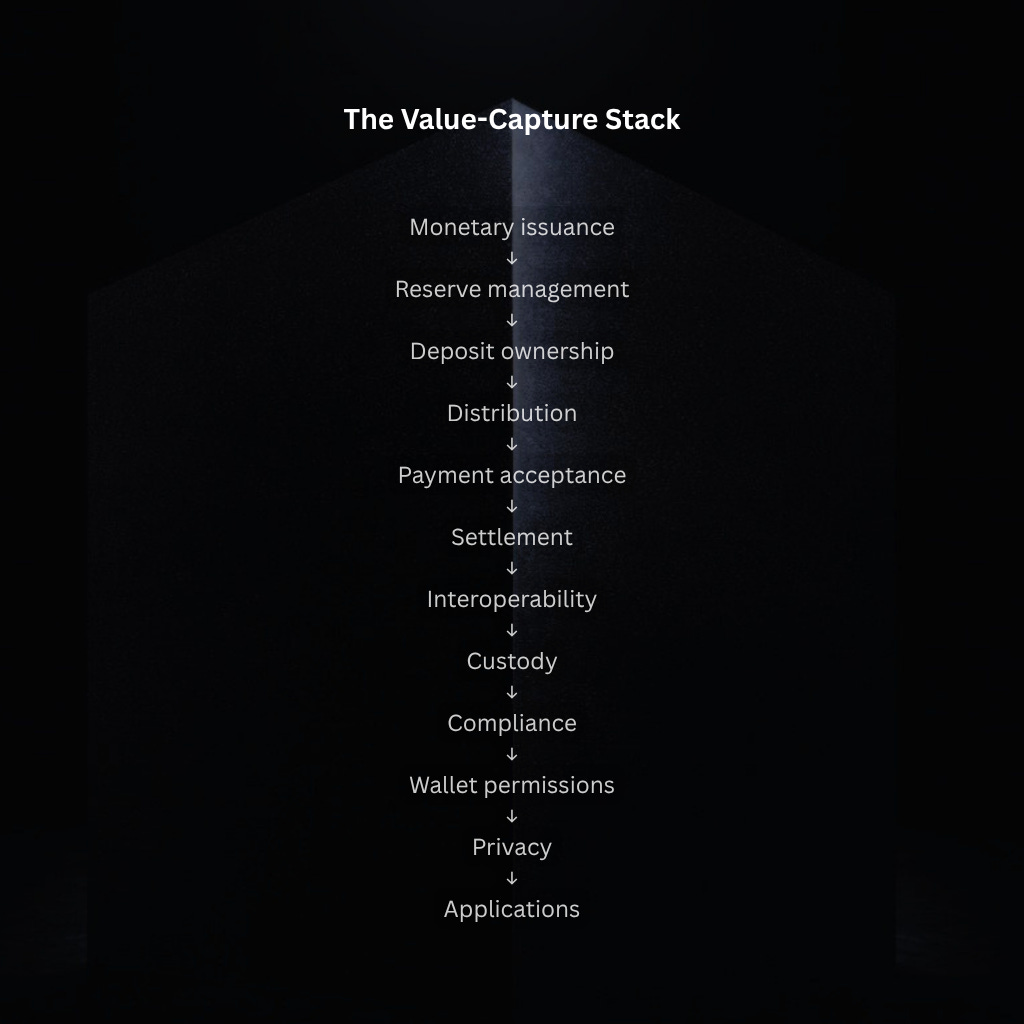
Each layer has different economics.
Issuers
Stablecoin issuers can capture:
reserve income
liquidity advantages
network effects
But issuer economics face pressure from:
regulation
reserve-sharing arrangements
interest-rate changes
commoditization
A large stablecoin supply does not guarantee permanent pricing power.
Banks
Banks may capture value through:
deposits
lending relationships
treasury services
custody
settlement-network participation
Banks have a major structural advantage:
They already control regulated customer relationships.
Their weakness is that they often operate more slowly and with less open programmability than digital-native systems.
Payment Networks
Payment networks may remain important even if the monetary unit changes.
They can provide:
merchant acceptance
fraud protection
consumer recourse
routing
foreign exchange
compliance
Stablecoins may alter payment plumbing without eliminating every existing network.
Payment companies may absorb the new technology and maintain their position.
Wallets
Wallets could become the strategic interface connecting:
money
identity
permissions
privacy
AI agents
If users interact with programmable money primarily through wallets, wallet providers may control:
distribution
default assets
transaction permissions
identity
compliance
The wallet may become more valuable than the monetary asset it holds.
Asset Managers
Tokenized government securities and money-market funds create a major role for asset managers.
They can capture:
management fees
reserve mandates
collateral demand
treasury-management flows
institutional distribution
Programmable money may increase demand for tokenized yield products rather than eliminate them.
Custodians
Institutional adoption requires trusted custody.
Custodians may control:
asset security
compliance
settlement integration
collateral movement
This layer may remain concentrated among regulated institutions.
Interoperability Providers
Interoperability becomes more valuable as fragmentation increases.
If multiple monetary systems coexist, the ability to connect them becomes structurally important.
Potential economic functions include:
cross-network messaging
settlement orchestration
data verification
compliance coordination
This may be one of the strongest hidden value layers.
Compliance and Verification Providers
Every expansion of programmable money increases the need to verify:
identity
authority
transaction legitimacy
machine agents
Compliance and verification may become recurring infrastructure rather than one-time services.
Public Blockchains
Public blockchains can capture value if monetary activity creates:
transaction fees
settlement demand
collateral demand
But value can also leak.
Activity may grow while:
applications capture the economics
stablecoins capture monetary premium
centralized providers own the customer
Network usage and native-asset value capture are not identical.
Public Tokens
The largest error may be assuming:
Programmable money grows, therefore every associated token wins.
Many tokens may capture little value.
Some infrastructure may be:
equity-owned
bank-owned
consortium-owned
Token capture must be proven rather than assumed.
False Winners
Several participants may appear positioned for the transition without capturing durable value.
Potential false-winner patterns include:
High activity, weak economics
A network processes transactions but captures minimal fees or token demand.
Strong narrative, replaceable infrastructure
A protocol is visible but easily substituted.
Regulatory access without distribution
An issuer receives permission but fails to gain users.
Bank pilots without production usage
Institutions announce projects that never become core infrastructure.
The transition must be separated from the investment vehicle.
PART V
DEPENDENCY GRAPH
Programmable money depends on more than monetary issuance.
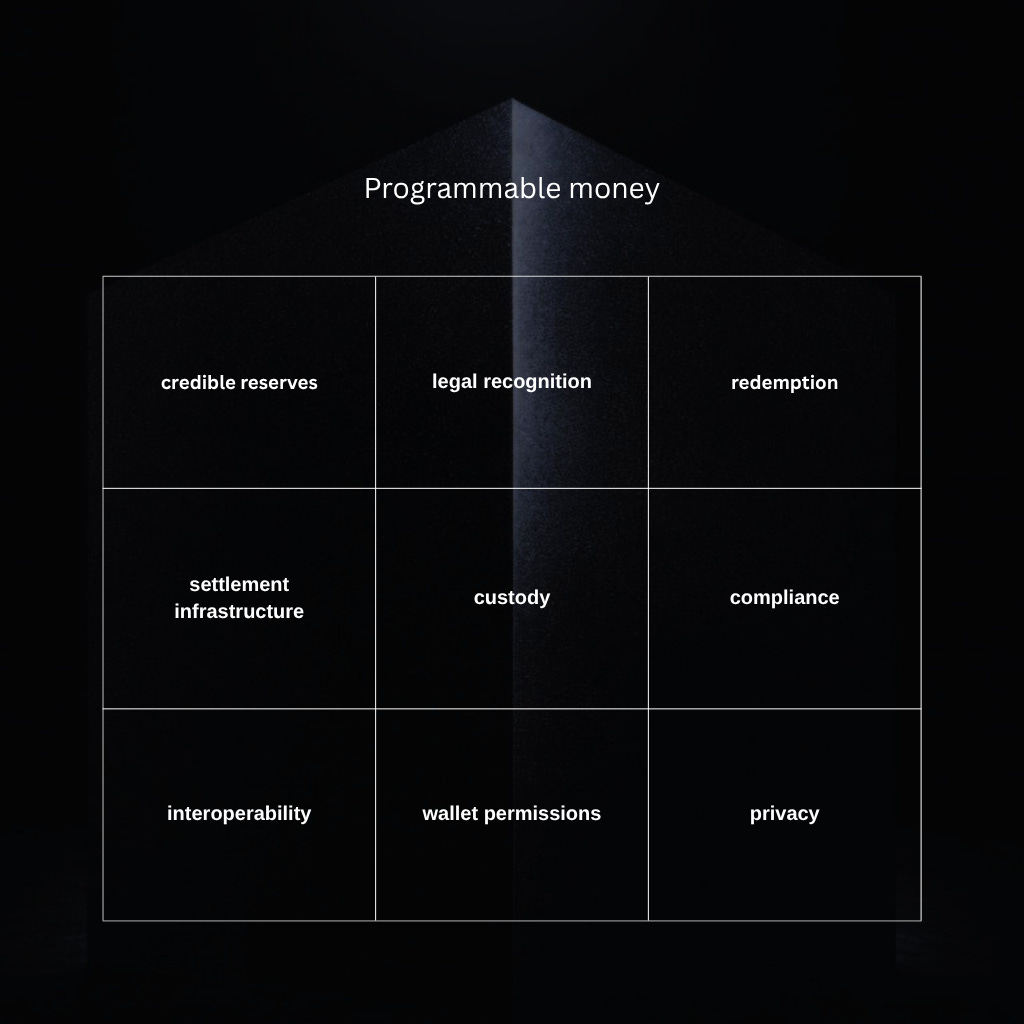
At the same time, other transitions increasingly depend on programmable money.
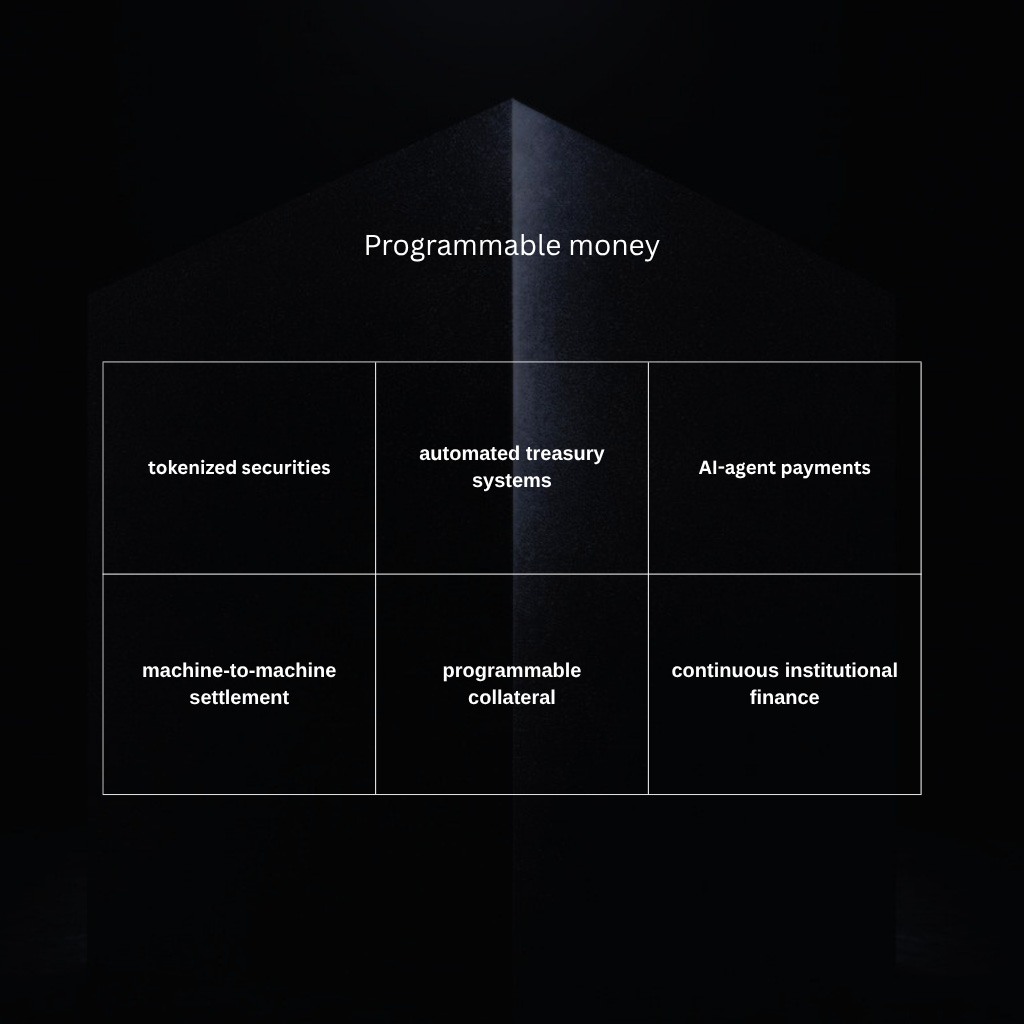
This is what makes the primitive foundational.
It is both dependent on infrastructure and capable of becoming infrastructure for everything above it.
PART VI
SECOND-ORDER EFFECTS
The first-order effect is faster digital payments.
That may be the least important consequence.
Banking Competition Intensifies
Stablecoin issuers can compete for balances historically held as bank deposits.
Banks may respond with:
tokenized deposits
improved payment infrastructure
digital-asset custody
The competition may improve services while compressing margins.
Treasury Management Becomes Continuous
Corporate treasuries may operate across:
stablecoins
tokenized deposits
tokenized government funds
Cash may move continuously based on:
yield
liquidity
collateral needs
Treasury operations could become increasingly software-driven.
Collateral Becomes More Mobile
Tokenized collateral can potentially move across venues and jurisdictions more efficiently.
This may improve capital efficiency.
It may also increase interconnectedness and the speed of contagion.
Faster settlement does not eliminate risk.
It can transmit risk more quickly.
Financial Markets Become More Continuous
Traditional market hours may become less relevant when:
cash
securities
collateral
foreign exchange
operate through programmable systems.
This could increase efficiency.
It could also reduce the natural pauses that currently slow market stress.
AI Agents Become Economic Participants
AI agents may eventually:
purchase services
rebalance treasuries
negotiate transactions
pay other agents
deploy capital within defined limits
Programmable money provides the payment rail.
Verification confirms the agent.
Wallet permissions define its authority.
Selective disclosure protects sensitive information.
Machine trust coordinates the system.
Monetary Sovereignty Becomes More Complex
A widely adopted foreign-currency stablecoin can extend monetary influence across borders.
Countries may respond through:
regulation
tokenized deposits
central-bank infrastructure
sovereign payment networks
Programmable money is therefore geopolitical infrastructure.
Financial Privacy Becomes More Important
As money becomes machine-readable and transactions become more connected to identity, data exposure increases.
Businesses will not want competitors to observe every payment.
Institutions will not want positions and treasury movements fully exposed.
Individuals will not want complete financial transparency.
Privacy becomes a consequence of programmability.
PART VII
FAILURE PATHS
Every structural thesis must define how it can fail.
Failure Path 1: Stablecoins Remain a Specialist Rail
Stablecoins may remain concentrated in:
digital-asset markets
cross-border transactions
high-inflation jurisdictions
They may fail to replace mainstream consumer payments because of:
limited recourse
regulatory complexity
fraud concerns
Where value reroutes
payment networks
banks
regulated processors
cross-border specialists
Failure Path 2: Banks Absorb the Transition
Banks may successfully introduce tokenized deposits and programmable services.
Under this scenario, stablecoins remain complementary rather than disruptive.
Where value reroutes
banks
banking-software providers
custodians
permissioned networks
central-bank settlement systems
Failure Path 3: Sovereign Systems Dominate
Governments may determine that open stablecoin systems create unacceptable risks to monetary control or financial stability.
They may favor:
tokenized central-bank reserves
regulated bank tokens
tightly controlled interoperability
Where value reroutes
central-bank infrastructure
sovereign technology providers
regulated bank consortia
Failure Path 4: Fragmentation Prevents Scale
Different jurisdictions may develop incompatible rules and systems.
This could reduce global interoperability.
Where value reroutes
compliance providers
interoperability systems
foreign-exchange networks
regional payment platforms
Failure Path 5: Programmability Creates New Risks
Software-defined money can introduce:
smart-contract vulnerabilities
cyberattacks
cascading liquidation risk
unauthorized agent activity
A major failure could slow adoption.
Where value reroutes
security providers
verification systems
permissioning infrastructure
Failure Path 6: Value Does Not Reach Public Markets
The transition may occur while most value accrues to:
private companies
banks
consortiums
The thesis could be correct while publicly available digital assets underperform.
This is one of the most important risks for investors.
PART VIII
SCENARIO MATRIX
Scenario 1: Stablecoin-Dominant System
Probability: 20%
Stablecoins become the primary programmable-money rail for global digital commerce.
Banks retain traditional deposits but lose selected payment and settlement functions.
Likely winners
stablecoin issuers
wallets
public blockchains
compliance providers
Primary risk
Regulatory and sovereign resistance.
Scenario 2: Bank Tokenized-Deposit System
Probability: 20%
Banks successfully modernize deposits and retain monetary dominance.
Stablecoins remain important but specialized.
Likely winners
commercial banks
banking technology
custodians
institutional settlement networks
Primary risk
Closed systems fail to interoperate or innovate quickly enough.
Scenario 3: Sovereign Unified-Ledger System
Probability: 10%
Central banks and regulated financial institutions develop shared programmable settlement systems.
Public stablecoins remain at the perimeter.
Likely winners
central-bank infrastructure providers
regulated banks
institutional tokenization platforms
Primary risk
Limited openness and slower private innovation.
Scenario 4: Hybrid Multi-Rail System
Probability: 45%
Stablecoins, tokenized deposits, central-bank settlement assets, and tokenized government securities coexist.
Different instruments dominate different use cases.
Interoperability becomes critical.
Likely winners
distribution platforms
wallets
interoperability providers
compliance systems
banks
Meridian view
Base case
This scenario best reflects the different needs of consumers, businesses, institutions, and sovereigns.
Scenario 5: Fragmented Failure
Probability: 5%
Regulatory conflict, technical failures, cyber incidents, and incompatible systems prevent broad adoption.
Likely winners
incumbent payment networks
conventional banking infrastructure
security and compliance providers
PART IX
THE MERIDIAN INTELLIGENCE MODEL
Everything discussed so far leads to one conclusion.
Most analysts evaluate programmable money by comparing individual products.
Meridian evaluates monetary systems differently.
We evaluate who controls the critical layers of the architecture.
That framework is the Programmable Money Control Model — PMCM v1.0
Every monetary architecture should be assessed across nine control points.
1. Issuance
Who creates the monetary claim?
2. Reserves
Who controls the backing assets and reserve income?
3. Distribution
Who places the monetary instrument in front of users and businesses?
4. Deposit Relationship
Who owns the account and customer balance?
5. Settlement
Which system provides finality?
6. Interoperability
Who connects competing monetary rails?
7. Compliance
Who determines whether a transaction is permitted?
8. Permissions
Who defines how humans or machines can use the money?
9. Privacy
Who determines what information must be disclosed?
PMCM Decision Rule
The most powerful institution may not dominate all nine layers.
The winning architecture may instead distribute power across several participants.
The durable value-capture opportunities are likely to sit where one participant controls a difficult-to-replace bottleneck across multiple layers.
PART X
MERIDIAN WATCHLIST
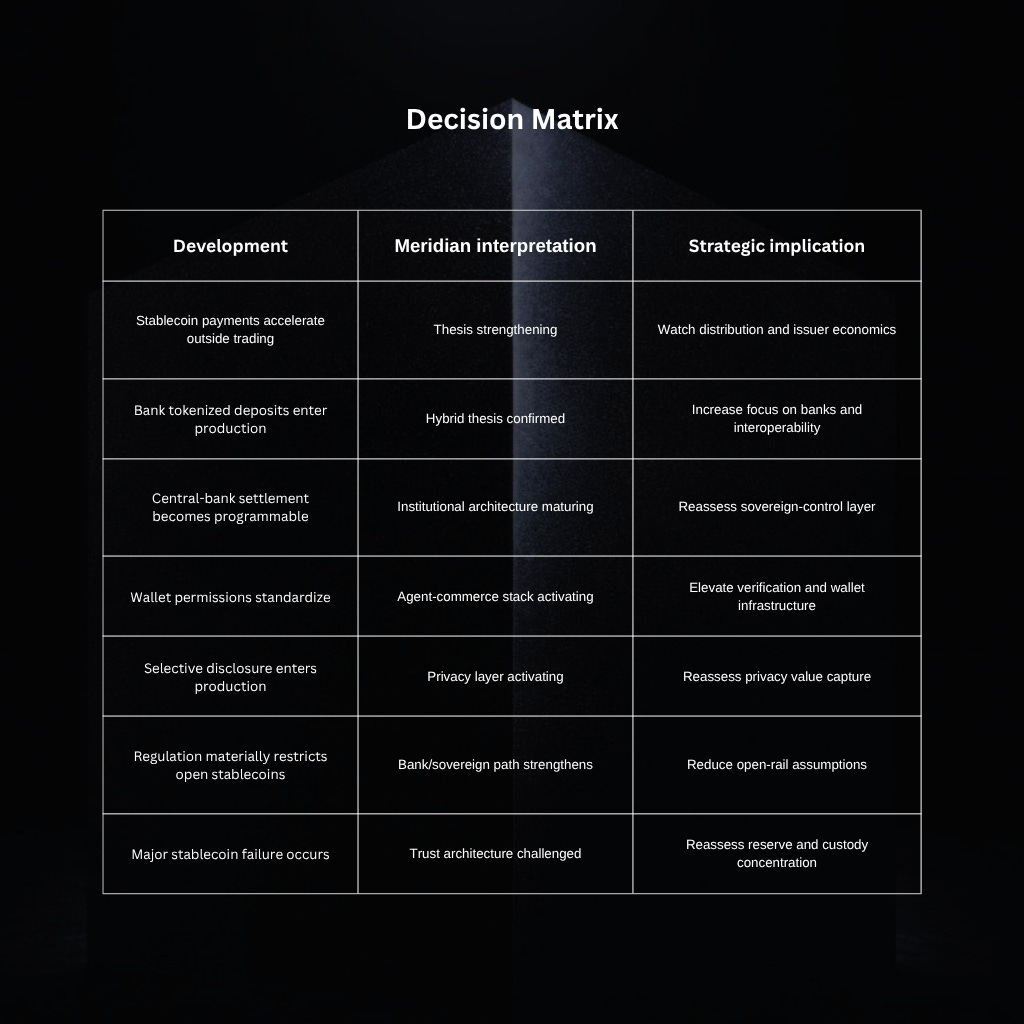
Signals That Would Increase Conviction
large-scale production deployment of bank tokenized deposits
sustained non-trading stablecoin transaction growth
tokenized central-bank settlement moving beyond prototypes
measurable use of tokenized collateral in institutional markets
cross-network interoperability reaching production scale
AI agents conducting economically meaningful transactions
Signals That Would Reduce Conviction
stablecoin growth remains primarily trading-driven
bank tokenization projects fail to move into production
regulatory fragmentation makes interoperability uneconomic
major reserve, redemption, or cybersecurity failure
tokenized assets remain less efficient than conventional databases
programmability produces more operational risk than economic benefit
Intelligence Shelf Life
Expected validity horizon: Three to five years
This report should be reviewed when any of the following occur:
the first major shared US tokenized-deposit network launches
stablecoin regulations enter full implementation
tokenized central-bank money moves into sustained production
a systemic failure materially changes trust in programmable money
The original report should remain historically preserved.
Future changes should be published as:
Programmable Money Thesis Review
Intelligence Report 002 — One-Year Review
The Monetary Architecture Update
PART XI
THE FINAL SIGNAL
The future of money is unlikely to arrive through one dramatic replacement.
It is more likely to emerge through institutional convergence.
Stablecoins will expand where openness and global access matter.
Banks will tokenize deposits where regulated relationships matter.
Central banks will modernize settlement where monetary finality matters.
Around them, asset managers, payment networks, wallets, verification systems, and privacy infrastructure will compete to control the financial operating layer.
The transition will not be defined only by what money becomes.
It will be defined by who controls the systems around it.
Questions History Will Eventually Answer
• Will stablecoins become the dominant form of programmable money?
• Will banks successfully absorb blockchain technology through tokenized deposits?
• Will wallet providers become more powerful than banks?
• Will interoperability become the most valuable infrastructure layer?
Meridian Strategic Conclusion
Money is becoming software.
But software does not eliminate institutions.
It reorganizes them.
Stablecoins have shown that programmable value can operate beyond traditional banking rails.
Banks are responding by making deposits programmable.
Central banks are exploring tokenized settlement.
Payment networks are integrating new monetary instruments.
Wallets, identity systems, compliance providers, and interoperability networks are becoming part of the monetary architecture.
This is why the stablecoin-versus-bank debate is incomplete.
The most probable future is not one monetary rail replacing all others.
It is a layered system in which multiple forms of money compete and interoperate while different institutions control different economic functions.
The most important question is therefore not:
Which digital dollar becomes largest?
It is:
Who controls issuance, distribution, settlement, permissions, and trust once money becomes programmable?
History rarely remembers only who introduced a technology first. It remembers the institutions that became indispensable once the technology matured.
The next financial system is unlikely to belong to a single stablecoin, bank, or blockchain. It will belong to the architecture that connects them.
Markets are still debating the products.
Meridian Signal is studying the operating system beneath them.
That is the signal.
Meridian Signal
Independent Strategic Intelligence Desk
General informational analysis. Not financial advice