Executive Summary
The global escalation environment remains below the danger levels reached earlier this month, but the path toward de-escalation is no longer straightforward.
The reopening of maritime traffic through the Strait of Hormuz has reduced immediate energy-shock risk and lowered the probability of a near-term regional escalation spiral. However, the broader geopolitical system remains fragile.
Pressure is now dispersing across multiple theaters simultaneously:
U.S.–Iran negotiations remain unstable
Ukraine–Russia tensions continue to intensify
Belarus has emerged as a growing secondary flashpoint
Taiwan has entered a new cycle of military readiness exercises
Energy and shipping routes remain vulnerable to disruption
The result is a geopolitical environment where escalation risk is no longer concentrated in a single theater.
Instead, risk is becoming distributed.
This lowers the probability of an immediate crisis while increasing the probability of strategic instability over time.
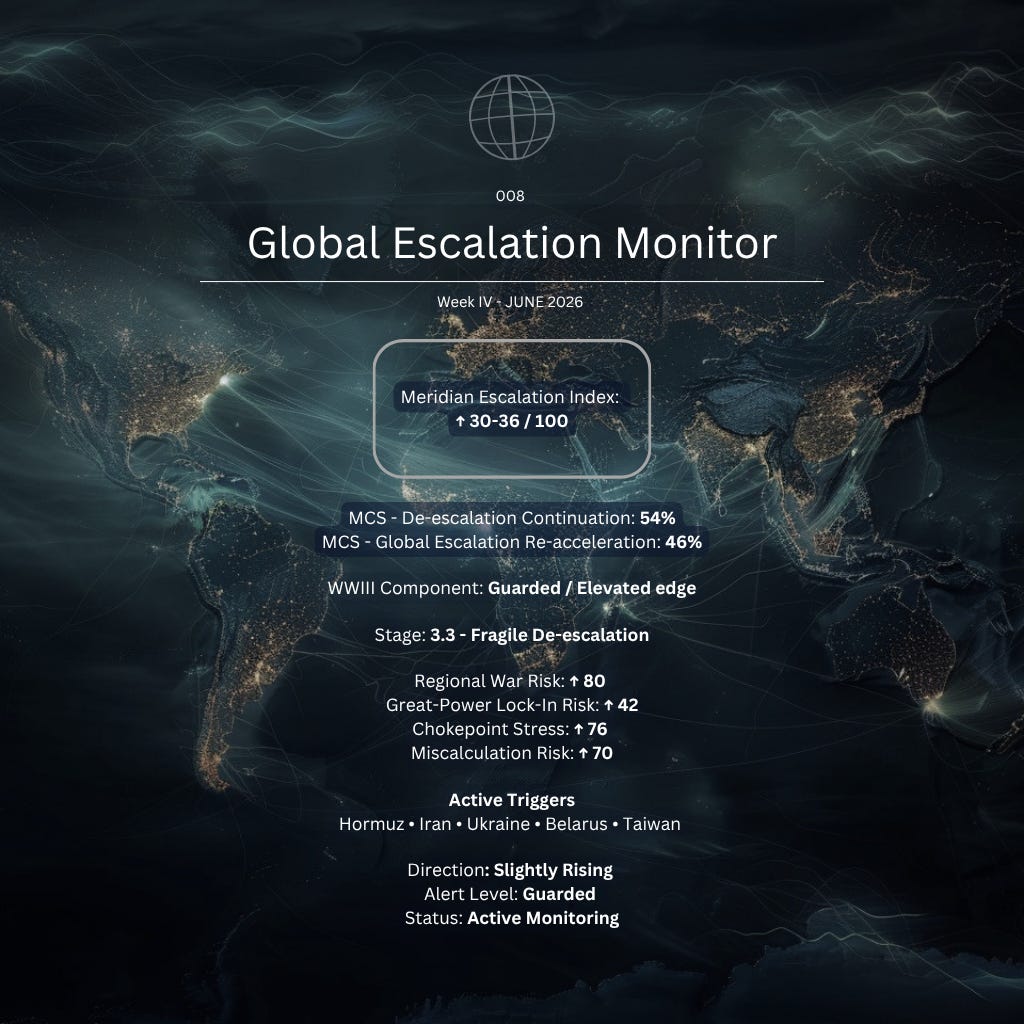
Meridian Conviction Scores
Meridian Conviction Score — De-escalation Continuation
54%
Current evidence still favors a continuation of the de-escalation trend.
The reopening of Hormuz shipping lanes, absence of direct great-power confrontation, and reduced immediate energy-shock pressure remain constructive developments.
However, conviction has weakened compared to previous editions.
Meridian Conviction Score — Global Escalation Re-acceleration
46%
The probability of renewed escalation has increased.
The risk is no longer centered solely on the Middle East.
Instead, the escalation chain is becoming multi-theater:
Middle East → Ukraine → Belarus → Taiwan
This broadens the number of pathways through which instability can re-accelerate.
Fresh Intelligence
Several developments materially influenced this week’s assessment:
Strait of Hormuz
Tanker traffic has resumed and shipping activity has improved.
This remains the most important positive development of the week.
However, traffic volumes remain below pre-crisis norms.
U.S.–Iran Negotiations
Diplomatic engagement continues but remains fragile.
Negotiations have not yet progressed into a stable framework capable of eliminating escalation risk.
Ukraine–Russia
Drone warfare continues to intensify.
Neither side is demonstrating meaningful de-escalation behavior.
Belarus Watch
Belarus has become a more important escalation variable.
While not currently a primary conflict zone, it has evolved into a meaningful strategic watchpoint.
Taiwan
Taiwan’s latest military readiness exercises reinforce the risk of secondary-theater escalation during periods of global distraction.
At present this remains a watchpoint rather than a crisis.
Structural Assessment
Regional War Risk
80 / 100
Regional conflict remains highly active despite the reduction in immediate escalation pressure.
Great-Power Lock-In Risk
42 / 100
Major powers remain involved diplomatically and strategically, but not yet in a direct military confrontation.
Chokepoint Stress
76 / 100
The Strait of Hormuz remains the single most important chokepoint being monitored.
Conditions have improved but remain elevated.
Miscalculation Risk
70 / 100
The greatest threat to stability remains accidental escalation rather than intentional escalation.
Multiple active theaters increase the probability of communication failures, misjudgments, and unintended escalation.
Escalation Chain Assessment
Primary Chain
Middle East
→ Energy Infrastructure
→ Maritime Routes
→ Global Markets
Current Status: Cooling
Secondary Chain
Ukraine
→ Belarus
→ NATO Sensitivities
Current Status: Heating
Tertiary Chain
Taiwan
→ Regional Military Activity
→ Great-Power Competition
Current Status: Watching
Active Triggers
Current Active Triggers:
Hormuz Shipping Recovery
U.S.–Iran Diplomatic Fragility
Ukraine Escalation Cycle
Belarus Strategic Pressure
Taiwan Military Readiness Exercises
Elevated Energy Sensitivity
Scenario Matrix
Base Case (36%)
Gradual normalization of Hormuz traffic and continuation of fragile de-escalation.
Unstable De-escalation (30%)
Diplomatic progress continues but periodic disruptions and regional flare-ups persist.
Ukraine–Belarus Escalation (14%)
Secondary-theater instability becomes the dominant escalation pathway.
Taiwan Escalation (10%)
Regional military activity expands during a period of global distraction.
Middle East Re-escalation (7%)
Hormuz or diplomatic negotiations deteriorate again.
Direct Great-Power Conflict (3%)
Low probability but remains non-zero.
Meridian Strategic Conclusion
The world is not moving toward World War III.
But it is also not returning to normal.
The most accurate interpretation of current conditions is:
The primary escalation cycle is cooling while secondary escalation pathways are becoming more active.
The immediate crisis phase has eased.
The strategic instability phase has not.
Investors, businesses, and policymakers should continue operating under a posture of guarded vigilance rather than crisis response.
The next major signal will likely emerge not from the Middle East, but from whichever secondary theater first converts tension into sustained escalation.
For now, de-escalation remains the highest-probability path.
But the margin is narrowing.
Editorial Note
The Global Escalation Monitor is a strategic intelligence publication by Meridian Signal designed to assess systemic geopolitical and macroeconomic risk.
Its purpose is not to predict conflict with certainty or advocate any investment action, but to track changes in probability, identify structural shifts, and provide context for long-term strategic decision-making.
All assessments reflect the information available at the time of publication and should be interpreted as analytical judgments rather than statements of certainty.
Meridian Signal is committed to tracking structure over headlines, probabilities over narratives, and signal over noise.
Meridian Signal
Independent Strategic Intelligence Desk
General informational analysis. Not financial advice