Executive Summary
After several weeks of elevated geopolitical stress, the global escalation environment has shifted meaningfully toward de-escalation.
The Meridian Escalation Index has declined to 28–34/100, reflecting a reduction in immediate systemic risk following reports of a preliminary U.S.–Iran understanding and expectations for the gradual reopening of the Strait of Hormuz.
Markets reacted positively. Oil prices fell sharply and global equities strengthened, reducing the probability of an immediate escalation spiral.
However, this should not be interpreted as a return to normal.
The global system remains fragile, secondary theaters remain active, and a breakdown in diplomacy could rapidly reverse recent improvements.
The current environment is best described as a de-escalation test rather than a completed resolution.
Meridian Escalation Snapshot
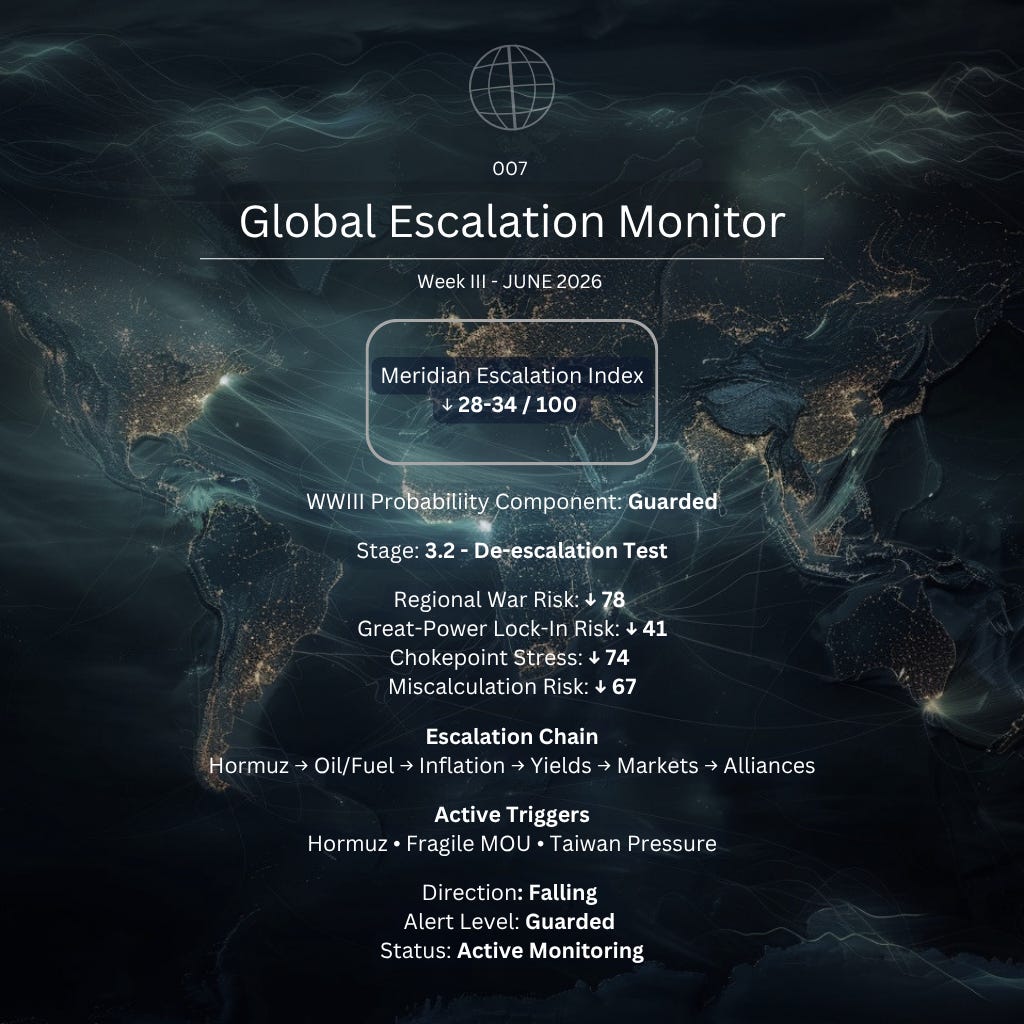
Meridian Escalation Index: 28–34 / 100
Trend: Falling
Alert Level: Guarded
Stage: 3.2 — De-escalation Test
Regional War Risk: Elevated but declining
Great-Power Confrontation Risk: Moderate
Global Economic Shock Risk: Improving
What Changed
For the first time since escalation accelerated, multiple structural indicators improved simultaneously.
Energy markets eased.
Shipping concerns moderated.
Market pricing shifted away from immediate conflict.
Diplomatic channels reopened.
Collectively, these developments reduced the probability of an uncontrolled escalation chain.
The system has moved from:
“Escalation becoming self-reinforcing.” toward: “De-escalation becoming increasingly plausible.”
That distinction matters.
Markets respond less to headlines than to changes in probability.
The Structural Chain Still Matters
Meridian continues to monitor the same critical transmission mechanism:
Hormuz → Energy → Inflation → Interest Rates → Financial Conditions → Global Alliances
During recent weeks this chain amplified geopolitical risk.
Today, that transmission mechanism is weakening.
But it has not disappeared.
Should disruption return to energy infrastructure or shipping routes, the same chain could reactivate quickly.
This remains the single most important macro linkage for investors to monitor.
Scenario Analysis
Base Case (42%)
Diplomatic progress continues.
Shipping gradually normalizes.
Energy markets stabilize.
Global financial conditions improve.
This remains our highest-probability scenario.
Fragile Stability (31%)
Negotiations continue but periodic tensions reappear.
Markets remain volatile.
Risk assets advance but with recurring geopolitical setbacks.
This remains a meaningful probability.
Re-escalation (15%)
Diplomatic efforts fail.
Military activity resumes.
Hormuz disruption returns.
Energy prices spike again.
Inflation pressure re-emerges globally.
This remains the primary downside scenario.
Secondary Theater Escalation (8%)
While Middle East tensions ease, pressure increases elsewhere.
Taiwan.
Eastern Europe.
Cyber conflict.
Hybrid warfare.
This scenario deserves close monitoring because geopolitical stress often rotates rather than disappears.
Great-Power Conflict (4%)
Direct confrontation among major powers remains a low-probability outcome.
Current conditions do not support an imminent transition toward global war.
However, history demonstrates that miscalculation rather than intention often drives systemic conflict.
Meridian Strategic Conclusion
The most important change this week is not that risk disappeared.
It is that the direction of risk changed.
Probability is now moving toward de-escalation instead of escalation.
That shift matters because capital markets price the future rather than the present.
Nevertheless, the global environment remains structurally fragile.
The current phase should be viewed as a stabilization attempt, not a completed normalization.
Meridian therefore maintains a Guarded posture.
Improving conditions justify reducing immediate crisis expectations, but they do not yet justify complacency.
Meridian Positioning
Strategic Posture: Constructively cautious.
The probability distribution has improved, but confirmation remains necessary.
What This Means
Avoid positioning solely around geopolitical fear.
Continue monitoring structural risk rather than daily headlines.
Watch energy markets as the earliest confirmation signal.
Focus on probability shifts rather than binary outcomes.
Maintain flexibility until de-escalation becomes durable.
Meridian Conviction Score
De-escalation Continuation
63 / 100
Global Escalation Re-acceleration
37 / 100
Editorial Note
The Global Escalation Monitor is a strategic intelligence publication by Meridian Signal designed to assess systemic geopolitical and macroeconomic risk.
Its purpose is not to predict conflict with certainty or advocate any investment action, but to track changes in probability, identify structural shifts, and provide context for long-term strategic decision-making.
All assessments reflect the information available at the time of publication and should be interpreted as analytical judgments rather than statements of certainty.
Meridian Signal is committed to tracking structure over headlines, probabilities over narratives, and signal over noise.
Meridian Signal
Independent Strategic Intelligence Desk
General informational analysis. Not financial advice