The latest Global Escalation Monitor shows a continued increase in systemic geopolitical risk.
The world is not entering World War III.
However, the structure that historically precedes broader international crises is becoming more interconnected.
The defining feature of the current environment is no longer a single conflict.
It is the interaction between maritime chokepoints, energy markets, sanctions, alliance dynamics, and simultaneous geopolitical pressure across multiple regions.
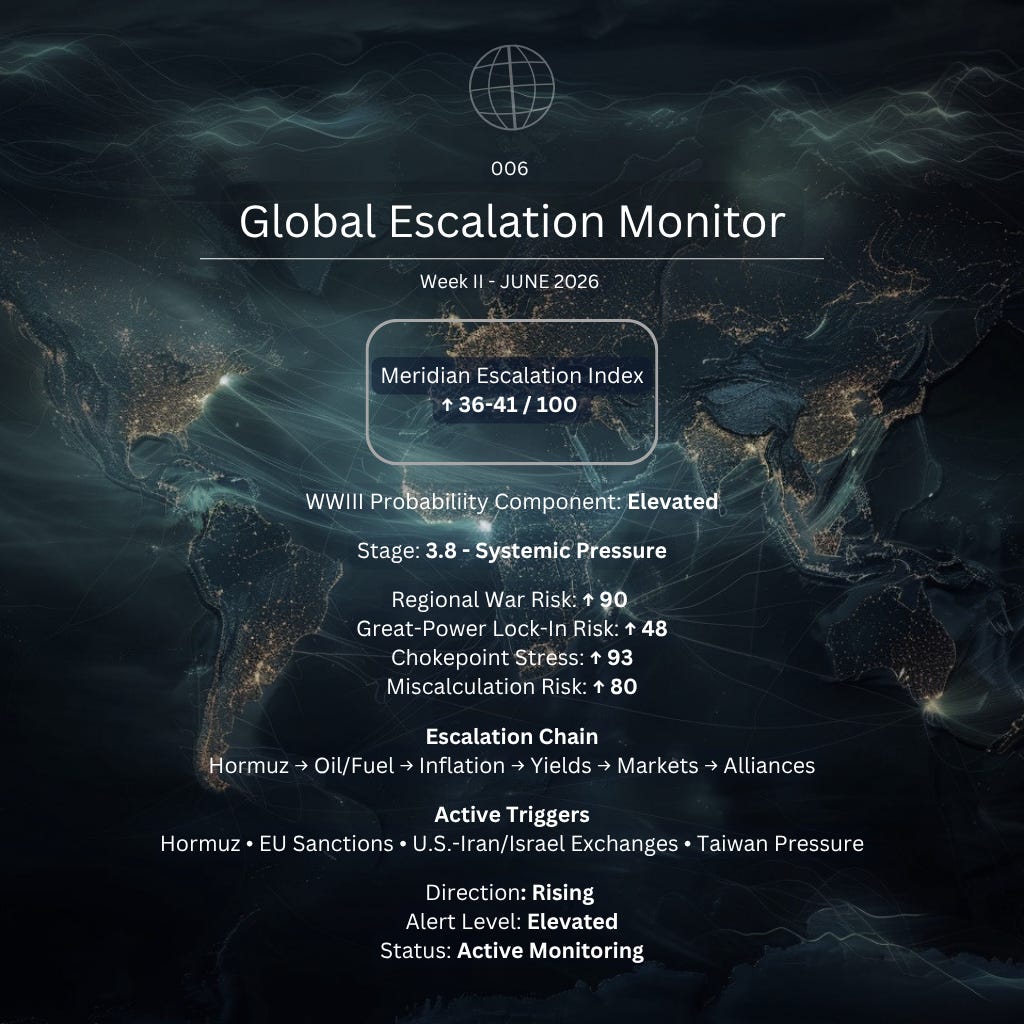
Our latest assessment places the current global escalation probability at:
36–41%
This remains below the threshold associated with a broader great-power conflict but represents a continued deterioration in the global risk environment.
The Most Important Change
The key development this week is that escalation is no longer confined to military activity.
It is increasingly spreading through economic and strategic infrastructure.
Recent sanctions related to maritime disruption in the Strait of Hormuz, continued pressure on global shipping routes, higher fuel-market volatility, and renewed activity around Taiwan all reinforce the same conclusion:
The system itself is becoming more fragile.
Rather than one isolated crisis, multiple pressure points are beginning to influence one another.
That transition matters.
History suggests that global instability becomes significantly more dangerous when independent geopolitical events begin sharing common transmission mechanisms.
Why Hormuz Remains Central
The Strait of Hormuz continues to represent the most important escalation variable in the current environment.
Its significance extends far beyond regional conflict.
Hormuz connects directly to:
global energy flows
inflation expectations
financial conditions
sovereign bond markets
political stability
alliance behavior
This creates an escalation chain that extends well beyond military considerations.
Current structural sequence:
Hormuz → Oil & Fuel → Inflation → Interest Rates → Financial Markets → Alliances → Secondary Theaters
This remains the dominant pathway monitored by WW3PM.
Systemic Fragility
While no single development confirms a broader conflict trajectory, the interaction between multiple variables has strengthened.
Current pressure points include:
continued Hormuz instability
maritime security concerns
sanctions expansion
energy market volatility
Taiwan maritime activity
elevated strategic miscalculation risk
Taken independently, each remains manageable.
Taken together, they increase systemic fragility.
This distinction is critical.
Major geopolitical transitions often emerge through cumulative pressure rather than sudden singular events.
Miscalculation Remains the Primary Risk
The monitor continues to identify strategic miscalculation as one of the highest-risk variables.
Escalation does not require intentional expansion.
It can emerge through:
navigation incidents
communication failures
retaliatory cycles
alliance obligations
economic pressure
or overlapping regional crises
As these systems become more interconnected, the probability of unintended escalation increases.
This remains one of the central observations of the current WW3PM framework.
Current Outlook
The base case remains a contained regional conflict accompanied by recurring energy and shipping disruptions.
However, the probability of broader synchronization between multiple geopolitical theaters has increased.
This does not imply that global war is imminent.
It suggests that the system is operating with less margin for error.
The coming weeks will likely be defined by whether diplomatic channels regain momentum or whether additional pressure accumulates across existing fault lines.
Final Assessment
The latest update reinforces a simple conclusion:
The world is not becoming more stable.
It is becoming more interconnected.
And in complex systems, interconnected pressure often matters more than individual events.
For now, global escalation risk remains elevated but below great-power conflict thresholds.
The focus is not on predicting war.
The focus is on understanding how structural pressure evolves before consensus recognizes it.
Meridian Signal
Independent Strategic Intelligence Desk
General informational analysis. Not financial advice