
Global escalation risk has increased again.
Over the past week, there were signs that tensions in the Middle East might stabilize. That window now appears to be narrowing.
Recent developments involving the United States and Iran, renewed threats surrounding the Strait of Hormuz, rising energy market stress, and continued pressure around Taiwan have collectively pushed the risk environment higher.
Our assessment is not that the world is entering World War III today.
Rather, the structural conditions that increase the probability of a wider conflict have strengthened.
Current Assessment
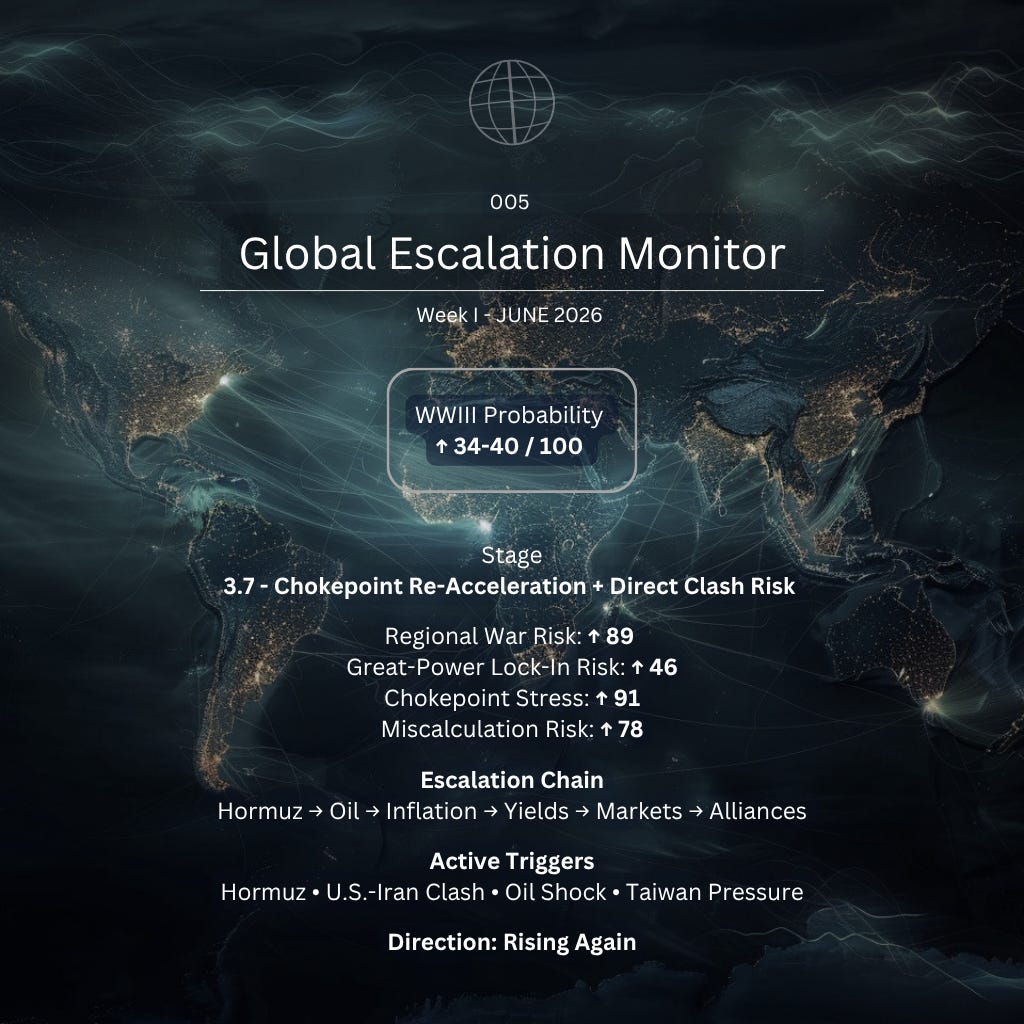
WWIII Probability Range: 34–40%
Direction: Rising
Classification: Dangerous Lower Band
Stage: Chokepoint Re-Acceleration + Direct Clash Risk
The probability remains below levels associated with imminent great-power conflict. However, the trajectory has shifted upward following a period of tentative stabilization.
What Changed
The most important development is not a single headline.
It is the deterioration of the de-escalation pathway.
Recent events suggest that communication channels between the United States and Iran are weakening while military interactions have become more direct.
At the same time:
Hormuz disruption risk has increased
Oil markets have repriced higher
Taiwan-related maritime pressure remains elevated
Global investors are once again factoring geopolitical risk into asset prices
The result is a system that has become more fragile than it was in the previous report.
Why Hormuz Matters
The Strait of Hormuz remains one of the most important geopolitical chokepoints on Earth.
A significant percentage of global energy flows pass through this narrow corridor.
Historically, regional conflicts have often remained contained until they threatened critical economic infrastructure.
Hormuz is different.
A disruption here does not remain regional.
It immediately becomes global.
The escalation chain is straightforward:
Hormuz → Oil → Inflation → Interest Rates → Financial Markets → Political Pressure → Broader Strategic Responses
This is why Hormuz remains the single most important variable in the current risk environment.
The Current Risk Structure
Regional War Risk
Risk remains elevated and continues to rise.
The probability of additional military exchanges in the Middle East is significantly higher than it was several weeks ago.
Great-Power Lock-In Risk
Still below critical levels.
However, simultaneous pressure involving Iran, Taiwan, and broader geopolitical rivalries increases the chance that separate crises begin interacting with one another.
Economic Shock Risk
High.
Energy markets remain the fastest transmission mechanism through which geopolitical instability can impact the global economy.
Miscalculation Risk
One of the most important indicators.
History shows that major conflicts often emerge not from deliberate decisions but from chains of unintended escalation.
As military activity increases and communication deteriorates, the probability of miscalculation rises.
Scenario Outlook
Base Case (Most Likely)
A contained regional conflict accompanied by recurring Hormuz-related stress and periodic energy market disruptions.
This remains our primary scenario.
Escalation Scenario
A prolonged cycle of direct U.S.–Iran military exchanges combined with significant shipping disruption in the Strait of Hormuz.
This would materially increase both economic and geopolitical risk.
Global Expansion Scenario
A secondary geopolitical theater activates while the Middle East remains unstable.
The probability remains relatively low, but it is rising.
This is the scenario that would push the WWIII probability materially higher.
De-Escalation Scenario
Diplomatic channels reopen, military activity slows, and shipping conditions stabilize.
This remains possible but currently appears less likely than in our previous assessment.
What We Are Watching Next
The next phase will likely be determined by six key indicators:
Any disruption to commercial shipping through Hormuz
Additional direct U.S.–Iran military exchanges
Evidence of casualties involving U.S. forces
Sustained upward pressure in energy markets
Changes in Chinese military activity around Taiwan
Cyber operations targeting critical infrastructure
These indicators will determine whether the current escalation remains regional or begins expanding into a broader strategic conflict.
Final Assessment
World War III is not our base case.
However, the risk environment has deteriorated.
The most important shift is not that a global war has become likely.
It is that the pathways leading toward one have become more visible.
The de-escalation window that appeared to be opening several days ago is narrowing.
For now, the world remains in a dangerous but manageable phase.
Whether it stays there will depend largely on what happens in the Middle East over the coming weeks.
WW3PM 005
Probability Range: 34–40%
Direction: Rising
Key Risk Driver: Strait of Hormuz
Primary Escalation Chain: Hormuz → Oil → Inflation → Markets → Alliances
Status: Monitoring Closely
Meridian Signal
Independent Strategic Intelligence Desk
General informational analysis. Not financial advice