
Evidence cutoff: September 21, 2026, 15:54:12 UTC, or 8:54:12 a.m. Pacific.
Forecast window: 30 days, ending October 21, 2026, 15:54:12 UTC, or 8:54:12 a.m. Pacific.
Executive assessment
The immediate economic risk is a transport system that keeps moving oil while becoming harder to rely on. Reporting describes tanker scarcity and expensive delivery workarounds alongside continued Gulf exports. Our assessment is that functioning substitutes can limit a supply shock without restoring dependable access. That distinction matters for buyers exposed to delivery delays, freight charges and another infrastructure interruption. Wall Street Journal, September 21
The Meridian Escalation Index is 60/100, unchanged from the comparable September 16 calculation. The Critical alert remains under the model’s acute regional override. It does not mean global war is the most likely outcome.
There is meaningful counterevidence to an uninterrupted escalation narrative. Diplomatic avenues remain open, and financial reporting describes relief in oil, bonds and equities. These observations support a larger role for stalemate and a possible negotiated improvement, without demonstrating durable operational restraint. Financial Times, September 21
Our largest individual scenario is strategic stalemate, at 38%. The combined probability of several distinct escalation outcomes is 47%. Those statements are compatible: the combined group is not one scenario.
The assessment remains provisional. Evidence Support is 58/100, Moderate, with incomplete operational coverage and limited access to several current reports.
Executive snapshot
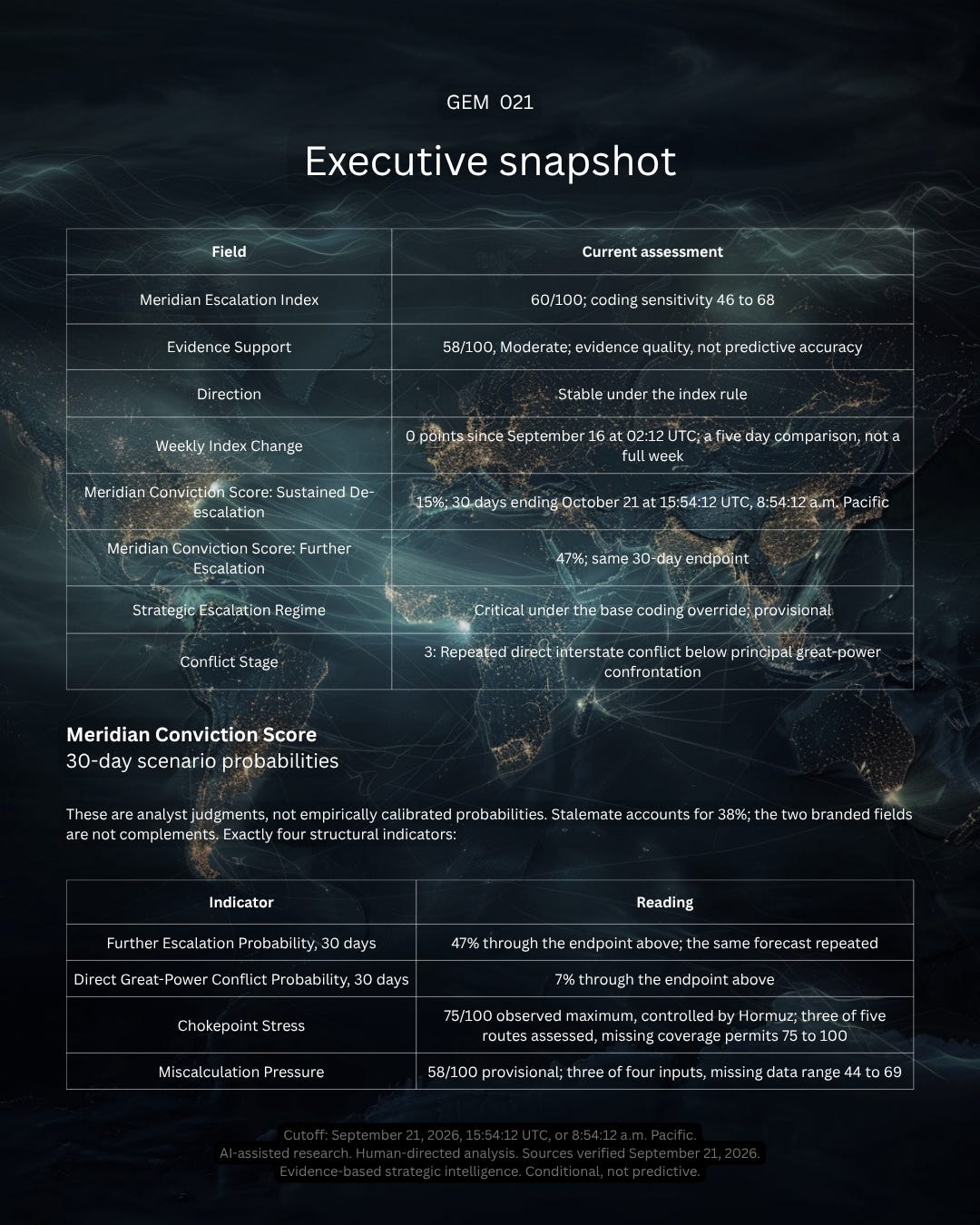
Active triggers: impaired export alternatives; restricted maritime access; continuing regional combat; uncertain implementation of restraint.
Alert Level: Critical. The override requires conflict, route impairment and export redundancy loss each at level three or higher. More favorable alternative codings would remove it.
Fresh intelligence and the delivery constraint
September 21 Reuters reporting describes continued passage through Hormuz, while visible commodity traffic remains restricted. Tracking cannot fully observe vessels operating without transponders. Different retrieved versions also disagree on vessel totals. We therefore do not present a precise reopening percentage or treat visible traffic as total delivered supply. Reuters maritime report
The structural issue is substitution. A bypass provides protection only while it remains usable; tanker transfers may preserve exports while adding another operational dependency. Reports of prospective partial pipeline recovery deserve attention, but an expected restart is not measured sustained throughput. Wall Street Journal supply assessment, September 21
Our inference is narrower than a global shortage prediction. Buyers can face less reliable delivery even while aggregate exports continue. Actual cargo arrivals, loading continuity and transport costs will determine how much of that vulnerability reaches the wider economy.
Theaters and escalation migration
The Middle East remains the central maritime transmission channel. Reuters reports fighting around strategic Yemeni heights, while sources describing a September 20 call say Washington did not pledge military support against the Houthis. Territorial pressure and restraint by an outside power can coexist. Reuters, Yemen fighting, Reuters, diplomatic call
Russia and Ukraine remain in repeated direct conflict. Reported border incursions require attention, but do not establish direct fighting between Russia and the North Atlantic Treaty Organization. Associated Press, September 21
The Taiwan observation recovered for this run covers September 14 to 15 only. It supports a dated pressure assessment, not a current blockade claim. Korea and several secondary theaters lack sufficient fresh operational coverage. These gaps are not readings of stability. Taiwan defense ministry
Migration is clearest through energy logistics and potential demands on shared military capacity. Simultaneous conflicts alone do not prove a coordinated campaign.
Restraint, nuclear safety and contrary evidence
Gulf calls for dialogue provide a plausible path toward improvement. They remain diplomatic positions rather than proof of implementation. Reported United States and China discussions similarly preserve contact; an artificial intelligence incident proposal is not a verified military hotline. Financial Times, Gulf diplomacy, Associated Press, bilateral discussions
The International Atomic Energy Agency’s September 14 statement documents safeguards concerns in Iran and reactor vulnerabilities in Ukraine, alongside negotiated repair work. This is structural context, not current daily telemetry or evidence of nuclear weapons use. Agency statement
Durable improvement requires restraint and physical recovery together. Rhetoric alone cannot meet that test.
The next 30 days
All estimates end October 21, 2026, at 15:54:12 UTC, 8:54:12 a.m. Pacific. Resolve the highest qualifying outcome first, F through C, then A or B.
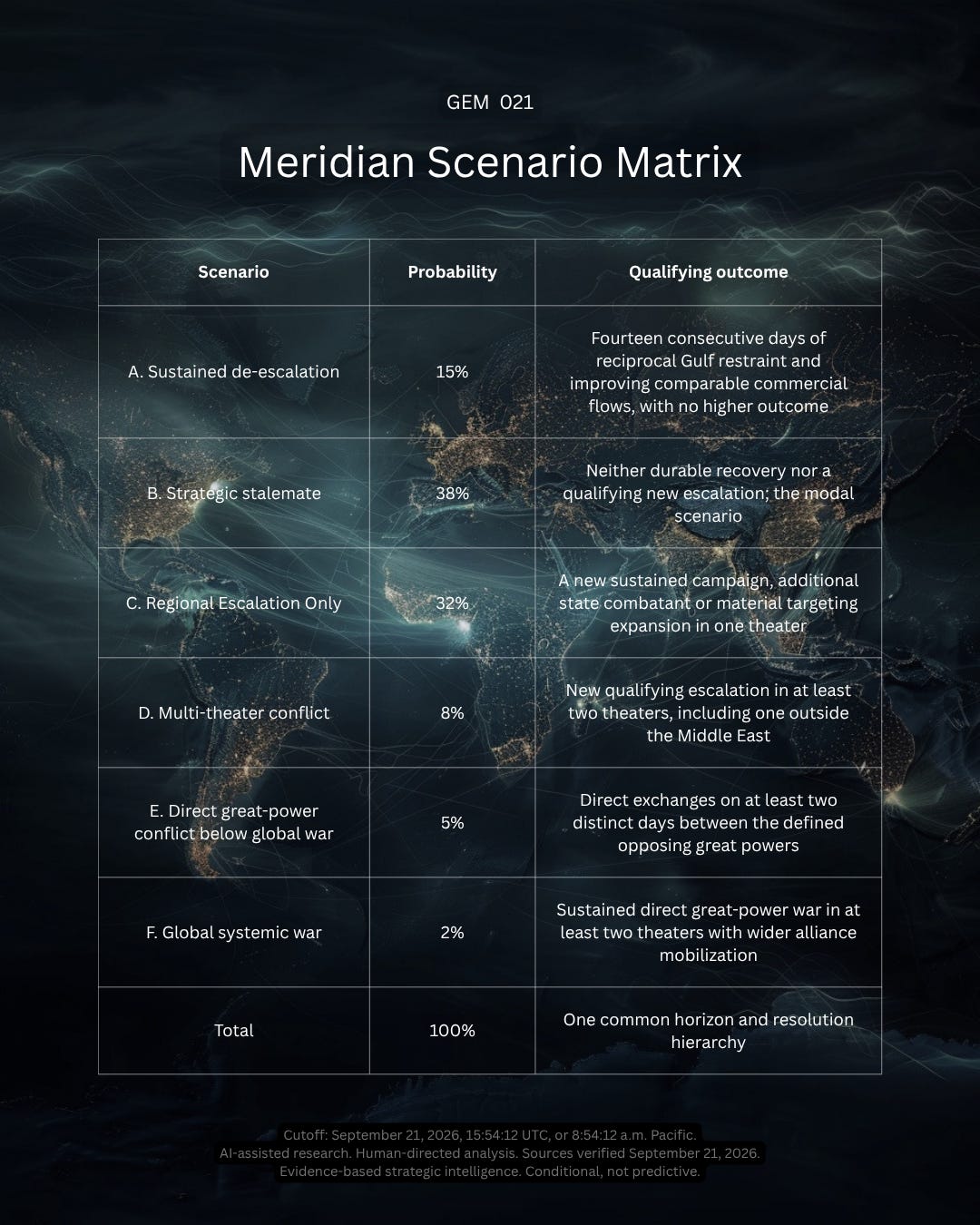
The relevant great-power pairings are United States or NATO forces against Russia, or United States forces against China. Sustained campaigns require repeated operations across at least seven days.
Further escalation is C+D+E+F, or 47%; direct great-power conflict is E+F, or 7%. Alternative complete allocations put further escalation between 33% and 70%. Those are assumption tests, not confidence intervals.
Emergency Energy Measures Probability is separately estimated at 20% over the same 30 days. It requires new conflict-caused official reserve releases, mandatory rationing or emergency import allocation in at least two of the United States, European Union, China, India or Japan, implemented for seven days within the window. Unchanged existing measures do not qualify. It overlaps the scenarios and is not added to their total.
What changed and what would change our view
All eight base index levels remain unchanged after reassessment. Evidence Support is lower because access and coverage are weaker. The refreshed forecast assigns more weight to restraint and stalemate, while recognizing that already observed fighting must not be counted as future escalation.
A sustained restoration of alternative exports and reciprocal restraint would weaken the Critical case. Independently verified expansion into new targets, a new state combatant or direct opposing great-power exchanges would strengthen it.
Financial market relief challenges a generalized panic interpretation. Synchronized credit and funding evidence remains incomplete, so systemic financial stress is neither established nor ruled out.
Priority watch list
Sustained Saudi bypass throughput and cargo loadings.
Comparable Hormuz traffic populations and observation windows.
Safe passage through Bab el-Mandeb, differentiated by vessel exposure.
Implemented Gulf agreements and reciprocal compliance.
New targeting beyond the starting regional campaign.
Verified border incidents and direct great-power exchanges.
Updated safeguards access and reactor power security.
New emergency energy measures in two qualifying jurisdictions.
Meridian Strategic Conclusion
Maintain a defensive monitoring posture, with attention on delivery reliability and the conditions for real recovery. Continuing exports help contain the shock; they do not by themselves remove the vulnerability.
The next useful signal is operational: dependable throughput, safer passage and restraint that survives contact with events. Until those conditions are demonstrated, the case for normalization remains incomplete. This assessment is not a recommendation to trade any particular asset.
Editorial note: The Global Escalation Monitor assesses geopolitical and macroeconomic risk for strategic decision-making. Its conclusions are conditional analytical judgments, not certain predictions of conflict or recommendations to buy or sell assets.
Research disclosure: Meridian Signal uses AI-assisted research and synthesis under human-directed editorial priorities. Material factual claims are linked to supporting sources, with access limitations and evidence gaps disclosed where they affect the assessment. Each edition states its evidence cutoff; individual sources may cover different observation periods.
The Meridian Escalation Index measures structural stress. Meridian Conviction Scores express judgment-based probabilities of defined outcomes over a stated forecast window. Evidence Support describes the quality of evidence supporting the index inputs, not forecasting accuracy. These probabilities have not been empirically calibrated. Material methodology changes and their effects on comparability are disclosed.
AI-assisted. Sources and limitations disclosed.