

Reporting Period: Week 36, August / September 2026
Intelligence Cutoff: August 31, 2026
AI-assisted. Human-directed. Source-verified.
Executive Assessment
Global Escalation Monitor 017 found that regional conflict was beginning to harden into a more durable system of coercive pressure.
This week, something more consequential happened.
Direct U.S.–Iran military exchange resumed.
U.S. forces struck Iranian launchers on Larak Island in the Strait of Hormuz. Iran subsequently retaliated against U.S. positions in Jordan.
That breaks one of the principal stabilizing conditions that had held since late July: direct military restraint between Washington and Tehran.
The Strait of Hormuz remains severely impaired. Maritime access is still politically contested. The possibility of mine warfare has returned to the center of the chokepoint problem.
At the same time, Russia and Ukraine are escalating their use of mass autonomous systems. European states are increasing defenses against drones and hybrid threats. Taiwan is emphasizing blockade and isolation scenarios in its defense planning.
The Meridian Escalation Index therefore rises from 73 to 77 out of 100.
That places the system immediately below Meridian’s Critical threshold.
But the monitor does not classify the environment as Critical yet.
The latest U.S.–Iran exchange remains limited. There has been no major American casualty event. NATO says it sees no imminent direct attack threat. There is no confirmed Russia–NATO deliberate military exchange. And Taiwan does not assess China as currently possessing an immediate full-scale amphibious invasion capability.
The correct conclusion is therefore:
Escalation is real. Critical activation is not yet confirmed.
Executive Snapshot
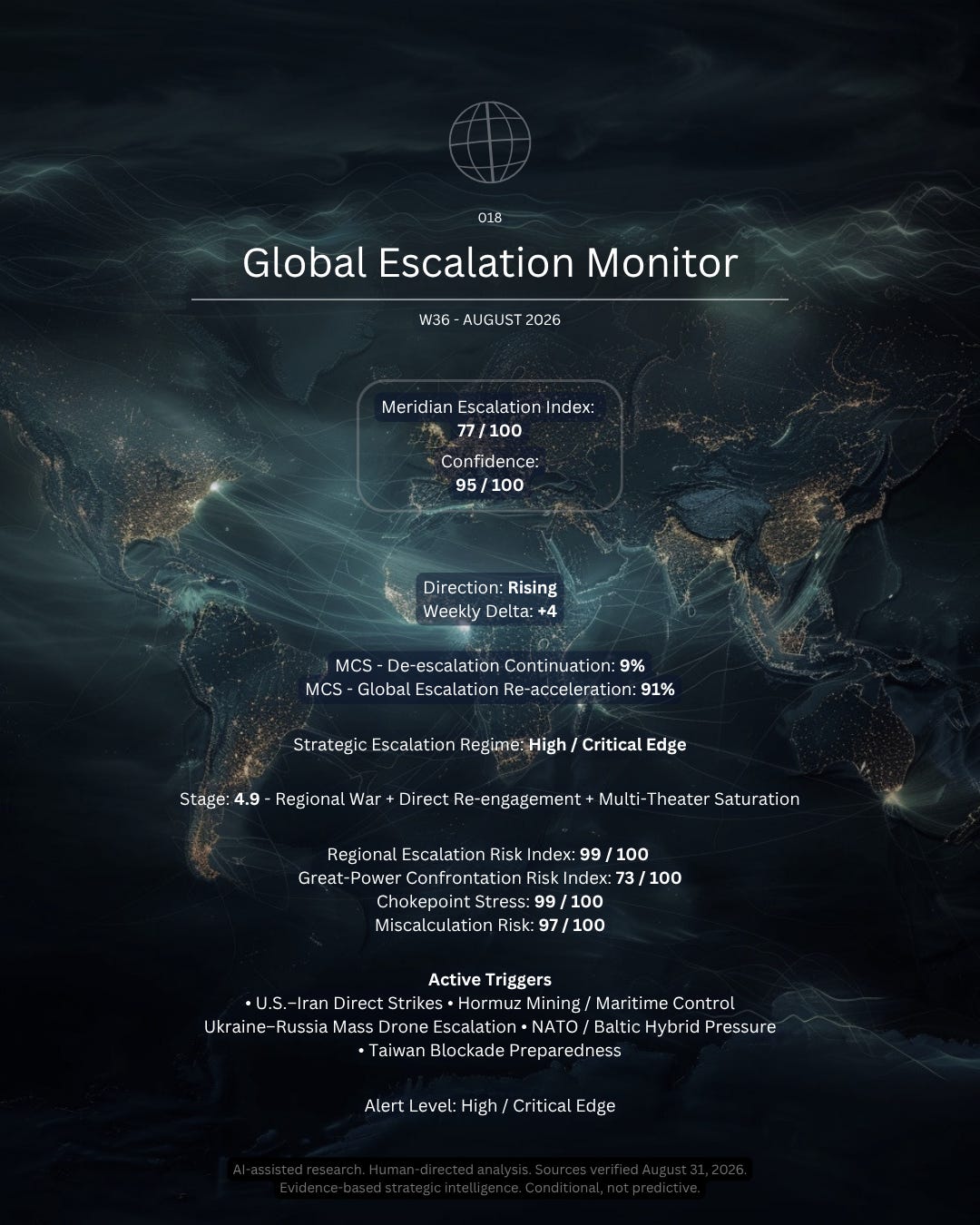
Stage
4.9 — Regional War + Direct Re-engagement + Multi-Theater Saturation
Active Triggers
U.S.–Iran Direct Strikes
Hormuz Mining / Maritime Control
Ukraine–Russia Mass Drone Escalation
NATO / Baltic Hybrid Pressure
Taiwan Blockade Preparedness
Strategic Posture
Defensive Vigilance · Critical Threshold Test
What Changed Since Global Escalation Monitor 017
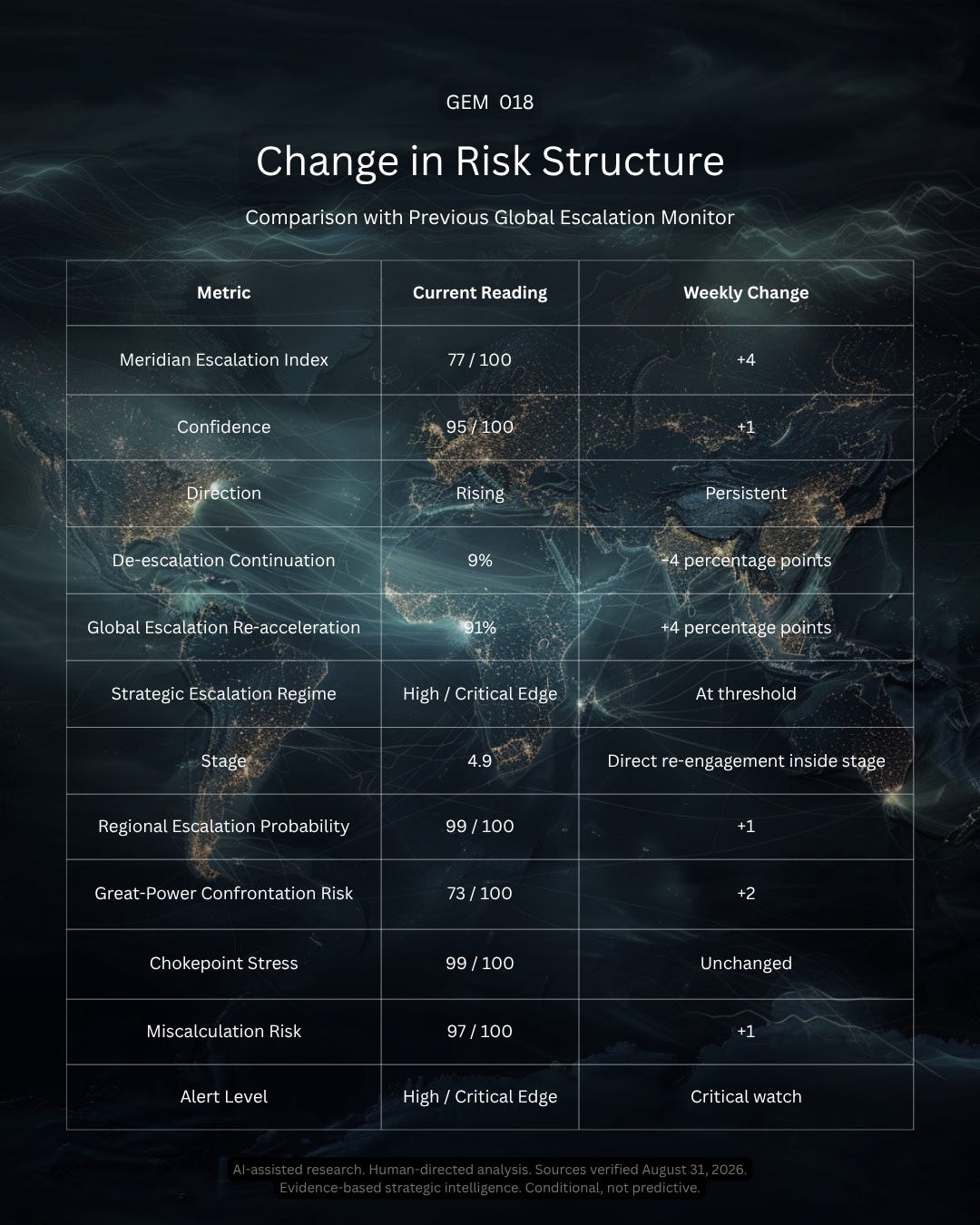
The most important change is straightforward:
Direct military restraint broke
GEM 017 was still compatible with a coercive equilibrium.
Washington and Tehran were using sanctions, selective passage, maritime rules, economic pressure and military signaling without returning to sustained direct exchanges.
That arrangement has now been punctured.
The United States struck Iranian launchers.
Iran retaliated against U.S. positions.
The confrontation therefore moved from:
Coercive pressure under military restraint
back toward:
Direct kinetic confrontation
That does not guarantee a sustained escalation cycle.
But it substantially increases the probability of one.
Hormuz Has Returned to the Center of the Military Problem
Hormuz Normalization Score: 4 / 100
The Strait of Hormuz remains near functional closure.
Limited passage still exists.
That matters because the monitor should not describe the route as literally sealed when some commercial traffic continues.
But normal passage has not returned.
The current environment combines:
restricted commercial transit
politically permissioned access
tanker interception risk
military activity
disputed maritime authority
potential mine warfare
The result is a chokepoint that remains technically navigable but strategically unreliable.
This is why Chokepoint Stress remains 99 / 100.
The question is no longer simply whether ships can physically move through Hormuz.
It is whether they can do so:
safely, repeatedly, commercially and without becoming part of a military confrontation.
That threshold has not been met.
The Middle East Is at the Ceiling of the Current Regime
Middle East Theater Score: 99 / 100
This is effectively the ceiling before a new classification is required.
The regional conflict now contains:
direct U.S.–Iran strikes
Iranian retaliation against U.S. facilities
maritime access restrictions
potential mine warfare
tanker interdiction
sanctions
proxy pressure
global energy-market transmission
The principal escalation chain is now active again:
Hormuz military preparation → U.S. pre-emption → Iranian retaliation → U.S. counter-retaliation → maritime escalation → Gulf-base exposure
The contradiction is that this chain has not yet become self-sustaining.
The direct exchange remains limited.
That distinction is why Meridian remains at Stage 4.9, rather than moving immediately into a Stage 5 systemic classification.
De-escalation Durability Has Fallen Again
De-escalation Durability Score: 7 / 100
This is one of the clearest readings in GEM 018.
The earlier diplomatic framework failed.
The coercive equilibrium that followed it has now also failed to prevent renewed direct military exchange.
De-escalation remains possible.
But the operating system is no longer generating restraint on its own.
Any credible future stabilization framework would need to suppress several mechanisms simultaneously:
direct U.S.–Iran attacks
mine warfare
commercial vessel attacks
retaliatory missile launches
proxy escalation
disputed transit enforcement
sanctions escalation
The burden of proof for another de-escalation call is now considerably higher than it was several weeks ago.
Russia–Ukraine Warfare Is Entering a Mass Autonomous Phase
Ukraine / Russia Theater Score: 96 / 100
The Ukraine war continues evolving in ways that matter beyond the immediate battlefield.
Russia has reportedly launched around 1,500 drones over four days during a sustained campaign against Kyiv and surrounding areas.
Ukraine continues conducting deep strikes against Russian logistics and commercial infrastructure.
The structural signal is not simply that drones are being used.
It is scale.
Autonomous mass is increasingly becoming a strategic instrument capable of generating persistent pressure without traditional air superiority.
That changes the economics and tempo of warfare.
It also increases the challenge for air defense.
The attacker may be able to generate far more low-cost targets than the defender can economically intercept.
That dynamic is becoming relevant well beyond Ukraine.
NATO Is Preparing for the Autonomous Threat
Structural NATO-Edge Risk: 76 / 100
European states around the Baltic are increasing coordination around drone and hybrid-defense systems.
At the same time, NATO has explicitly said it sees no imminent direct attack threat.
Both signals need to be held together.
The first tells us that European defense planners believe the threat environment is worsening.
The second tells us that the evidence does not support an imminent NATO–Russia war call.
The correct interpretation is:
Defensive preparation is accelerating faster than evidence of intentional direct confrontation.
That keeps alliance-edge risk elevated while preventing an unjustified jump in the direct Great-Power Confrontation probability.
Taiwan: Blockade Risk Matters More Than Invasion Headlines
Taiwan / Indo-Pacific Theater Score: 79 / 100
Taiwan’s latest defense assessment emphasizes growing Chinese capability for:
air control
maritime control
joint blockade
isolation of external supply lines
At the same time, Taiwan does not assess China as currently ready for a full amphibious invasion.
That creates a more precise strategic signal:
The nearer-term structural concern is blockade and isolation, not necessarily immediate invasion.
This matters because a blockade-style crisis could create U.S.–China confrontation without beginning as a conventional amphibious assault.
It may therefore represent a lower threshold for great-power involvement.
Korean Peninsula Remains a Secondary but Rising Risk
Theater Score: 64 / 100
North Korea continues signaling that its nuclear-force expansion will persist.
Pyongyang is also criticizing upcoming U.S.–South Korea–Japan military exercises.
This does not constitute an activated Korean conflict scenario.
But it adds another strategic theater that requires:
missile defense
intelligence
naval presence
alliance coordination
political attention
That matters more in a world where those same resources are already being demanded elsewhere.
Multi-Theater Saturation Is Becoming the Core Structural Problem
Secondary Theater Rotation Score: 97 / 100
The system now contains simultaneously:
U.S.–Iran direct exchange
→ Hormuz militarization
→ Red Sea disruption
→ Russia–Ukraine mass autonomous warfare
→ NATO hybrid-defense buildup
→ Taiwan blockade preparedness
→ North Korean nuclear-force expansion
These remain separate theaters.
Meridian does not assess them as one coordinated global conflict.
But they increasingly compete for the same scarce resources:
air defense
naval assets
intelligence
munitions
logistics
political attention
energy buffers
diplomatic capacity
The system is therefore entering strategic saturation.
A country does not need to lose control of one theater for the system to become dangerous.
It can become dangerous because too many theaters demand attention simultaneously.
Great-Power Confrontation Risk
Structural Risk Index: 73 / 100
This remains a structural entanglement measure.
It does not mean there is a 73% probability of direct war between major powers.
The mutually exclusive Scenario Matrix estimate for Great-Power Confrontation is 9%.
The structural index rises because:
NATO states are building new hybrid and drone defenses
Russia and Ukraine are expanding autonomous warfare
Chinese blockade capability is becoming more explicit
U.S. military resources remain heavily committed in the Middle East
multiple theaters are competing for the same strategic capacity
Major-power entanglement can rise substantially before direct war becomes the dominant outcome.
That is what the structural score is intended to capture.
Miscalculation Risk
97 / 100
This is now effectively at the top of the monitor.
The environment contains:
sea-mine preparation
tanker interception
direct U.S. airstrikes
Iranian ballistic retaliation
autonomous mass-drone attacks
unidentified hybrid threats
NATO defensive systems
blockade planning around Taiwan
multiple alliance commitments
The core danger remains:
Escalation does not require every actor to want escalation.
It requires only one tactical event to cross a threshold that political leaders cannot reverse quickly enough.
That is why miscalculation, rather than deliberate global-war planning, remains one of the most important variables in the monitor.
Economic Transmission
The return of direct U.S.–Iran exchanges pushed oil back above $90.
The Strategic Petroleum Reserve remains depleted relative to previous geopolitical crises.
European equities weakened.
Bond yields rose.
The strategic issue is not any one market move.
It is diminishing resilience.
The chain increasingly looks like:
Higher geopolitical risk + impaired chokepoints + reduced emergency energy buffers → less capacity to absorb the next shock
Global Economic Shock Risk: 93 / 100
The international system can still absorb additional stress.
It can absorb less than it could earlier in the cycle.
Scenario Matrix
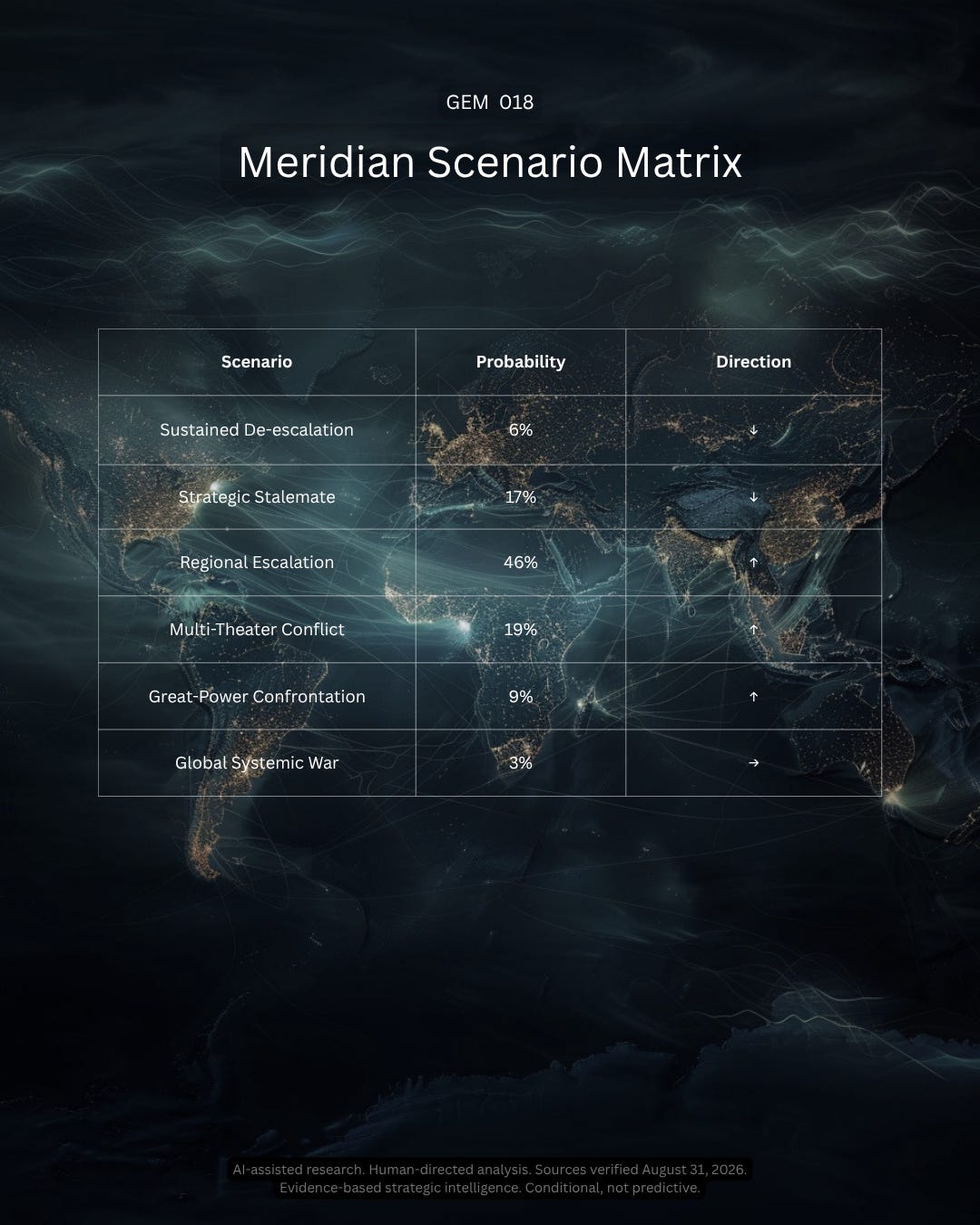
Base Case: Regional Escalation — 46%
Regional Escalation remains the dominant scenario.
The likely structure includes:
intermittent direct U.S.–Iran military exchanges
militarized Hormuz access
restricted commercial passage
persistent sanctions
Houthi pressure
elevated oil volatility
continued Russia–Ukraine mass-strike warfare
NATO defensive preparation
no full-scale great-power war
Multi-Theater Conflict — 19%
This remains the second probability I would watch most closely.
The system is not yet merging into one global war.
But several theaters are becoming simultaneously operationally demanding.
That is a meaningful deterioration.
Great-Power Confrontation — 9%
This increases by one percentage point.
The shift reflects stronger NATO-edge preparations and more explicit blockade-related developments around Taiwan.
It remains far below the structural 73 / 100 Great-Power Confrontation Risk reading because these measures answer different questions.
Global Systemic War — 3%
Unchanged.
This deserves emphasis.
The geopolitical environment deteriorated materially.
Yet Meridian does not find sufficient evidence to raise the global systemic-war probability.
Why?
no confirmed deliberate Russia–NATO exchange
NATO itself sees no imminent attack threat
no verified China–Taiwan activation sequence
the latest U.S.–Iran exchange remains limited
major actors continue signaling some desire to constrain escalation
That is the role of the System Integrity Layer:
to prevent dramatic headlines from automatically becoming dramatic probabilities.
Meridian Conviction Scores
De-escalation Continuation
9%
Down from 13%.
The probability falls because direct U.S.–Iran military exchange resumed while Hormuz remains militarized and Ukraine–Russia military intensity continues rising.
Global Escalation Re-acceleration
91%
Up from 87%.
This does not mean Meridian assigns a 91% probability to global war.
It means the framework assesses a 91% probability that the broader escalation environment remains materially elevated or worsens further before durable normalization is achieved.
What Would Cross the Critical Threshold?
The next move matters disproportionately because the Meridian Escalation Index now sits at 77 / 100.
Evidence capable of pushing the system above 80 includes:
another sustained round of major U.S.–Iran attacks
substantial U.S. or Iranian military casualties
verified Iranian mining that materially obstructs Hormuz
destruction or detention of major international tankers
major Gulf oil or LNG infrastructure disabled
sustained Saudi or Emirati direct combat involvement
a confirmed intentional Russian attack on NATO territory
NATO attacks on Russian forces beyond immediate defensive interception
Chinese blockade operations against Taiwan
a North Korean attack on South Korea or Japan
direct Turkey–Israel military exchange
Any one of these would require immediate recalibration.
Several occurring together would likely represent a regime transition.
What Would Lower the Risk?
The index could move materially lower if:
the latest U.S.–Iran exchange ends without another round
negotiations restart
Hormuz throughput rises materially
mine activity is verifiably halted
tanker interdictions decline
oil loses the renewed geopolitical premium
Russia–Ukraine mass-drone intensity declines
NATO hybrid incidents stabilize
Chinese activity remains below blockade implementation
The physical system must validate any future diplomatic improvement.
Statements alone are no longer enough.
What We Are Watching Next
The system is now close enough to the Critical threshold that the next set of signals matters more than incremental weekly movement.
The priority watch list is:
Any second sustained U.S.–Iran strike cycle
Iranian mining activity in Hormuz
U.S. and Iranian military casualties
Large tanker and LNG movements
Houthi operations around Bab el-Mandeb
Oil and freight-market reaction
Russia–Ukraine mass-drone tempo
NATO / Baltic hybrid incidents
Chinese blockade-related operations around Taiwan
Any cross-theater military redeployment that materially reduces deterrence elsewhere
Meridian Strategic Conclusion
Global Escalation Monitor 017 identified a world in which regional conflict was hardening into durable coercive structures.
Global Escalation Monitor 018 adds something more dangerous:
Direct military exchange has returned.
The United States has again struck Iranian territory.
Iran has retaliated against U.S. positions.
Hormuz remains militarized.
Potential mine warfare has returned to the center of the chokepoint problem.
Russia and Ukraine are simultaneously moving deeper into autonomous mass-strike warfare.
European states are building coordinated defenses against hybrid and drone threats.
Taiwan is warning that Chinese planning increasingly emphasizes blockade and isolation.
None of this means the world has crossed into systemic war.
But the amount of strategic friction the international system must absorb simultaneously is now approaching the upper edge of the current regime.
Meridian Escalation Index
77 / 100
Confidence
95 / 100
Direction
Rising
Weekly Delta
+4
Strategic Escalation Regime
High / Critical Edge
Stage
4.9 — Regional War + Direct Re-engagement + Multi-Theater Saturation
De-escalation Continuation
9%
Global Escalation Re-acceleration
91%
Alert Level
High / Critical Edge
Strategic Posture
Defensive Vigilance · Critical Threshold Test
Institutional Verdict
The system has not crossed into a global-war regime. But direct U.S.–Iran military exchange has resumed at the same time that Russia–Ukraine warfare is intensifying and Indo-Pacific blockade risk is becoming more explicit. Meridian is now testing the Critical threshold. The next sustained kinetic escalation could matter more than several weeks of incremental deterioration combined.
Editorial Note
The Global Escalation Monitor is a strategic intelligence publication designed to assess systemic geopolitical and macroeconomic risk. It does not predict conflict with certainty or advocate any investment action. Its purpose is to track changes in probability, identify structural shifts, and provide context for long term strategic decision making.
Research Disclosure
Meridian Signal uses artificial intelligence assisted research and data synthesis under human directed editorial judgment. Material claims are source validated before publication. Proprietary formulas, weights, normalization rules, private thresholds and calculation mechanics are not disclosed. Governed readings publish only after their data, source quality and internal consistency satisfy Meridian standards.
AI-assisted. Human-directed. Source-verified.
Meridian Signal
Independent Strategic Intelligence Desk
General informational analysis only. This is not individualized financial, investment, legal, or tax advice.