

Publication Date: August 24, 2026 | Reporting Period: Week 35
AI-assisted. Human-directed. Source-verified.
Executive Assessment
Global Escalation Monitor 016 was defined by the failure of the existing de-escalation architecture.
This week, the more important question is what is beginning to replace it.
The answer is not peace.
It is also not unrestricted regional war.
Instead, the conflict is beginning to harden into a more durable system of economic pressure, selective maritime access, military deterrence, proxy activity and strategic resource competition.
Iran is increasingly formalizing its claim over passage through the Strait of Hormuz. Vessels have reportedly been blacklisted for violating Iranian transit rules, while selected tankers have received permission to pass.
That distinction matters.
Hormuz is no longer functioning simply as an open or closed chokepoint.
It is increasingly behaving like a permissioned corridor.
At the same time, Washington is widening economic pressure on Iran while preserving additional escalation options. Ukraine and Russia are extending their conflict further into logistics, energy and commercial infrastructure. North Korea is again testing missiles. Taiwan is increasing long-term defense spending.
And for the first time in this sequence, there is clearer evidence that one theater is beginning to affect military capacity in another.
The Meridian Escalation Index therefore rises modestly from 71 to 73 out of 100.
The increase is smaller than last week because this is not another regime break.
It is something potentially more persistent:
Escalation is becoming institutionalized.
Executive Snapshot
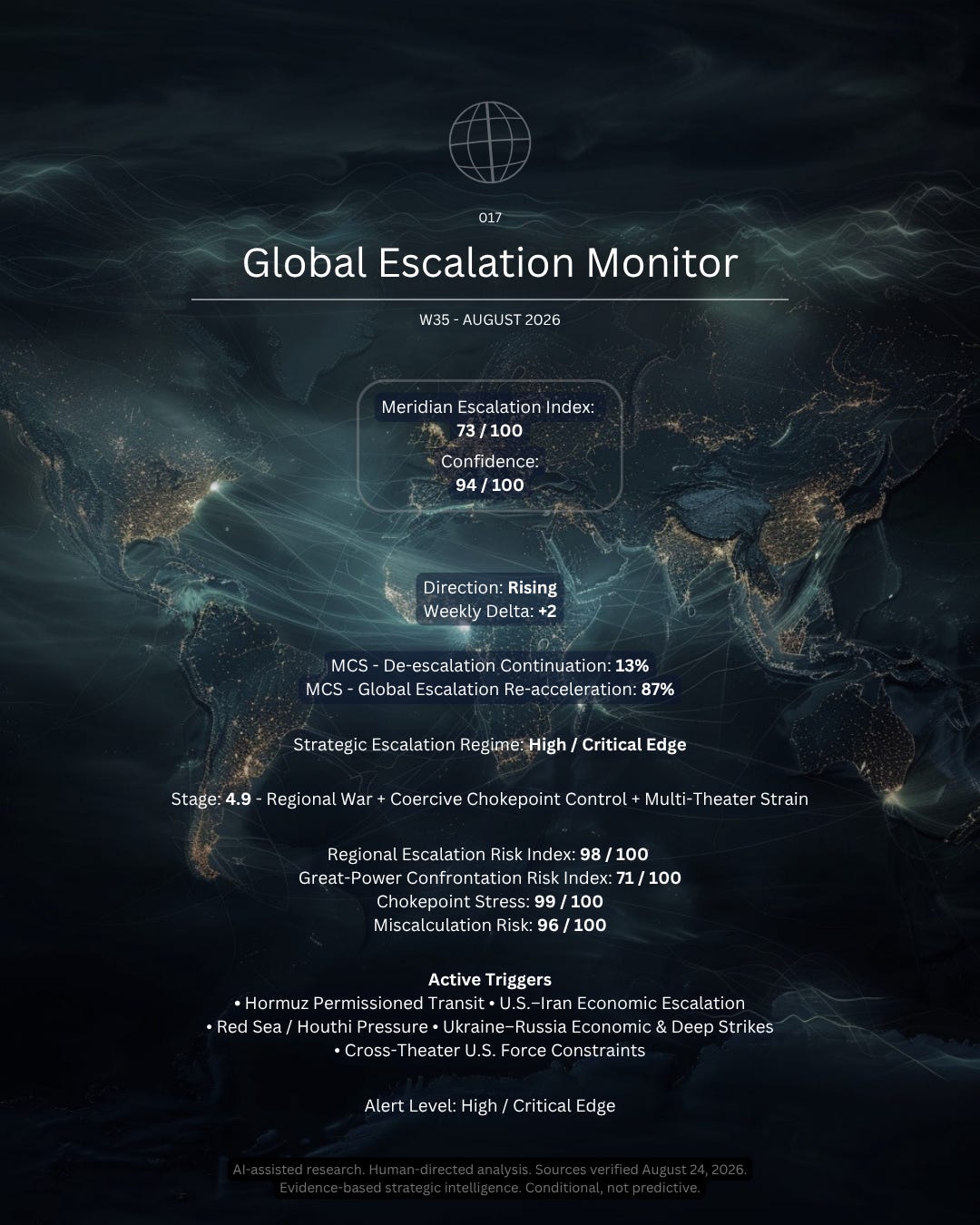
Active Triggers
Hormuz Permissioned Transit
U.S.–Iran Economic Escalation
Red Sea / Houthi Pressure
Ukraine–Russia Economic & Deep Strikes
Cross-Theater U.S. Force Constraints
Strategic Posture
Defensive Vigilance · Critical Threshold Watch
What Changed Since Global Escalation Monitor 016
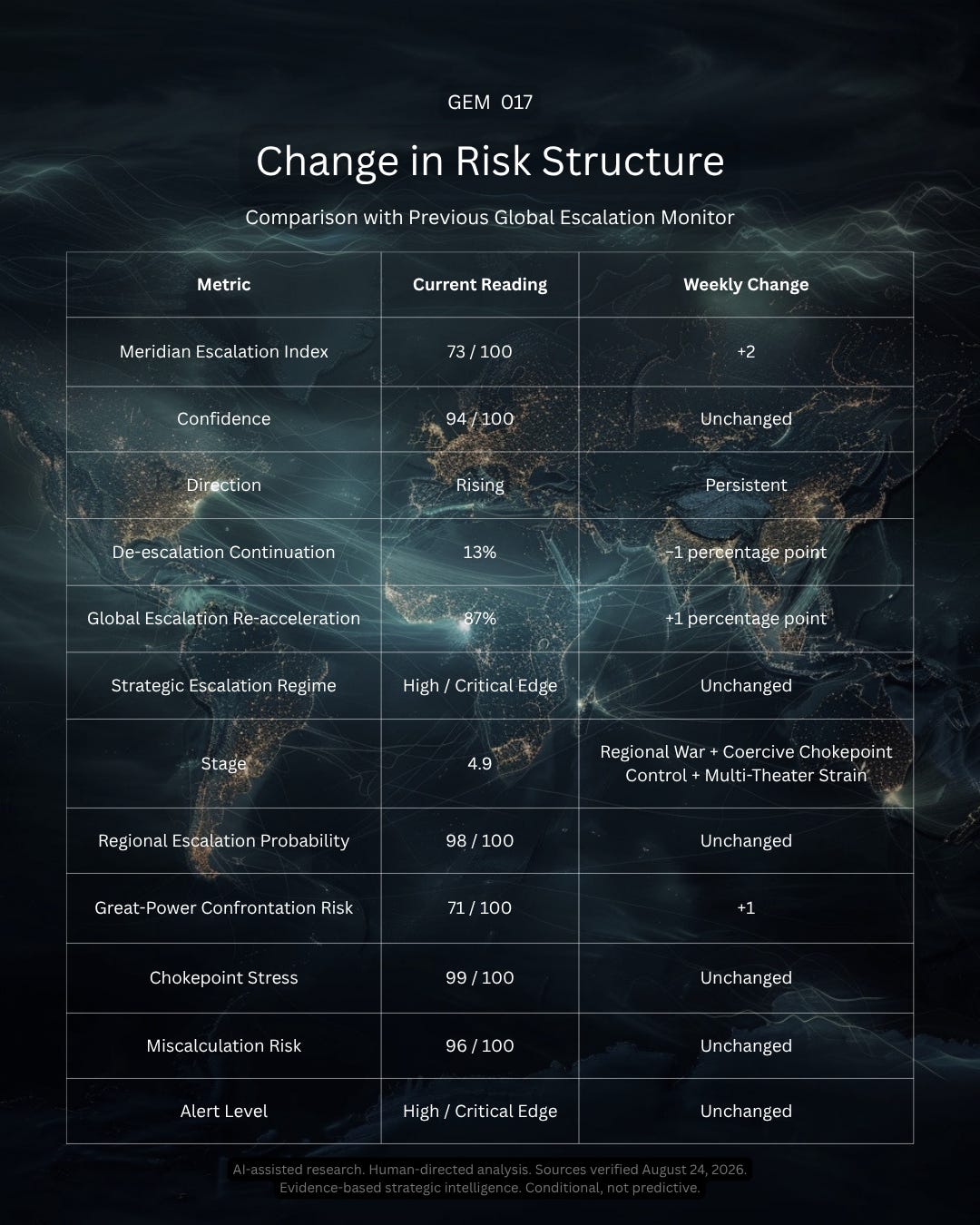
The system did not experience another sudden escalation shock this week.
That is important.
But the absence of another large jump should not be confused with stabilization.
The more consequential development is that several emergency behaviors are starting to look less temporary.
Iran is establishing rules around passage through Hormuz.
The United States is expanding economic pressure rather than moving immediately back toward unrestricted military escalation.
Ukraine and Russia are increasingly attacking the economic infrastructure that sustains the war.
And military commitments in one region are beginning to affect force availability elsewhere.
These changes point toward a different phase:
A prolonged coercive equilibrium in which the conflict becomes structurally embedded even when direct military intensity fluctuates.
Hormuz Is Becoming Permissioned
Strait of Hormuz Normalization Score: 6 / 100
Hormuz remains severely impaired.
But its structure is becoming more important than its raw throughput.
Iran has reportedly blacklisted dozens of vessels for violating its transit rules and threatened penalties including detention or confiscation.
At the same time, selected Iraqi tankers have been granted permission to pass.
That combination creates a fundamentally different model from simple closure.
The route is not completely sealed.
Access exists.
But access is becoming conditional.
The distinction is:
The Strait can remain physically open while becoming politically permissioned.
That is why Meridian continues to classify Hormuz as near functional closure despite some authorized movement.
Normal passage does not require individualized political permission.
A New Form of Chokepoint Power Is Emerging
The conflict is reinforcing a geopolitical primitive Meridian has been tracking throughout this escalation sequence:
Permissioned Chokepoint Sovereignty
Control over a strategic corridor does not require permanent physical closure.
A state can instead attempt to control:
who passes
under what conditions
which cargoes qualify
what information must be disclosed
which vessels are blacklisted
which governments receive exemptions
what penalties apply for noncompliance
That creates economic and political leverage without requiring every ship to be stopped.
The implication extends beyond Hormuz.
Similar models could eventually matter around:
Bab el-Mandeb
the Black Sea
Taiwan Strait
Arctic shipping
critical undersea infrastructure
The current confrontation may therefore be revealing a broader model of twenty-first-century coercion.
Middle East: Extreme, but Not Newly Broken
Theater Score: 98 / 100
The Middle East remains the dominant global escalation theater.
Its score does not rise this week because there was not enough fresh direct military escalation to justify another increase.
But the conflict is becoming more layered.
Three systems now operate simultaneously.
Military pressure
Maritime attacks, blockade architecture and persistent military threats.
Economic pressure
Expanded U.S. sanctions and potential penalties against third parties.
Permission pressure
Iranian attempts to enforce selective access through Hormuz.
Together, they create a confrontation that can remain severe even when the direct strike tempo falls.
The principal deterioration chain is now:
Economic pressure → Iranian retaliation → stricter maritime enforcement → shipping disruption → U.S. countermeasures → renewed military escalation
That pathway remains active.
De-escalation Is No Longer About Restoring the Old Framework
De-escalation Durability Score: 11 / 100
The score improves by one point, but remains near the floor.
The slight increase reflects the absence of another large U.S.–Iran strike cycle and evidence that selective commercial arrangements remain possible.
That is not normalization.
It simply means the confrontation still contains bargaining space.
The earlier ceasefire framework has already failed.
The challenge now is different.
A future agreement would need to create rules both sides can enforce without treating every concession as surrender.
That likely requires agreement over:
maritime access
vessel enforcement
sanctions
port restrictions
shipping security
proxy behavior
military proximity
Gulf security guarantees
That is a much more difficult negotiating architecture.
Ukraine Is Expanding the Definition of the Battlefield
Ukraine / Russia Theater Score: 94 / 100
The war continues moving beyond traditional military targets.
Ukraine is increasingly targeting Russian:
logistics hubs
refineries
energy infrastructure
commercial systems
Russia continues striking Ukrainian infrastructure and rejects proposals to protect civilian Black Sea shipping unless its own energy system is included.
That creates a deeper problem for eventual negotiations.
The longer a conflict continues, the broader the definition of legitimate wartime infrastructure becomes.
What begins with military installations expands toward transportation.
Then energy.
Then logistics.
Then commercial systems.
Eventually, negotiating a ceasefire requires agreement not only on territory, but on what counts as the battlefield.
That boundary is becoming less clear.
Alliance-Edge Risk Requires More Discipline, Not More Alarm
One of the most important integrity corrections this week came from the NATO perimeter.
Previous unmanned-system incidents had raised the possibility that Russian-linked systems were entering allied airspace.
Fresh attribution showed that at least one separate drone entering Latvian airspace was Ukrainian rather than Russian.
That matters.
Not because alliance-edge risk disappeared.
It did not.
But because the distinction between:
Russian attack
and
spillover from an active war
is enormously important.
The Global Escalation Monitor should not convert every unidentified drone into evidence of deliberate great-power confrontation.
The structural danger remains high.
The attribution standard should remain higher.
Taiwan: Long-Term Deterrence Is Becoming Institutionalized
Taiwan / Indo-Pacific Theater Score: 75 / 100
Taiwan proposed an approximately 18% increase in defense spending for 2027.
The significance is not an imminent military crisis.
It is institutionalization.
Taiwan is increasingly building defense around:
missiles
drones
submarines
dispersed infrastructure
civil resilience
shortened warning times
The correct interpretation remains:
Readiness and resource commitment are increasing. Activation evidence is not.
That distinction keeps the Indo-Pacific elevated without treating every defense decision as proof of an approaching war.
Korean Peninsula: Pressure and Diplomacy Are Moving Together
Theater Score: 62 / 100
North Korea launched more than ten short-range ballistic missiles.
That pushes the immediate military signal higher.
But the theater contains strong contradictions.
Washington continues signaling interest in renewed diplomacy.
Some U.S.–South Korean exercises have been scaled back.
And a future amphibious exercise was cancelled.
The result is not a clean escalation trend.
It is a more complicated structure:
military signaling + nuclear expansion + reduced exercises + diplomatic possibility
That remains dangerous.
But it is not yet an activated Korean conflict pathway.
The Most Important New Signal: Strategic Bandwidth
Secondary Theater Rotation Score: 96 / 100
The most consequential evidence in GEM 017 may not be a missile launch or a tanker restriction.
It may be a cancelled military exercise.
A planned U.S.–South Korea amphibious exercise was reportedly cancelled because the Iran conflict is constraining available American forces.
That is different from ordinary geopolitical simultaneity.
It shows direct operational coupling.
One theater is beginning to consume resources that would otherwise support deterrence in another.
This is strategic bandwidth compression.
The wars remain separate.
But the capacity used to manage them is shared.
That creates a new escalation mechanism:
Conflict A consumes military capacity → deterrence weakens in Theater B → adversary perceives opportunity → additional pressure emerges → resources fragment further
No global war is required for that cycle to become strategically significant.
Great-Power Confrontation Risk
Structural Risk Index: 71 / 100
This remains a structural-entanglement measure.
It does not mean there is a 71% probability of direct great-power war.
The mutually exclusive Scenario Matrix estimate for direct Great-Power Confrontation remains 8%.
The structural index is higher because the international system increasingly contains:
NATO support for Ukraine
long-term European defense commitments
Black Sea infrastructure risk
U.S. force diversion toward Iran
rising Taiwan defense spending
North Korean missile activity
deeper Russia–North Korea cooperation
Major powers can become increasingly constrained long before they directly fight one another.
That is what this score is trying to capture.
Miscalculation Risk
96 / 100
Miscalculation remains extreme.
The system contains:
blacklisted tankers
selective maritime permissions
hidden or altered vessel tracking
proxy attacks
autonomous deep-strike systems
Black Sea drones
NATO air-defense activity
Korean missile launches
multiple theaters competing for the same military resources
Every additional conditional or autonomous system increases the number of decisions that must be made correctly.
The danger is increasingly less about one leader deciding to begin a larger war.
It is about the system creating more opportunities for events to move faster than political control.
Economic Transmission
The economic picture is contradictory.
Oil declined despite additional U.S. sanctions.
That is evidence against an immediate uncontrolled supply crisis.
But physical energy markets remain constrained.
Strategic and commercial buffers have weakened.
Refined-product shortages remain a concern.
And prolonged Hormuz impairment could keep global energy costs structurally higher even without another dramatic shock.
The important distinction is:
Market panic has moderated. Physical scarcity has not disappeared.
That gap matters because markets can reprice much faster than physical supply systems can recover.
Scenario Matrix
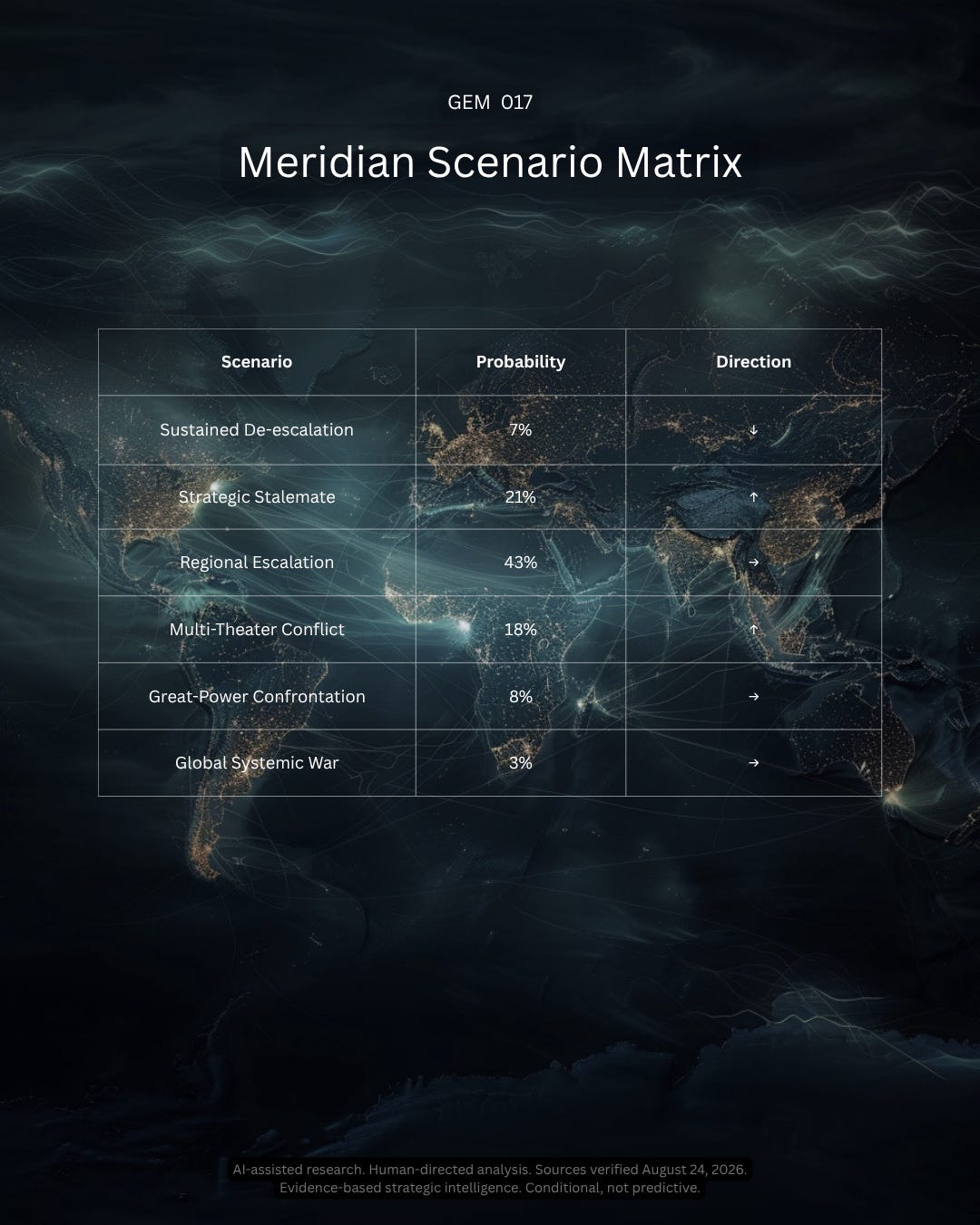
Base Case: Regional Escalation — 43%
Regional Escalation remains the dominant scenario.
But its character is changing.
The more likely structure is increasingly:
Regional war + economic coercion + selective maritime access + proxy pressure + strategic resource constraints
rather than continuous unrestricted direct warfare.
Strategic Stalemate — 21%
This scenario deserves increasing attention.
A prolonged period could emerge in which:
neither Washington nor Tehran obtains its preferred settlement
Hormuz remains selectively accessible
sanctions persist
direct strikes remain intermittent
proxies stay active
global shipping adapts at higher cost
no durable peace emerges
That would not be de-escalation.
It would be a coercive equilibrium.
Multi-Theater Conflict — 18%
This rises another point.
It remains the scenario Meridian is watching most closely after the base case.
The key warning is no longer simply multiple conflicts existing simultaneously.
It is those conflicts beginning to affect one another’s resources, deterrence and decision capacity.
Global Systemic War — 3%
Unchanged.
The evidence does not justify raising it.
There is still:
no verified deliberate NATO–Russia military exchange
no Chinese invasion activation sequence
no direct great-power conflict
no broad global alliance mobilization toward systemic war
The world remains on the Critical Edge, not inside a systemic-war regime.
Meridian Conviction Scores
De-escalation Continuation
13%
The probability remains extremely low.
Selective commercial accommodations prevent the score from approaching zero, but no credible durable political architecture has emerged.
Global Escalation Re-acceleration
87%
This means Meridian assigns an 87% probability that the broader escalation environment remains materially elevated or deteriorates further before durable normalization is achieved.
It does not mean an 87% probability of World War III.
What Would Change Our View
Evidence that could move the Meridian Escalation Index above 78
Iran routinely detains or confiscates major international tankers
Hormuz traffic approaches zero
U.S. forces attempt to forcibly break Iran’s transit regime
direct U.S.–Iran strikes resume at scale
major Saudi or Emirati infrastructure is disabled
Houthi operations materially close Bab el-Mandeb
a confirmed deliberate Russian strike hits NATO territory
NATO begins direct attacks on Russian forces
China initiates blockade-style operations around Taiwan
North Korea attacks South Korea or Japan
simultaneous crises cause visible deterioration in deterrence elsewhere
Evidence that could move the index below 65
a new U.S.–Iran negotiating framework
suspension of Iranian vessel blacklists
materially higher tanker and LNG traffic
normalization of maritime insurance
reduced Houthi activity
agreement protecting Black Sea civilian shipping
lower Ukraine–Russia long-range strike intensity
sustained Korean diplomatic progress
no additional NATO-edge incidents
What We Are Watching Next
The next threshold is not simply whether another attack occurs.
It is whether today’s emergency structures begin becoming permanent.
We are watching:
Iranian enforcement of vessel blacklists
Tanker detention or confiscation
Daily Hormuz throughput
U.S. response to permissioned transit
Additional economic sanctions
Houthi activity around Bab el-Mandeb
Ukraine–Russia attacks on economic infrastructure
Black Sea civilian shipping
U.S. force allocation across theaters
Taiwan military spending and readiness
North Korean missile activity
Any sign that resource constraints materially weaken deterrence elsewhere
Meridian Strategic Conclusion
Global Escalation Monitor 016 was defined by the collapse of the existing de-escalation architecture.
Global Escalation Monitor 017 is defined by what is replacing it.
Not peace.
Not unrestricted war.
A harder, more durable coercive system.
Iran is increasingly treating Hormuz as a permissioned corridor.
The United States is widening economic pressure while preserving military options.
Ukraine and Russia are extending war into logistics, energy and commercial systems.
The Red Sea remains unstable.
North Korea is launching missiles while Washington simultaneously reduces some exercises because another theater is consuming military capacity.
That last development may ultimately matter more than it appears.
The conflicts remain separate.
But the capacity to manage them is becoming shared.
That is how regional conflicts begin to matter systemically before they become one global conflict.
Meridian Escalation Index
73 / 100
Direction
Rising
Weekly Delta
+2
Strategic Escalation Regime
High / Critical Edge
Stage
4.9 — Regional War + Coercive Chokepoint Control + Multi-Theater Strain
Alert Level
High / Critical Edge
Strategic Posture
Defensive Vigilance · Critical Threshold Watch
Institutional Verdict
The world has not crossed into systemic war. But regional conflict is hardening into durable coercive structures while the strategic capacity required to contain simultaneous crises is becoming increasingly shared. The next threshold is not another dramatic headline. It is whether pressure in one theater begins materially weakening deterrence in another.
Editorial Note
The Global Escalation Monitor is a strategic intelligence publication designed to assess systemic geopolitical and macroeconomic risk. It does not predict conflict with certainty or advocate any investment action. Its purpose is to track changes in probability, identify structural shifts, and provide context for long term strategic decision making.
Research Disclosure
Meridian Signal uses artificial intelligence assisted research and data synthesis under human directed editorial judgment. Material claims are source validated before publication. Proprietary formulas, weights, normalization rules, private thresholds and calculation mechanics are not disclosed. Governed readings publish only after their data, source quality and internal consistency satisfy Meridian standards.
AI-assisted. Human-directed. Source-verified.
Meridian Signal
Independent Strategic Intelligence Desk
General informational analysis only. This is not individualized financial, investment, legal, or tax advice.