

Publication Date: August 18, 2026 | Reporting Period: Week 34
AI-assisted. Human-directed. Source-verified.
Executive Assessment
Last week, we said the de-escalation window was narrowing.
This week, that window failed its first major test.
The existing U.S.–Iran framework expired without producing a durable settlement. Washington says no negotiations are currently scheduled. Tehran continues to condition reopening of the Strait of Hormuz on broader concessions while signaling a harder military posture.
More importantly, the physical system deteriorated with the diplomacy.
Hormuz remains severely impaired. Commercial shipping has again been struck. Maritime traffic remains far below normal. Oil has moved back above $90.
At the same time, pressure outside the Middle East is becoming harder to dismiss as background noise.
Ukraine dramatically expanded the scale of its deep-strike campaign against Russia. A suspected Russia-linked drone was destroyed by a NATO aircraft after entering Romanian airspace. And a new deconfliction problem is emerging between Israel and Turkey around military operations in Syria.
None of these developments independently means the world has entered systemic war.
Together, however, they create a more dangerous operating environment.
The Meridian Escalation Index rises from 64 to 71 out of 100.
The probability that de-escalation continues falls to 14%.
The probability that the broader escalation environment re-accelerates rises to 86%.
And the Strategic Escalation Regime moves to High / Critical Edge.
The important signal is not that global war suddenly became likely.
It is that the international system now has more simultaneous points where a tactical mistake could become a strategic event.
Executive Snapshot
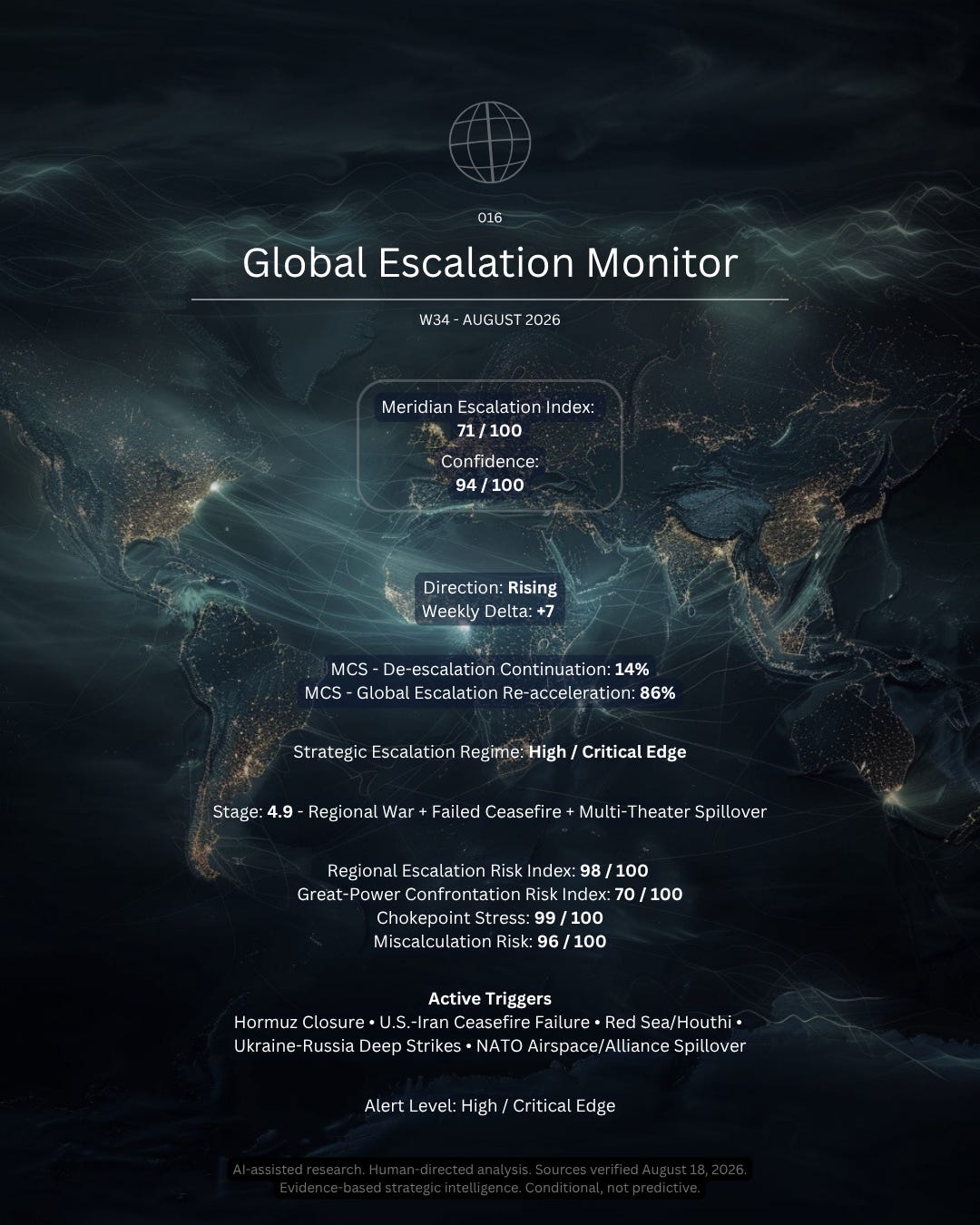
Active Triggers
Hormuz Closure / Maritime Attacks
U.S.–Iran Ceasefire Failure
Red Sea / Houthi Pressure
Ukraine–Russia Deep Strikes
NATO Airspace / Alliance Spillover
Strategic Posture: Defensive Vigilance · Escalation Containment Watch
What Changed Since Global Escalation Monitor 015
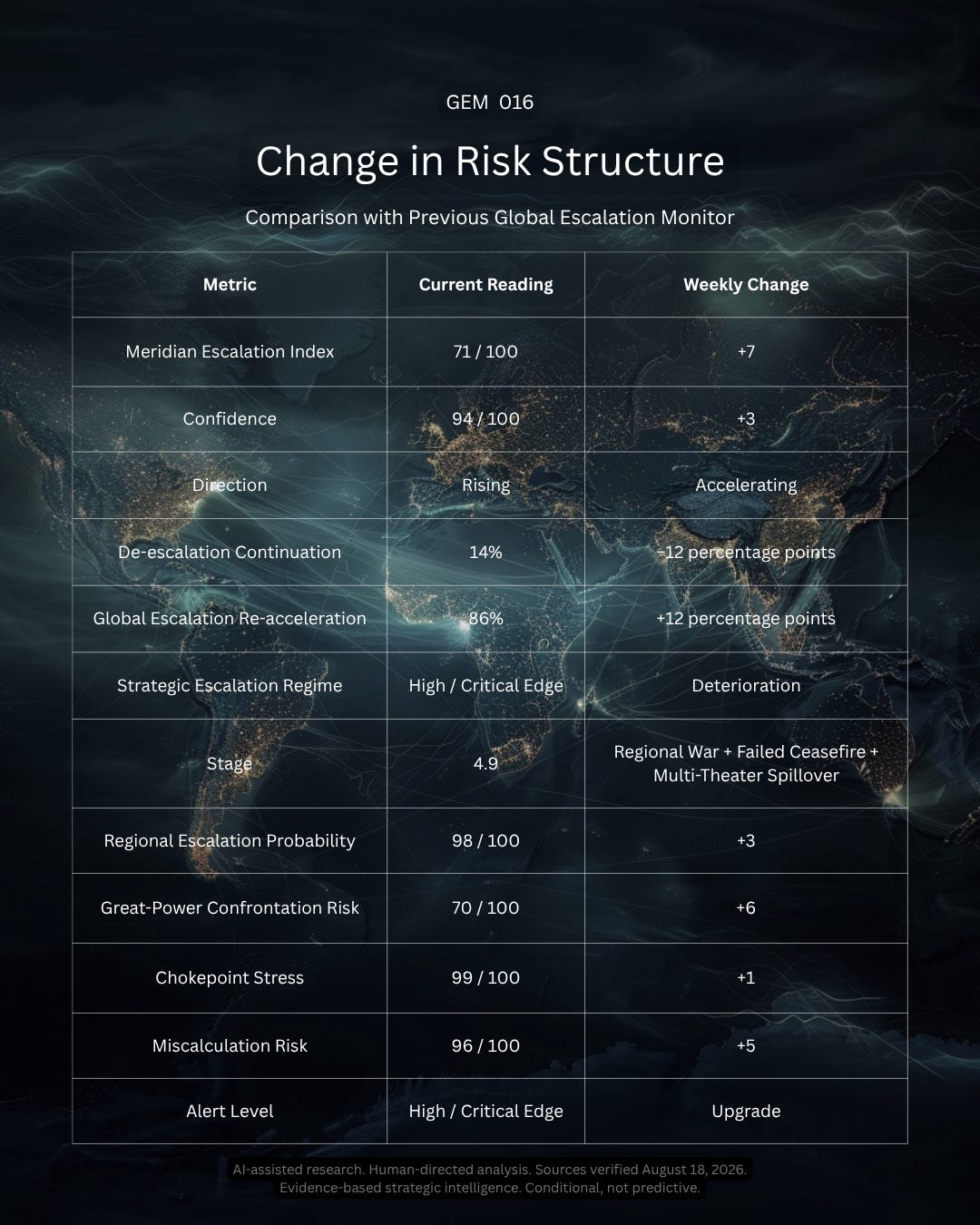
The largest change is not another isolated military incident.
It is the failure of the structure that was supposed to prevent the existing conflict from re-accelerating.
The U.S.–Iran framework reached the end of its 60-day horizon without producing a comprehensive replacement agreement.
That matters because the dispute was never only about stopping direct strikes.
A durable settlement also needed to address maritime passage, the U.S. blockade, Iranian access to ports, sanctions, frozen assets, nuclear issues, commercial shipping and regional proxy activity.
Those questions remain unresolved.
The monitor therefore no longer treats preservation of the existing framework as the primary path toward de-escalation.
Stabilization now requires reconstruction.
Hormuz Is Approaching Functional Closure
The Strait of Hormuz remains the most important physical confirmation point in the monitor.
Its Normalization Score falls to 5 / 100.
Limited traffic continues, so describing the strait as literally closed would overstate the evidence.
Operationally, however, conditions remain severe.
Tracked commodity crossings remain in single digits. Large crude and liquefied-natural-gas tanker activity remains heavily impaired. A commercial vessel has again been struck, while additional missiles were reportedly directed toward maritime traffic.
This distinction is important:
A chokepoint does not need to be physically sealed to become economically dysfunctional.
If vessels cannot move safely, predictably and at commercially normal volumes, the route is not normalized.
That is why Chokepoint Stress rises to 99 / 100.
The Middle East Has Entered a Failed-Ceasefire Architecture
Middle East Theater Score:
98 / 100
The conflict remains regional.
But the structure has deteriorated.
The previous architecture could be described as:
Active regional war → strike pause → diplomatic negotiation → possible maritime normalization
That chain has broken.
The current deterioration pathway is:
Failed framework → maritime coercion → vessel casualties → retaliatory pressure → renewed direct strikes → Gulf infrastructure exposure
A separate economic chain is already operating:
Hormuz impairment → oil risk premium → inflation pressure → higher yields → tighter financial conditions
Brent crude has returned above $90.
That does not create the geopolitical crisis.
It shows that the geopolitical crisis is transmitting into the economic system again.
Ukraine Is Becoming More Relevant to the Global Risk Structure
Ukraine / Russia Theater Score:
93 / 100
The Ukraine war is not new.
The scale and geography of the latest activity are.
Ukraine’s deep-strike campaign has expanded dramatically, including a reported operation involving hundreds of drones directed toward Moscow and surrounding areas.
Russia continues striking Ukrainian territory in return.
The more important development for the Global Escalation Monitor, however, occurred at the NATO perimeter.
A NATO-deployed Spanish fighter destroyed a suspected Russian drone after it entered Romanian airspace.
Attribution remains unresolved.
That matters.
This should not be described as a deliberate Russia–NATO military exchange.
But it does represent a structural change in the operating environment:
NATO forces have now used kinetic force against an object associated with the Ukraine war inside NATO airspace.
That increases the number of situations in which military decisions must be made before intent is completely understood.
Miscalculation Is Becoming the Central Risk
Miscalculation Risk:
96 / 100
This is one of the highest readings in the history of the monitor.
The reason is not simply that more countries are angry with one another.
It is operational density.
The current system includes:
U.S. and Iranian forces
commercial vessels operating under incomplete tracking
missiles directed toward shipping
Houthi operations
NATO aircraft
unidentified drones
deep Ukrainian strikes inside Russia
Russian retaliation
Turkish and Israeli forces operating around Syria
overlapping alliance commitments
The strategic problem is increasingly straightforward:
Too many tactical decisions have to go right at the same time.
The immediate danger is therefore not necessarily that governments deliberately choose a wider war.
It is that one vessel, drone, missile or air-defense decision creates consequences that political leaders then struggle to contain.
A New Syria–Turkey–Israel Risk Has Appeared
The Monitor identified another emerging interface this week.
Israeli military operations in Syria are increasingly occurring near areas where Turkish forces could operate.
The United States is now working on a deconfliction mechanism involving Israel, Turkey and Syria.
This does not yet justify treating Syria as one of the dominant Global Escalation Monitor theaters.
But it introduces a structurally important configuration:
A NATO member and Israel operating militarily in close proximity inside a third country.
The purpose of tracking this early is not to predict confrontation.
It is to recognize a new pathway before an incident forces everyone else to recognize it.
Taiwan Cooled Slightly
Taiwan / Indo-Pacific Theater Score:
74 / 100
Not every theater deteriorated this week.
Taiwan completed its Han Kuang exercise window without evidence of a major Chinese activation sequence.
Chinese military pressure remains structurally elevated, but the absence of a major counter-escalation during the exercise period justifies a modest downward adjustment.
This is important to the integrity of the monitor.
A worsening global picture should not automatically force every theater score higher.
The evidence should.
Korean Peninsula Remains Mixed
Korean Peninsula Theater Score:
58 / 100
The United States and South Korea began their scheduled military exercises, and North Korea condemned them.
At the same time, Washington reduced its participation and continued signaling interest in dialogue with Pyongyang.
Those are conflicting signals.
The correct reading is therefore mixed / slightly falling, rather than automatically treating the exercise itself as evidence of escalation.
Escalation Is Becoming More Distributed
Secondary Theater Rotation Score:
95 / 100
The global pressure map now extends across:
Hormuz and Iran
→ Red Sea and Yemen
→ Ukraine and Russia
→ NATO airspace
→ Syria, Israel and Turkey
→ Taiwan
→ Korean Peninsula
These are not one coordinated war.
That distinction remains essential.
But they increasingly form a system of simultaneous operational interfaces.
Pressure in one theater consumes military capacity, diplomatic attention and political flexibility that might otherwise be available to contain another.
The result is a world with fewer buffers.
Great-Power Confrontation Risk
70 / 100
This is a structural risk index.
It does not mean Meridian assigns a 70% probability to direct great-power war.
The corresponding mutually exclusive Scenario Matrix probability for direct Great-Power Confrontation is 8%.
The structural index rises because major powers and their alliances are becoming more exposed to:
deep-strike operations
NATO-edge incidents
military resource dispersion
competing alliance obligations
maritime enforcement
autonomous systems with uncertain attribution
compressed decision times
This distinction is critical.
Structural entanglement can become severe long before direct great-power war becomes the most probable scenario.
De-escalation Durability
10 / 100
Previous: 22 / 100
Classification: Current framework failed
This is one of the clearest changes in GEM 016.
De-escalation remains possible.
But the mechanism has changed.
Preserving the June framework is no longer enough because that framework has reached its deadline without durable resolution.
Any new stabilization architecture will need to resolve several questions simultaneously:
Hormuz governance
commercial shipping security
the U.S. naval blockade
Iranian access
sanctions
frozen assets
nuclear issues
proxy activity
Gulf security guarantees
That is considerably harder than simply extending a temporary pause.
The correct conclusion is:
De-escalation remains possible, but preservation has failed. Stabilization now requires reconstruction.
Scenario Matrix
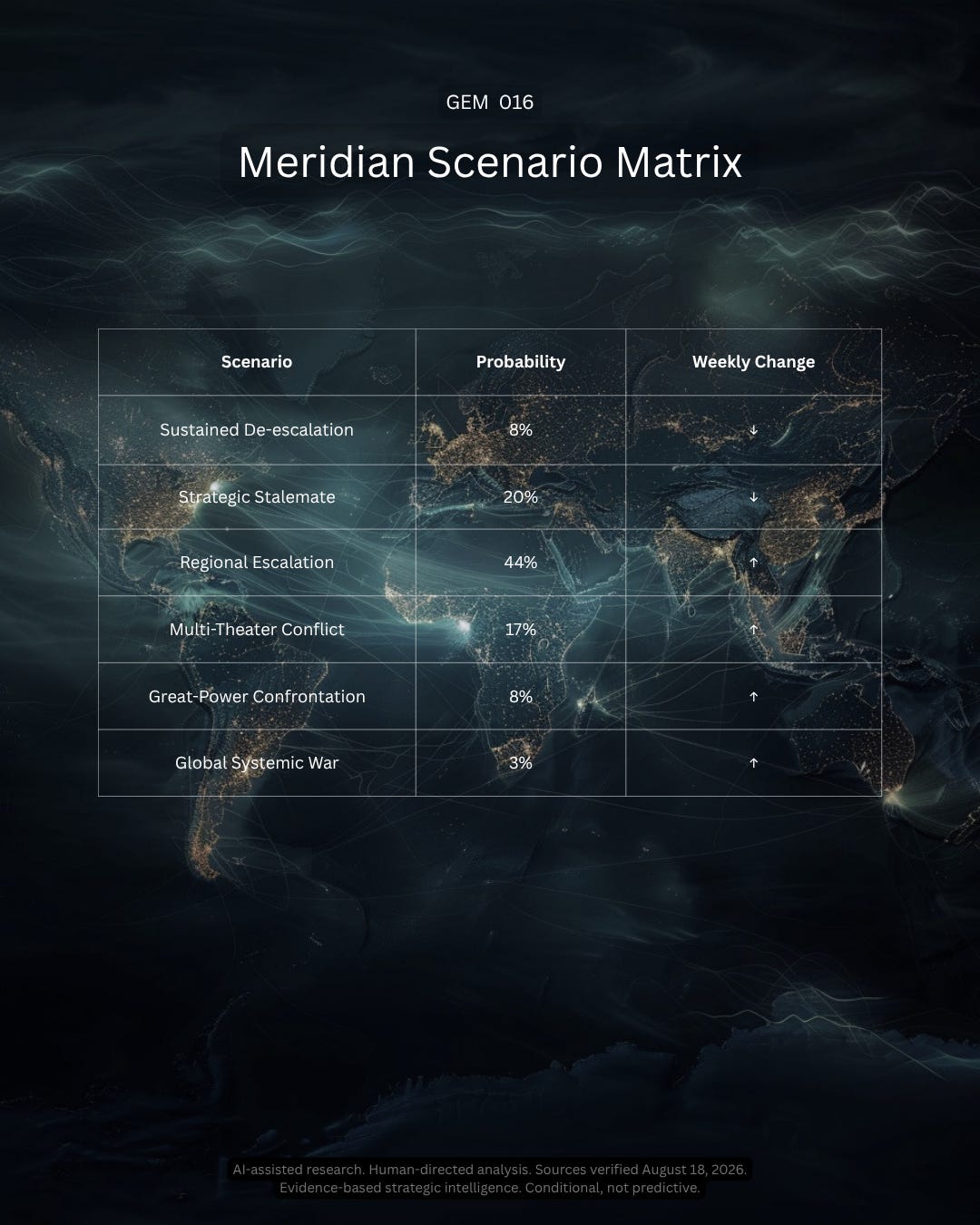
Base Case: Regional Escalation
44%
The most likely environment remains regional rather than global.
The base case includes:
prolonged U.S.–Iran confrontation
severely impaired Hormuz transit
recurring vessel attacks
continued Houthi pressure
elevated energy prices
deep Ukraine–Russia strikes
intermittent NATO-edge incidents
episodic and unsuccessful diplomacy
But the probability that deserves special attention this week is not Global Systemic War.
It is Multi-Theater Conflict, which rises to 17%.
That is the more important structural deterioration.
The international system is becoming more distributed before it becomes more global.
What About Global War?
Global Systemic War:
3%
The probability rises from 2%.
That remains a tail scenario.
We do not see sufficient evidence of coordinated great-power mobilization toward a systemic war.
There has been no confirmed deliberate Russian attack on NATO territory.
There is no verified Chinese invasion sequence around Taiwan.
The United States and Iran have not returned to unrestricted direct military exchanges.
Diplomatic channels have weakened, but they have not disappeared completely.
Those contradictions matter.
They are why the Strategic Escalation Regime moves to High / Critical Edge, rather than Critical or Systemic Crisis.
The world became materially more dangerous.
That is different from saying world war became likely.
Meridian Conviction Scores
De-escalation Continuation
14%
Down from 26%.
The existing diplomatic mechanism failed to produce durable normalization, while physical maritime conditions deteriorated.
Global Escalation Re-acceleration
86%
Up from 74%.
This does not mean there is an 86% probability of global war.
It means Meridian assigns an 86% probability that the broader escalation environment remains materially elevated or deteriorates further before durable normalization is achieved.
That distinction should remain explicit.
Economic Transmission
The geopolitical shock is again moving visibly through markets.
Oil has returned above $90.
Long-term U.S. Treasury yields have moved higher as investors confront the combination of energy-driven inflation risk and existing fiscal pressure.
Equities have weakened while volatility has increased.
The transmission chain remains:
Geopolitical disruption → energy premium → inflation persistence → higher long yields → tighter financial conditions → less policy flexibility
That matters because geopolitical escalation becomes more difficult to contain when the economic system simultaneously loses room to absorb it
What Would Change Our View
Evidence that would move the system toward Critical
sustained direct U.S.–Iran strikes resume
significant U.S. or Iranian military casualties
most Hormuz traffic stops
major Gulf oil or LNG infrastructure is disabled
repeated successful attacks on commercial shipping
Saudi Arabia or the United Arab Emirates enters sustained direct combat
a confirmed intentional Russian strike hits NATO territory
NATO begins attacking Russian forces beyond immediate defensive interception
China initiates blockade-style operations around Taiwan
Turkey and Israel exchange direct military fire
nuclear facilities or command systems become direct targets
Evidence that would materially improve the outlook
a replacement U.S.–Iran framework is signed
commercial Hormuz traffic recovers materially
large crude and LNG tankers resume regular passage
attacks on commercial shipping stop for several weeks
the U.S. blockade is reduced or terminated
Iranian missile activity against maritime traffic ceases
Houthi pressure declines
Ukraine–Russia long-range strike intensity falls
NATO-edge drone incidents stop
secondary theaters remain contained
What We Are Watching Next
The next threshold is no longer whether diplomacy sounds constructive.
It is whether the system can rebuild a functioning containment architecture.
The decisive evidence will come from:
Hormuz throughput
large crude and LNG tanker movements
U.S.–Iran military activity
attacks against commercial vessels
Houthi operations
Ukraine–Russia deep-strike intensity
NATO airspace incidents
attribution of autonomous systems near alliance territory
Israel–Turkey deconfliction in Syria
any change in Chinese operational posture around Taiwan
Meridian Strategic Conclusion
Global Escalation Monitor 015 concluded that the de-escalation window was narrowing.
Global Escalation Monitor 016 finds that the existing window has effectively closed.
The U.S.–Iran framework expired without durable resolution.
Hormuz remains severely impaired.
Commercial shipping has again been struck.
Ukraine and Russia are exchanging attacks at greater depth and scale.
A suspected Russia-linked drone has been destroyed by a NATO aircraft inside Romanian airspace.
And a new Turkey–Israel deconfliction problem is emerging in Syria.
Yet the most important conclusion remains one of discipline:
This is still not a global-war regime.
Global Systemic War rises from 2% to 3%.
That is not the dominant change.
The dominant change is the growing probability that regional escalation becomes multi-theater stress while the international system has fewer buffers available to absorb tactical mistakes.
Meridian Escalation Index: 71 / 100
Direction: Rising
Strategic Escalation Regime: High / Critical Edge
Alert Level: High / Critical Edge
Strategic Posture: Defensive Vigilance · Escalation Containment Watch
Institutional Verdict
The immediate danger is not that the world deliberately chooses systemic war. It is that a failed Middle East settlement, extreme maritime friction, deeper Russia–Ukraine strikes and growing alliance-edge incidents create more tactical decisions than the international system can safely absorb.
Editorial Note
The Global Escalation Monitor is a strategic intelligence publication designed to assess systemic geopolitical and macroeconomic risk. It does not predict conflict with certainty or advocate any investment action. Its purpose is to track changes in probability, identify structural shifts, and provide context for long term strategic decision making.
Research Disclosure
Meridian Signal uses artificial intelligence assisted research and data synthesis under human directed editorial judgment. Material claims are source validated before publication. Proprietary formulas, weights, normalization rules, private thresholds and calculation mechanics are not disclosed. Governed readings publish only after their data, source quality and internal consistency satisfy Meridian standards.
AI-assisted. Human-directed. Source-verified.
Meridian Signal
Independent Strategic Intelligence Desk
General informational analysis only. This is not individualized financial, investment, legal, or tax advice.