

Publication Date: August 11, 2026 | Reporting Period: Week 33
If you only watched the diplomatic headlines over the past two weeks, you might think the global system was gradually finding its way toward stabilization.
I don’t think the evidence supports that conclusion anymore.
The diplomatic pathway is still there. But the physical system underneath it is not normalizing fast enough.
Hormuz remains heavily impaired. The political distance between the United States and Iran has widened. Houthi activity is again adding pressure around the Red Sea. Ukraine’s long range strike campaign is expanding geographically. And military readiness is increasing across several secondary theaters.
None of that means a global war is imminent.
It does mean the stabilization window has become narrower.
Executive Assessment
Meridian Signal’s Meridian Escalation Index rises to 64 / 100, up five points from the previous edition.
The direction has reversed from slightly falling to rising.
Our probability that the recent de-escalation trend continues falls to 26%, while the probability of meaningful global escalation re-acceleration rises to 74%.
The Strategic Escalation Regime remains High, rather than Critical.
That distinction is important.
We are not seeing coordinated great-power mobilization toward systemic war. We are seeing something different: regional instability persisting across multiple theaters while several mechanisms capable of producing miscalculation strengthen simultaneously.
The base case has therefore shifted.
Last week, negotiated containment was becoming credible.
This week, regional escalation under unstable containment is the more probable path.
Executive Snapshot
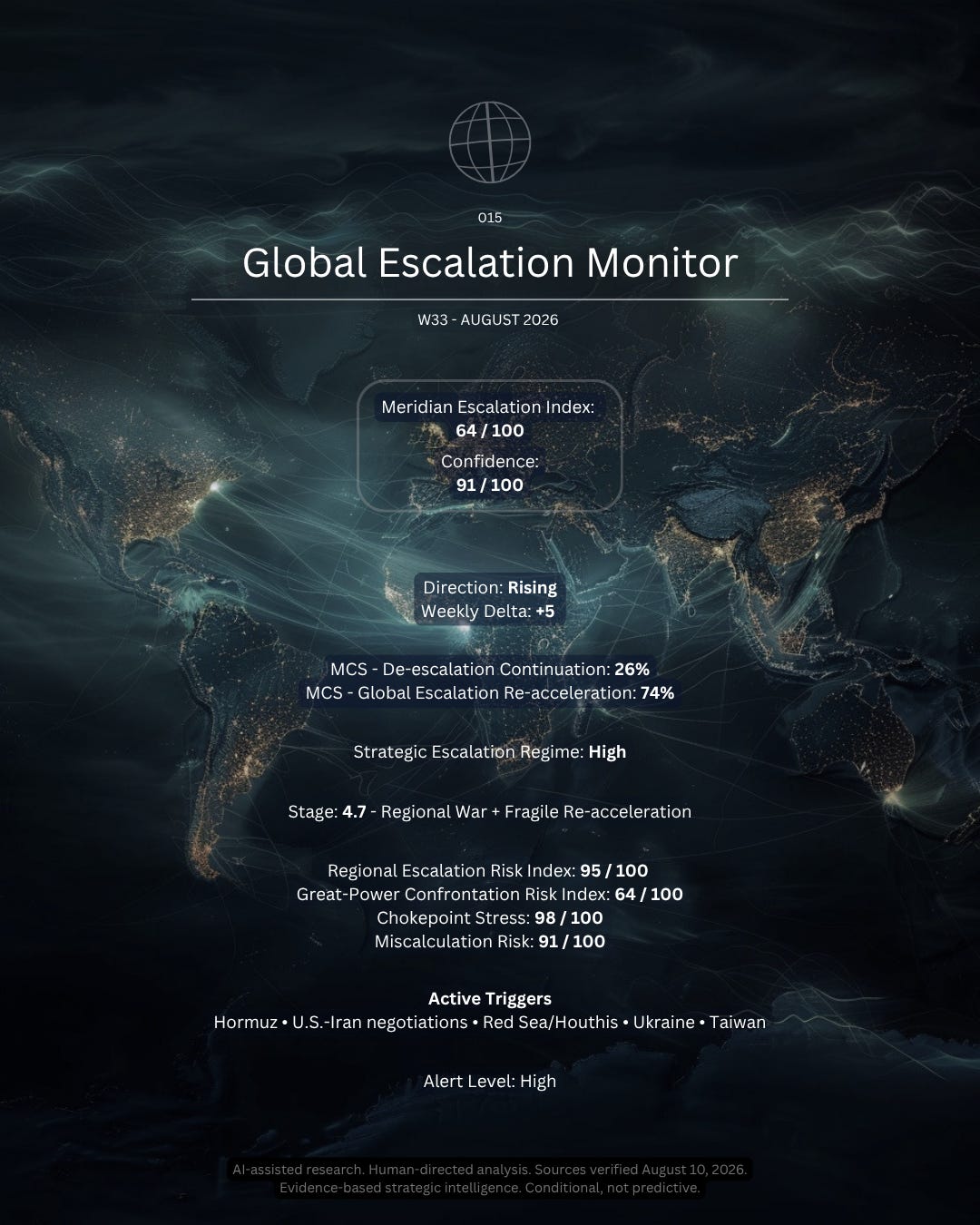
Strategic Posture: Defensive Vigilance · Re-acceleration Watch
What Changed Since Global Escalation Monitor 014
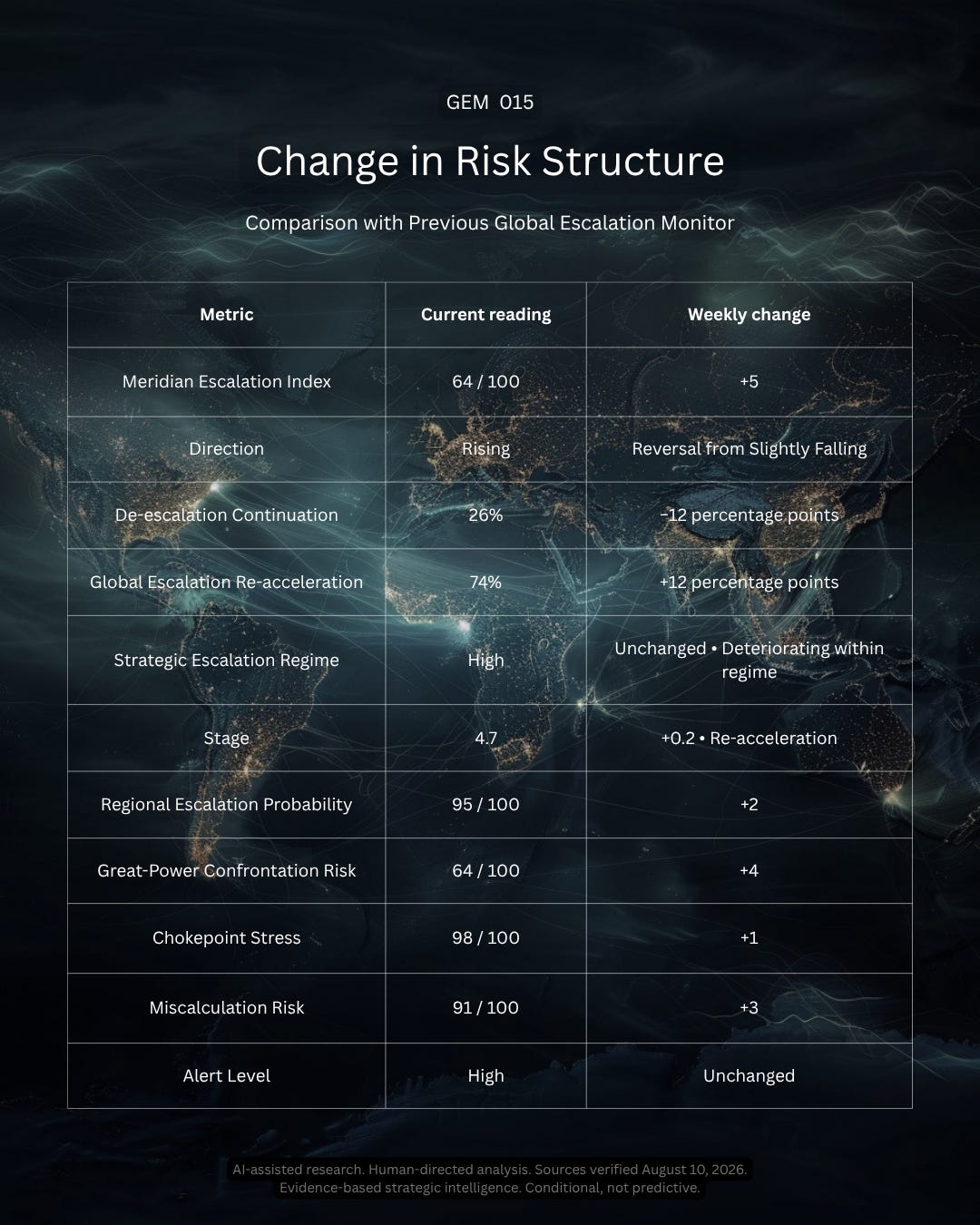
The largest change is not a new war.
It is the weakening of the mechanism that was supposed to reduce the existing one.
The United States and Iran have not completely abandoned diplomacy, but the probability that negotiations produce near term physical normalization has fallen.
That matters because Hormuz remains the most important confirmation mechanism in the entire monitor.
Diplomatic language can improve before the system improves.
Shipping cannot fake normalization.
Until commercial traffic moves reliably, attacks remain suppressed and the condition persists, the Strait should still be treated as impaired.
That is why Chokepoint Stress remains 98 / 100.
The second deterioration is the return of meaningful pressure around the Red Sea and Yemen.
There is an interesting contradiction here.
Commercial carriers have begun restoring some Suez and Red Sea services, which is a real normalization signal.
At the same time, military activity has increased.
So the signal is not that the Red Sea is closed again.
It is that commercial normalization and military deterioration are happening at the same time.
That makes the system more fragile, not easier to interpret.
The Middle East
The Middle East remains the dominant global escalation theater.
Our theater reading rises to 95 / 100.
The reason is less about a dramatic new battlefield event and more about the failure of diplomatic progress to translate into operational normalization.
The United States and Iran still have pathways available to reduce escalation.
But those pathways now require more proof.
For Meridian to materially lower the Middle East reading, we would want to see several conditions align:
an enforceable political arrangement, recognized rules for Hormuz transit, materially higher commercial throughput, sustained suppression of vessel attacks, reduced proxy pressure and a declining energy risk premium.
Until that happens, diplomacy remains a possibility.
Not yet a condition.
Ukraine and Russia
Ukraine and Russia rise to 89 / 100.
The important development is geographic expansion.
Ukraine’s ability to strike deeper inside Russian territory is becoming more consequential, particularly as energy and strategic infrastructure become targets.
At the same time, Poland and the Baltic states are increasing protection around critical infrastructure.
That does not mean direct conflict between Russia and the North Atlantic Treaty Organization is becoming the base case.
It means the number of pathways through which an incident could produce unwanted escalation is increasing.
That is why Miscalculation Risk rises to 91 / 100.
The system does not need deliberate great-power war to become more dangerous.
It only needs one side to misread the other at the wrong moment.
Taiwan and the Indo-Pacific
Taiwan moves modestly higher to 77 / 100.
We do not see sufficient evidence to call an imminent China Taiwan military crisis.
The more important signal is preparedness.
Taiwan is increasingly training for degraded communications, decentralized command, industrial dispersal and compressed warning time.
That is a long-duration structural development.
The signal here is not:
War is about to begin.
It is:
Taiwan is increasingly organizing around the assumption that future warning may be limited.
That deserves attention, but not exaggeration.
Korean Peninsula
The Korean Peninsula rises to 61 / 100 as major United States and South Korean military exercises approach.
This remains a secondary watch theater.
The exercises themselves do not constitute escalation.
The risk comes from the response they could generate and the possibility that military signaling creates an additional pressure point while several other theaters are already elevated.
That distinction matters.
One isolated exercise is manageable.
Several elevated theaters operating simultaneously reduce the system’s margin for error.
Escalation Is Rotating, Not Disappearing
The Secondary Theater Rotation Score rises to 92 / 100.
This may be the most important structural reading underneath the headline numbers.
Pressure is moving across:
Hormuz → Red Sea and Yemen → Ukraine and Russia → the eastern North Atlantic Treaty Organization perimeter → Taiwan → the Korean Peninsula
These conflicts have not merged into one unified war.
That is not our assessment.
But the global system is operating with fewer buffers simultaneously.
De-escalation in one place therefore matters less if pressure simply migrates somewhere else.
This is why Meridian tracks escalation rotation separately from headline conflict intensity.
De-escalation Durability
De-escalation Durability Score: 22 / 100
Previous: 34 / 100.
The reading has deteriorated sharply.
Last week there was a reasonable case that diplomacy could begin converting political progress into operational normalization.
That case is weaker now.
The test from here is straightforward.
We need physical confirmation.
Shipping must normalize.
Attacks must remain suppressed.
Political commitments must survive beyond a few days.
Energy markets must begin removing the geopolitical premium.
Until those signals appear together, we should treat stabilization as fragile.
Scenario Matrix
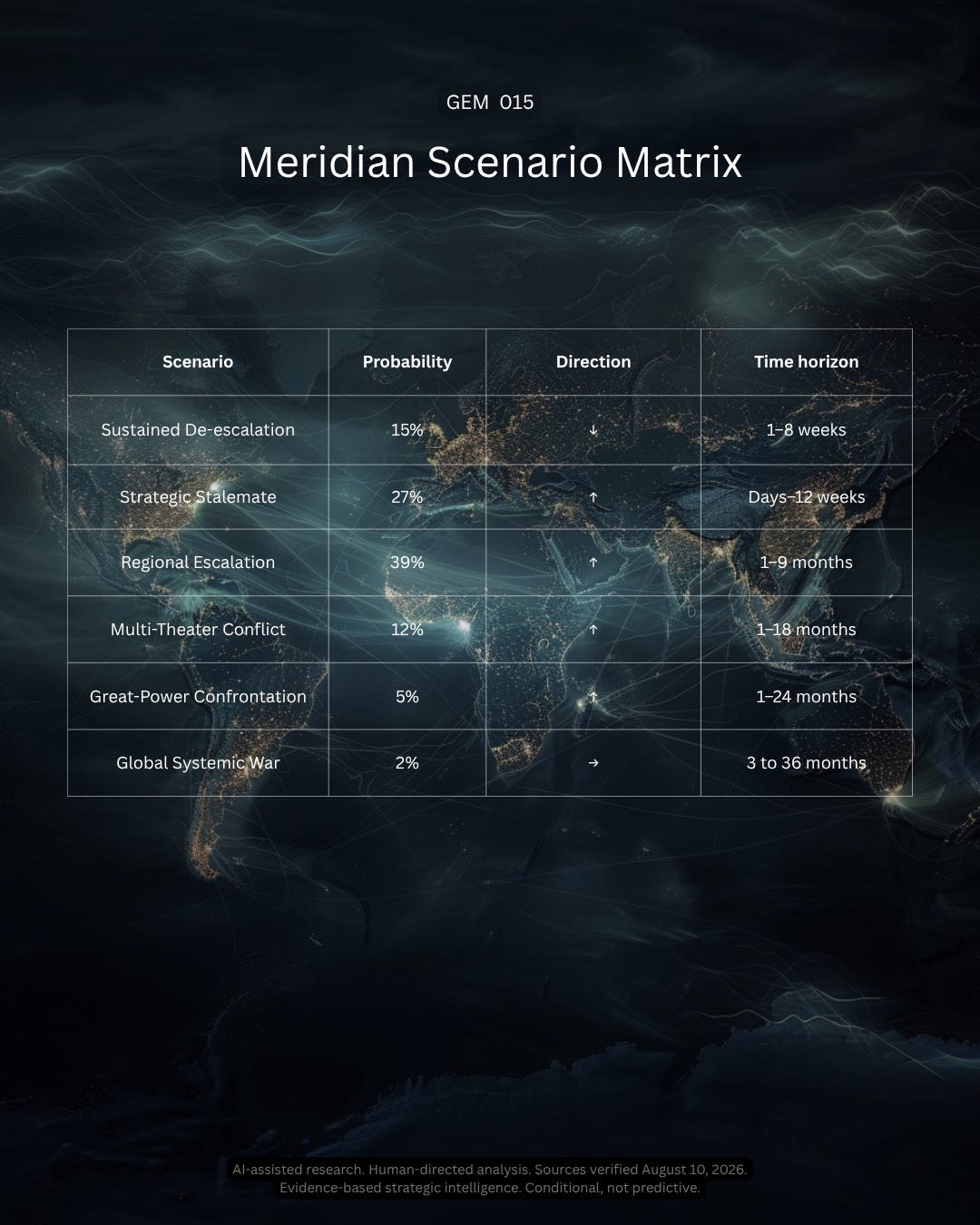
The most likely path is now regional escalation under unstable containment.
That does not require a return to unrestricted United States Iran warfare.
It can occur through continued maritime coercion, proxy attacks, intermittent military exchanges, energy disruption and prolonged uncertainty.
The most extreme outcome remains unlikely.
Our Global Systemic War probability remains 2%.
That is important context.
The world became more fragile this week.
It did not suddenly become destined for world war.
Meridian Conviction Scores
De-escalation Continuation
26%
Down 12 percentage points.
Global Escalation Re-acceleration
74%
Up 12 percentage points.
This reversal is the defining signal of Global Escalation Monitor 015.
The direction of travel changed materially even though the broader Strategic Escalation Regime remains High.
What We Are Watching Next
The first confirmation point remains Hormuz.
If commercial throughput begins recovering materially and remains stable, the escalation thesis can improve quickly.
If negotiations continue deteriorating while Hormuz remains impaired, the opposite becomes true.
The next signals are Houthi activity around the Red Sea, deeper Ukraine Russia strike exchanges, infrastructure security along the North Atlantic Treaty Organization perimeter, Taiwan Strait activity and the response to upcoming United States South Korea exercises.
We are not trying to predict every event.
We are trying to identify what would actually change the structure.
Meridian Strategic Conclusion
The global system did not enter a new systemic war regime this week.
But the path that had begun lowering risk lost credibility.
Maritime coercion remains unresolved.
Proxy pressure is returning.
Ukraine’s strike geography is expanding.
Military preparedness is increasing across secondary theaters.
And the margin for miscalculation is getting smaller.
That changes the posture.
Last week, the right approach was to give diplomacy room to work while waiting for physical confirmation.
This week, the better approach is:
Assume fragility until normalization proves otherwise.
The decisive evidence will not come from another statement.
It will come from ships moving reliably through Hormuz, attacks remaining suppressed and that condition lasting.
Until then, the stabilization seen in Global Escalation Monitor 014 looks less like the beginning of normalization and more like an interrupted attempt at it.
Institutional Verdict
Global escalation risk is rising again, but systemic war remains a tail scenario.
The immediate danger is not an inevitable World War III pathway.
It is prolonged regional instability, multiple active pressure points and a growing probability that one theater produces a mistake the others make harder to contain.
Strategic Posture: Defensive Vigilance · Re-acceleration Watch
Editorial Note
The Global Escalation Monitor is a strategic intelligence publication designed to assess systemic geopolitical and macroeconomic risk. It does not predict conflict with certainty or advocate any investment action. Its purpose is to track changes in probability, identify structural shifts, and provide context for long term strategic decision making.
Research Disclosure
Meridian Signal uses artificial intelligence assisted research and data synthesis under human directed editorial judgment. Material claims are source validated before publication. Proprietary formulas, weights, normalization rules, private thresholds and calculation mechanics are not disclosed. Governed readings publish only after their data, source quality and internal consistency satisfy Meridian standards.
AI-assisted. Human-directed. Source-verified.
Meridian Signal
Independent Strategic Intelligence Desk
General informational analysis only. This is not individualized financial, investment, legal, or tax advice.