Publication Date: August 04, 2026 | Reporting Period: Week 32
Executive Assessment
The global escalation environment improved modestly for a second consecutive week.
This time, the improvement is more substantive.
Qatar, Oman, and Pakistan are now visibly engaged in efforts to contain the United States–Iran conflict. A potential maritime arrangement for the Strait of Hormuz is under discussion. Oil prices have responded sharply, and negotiations between Israel and Lebanon have created another diplomatic channel within the broader Middle East conflict system.
These developments have reduced the immediate probability of renewed direct military escalation.
But diplomacy is improving faster than the physical system.
Commercial traffic through the Strait of Hormuz remains severely restricted. Vessel attacks have continued. Iran and the United States remain divided over whether Tehran should receive control or oversight rights over international passage. The Red Sea remains impaired, and global energy inventories will take considerable time to recover even under a successful agreement.
The system has therefore shifted from a fragile military pause into a conditional diplomatic opening under continued maritime coercion.
That is genuine progress.
It is not durable normalization.
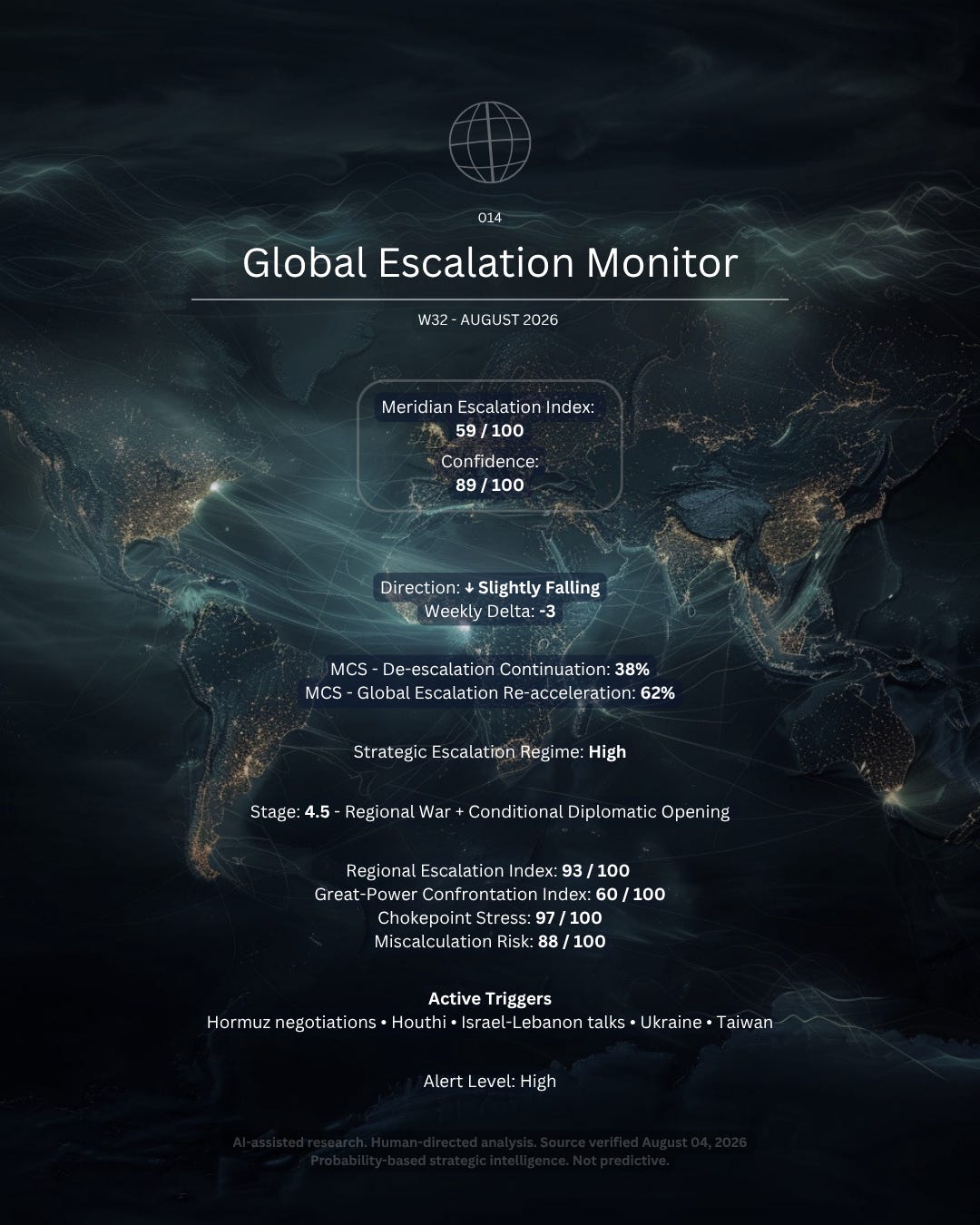
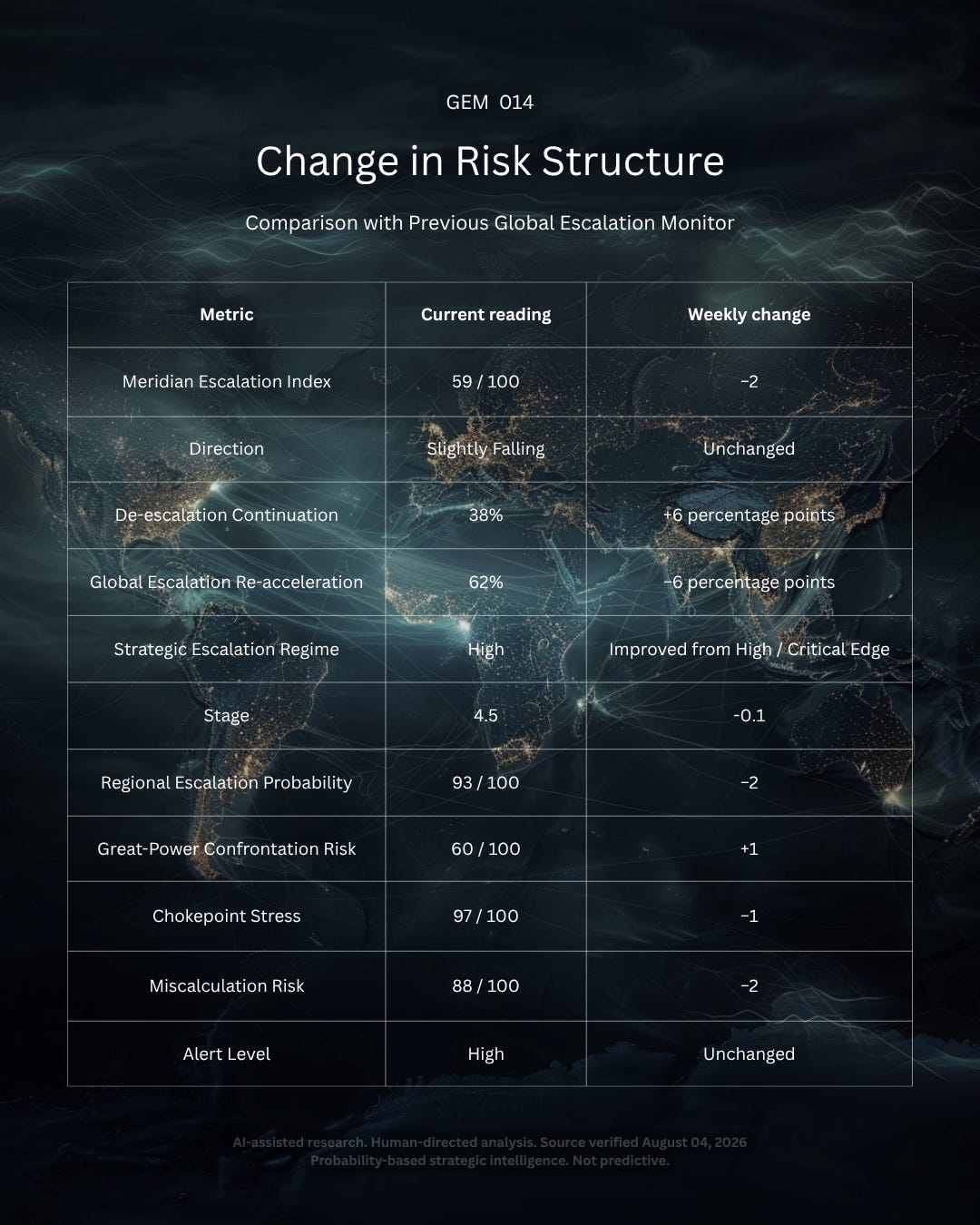
The Meridian Escalation Index falls two points to 59 out of 100, while the probability of continued de-escalation rises to 38%. Negotiated containment has become the narrow base case for the first time, but the margin over renewed regional escalation remains small.
Executive Snapshot
Signal Quality
Intelligence freshness: Live through August 4, 2026
Evidence quality: High
Confidence level: 89 / 100
Change since previous edition: Moderate improvement
Primary contradiction: Diplomatic progress versus continuing physical disruption
Thesis status: Improved, not normalized
Meridian Conviction Scores
De-escalation Continuation
38%
The probability of continued stabilization rises by six percentage points.
The improvement is supported by:
stronger involvement from multiple mediators
a more specific maritime proposal
reduced direct strike velocity
a meaningful decline in the oil-risk premium
renewed Israel–Lebanon negotiations
increasing political incentives to contain the conflict
The reading remains below 50% because no final agreement exists, maritime attacks continue, proxy compliance remains uncertain, and control of the Strait of Hormuz remains unresolved.
Global Escalation Re-acceleration
62%
This does not represent the probability of world war.
It measures the probability that escalation rises materially again, or remains structurally elevated, before durable normalization occurs.
The principal drivers remain:
failure of the Hormuz negotiations
renewed vessel interdictions
Iranian retaliation or renewed United States strikes
continued Houthi pressure
persistent war in Ukraine
rising readiness around Taiwan
strategic resource dispersion across several theaters
The balance of probability still favors continued fragility over a clean resolution.
What Changed Since Global Escalation Monitor 013
Diplomacy became more credible
The previous edition identified a developing diplomatic opening. This week, that opening became more structured.
Qatar reported progress toward ending the United States–Iran conflict. Oman continued working on a maritime arrangement for Hormuz, while Pakistan became more visible in the wider mediation effort.
This matters because the diplomatic channel is no longer dependent on one bilateral relationship. A distributed mediation structure is more resilient and provides the parties with additional ways to negotiate without appearing to retreat publicly.
Markets assigned greater probability to containment
Oil prices fell sharply as traders increased the probability of an agreement.
That repricing is meaningful because it shows that the market no longer treats renewed strikes as the only credible near-term pathway.
But the move must be interpreted carefully.
Oil prices reflect expectations.
Shipping traffic reflects operational reality.
Those two indicators are not yet aligned.
Israel–Lebanon talks created a second diplomatic channel
United States-facilitated talks between Israel and Lebanon began in Rome.
The immediate objective is to create more durable security arrangements and restore Lebanese state authority in the south. If implemented, the talks could reduce the probability that Lebanon becomes the next dominant escalation theater.
For now, the negotiations represent a diplomatic opening rather than a verified change in military conditions.
The physical maritime crisis remained largely unchanged
Only a small number of tracked vessels passed through Hormuz, and traffic through Bab el-Mandeb remained far below normal.
Commercial operators continue to face attack risk. Insurers remain cautious. Iran continues seeking a role in controlling or supervising passage.
The crisis has therefore entered an unusual state:
Political confidence is improving while operational confidence remains extremely weak.
Structural Assessment
The central issue is no longer whether diplomacy exists.
It does.
The issue is whether the diplomatic process can produce an enforceable operating system for maritime passage.
The conflict has exposed a deeper struggle over the meaning of control at global chokepoints.
Iran does not need to close the Strait of Hormuz permanently to exercise influence. It may instead seek conditional control over:
who enters
who exits
what information must be provided
which cargoes receive permission
when passage is allowed
which authority guarantees security
This represents a model of permissioned chokepoint sovereignty.
Under this model, an international passage can remain technically open while becoming economically unreliable, politically conditional, and strategically controlled.
That distinction matters far beyond Hormuz.
Similar forms of conditional access could eventually emerge around the Red Sea, Black Sea, Taiwan Strait, Arctic routes, undersea infrastructure corridors, and digital communications systems.
The immediate conflict may be moving toward containment.
The strategic precedent being created could endure much longer.
Theater Assessment
Middle East
Theater score: 91 / 100
Direction: Falling modestly
The Middle East remains the dominant source of global systemic risk.
The score declined because direct strike velocity slowed, mediation strengthened, oil prices fell, and Israel–Lebanon talks resumed.
It remains above 90 because:
Hormuz is not operating normally
vessel attacks continue
Iran seeks authority over passage
Houthi pressure remains active
energy inventories are depleted
proxy compliance is unverified
The next decisive signal will be operational rather than rhetorical.
A signed agreement matters.
Safe and repeated vessel passage matters more.
Ukraine and Russia
Theater score: 85 / 100
Direction: Stable
The war remains structurally entrenched.
Russia continues pursuing military objectives while awaiting possible new United States proposals. North Atlantic Treaty Organization members have committed substantial multi-year assistance, reducing the probability that Western support disappears abruptly.
There is no verified peace architecture.
The principal global risk is not an immediate expansion into world war. It is prolonged attrition combined with Black Sea incidents, attacks on logistics, political instability, and the continuing possibility of accidental involvement by a treaty member.
Taiwan and the Indo-Pacific
Theater score: 75 / 100
Direction: Rising
Taiwan is entering a major readiness period.
Its Han Kuang exercises are designed partly around a scenario in which routine Chinese military activity conceals preparations for a broader attack. The drills will test rapid mobilization, continuity of arms production, and resilience under pressure.
This does not indicate that an invasion is imminent.
It does indicate that warning times are compressing.
The line between routine coercive activity and potential operational preparation is becoming more difficult to distinguish.
Korean Peninsula
Theater score: 57 / 100
Direction: Slowly rising
North Korea increased military signaling after criticizing Japanese missile activity and wider United States-led regional exercises.
No immediate operational escalation has been confirmed.
The theater matters because it adds another deterrence problem to an Indo-Pacific system already managing China–Taiwan pressure, Japanese military expansion, and greater United States regional involvement.
Escalation Migration
Risk is not disappearing.
It is becoming more geographically distributed.
The Middle East remains the primary source of immediate systemic pressure. But incremental new risk is increasingly moving toward the Indo-Pacific.
The current hierarchy is:
Middle East and the Strait of Hormuz
Ukraine and the Black Sea
Taiwan Strait
Red Sea and Bab el-Mandeb
Korean Peninsula
The Secondary Theater Rotation Score rises to 88 out of 100.
This reflects a system in which several theaters remain formally separate but are connected through:
military inventories
alliance capacity
energy security
shipping routes
industrial production
political attention
strategic opportunism
The system has not become one unified global war.
It has become a network in which pressure in one theater reduces resilience everywhere else.
De-escalation Durability
De-escalation Durability Score: 34 / 100
The score rises seven points.
That is meaningful progress.
It remains classified as weak and conditional stabilization.
For de-escalation to become moderately durable, the monitor would need evidence such as:
a written United States–Iran framework
mutually accepted transit rules
independently verified commercial passage
a sustained decline in vessel attacks
lower insurance and freight costs
the return of large oil and liquefied-natural-gas carriers
verified proxy restraint
several weeks without renewed direct strikes
The distinction is critical:
The diplomatic pathway is becoming more credible, but the operating system has not yet obeyed the diplomacy.
Chokepoint Assessment
Strait of Hormuz Normalization
17 / 100
The score improves from 12 but remains extremely low.
A proposed framework now exists, and markets are beginning to price the possibility of reopening.
But commercial normalization remains absent.
Traffic is limited. Passage authority is disputed. Attacks continue. Insurers and operators remain cautious.
Bab el-Mandeb Normalization
14 / 100
The Red Sea remains persistently impaired.
Commercial operators continue to avoid the route, and regional governments are seeking broader international protection mechanisms.
Combined Chokepoint Stress
97 / 100
This is the central reason the global regime remains classified as High.
Diplomacy improved.
Throughput did not.
Scenario Matrix
New base case
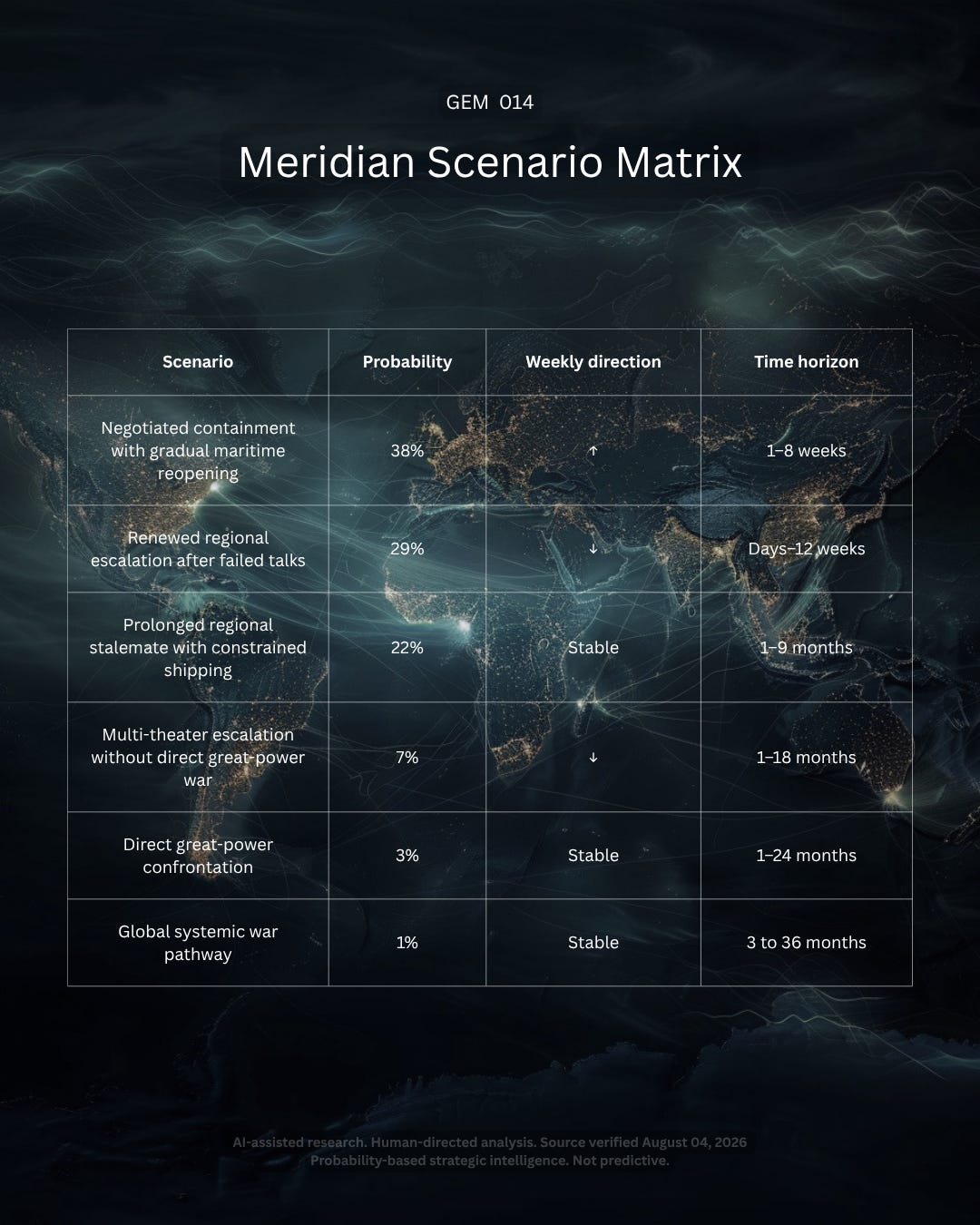
Negotiated containment with incomplete and gradual maritime reopening: 38%
This becomes the narrow base case for the first time.
It would likely involve:
continued indirect negotiations
a temporary Hormuz operating arrangement
a slow commercial return
intermittent vessel incidents
incomplete proxy compliance
continued oil volatility
no comprehensive settlement of the wider regional dispute
The margin over renewed escalation is only nine percentage points.
The system remains at a genuine branching point.
Strategic Implications
Energy
The oil market is repricing the probability of an agreement.
The physical energy system remains depleted and vulnerable.
Even successful negotiations would not immediately restore inventories, refining flexibility, insurance confidence, or shipping capacity.
Another serious attack could rapidly reverse the current market relief.
Global trade
The defining signal is not whether Hormuz is formally open.
It is whether operators can cross safely, repeatedly, and without politically conditional authorization.
Until that occurs, the global trade system remains exposed to higher costs, longer routes, delayed shipments, and weaker confidence.
Markets
Near-term relief is justified.
Full normalization is not.
Markets may continue responding positively to diplomatic announcements, but the gap between political language and operational throughput creates substantial reversal risk.
Institutional planning
The correct response is not panic.
It is continued contingency planning.
Organizations exposed to energy, shipping, defense, logistics, insurance, or cross-border supply chains should treat current improvement as an opportunity to strengthen resilience rather than assume that the disruption has ended.
What Would Change Our View
Evidence supporting a stronger de-escalation call
a signed United States–Iran framework
clearly defined Hormuz transit rules
sustained increases in tanker traffic
lower maritime insurance premiums
several weeks without ship attacks
verified Houthi restraint
implementation of Israel–Lebanon security arrangements
continued oil normalization without renewed supply damage
Evidence supporting renewed escalation
failure of the maritime negotiations
renewed United States strikes
Iranian attacks on Gulf military installations
another major vessel sinking
enforcement of an Iranian authorization or toll regime
a major attack on Saudi energy infrastructure
near-total closure of Bab el-Mandeb
a direct North Atlantic Treaty Organization–Russia incident
extended Chinese mobilization around Taiwan
What We Are Watching Next
Whether the United States–Iran framework becomes written and enforceable
Actual vessel traffic through the Strait of Hormuz
Shipping insurance and freight costs
Further attacks on commercial vessels
Houthi behavior in the Red Sea
Implementation of Israel–Lebanon negotiations
Taiwan’s Han Kuang exercises
Russian and North Atlantic Treaty Organization activity around Ukraine
Oil inventory recovery and export reliability
Signs of opportunistic escalation in secondary theaters
Strategic Posture
Defensive Vigilance
Recognize the diplomatic improvement.
Do not mistake it for operational normalization.
Maintain protection against failed negotiations, renewed maritime attacks, and secondary-theater escalation.
The most reliable confirmation will not come from another optimistic statement.
It will come from ships moving safely, repeatedly, and without permission disputes.
Meridian Strategic Conclusion
The global escalation environment improved for a second consecutive week.
This time, the improvement is supported by more than rhetoric.
There are identifiable mediators, a potential Hormuz framework, reduced direct military velocity, active Israel–Lebanon talks, and a meaningful decline in the oil-risk premium.
But the physical system continues to tell a different story.
The Strait of Hormuz remains impaired.
Bab el-Mandeb remains dangerous.
Commercial vessels remain exposed.
Control over international passage remains disputed.
Energy inventories remain depleted.
Ukraine remains entrenched.
Taiwan is entering a higher-readiness phase.
The correct conclusion is therefore:
Diplomacy is beginning to outrun escalation, but it has not yet outrun the damage embedded in the system.
Meridian Escalation Index: 59 / 100
Direction: Slightly Falling
Alert Level: High
Institutional verdict: Negotiated containment has become the narrow base case. Durable normalization has not.
Editorial Note
The Global Escalation Monitor is a strategic intelligence publication by Meridian Signal designed to assess systemic geopolitical and macroeconomic risk.
Its purpose is not to predict conflict with certainty or advocate any investment action. It tracks changes in probability, identifies structural shifts, and provides context for long-term strategic decision-making.
All assessments reflect the information available at the time of publication and should be interpreted as analytical judgments rather than statements of certainty.
Research Disclosure
Meridian Signal uses AI-assisted systems to accelerate research, source discovery, data comparison and analytical synthesis. AI outputs are not treated as authoritative by default. Every publication is human-directed, source-reviewed, and evaluated before release. Material claims are evaluated against available sources, and all final scores, probabilities, interpretations and editorial conclusions are reviewed and directed by Meridian Signal.
Meridian Signal
Independent Strategic Intelligence Desk
General information only. Not financial advice