Publication Date: July 27, 2026 | Reporting Period: Week 31
Executive Assessment
The global escalation environment improved modestly over the past week, but the improvement should not be mistaken for normalization.
The most important development is the suspension of the latest U.S. strike campaign against Iran and the reopening of indirect diplomatic communication. This has reduced immediate military velocity and created the first credible negotiation window since the conflict expanded across Hormuz and Bab-el-Mandeb.
However, the structural drivers of the crisis remain unresolved.
Iran and the United States still disagree over control and access through the Strait of Hormuz. Commercial traffic remains deeply depressed. Iran-aligned groups continue operating across the region, while Houthi attacks have extended pressure toward Saudi energy infrastructure and the Red Sea export system.
At the same time, global pressure remains elevated elsewhere. Ukraine has no concrete settlement process, China has initiated new live-fire activity in the Taiwan Strait, and the wider international system continues to manage several active strategic theaters simultaneously.
The correct interpretation is therefore not that the crisis is ending.
It is that the crisis has entered a fragile negotiation window inside an unresolved regional war.
Executive Snapshot
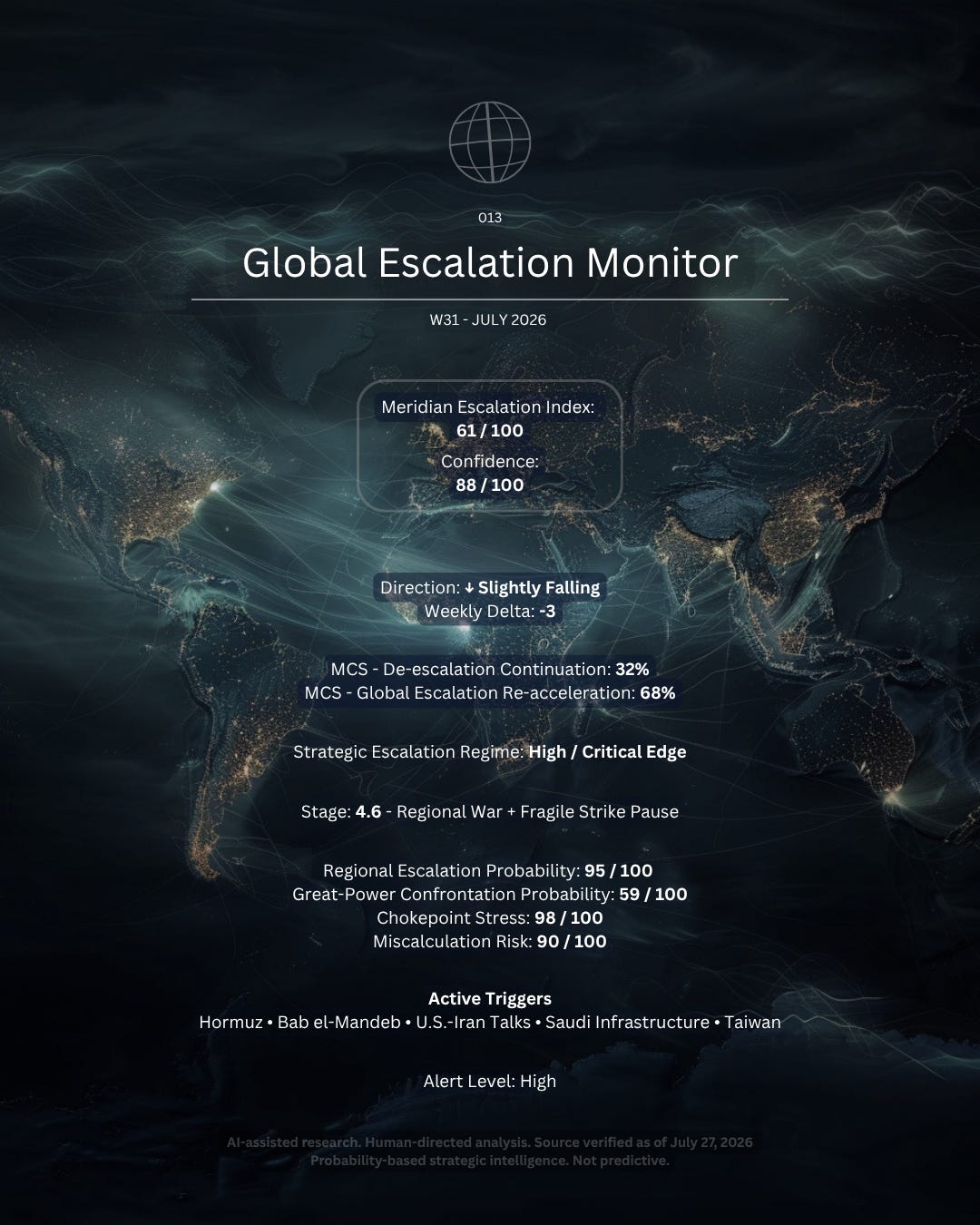
Signal Quality
Intelligence freshness: Live
Evidence quality: High
Cross-source agreement: High
Thesis change: Tactical improvement, structural instability
Global New Information Score
82 / 100
Classification: Major strategic shift, not regime resolution
What Changed
1. Direct U.S.–Iran escalation paused
The clearest improvement is the suspension of the latest U.S. air campaign against Iran.
Indirect diplomatic communication has resumed, and both sides now possess stronger economic and political incentives to prevent another immediate strike cycle.
This matters because direct military contact between the United States and Iran had become the fastest-moving escalation channel inside the system.
The pause reduces:
immediate strike velocity
near-term retaliation pressure
energy-market panic
the probability of rapid alliance involvement
the risk of major casualties during the negotiation period
But it does not resolve the confrontation.
The United States has preserved the option to restart military action, while Iran continues to deny that it requested formal negotiations and maintains its claim over maritime access through Hormuz.
The result is a tactical pause, not a verified settlement.
2. Hormuz has not normalized
The Strait of Hormuz remains the central unresolved risk.
Limited commercial passage continues, but physical flows remain far below normal. Shipping firms, insurers, crews, and cargo owners have not treated the military pause as evidence of durable security.
Hormuz Normalization Score: 12 / 100
Current classification: Near-functional closure with disputed controlled passage
The critical distinction is:
Military activity paused faster than commercial confidence recovered.
A shipping corridor does not normalize when strikes stop for several days.
It normalizes when:
vessels can transit without political authorization disputes
insurance costs decline
major crude and LNG carriers return
crews accept the route
commercial schedules become reliable
maritime rules are understood by all parties
Those conditions are not yet present.
3. Proxy and maritime pressure continues
The direct U.S.–Iran layer has cooled, but the surrounding conflict architecture remains active.
Drone activity and Iran-aligned operations have continued across parts of the Gulf region. The Houthis have also extended pressure toward Saudi oil and transportation infrastructure supporting Red Sea exports.
This creates a layered conflict:
Direct layer: U.S.–Iran strike pause and indirect talks
Maritime layer: Contested Hormuz access and severely constrained commercial transit
Proxy layer: Drone activity, Houthi attacks, and pressure on Saudi infrastructure
De-escalation at the state-to-state level can therefore coexist with deterioration through proxies and maritime coercion.
Structural Assessment
Regional Escalation Probability
95 / 100
The Middle East remains inside an active regional-war structure.
The current uncertainty is not whether regional escalation exists. It is whether the strike pause can prevent further expansion.
The principal deterioration pathway remains:
Failed talks → resumed U.S. strikes → Iranian retaliation → Gulf infrastructure attacks → wider proxy activation
The principal improvement pathway is:
Strike pause → negotiated transit mechanism → verified commercial passage → oil-flow recovery → proxy stand-down
The international system currently sits between those two chains.
Great-Power Confrontation Probability
59 / 100
This is a structural-entanglement score.
It does not mean there is a 59% probability of direct war between the United States, China, or Russia.
It measures the degree to which major powers are becoming constrained or committed through:
simultaneous military obligations
alliance relationships
maritime deployments
weapons and air-defense requirements
deterrence signaling
competing security priorities
reduced diplomatic flexibility
The score increased slightly despite the Middle East strike pause because pressure around Taiwan has intensified while Ukraine remains unresolved.
The direct great-power confrontation scenario remains outside the base case.
Chokepoint Stress
98 / 100
The dual-chokepoint structure remains one of the system’s most consequential risks.
Hormuz remains severely impaired.
Bab-el-Mandeb remains actively threatened and partially disrupted.
Pressure across both corridors connects regional conflict directly to:
oil and LNG supplies
shipping insurance
freight costs
inflation expectations
bond yields
global growth
alliance cohesion
central-bank policy flexibility
The strike pause reduced the immediate oil-risk premium.
It did not restore the physical energy system.
Miscalculation Risk
90 / 100
Miscalculation risk declined slightly, but it remains extreme.
The current environment still contains:
disputed vessel authorization
commercial ships operating under uncertain rules
proxy drone activity
Houthi attacks on Saudi infrastructure
multiple regional command systems
compressed decision windows
live-fire exercises near Taiwan
strategic leaders attempting diplomacy while tactical actors remain active
The most dangerous mismatch is:
Diplomatic optimism at the strategic level while operational forces continue acting under the assumptions of active conflict.
A maritime interception, drone strike, or misidentified vessel could undermine negotiations before they produce a durable framework.
De-escalation Durability
De-escalation Durability Score: 27 / 100
Classification: Weak and highly conditional
This is a meaningful improvement from the previous reading of 16.
The direct strike pause and renewed diplomacy create a credible exit route.
However, durable de-escalation still requires:
A verified prohibition on attacks against commercial shipping
Mutually understood Hormuz transit rules
A mechanism for investigating maritime incidents
Limits on proxy attacks against Gulf states
Protection of Saudi energy infrastructure
Observable recovery in shipping and insurance behavior
A sustained cessation of direct U.S.–Iran strikes
Until those conditions appear, the current pause should be interpreted as:
An intermission with diplomatic potential, not the end of the conflict.
Theater Assessment
Middle East
Status: Primary escalation center
Theater score: 94 / 100
Direction: Slightly falling at the direct level
Stable to rising at the maritime and proxy levels
The region has entered a more balanced but still unstable phase.
Direct confrontation has slowed.
The surrounding systems that can restart it remain active.
Ukraine
Theater score: 85 / 100
Direction: Stable at a highly elevated level
Diplomatic activity has increased, but no concrete peace framework has emerged.
Ukraine continues to generate substantial demand for:
air defense
munitions
financial assistance
intelligence support
diplomatic attention
industrial capacity
The global significance is cumulative.
The Middle East and Ukraine remain separate wars, but managing both simultaneously reduces Western flexibility and increases the value of strategic distraction to adversaries.
Taiwan and the Indo-Pacific
Theater score: 73 / 100
Direction: Rising
China’s new live-fire activity in the Taiwan Strait raises the theater score even as direct U.S.–Iran escalation slows.
There is no confirmed invasion sequence.
The concern is the continued normalization of high-intensity coercive activity while U.S. attention and military resources remain divided.
The relevant risk includes:
shrinking warning time
exercise-to-operation ambiguity
increased naval density
blockade rehearsal
testing of U.S. response capacity
misinterpretation during simultaneous crises
Taiwan remains a strategic pressure node rather than an activated war theater.
Korean Peninsula
Theater score: 55 / 100
Direction: Slowly rising
The Korean Peninsula remains below immediate activation threshold.
However, nuclear-force expansion, military-industrial development, and deeper Russia–North Korea cooperation continue to increase long-duration strategic pressure.
Escalation Migration
Risk is not rotating out of the Middle East and into another theater.
It is remaining elevated across several theaters simultaneously.
Primary center: U.S.–Iran confrontation and Hormuz
Expanding maritime pressure: Bab-el-Mandeb and Saudi infrastructure
Persistent secondary pressure: Ukraine and Russia
Rising strategic pressure: Taiwan and the Indo-Pacific
Secondary Theater Rotation Score: 87 / 100
Classification: Multi-theater strategic stress
The conflicts are not becoming one integrated global war.
But they are interacting through:
divided military resources
limited air-defense capacity
diplomatic overload
energy-market pressure
alliance commitments
compressed decision-making time
That interaction keeps the broader system fragile.
Economic and Energy Transmission
Global Economic Shock Risk
87 / 100
Oil prices fell sharply after the strike pause.
That is an important relief signal.
However, the physical energy system remains more impaired than the market reaction suggests.
Hormuz flows remain severely constrained.
Bab-el-Mandeb traffic remains depressed.
Saudi oil transportation infrastructure has been targeted.
The current structure therefore contains two competing chains.
Relief chain
Military pause → lower oil-risk premium → temporary inflation relief
Renewed shock chain
Depressed physical flows → inventory drawdown → freight and insurance pressure → renewed price spike if talks fail
The current decline in oil should therefore be interpreted as:
A conditional repricing of diplomacy, not proof that the energy system has normalized.
Primitive Discovery
Emerging primitive: Conditional Access Sovereignty
The conflict is revealing a broader strategic primitive.
International transit routes can remain physically open while becoming:
politically permissioned
selectively enforced
commercially unreliable
economically unusable
controlled through military or proxy pressure
This can involve:
authorization requirements
designated transit channels
flag-state discrimination
cargo-based restrictions
proxy control of alternative corridors
insurance coercion
attacks that deter commercial usage without formal closure
This model could extend beyond the current crisis to:
Hormuz
Bab-el-Mandeb
the Taiwan Strait
the Black Sea
future Arctic routes
The strategic lesson is straightforward:
Control over access can create leverage without formal territorial occupation or permanent physical closure.
Meridian Conviction Scores
MCS: De-escalation Continuation
32%
The score increased from 20% because:
direct strikes paused
diplomatic communication resumed
political and economic incentives for containment increased
oil markets responded positively
immediate military velocity declined
The score remains below 50% because:
no agreement has been signed
shipping remains severely impaired
proxy activity continues
both sides maintain incompatible Hormuz claims
MCS: Global Escalation Re-acceleration
68%
This means there is a 68% probability that the broader escalation environment either worsens again or remains materially elevated before durable normalization is achieved.
It does not mean a 68% probability of global war.
The score reflects:
unresolved maritime access
continued proxy activity
severely impaired commercial transit
high miscalculation risk
pressure on Saudi infrastructure
unresolved Ukraine conflict
rising Taiwan activity
Scenario Matrix
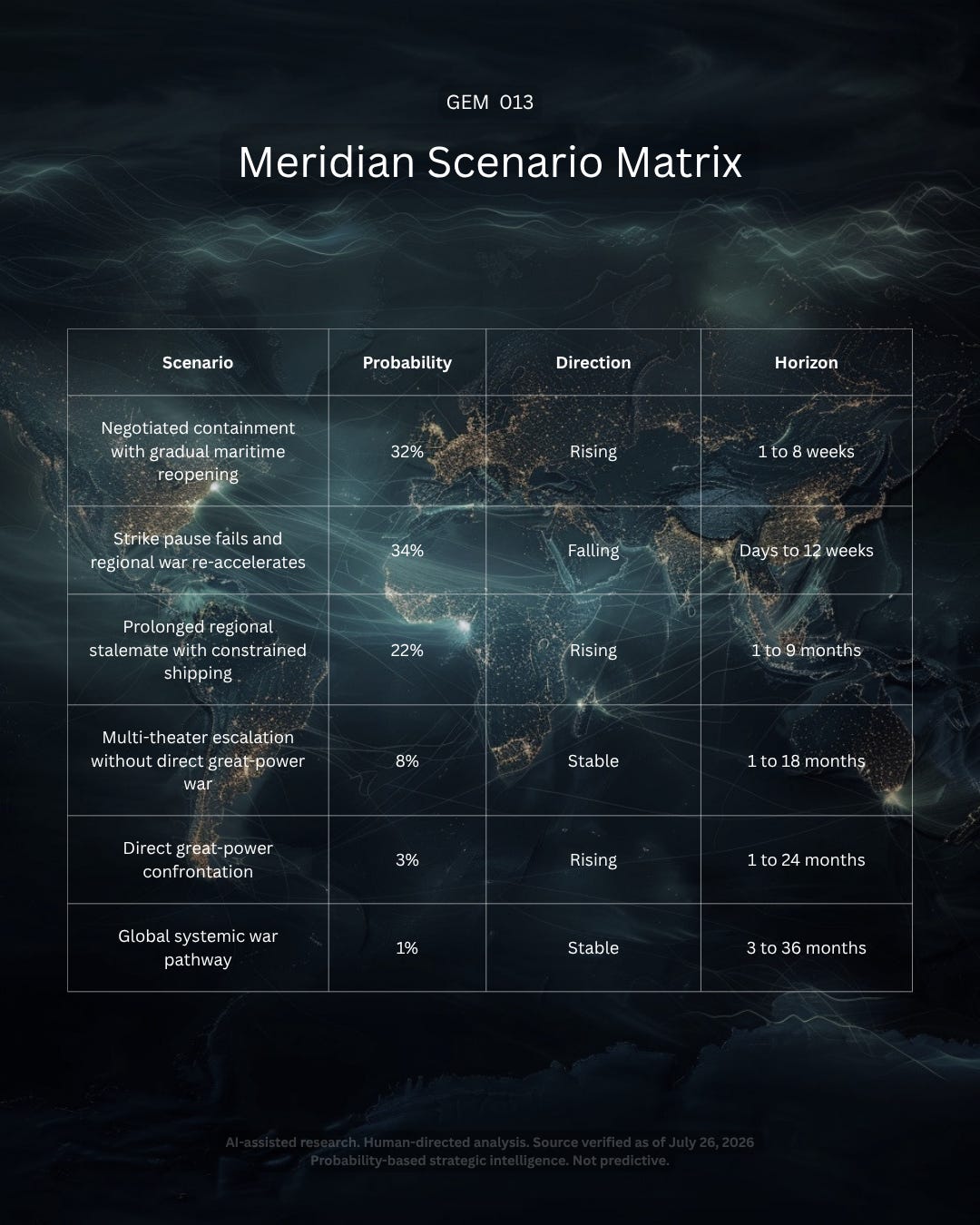
Base case
Strike pause fails or remains incomplete, producing intermittent regional re-escalation
Probability: 34%
This scenario is only narrowly more probable than negotiated containment.
That makes the current environment more balanced than the previous edition, but not secure.
Likely characteristics include:
intermittent direct-strike pauses
negotiations without comprehensive settlement
constrained Hormuz traffic
continuing proxy attacks
oil volatility
recurring diplomatic breakdowns
conflict remaining regional rather than global
Delta Since Global Escalation Monitor 012
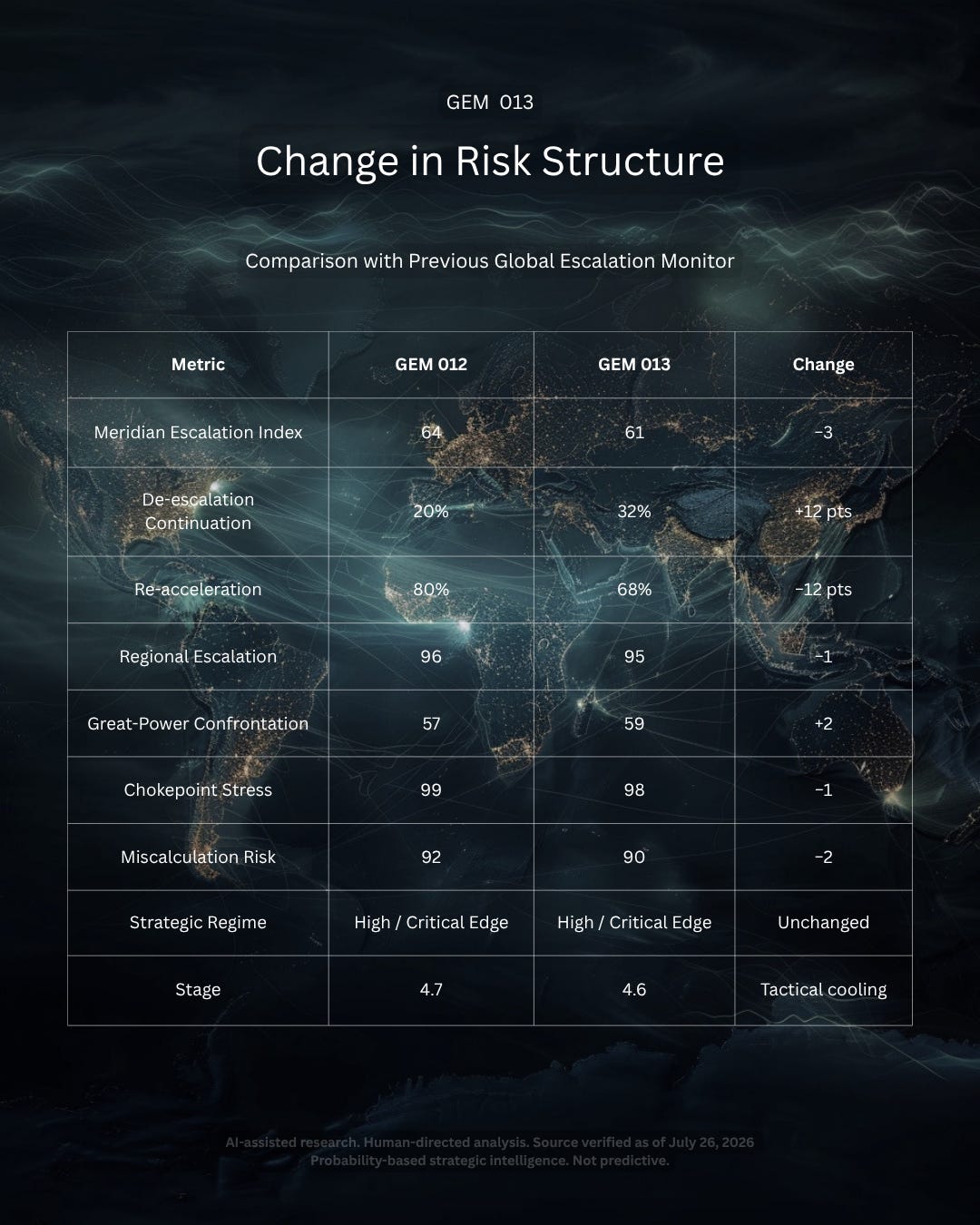
The central change is not the end of the crisis.
It is a transition from:
rapid direct escalation
to:
a fragile negotiation test inside an unresolved conflict system.
What Would Change Our View
The assessment would deteriorate if:
large-scale U.S. strikes resume
Iran attacks additional Gulf bases
Saudi Arabia enters sustained direct combat
Hormuz traffic falls toward complete stoppage
Bab-el-Mandeb attacks become consistently enforceable
major Saudi energy infrastructure is disabled
a neutral or major-power vessel is struck
China expands Taiwan drills into encirclement or blockade operations
Russia materially expands the Ukraine war
a nuclear facility or command system is targeted
The assessment would improve if:
a signed U.S.–Iran agreement is announced
unrestricted Hormuz passage is independently verified
proxy drone and Houthi attacks cease
commercial traffic begins sustained recovery
insurance and freight costs normalize
Saudi infrastructure attacks stop
oil loses most of its remaining war premium
Taiwan exercises conclude without follow-on escalation
a credible Ukraine ceasefire process begins
What We Are Watching Next
Whether indirect U.S.–Iran talks produce written maritime terms
Daily commercial traffic through Hormuz
Return of large crude and LNG carriers
Insurance and freight behavior
Proxy drone activity during the strike pause
Houthi attacks against Saudi infrastructure
Bab-el-Mandeb transit volumes
Whether oil’s decline is sustained
U.S. force posture and munitions movements
Chinese live-fire activity around Taiwan
Any transition toward blockade-style exercises
Concrete Ukraine ceasefire proposals
Meridian Strategic Conclusion
The latest development is real, but easy to misinterpret.
The U.S.–Iran strike pause is the first meaningful de-escalatory event since the conflict expanded into a dual-chokepoint structure.
It lowers immediate military velocity.
It reduces the Meridian Escalation Index.
It improves the probability of negotiated containment.
But the underlying conflict architecture remains intact.
Hormuz traffic is still severely impaired.
Iran and the United States still disagree over who controls passage.
Houthi attacks continue to pressure Saudi infrastructure.
Bab-el-Mandeb remains vulnerable.
Ukraine has no concrete peace framework.
China has begun new live-fire activity in the Taiwan Strait.
The correct conclusion is not:
The crisis is ending.
It is:
The crisis has entered a fragile negotiation window before its structural drivers have been resolved.
Strategic posture: Defensive vigilance
Direction: Slightly Falling
Alert level: High
Strategic Escalation Regime: High / Critical Edge
Stage: 4.6: Regional War + Fragile Strike Pause
Bottom line
Direct escalation has cooled, but the system remains one failed negotiation, one maritime incident, or one proxy attack away from renewed acceleration.
Editorial Note
The Global Escalation Monitor is a strategic intelligence publication by Meridian Signal designed to assess systemic geopolitical and macroeconomic risk.
Its purpose is not to predict conflict with certainty or advocate any investment action. It tracks changes in probability, identifies structural shifts, and provides context for long-term strategic decision-making.
All assessments reflect the information available at the time of publication and should be interpreted as analytical judgments rather than statements of certainty.
Research Disclosure
Meridian Signal uses AI-assisted systems to accelerate research, source discovery, data comparison and analytical synthesis. AI outputs are not treated as authoritative by default. Every publication is human-directed, source-reviewed, and evaluated before release. Material claims are evaluated against available sources, and all final scores, probabilities, interpretations and editorial conclusions are reviewed and directed by Meridian Signal.
Meridian Signal
Independent Strategic Intelligence Desk
General information only. Not financial advice