Publication Date: July 21, 2026 | Reporting Period: Week 30
Executive Assessment
The global escalation environment has deteriorated again.
The defining change is no longer the militarization of a single strategic chokepoint. Pressure around the Strait of Hormuz is now being compounded by an emerging threat to Bab el Mandeb, creating a dual chokepoint escalation structure across two critical maritime corridors.
Commercial traffic through Hormuz has fallen sharply. The absence of visible large crude and LNG tanker crossings, additional vessel attacks, and persistent United States–Iran military exchanges indicate that the route is approaching functional closure even if limited passage continues.
At the same time, the Iran aligned Houthis have declared a maritime blockade targeting Saudi Arabia. If enforcement becomes operational, Saudi exports rerouted away from the Persian Gulf could face additional pressure at Bab el Mandeb.
This creates a more dangerous system.
The conflict remains regional in military terms, but its economic transmission is becoming increasingly global. Energy flows, freight costs, inflation expectations, interest rates, and international alliance commitments are now connected to the same escalation chain.
The world has not entered a global war regime.
But the resilience separating regional conflict from wider systemic instability has weakened materially.
Executive Snapshot
What Changed
1. Maritime pressure has expanded beyond Hormuz
The previous edition identified the militarization of the Strait of Hormuz as the dominant escalation risk.
This week, that risk expanded geographically.
Hormuz remains severely impaired, but the Houthis’ declaration of a maritime blockade against Saudi Arabia introduces potential pressure at Bab el Mandeb, the strategic passage linking the Red Sea to the Gulf of Aden.
This matters because Saudi exporters have increasingly relied on routes outside the Persian Gulf as Hormuz became less dependable.
If pressure rises at both chokepoints, rerouting ceases to function as a reliable release valve.
The structure changes from:
One impaired corridor with alternatives
to:
Multiple impaired corridors with fewer safe alternatives
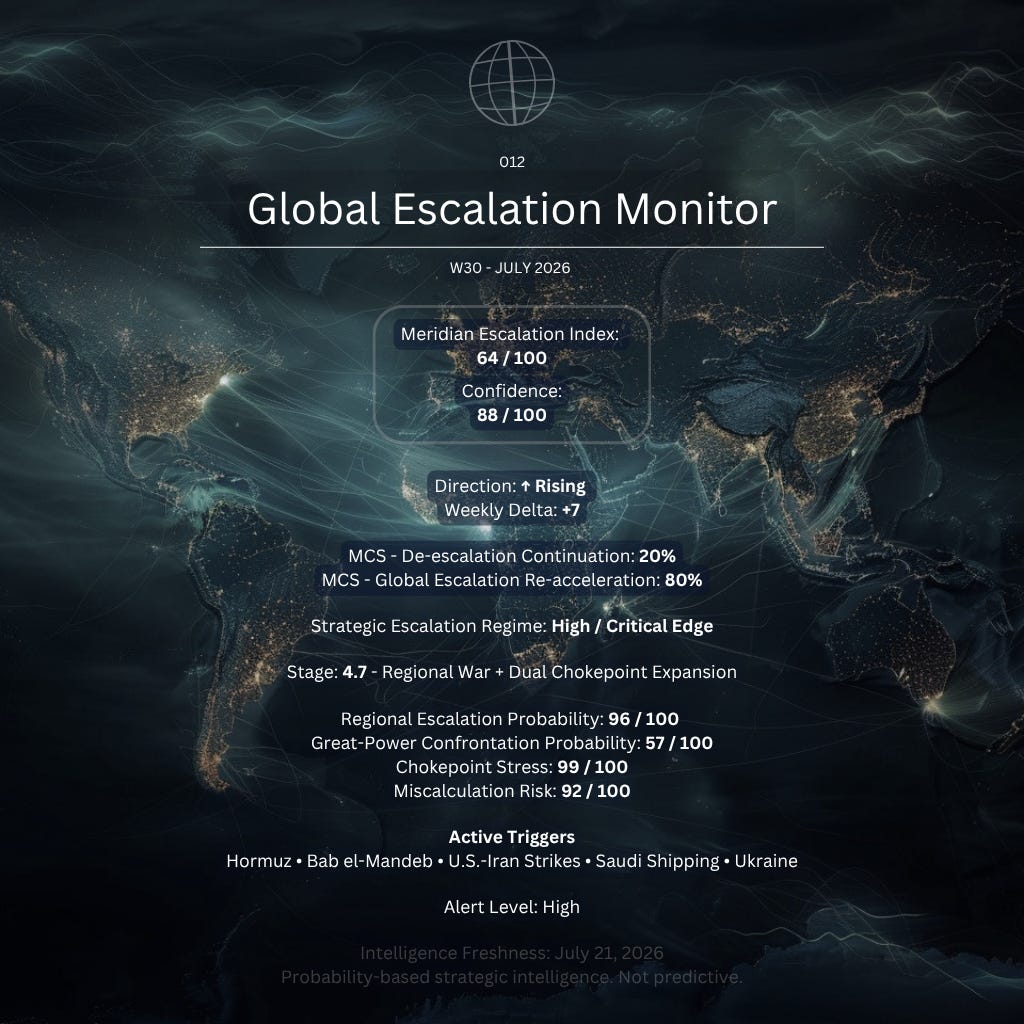
That is the central reason the Meridian Escalation Index increased from 57 to 64.
2. Hormuz is approaching functional closure
The Strait of Hormuz may not be formally closed, but the practical distinction is narrowing.
Only limited commodity traffic has continued, while visible large crude and LNG tanker crossings have fallen away. Additional attacks against vessels near Hormuz and Oman have further damaged commercial confidence.
A route does not need to be legally or physically sealed to become economically unusable.
It can become functionally closed through:
unacceptable insurance costs
vessel withdrawal
crew risk
military interception
uncertainty over rules of passage
fear of accidental targeting
inability to guarantee delivery schedules
Hormuz Normalization Score: 9 / 100
Current classification
Near functional closure and highly militarized passage
3. Bab el Mandeb has become the second major watchpoint
The Houthi maritime declaration does not yet prove that Bab el Mandeb can be fully closed.
But full closure is not necessary for the threat to matter.
Repeated attacks, credible enforcement attempts, or the perception that Saudi linked vessels are unsafe could increase:
escort requirements
insurance premiums
shipping delays
rerouting costs
regional military deployments
coalition involvement
Bab el Mandeb Normalization Score: 22 / 100
Current classification: Threatened with early enforcement risk
The combined result is a nearly maximum Chokepoint Stress score of 99/100.
Structural Assessment
Regional Escalation Probability: 96 / 100
The Middle East is already operating inside an active regional war structure.
The remaining uncertainty concerns how far that confrontation expands.
Current escalation pathways include:
continuing United States and Iranian strikes
attacks on tankers and commercial shipping
Iranian pressure around Hormuz
Houthi threats against Saudi maritime traffic
Saudi protective operations
exposure of Gulf military bases
potential Israeli re entry
broader activation of Iran aligned groups
Regional escalation is therefore no longer merely a future scenario.
It is an active condition with further expansion risk.
Great Power Confrontation Probability: 57 / 100
This reading does not mean a 57% probability of direct war between the United States, Russia, or China.
It measures the degree to which major powers are becoming structurally committed across multiple theaters through:
military deployments
alliance obligations
proxy support
deterrence signaling
maritime enforcement
competing security commitments
reduced diplomatic flexibility
The direct great power military conflict estimate remains approximately 9%.
That remains outside the base case.
However, the probability has risen because the United States is increasingly committed in the Middle East while Russia continues pressure in Ukraine and China expands maritime activity around Taiwan.
Chokepoint Stress: 99 / 100
This is the highest and most consequential structural reading in the current report.
Hormuz and Bab el Mandeb jointly support the movement of energy, commercial goods, and strategic trade across the Middle East.
Simultaneous pressure on both routes creates a transmission mechanism capable of converting regional conflict into:
global oil disruption
freight inflation
higher bond yields
weaker economic growth
tighter financial conditions
greater pressure on governments and alliances
The reading remains below 100 because limited Hormuz passage continues and the Houthi declaration has not yet demonstrated complete enforcement capability.
Miscalculation Risk: 92 / 100
Miscalculation remains the system’s most dangerous operational variable.
The current environment includes:
military aircraft
missiles and drones
commercial tankers
naval escorts
coastal defense systems
United States and Iranian forces
Houthi forces
Saudi forces
neutral flag states
Gulf infrastructure
competing interpretations of maritime authority
Each additional actor introduces another decision point.
The greatest danger may not be that a leader deliberately chooses a broader war.
It may be that one vessel is misidentified, one interception produces casualties, or one retaliatory strike crosses an alliance threshold.
The resulting chain could become:
Misidentification → casualties → retaliation → alliance involvement → broader escalation
De Escalation Durability
De Escalation Durability Score: 16 / 100
Classification: Extremely fragile and failing
Diplomatic channels remain available. Mediators have reportedly advanced a temporary ceasefire proposal, and neither side has permanently closed the door to negotiations.
But diplomacy is not currently governing military behavior.
United States and Iranian strikes continue. Maritime access remains disputed. Proxy pressure is expanding. Commercial shipping confidence is deteriorating.
A durable agreement would need to address more than a pause in direct attacks.
It would require:
verified cessation of strikes
guaranteed commercial passage
clear maritime enforcement rules
limitations on proxy attacks
protections for Gulf energy infrastructure
investigation of vessel incidents
consequences for violations
implementation across both Hormuz and Bab el Mandeb
Until those conditions exist, temporary pauses should be interpreted as tactical interruptions rather than durable normalization.
Theater Assessment
Middle East
Status: Primary escalation center
Theater score: 96 / 100
Direction: Rapidly rising
The dominant escalation chain is now:
Hormuz disruption → Saudi rerouting → Bab el Mandeb pressure → coalition response → wider regional targeting
The conflict has become more dangerous because the alternative route is beginning to face pressure from the same regional confrontation.
Ukraine
Theater score: 85 / 100
Direction: Rising
Ukraine remains a separate war, but its interaction with the wider escalation environment matters.
The conflict continues to generate rising civilian casualties and significant demand for:
air defense
ammunition
intelligence support
financial assistance
diplomatic attention
industrial production
The global concern is not that Ukraine automatically merges with the Middle East conflict.
It is that simultaneous crises reduce allied flexibility and create opportunities for adversaries to exploit overstretched military and political systems.
Taiwan and the Indo Pacific
Theater score: 67 / 100
Direction: Gradually rising
There is no confirmed invasion sequence.
The concern is the continued normalization of coercive activity around Taiwan while United States attention and military resources are divided elsewhere.
The relevant warning signals include:
increasing naval density
shortened warning times
pressure across the First Island Chain
joint China Russia military activity
exercises that could obscure operational preparation
testing of United States response capacity
Taiwan remains a strategic pressure node rather than an activated war theater.
Korean Peninsula
Theater score: 54 / 100
Direction: Slowly rising
North Korea continues to expand nuclear and military capabilities, including intelligence, naval infrastructure, and force modernization.
This is not an immediate activation signal.
It is a longer term increase in the number of strategic systems demanding attention at the same time.
Escalation Migration
Risk is not rotating from one theater into another.
It is accumulating.
Primary escalation center: Hormuz and the United States–Iran confrontation
Expanding regional front: Bab el Mandeb and Saudi maritime security
Persistent secondary pressure: Ukraine and Russia
Tertiary strategic pressure: Taiwan and the Indo Pacific
Secondary Theater Rotation Score: 84 / 100
Classification: Multi theater strategic stress
The wars and disputes are not becoming one integrated conflict.
But the international system is increasingly required to manage them simultaneously.
That reduces resilience to additional shocks.
Economic and Energy Transmission
Global Economic Shock Risk: 91 / 100
The conflict has already affected a meaningful portion of global energy supply.
Pressure at Bab el Mandeb could compound the disruption by restricting additional Saudi exports and increasing dependence on more expensive or less efficient transportation routes.
The transmission chain is becoming clearer:
Hormuz impairment
→ Saudi export rerouting
→ Bab el Mandeb pressure
→ oil and freight premium
→ inflation pressure
→ higher yields
→ weaker growth
→ reduced policy flexibility
This is a stagflation sensitive structure.
Energy disruption can weaken growth while keeping inflation elevated, leaving central banks with fewer attractive policy choices.
Primitive Discovery
Emerging primitive
Maritime access as a strategic weapon
The conflict is revealing a broader geopolitical primitive:
Commercial access can be weaponized without formally occupying territory or permanently closing a route.
This can be achieved through:
selective vessel passage
flag state discrimination
cargo based interdiction
proxy enforcement
insurance coercion
port exclusion
attacks that make routes economically unusable
denial of reliable alternatives
This model may persist beyond the current conflict because it gives states and aligned groups global economic leverage without requiring traditional territorial control.
Meridian Conviction Scores
MCS: De Escalation Continuation: 20%
A diplomatic pathway still exists.
But daily military operations, proxy activation, incompatible objectives, and collapsing commercial confidence make sustained de escalation the minority outcome.
MCS: Global Escalation Re acceleration
80%
This means there is an 80% probability that the broader escalation environment worsens or remains materially elevated before durable normalization appears.
It does not mean an 80% probability of World War III.
The score reflects:
continued regional war
simultaneous chokepoint pressure
rapidly deteriorating de escalation durability
elevated operational tempo
rising miscalculation risk
persistent Ukraine pressure
continuing Indo Pacific activity
growing energy market exposure
Scenario Matrix
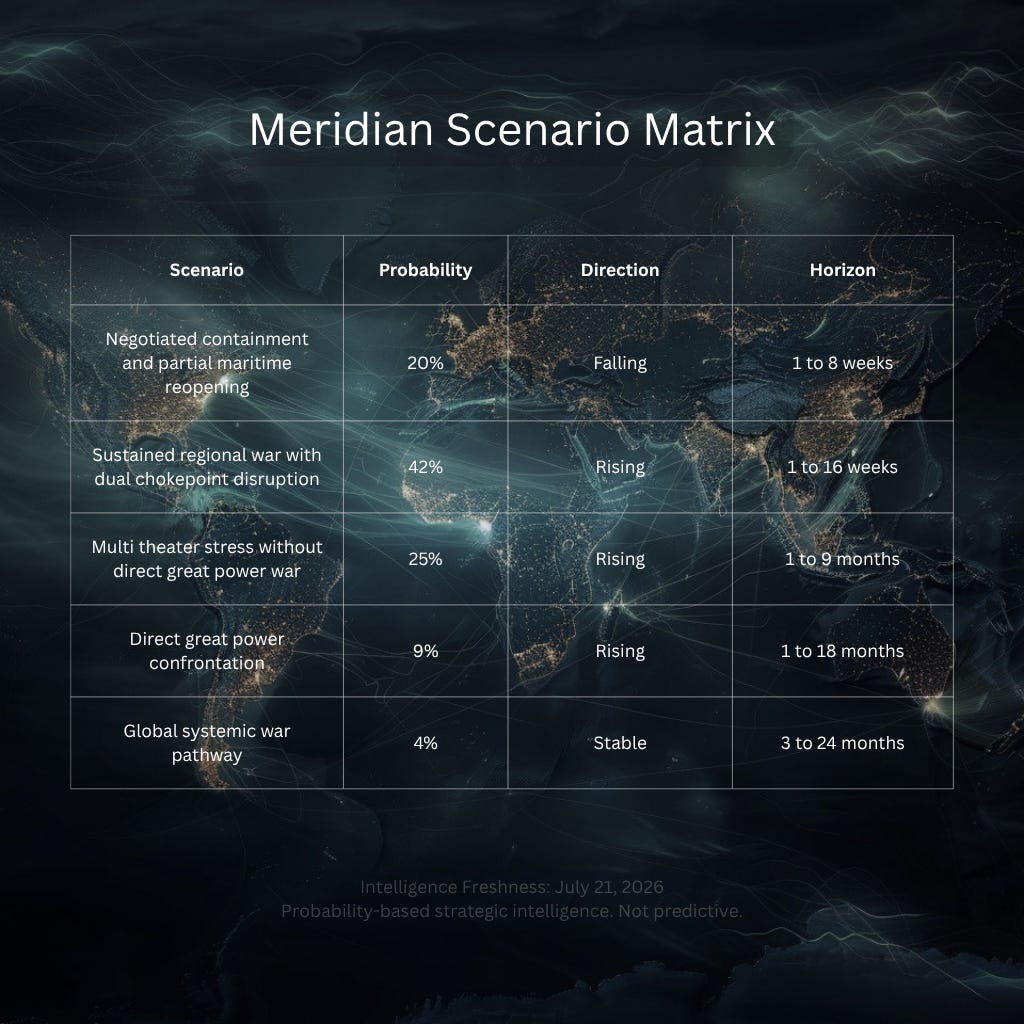
Base case
Sustained regional war with uneven access through Hormuz and Bab el Mandeb
Probability: 42%
The base case includes:
continued United States and Iranian strikes
limited commercial Hormuz passage
periodic vessel attacks
Houthi pressure on Saudi shipping
Saudi and allied protective operations
elevated energy and freight volatility
recurring ceasefire initiatives
no durable settlement
military conflict remaining regional
economic consequences spreading globally
Delta Since Global Escalation Monitor 011
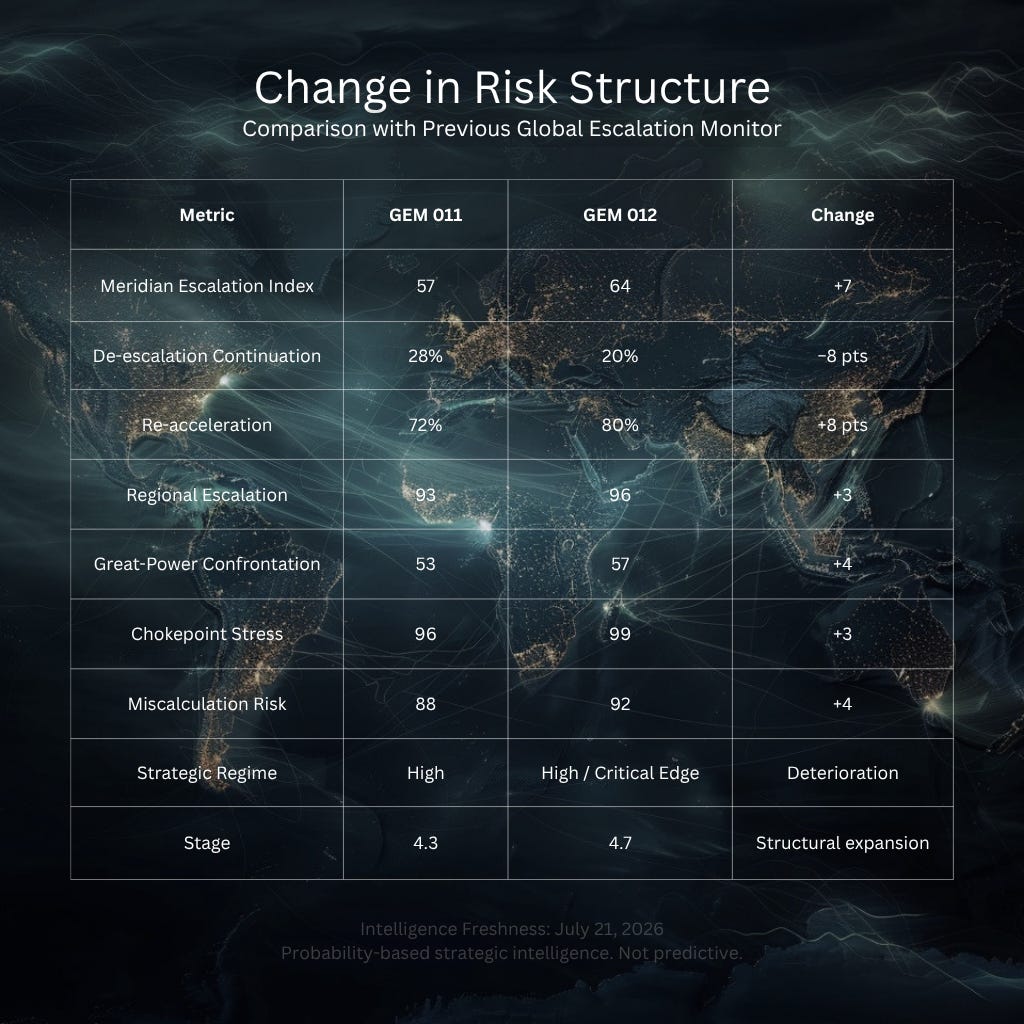
The most important change is not simply that every score increased.
It is that the escalation structure expanded from one militarized chokepoint into two potentially interconnected maritime fronts.
What Would Change Our View
The assessment would deteriorate further if:
Bab el Mandeb enforcement produces repeated successful attacks
Saudi Arabia enters sustained direct combat
most Hormuz traffic stops for several consecutive days
major Gulf oil or LNG infrastructure is disabled
additional United States personnel suffer mass casualties
Israel begins a materially larger strike campaign
Iran activates broad proxy attacks across several states
a major power or NATO linked vessel is struck
oil enters uncontrolled crisis pricing
Russia expands into a NATO adjacent theater
China begins blockade style exercises around Taiwan
The assessment would improve if:
a verified ceasefire is implemented
United States and Iranian strikes stop
Hormuz traffic begins normalizing
the Houthi blockade is withdrawn or proves non operational
Saudi shipping resumes without major incidents
oil loses most of its war premium
a durable maritime verification system is established
Ukraine and Taiwan pressure remain contained
What We Are Watching Next
Whether the Houthi maritime declaration becomes operational
Saudi escort and military protection of commercial vessels
Daily Hormuz transit volumes
Large crude and LNG tanker movements
Further attacks near Oman or the Gulf
United States and Iranian strike tempo
Gulf energy and desalination infrastructure
Oil prices, tanker insurance, and freight rates
Implementation of any temporary ceasefire proposal
Russian operational escalation in Ukraine
Chinese maritime activity around Taiwan
Involvement of neutral or major power vessels
Meridian Strategic Conclusion
The world has not entered global war.
But the conflict has crossed another structural threshold.
Last week, the central risk was the militarization of Hormuz.
This week, the emerging risk is the extension of maritime pressure toward Bab el Mandeb, potentially threatening both the principal Gulf route and one of the most important alternatives available to Saudi energy exports.
That creates a more dangerous system:
Regional war + dual chokepoint pressure + persistent strikes + multi theater strategic distraction
The most likely outcome remains a prolonged regional confrontation rather than direct great power war.
But the international system has become less resilient.
Every disrupted route increases dependence on another route.
Every additional front introduces new military actors and command structures.
Every added command structure creates another opportunity for a tactical mistake to become a strategic event.
Strategic posture: Defensive vigilance
Direction: Rising
Alert level: High
Strategic Escalation Regime: High / Critical Edge
Stage: 4.7: Regional War + Dual Chokepoint Expansion
Bottom line
The system remains below global war territory, but simultaneous pressure on Hormuz and Bab el Mandeb has made the conflict more economically global and operationally dangerous than at any previous point in the current escalation cycle.
Editorial Note
The Global Escalation Monitor is a strategic intelligence publication by Meridian Signal designed to assess systemic geopolitical and macroeconomic risk.
Its purpose is not to predict conflict with certainty or advocate any investment action. It tracks changes in probability, identifies structural shifts, and provides context for long term strategic decision making.
All assessments reflect the information available at the time of publication and should be interpreted as analytical judgments rather than statements of certainty.
Meridian Signal is committed to tracking structure over headlines, probabilities over narratives, and signal over noise.
Meridian Signal
Independent Strategic Intelligence Desk
General informational analysis. Not financial advice