Publication Date: July 13, 2026 | Reporting Period: Week 29
Executive Assessment
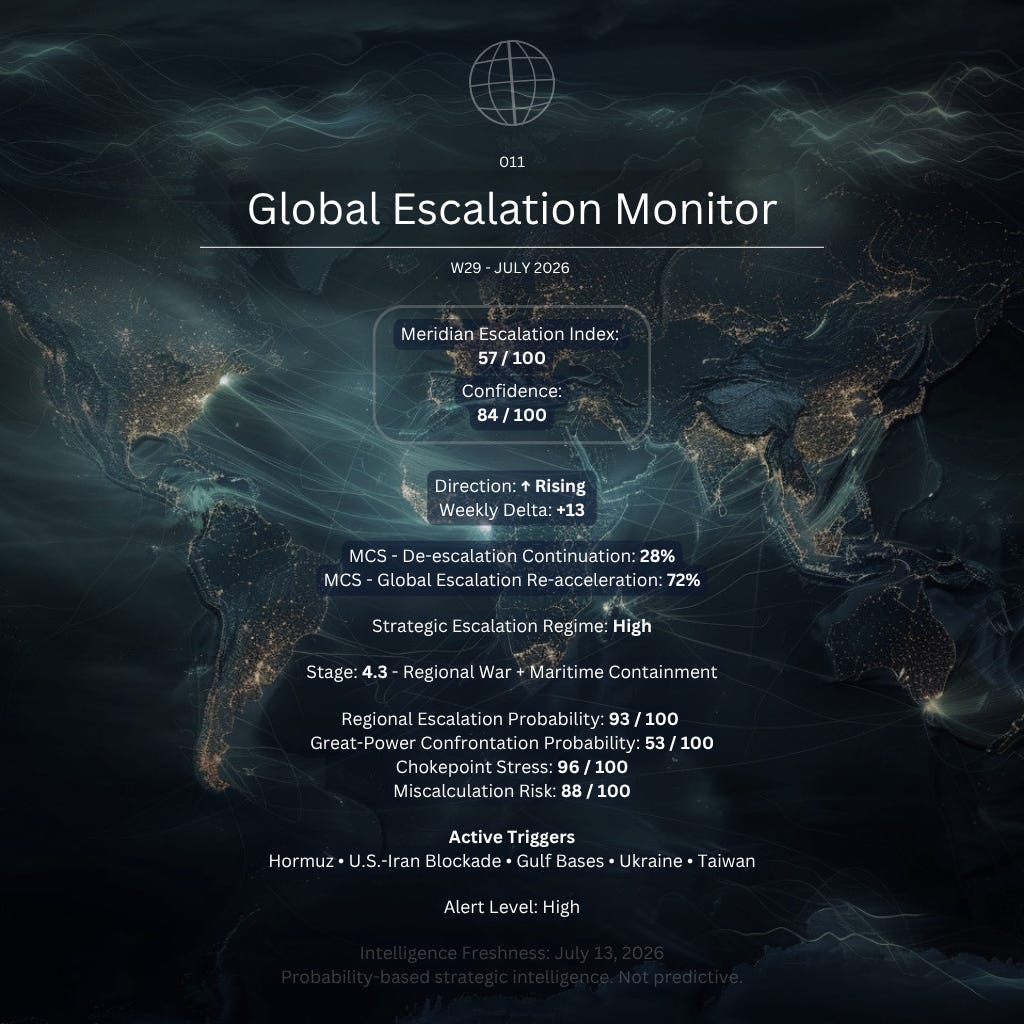
The international security environment has crossed from elevated pressure into an active regional escalation regime.
The central development is the announced U.S. maritime blockade covering Iranian ports, oil terminals, and coastal areas. According to a maritime advisory reported by Reuters, enforcement is scheduled to apply to vessel traffic regardless of flag beginning July 14. The United States has separately maintained that the Strait of Hormuz will remain open, while Iran continues to dispute Washington’s authority over access and control.
This distinction matters.
A missile strike or tanker incident can remain episodic. A blockade creates a continuing operational environment involving vessel identification, cargo ownership, interception decisions, military escorts, rules of engagement, and possible retaliation. Every commercial movement can now become a tactical decision, and every tactical decision carries the potential to become a strategic event.
The world has not entered a global-war regime. Direct confrontation between the United States and either Russia or China remains outside the base case.
But the margin separating regional war from broader systemic escalation has narrowed materially.
Executive Snapshot
What Changed
1. The confrontation is becoming persistent rather than episodic
The most important development is not simply another exchange of strikes.
It is the creation of a continuing maritime-enforcement environment.
The announced blockade reportedly covers Iranian ports, oil terminals, and coastal areas. Reuters also reported rival U.S. and Iranian claims over Hormuz, renewed clashes, and an increasingly fragile ceasefire framework.
This introduces recurring decisions involving:
whether a vessel is authorized
whether cargo is Iranian-linked
which flag state is involved
whether a ship complies with warnings
whether military escort is present
what level of force is permitted
how Iran responds to interdiction
The resulting risk is not only intentional escalation.
It is operational density: too many forces, vessels, authorities, and competing claims occupying the same narrow strategic corridor.
2. Hormuz normalization has failed
Commercial passage has not stopped completely, which remains an important stabilizing contradiction.
But traffic has slowed, vessels have reportedly been stopped or damaged, and competing U.S. and Iranian claims have replaced the earlier assumption of gradual normalization. Reuters reported Hormuz traffic slowing to a multiweek low as renewed strikes increased safety risks.
Chokepoint Normalization Score: 18 / 100
Current classification: Restricted and militarized passage
Chokepoint Stress: 96 / 100
Hormuz is now the dominant global escalation node because it connects military conflict directly to:
oil and LNG flows
shipping insurance
inflation expectations
sovereign relationships
Gulf security
market volatility
international maritime law
3. The June de-escalation architecture is no longer durable
The earlier U.S.–Iran memorandum created a temporary mechanism for commercial shipping and negotiations, but disputes over vessel access, maritime authority, sanctions, Iranian oil, and enforcement terms have progressively weakened it. Reuters reported that the agreement called for temporary safe passage, but later disagreements and renewed attacks undermined its credibility.
De-escalation Durability Score: 22 / 100
Classification: Extremely fragile
De-escalation remains possible, but it is no longer self-sustaining.
A new settlement would need to establish:
enforceable maritime rules
verified cessation of attacks
mutually understood transit rights
a dispute-resolution mechanism
restrictions on military proximity
credible diplomatic follow-through
Without those elements, temporary pauses are more likely to become intervals between confrontations than a durable path toward normalization.
Structural Assessment
Regional Escalation Probability: 93 / 100
The conflict already contains several reinforcing elements:
U.S. military strikes against Iran
Iranian attacks on U.S. positions and commercial shipping
maritime blockade enforcement
contested control of Hormuz
exposure of Gulf installations
possible activation of Iran-aligned regional forces
potential Israeli involvement
The base case is no longer quick stabilization.
It is a sustained but geographically contained regional confrontation.
Great-Power Confrontation Probability: 53 / 100
This score does not mean there is a 53% probability of direct war between major powers.
It measures structural lock-in through:
alliance obligations
simultaneous military commitments
deterrence signaling
proxy support
competing maritime positions
reduced diplomatic flexibility
pressure across multiple theaters
The estimate for direct great-power military conflict remains materially lower at approximately 8%.
The score has nevertheless risen because the United States is becoming more deeply committed in the Middle East while Russia maintains pressure in Ukraine and China continues coercive operations around Taiwan.
Miscalculation Risk: 88 / 100
Miscalculation is now one of the most dangerous elements in the system.
A blockade requires repeated real-time judgments about vessels, cargo, authorization, compliance, escort, and force. A disputed interception involving an allied or neutral vessel could internationalize the confrontation even when none of the actors initially intended that outcome.
The current danger is therefore not limited to deliberate strategic expansion.
It includes an escalation chain produced by:
misidentification → interception → casualties → retaliation → alliance pressure
Theater Assessment
Middle East
Status: Primary escalation center
Theater score: 91 / 100
Direction: Rapidly rising
The active chain is:
Blockade → interception → retaliation → Gulf-base attacks → expanded strikes → regional alignment pressure
The conflict has moved beyond a dispute over isolated attacks. Maritime access, Iranian sovereignty claims, U.S. enforcement, energy security, and commercial shipping are now interacting inside one theater.
Ukraine
Theater score: 82 / 100
Direction: Rising
Ukraine remains a separate conflict, but it materially affects the global escalation system.
Russian attacks intensified in early July, while the United Nations reported at least 265 civilians killed in Ukraine during June, the highest monthly civilian toll since the early stages of the full-scale invasion.
The relevant global risk is not that Ukraine automatically merges with the Iran conflict.
It is that simultaneous crises:
divide air-defense capacity
strain ammunition and logistics
reduce diplomatic attention
constrain U.S. and allied flexibility
create opportunities for adversaries to test overstretched systems
Taiwan and the Indo-Pacific
Theater score: 65 / 100
Direction: Gradually rising
Taiwan reported an upward trend in Chinese naval activity during the peak exercise period, including activity associated with joint drills involving Russia. A Chinese missile test into the Pacific has also heightened regional concern.
There is no confirmed invasion sequence.
The risk instead comes from:
normalization of coercive military activity
shrinking warning times
limited advance communication
testing of U.S. attention during a Middle East crisis
gradual erosion of the distinction between exercises and operational preparation
Escalation Migration
Risk is not rotating away from the Middle East.
It is becoming concentrated in the Middle East while remaining elevated elsewhere.
Primary theater: Hormuz and the U.S.–Iran confrontation
Secondary theater: Ukraine and Russia
Tertiary strategic pressure: Taiwan and the Indo-Pacific
Secondary Theater Rotation Score: 76 / 100
Classification: Multi-theater stress
This does not mean the wars are becoming one integrated conflict.
It means the international system must manage several serious confrontations simultaneously, reducing its resilience to new shocks.
Energy and Economic Transmission
Global Economic Shock Risk
84 / 100
Oil prices rose sharply as renewed U.S.–Iran clashes and the blockade announcement increased fears of disruption in Hormuz. Reuters reported oil rising approximately 9% to a one-month high amid renewed strikes and the blockade plan.
The transmission chain is straightforward:
Hormuz insecurity
→ oil risk premium
→ inflation expectations
→ higher yields
→ pressure on risk assets
→ weaker growth expectations
→ less policy flexibility
Oil has not yet returned to uncontrolled crisis pricing. That remains one of the strongest pieces of evidence against an immediate transition into a systemic global crisis.
But the system has become more vulnerable because maritime security, inflation, and military escalation are now tied to the same chokepoint.
Meridian Conviction Scores
MCS: De-escalation Continuation
28%
A diplomatic pathway remains open, but the prior arrangement has lost durability.
Continued de-escalation now requires a replacement framework rather than simple preservation of the June agreement.
MCS: Global Escalation Re-acceleration
72%
This is the probability that the broader escalation environment worsens further before durable stabilization appears.
It is not a 72% probability of World War III.
The score reflects:
active regional war
militarized maritime access
expanding enforcement requirements
high miscalculation risk
concurrent pressure in Ukraine and Taiwan
energy-market vulnerability
Scenario Matrix
Negotiated containment and partial maritime stabilization
Probability: 28%
Direction: ↓
Time horizon: 2–8 weeks
Sustained U.S.–Iran regional war with intermittent Hormuz disruption
Probability: 39%
Direction: ↑
Time horizon: 1–12 weeks
Multi-theater strategic stress without direct great-power war
Probability: 22%
Direction: ↑
Time horizon: 1–6 months
Direct great-power confrontation
Probability: 8%
Direction: ↑
Time horizon: 1–12 months
Global systemic war pathway
Probability: 3%
Direction: →
Time horizon: 3–24 months
Base case
Sustained regional confrontation with uneven maritime access
Probability: 39%
This scenario includes:
recurring U.S.–Iran strikes
disputed shipping access
periodic tanker incidents
elevated oil volatility
continuing Gulf-base exposure
diplomacy without a comprehensive settlement
conflict remaining regional rather than global
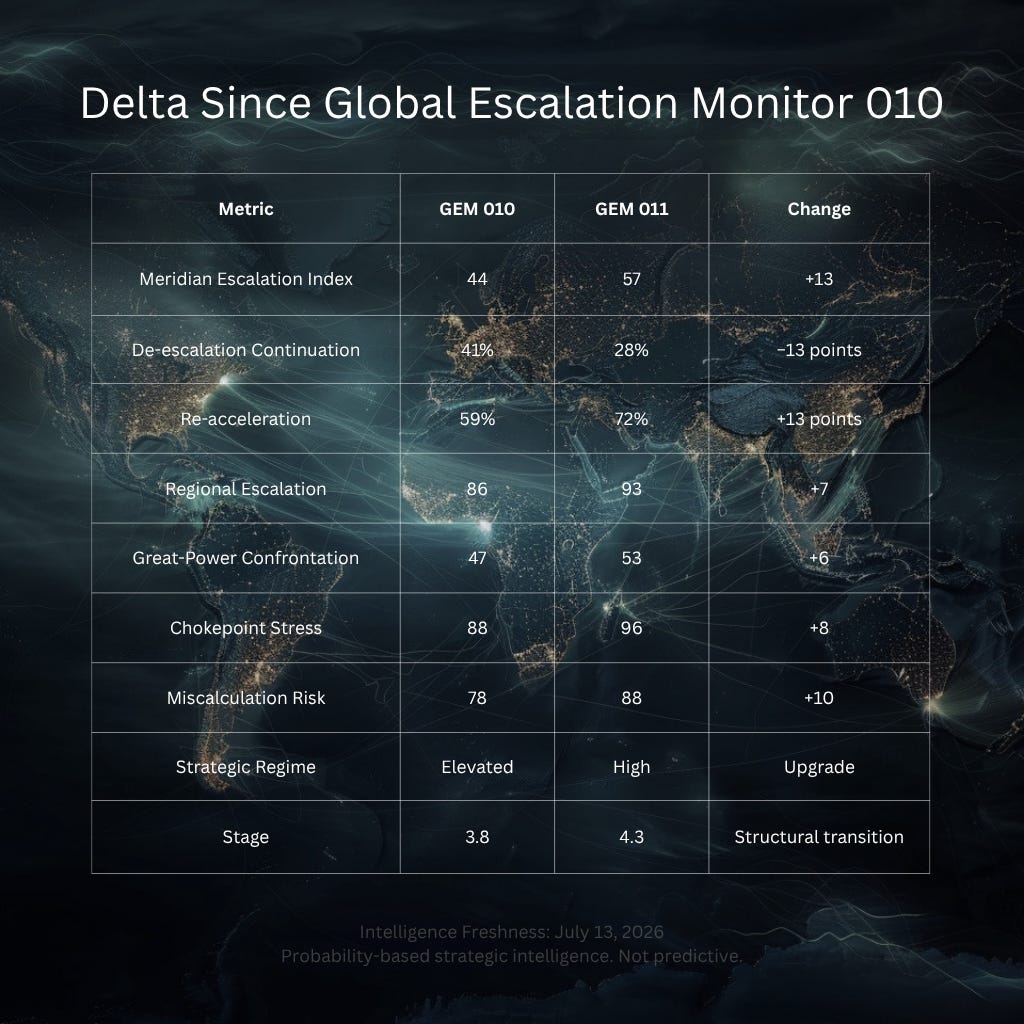
The most important change is not simply that every risk score increased.
It is that the system moved into a different operating structure:
from episodic conflict around a chokepoint to persistent military enforcement around that chokepoint.
What Would Change Our View
The assessment would deteriorate further if:
U.S. forces seize or destroy an Iranian vessel
Iran stops most commercial Hormuz traffic
major Gulf energy infrastructure is attacked
substantial U.S. casualties occur
Saudi Arabia or the UAE enters direct combat
Israel initiates a major new strike campaign
Iran activates a broad regional proxy response
a neutral vessel draws a third government into the dispute
oil returns to wartime extremes
China begins blockade-style exercises around Taiwan
Russia materially expands its Ukraine offensive
The assessment would improve if:
blockade enforcement is paused
Iran publicly guarantees unrestricted commercial passage
attacks on vessels stop for several weeks
a verified replacement agreement is signed
oil loses most of its geopolitical premium
U.S. and Iranian forces reduce operational proximity
Ukraine and Taiwan pressures remain contained
What We Are Watching Next
The first actual enforcement actions under the announced blockade
Iran’s response to vessel interception or diversion
Commercial traffic volumes through Hormuz
Tanker insurance, freight rates, and rerouting behavior
Attacks on U.S. bases or Gulf energy infrastructure
Israeli military posture toward Iran
Oil-price persistence rather than the initial spike
Russian operational escalation in Ukraine
Chinese naval and missile activity around Taiwan
Any credible replacement for the failed U.S.–Iran framework
Meridian Strategic Conclusion
The world has not entered World War III.
But this is no longer a fragile de-escalation test.
The international system has entered a more dangerous structure:
Active regional war, militarized maritime access, and repeated opportunities for miscalculation.
The blockade is the defining development because it changes Hormuz from a disputed transit route into a continuing enforcement environment.
That creates more decisions, more contact, more ambiguity, and more ways for a tactical event to become a strategic one.
The most likely outcome remains a contained but prolonged regional confrontation.
The most dangerous pathway is not a deliberately planned global war. It is a chain in which a vessel incident produces casualties, retaliation, alliance involvement, energy disruption, and simultaneous pressure across other theaters.
Strategic posture: Defensive vigilance
Direction: Rising
Alert level: High
Strategic Escalation Regime: High
Stage: 4.3: Regional War + Maritime Containment
Bottom line: The system remains below global-war territory, but the margin separating regional conflict from systemic escalation has narrowed materially.
Editorial Note
The Global Escalation Monitor is a strategic intelligence publication by Meridian Signal designed to assess systemic geopolitical and macroeconomic risk.
Its purpose is not to predict conflict with certainty or advocate any investment action, but to track changes in probability, identify structural shifts, and provide context for long-term strategic decision-making.
All assessments reflect the information available at the time of publication and should be interpreted as analytical judgments rather than statements of certainty.
Meridian Signal is committed to tracking structure over headlines, probabilities over narratives, and signal over noise.
Meridian Signal
Independent Strategic Intelligence Desk
General informational analysis. Not financial advice