Publication Date: July 7, 2026 | Reporting Period: Week 28
Executive Assessment
The global security environment has become more fragile over the past week.
Following several weeks where diplomatic efforts had modestly reduced immediate escalation pressure, new developments have reversed part of that progress. The reported missile attack on commercial vessels transiting the Strait of Hormuz has reintroduced one of the world’s most consequential geopolitical risks: disruption of a critical global energy corridor.
At the same time, the war in Ukraine continues to demonstrate that high-intensity conflict remains unresolved, while military activity surrounding Taiwan continues to reinforce long-term strategic competition between China and the United States.
None of these developments individually imply an imminent global conflict.
Collectively, however, they increase the probability of regional escalation while reducing confidence that recent de-escalation trends will continue uninterrupted.
Our assessment has therefore shifted from Guarded Stability toward Elevated Escalation.
The probability of a direct great-power confrontation remains relatively low, but the number of active escalation pathways has increased.
Executive Snapshot
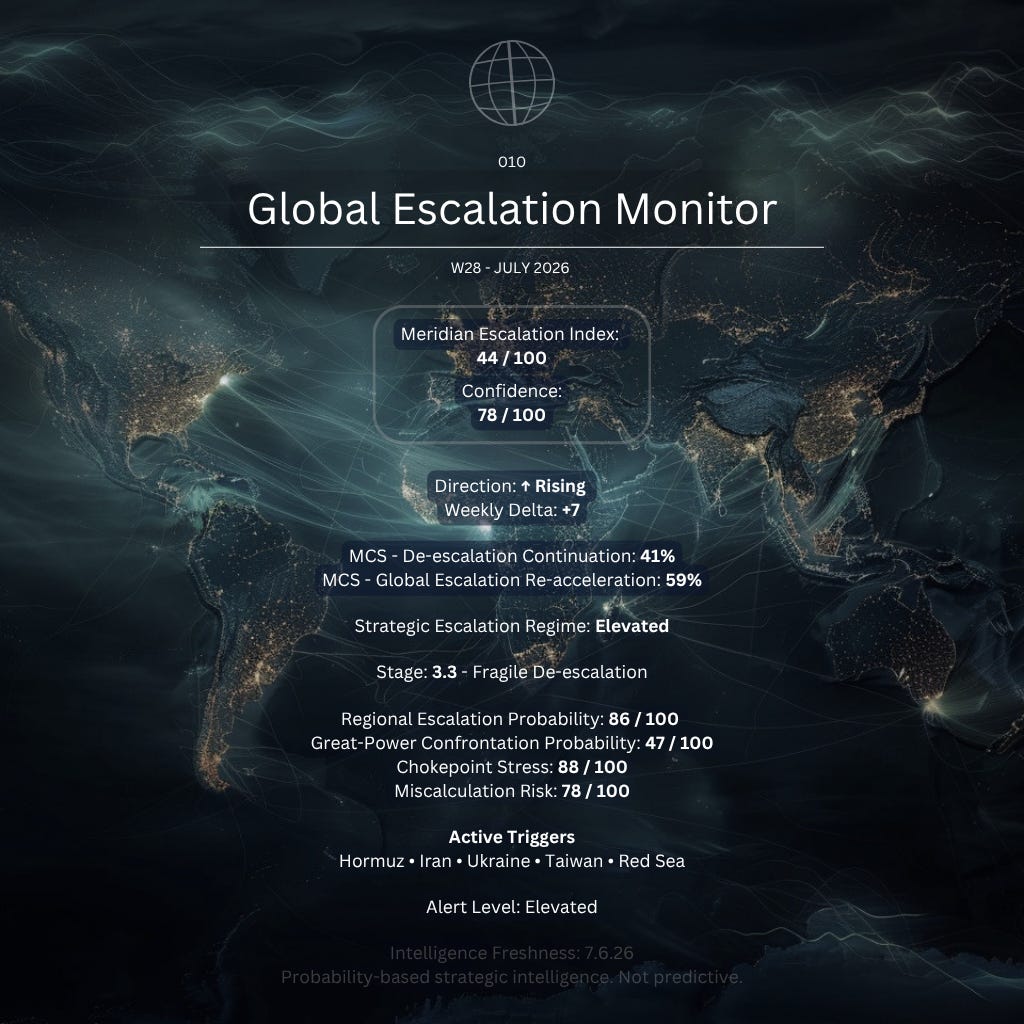
Meridian Escalation Index: 44 / 100
Direction: Rising ↑
Confidence: 78 / 100
High confidence.
Current conclusions are supported by multiple independent geopolitical, military, and market signals.
Strategic Escalation Regime: Elevated
The international system remains below crisis levels but is moving away from stabilization.
What Changed
Three developments drove this week’s assessment.
Strait of Hormuz
The reported attack against commercial shipping reactivates one of the most strategically sensitive maritime corridors in the global economy.
Even limited disruptions have the potential to affect:
global energy prices
shipping insurance
maritime security
inflation expectations
military deployments
The significance extends well beyond the immediate incident.
Hormuz remains one of the world’s most important geopolitical pressure points.
Ukraine
Large-scale Russian missile and drone strikes continue to demonstrate that the conflict remains capable of sudden escalation.
Despite periods of reduced media attention, the conflict has not entered a stable equilibrium.
Military attrition continues.
Taiwan
Chinese naval activity remains elevated.
While no immediate invasion indicators are present, the continued normalization of military pressure increases long-term strategic risk and raises the probability of future incidents.
Why It Matters
Markets often focus on individual headlines.
Strategic intelligence focuses on the interaction between independent events.
This week illustrates that principle.
The Middle East, Eastern Europe, and the Indo-Pacific remain separate theaters, but together they increase global systemic fragility.
The concern is not that these conflicts merge into a single global war.
The concern is that simultaneous pressure across multiple theaters reduces policymakers’ flexibility and increases the probability of strategic miscalculation.
History suggests that major geopolitical crises frequently emerge through chains of interconnected events rather than one decisive incident.
Scenario Matrix
Scenario 1: Controlled De-escalation
Probability: 41%
Diplomatic engagement stabilizes maritime security, energy markets normalize, and regional tensions gradually decline.
Scenario 2: Regional Escalation
Probability: 37%
Further attacks or retaliatory actions expand regional instability while remaining geographically contained.
This remains our base case.
Scenario 3: Multi-Theater Stress
Probability: 17%
Simultaneous deterioration across the Middle East, Ukraine, and the Indo-Pacific increases global uncertainty and strains diplomatic capacity.
Scenario 4: Great-Power Confrontation
Probability: 5%
A direct military confrontation between major powers remains a low-probability but high-impact scenario.
Current intelligence does not support this as the most likely outcome.
Meridian Strategic Conclusion
The global system has entered a more fragile phase.
Our assessment is not driven by any single event but by the interaction of several independent escalation pathways.
The reported Hormuz incident is strategically important because it affects one of the world’s most critical economic chokepoints while occurring alongside continuing conflict in Ukraine and persistent military pressure around Taiwan.
World War III remains a low-probability outcome.
However, regional escalation risk has increased meaningfully.
The current environment calls for disciplined monitoring rather than emotional reaction.
The key question over the coming weeks is whether diplomacy can contain these flashpoints or whether additional incidents begin reinforcing one another into a broader cycle of instability.
For now, the trend has shifted from stabilization toward renewed escalation.
Signal Over Noise.
Editorial Note
The Global Escalation Monitor is a strategic intelligence publication by Meridian Signal designed to assess systemic geopolitical and macroeconomic risk.
Its purpose is not to predict conflict with certainty or advocate any investment action, but to provide a structured, probability-based assessment of evolving geopolitical conditions through the Meridian Signal framework.
All probability estimates reflect analytical judgments based on publicly available information at the time of publication and should be interpreted as scenario assessments rather than forecasts.
Meridian Signal
Independent Strategic Intelligence Desk
General informational analysis. Not financial advice