Executive Assessment
The global security environment remains in a fragile equilibrium.
Last week’s improvement in geopolitical conditions has partially reversed as renewed military activity, diplomatic uncertainty, and persistent regional conflicts have increased systemic pressure. While none of the current developments independently suggest an imminent transition toward global war, their simultaneous re-emergence has reduced confidence that recent de-escalation will continue uninterrupted.
The most significant source of renewed uncertainty remains the Middle East. Although diplomatic engagement between the United States and Iran continues, the aftermath of recent military exchanges has left the region vulnerable to renewed miscalculation, particularly around the Strait of Hormuz. At the same time, the conflict in Ukraine remains structurally unresolved, while military readiness across the Taiwan Strait continues to trend higher.
Taken together, these developments move the global system away from stabilization and back toward a state of guarded uncertainty.
The monitor therefore upgrades the overall environment from improving to fragile de-escalation under pressure.
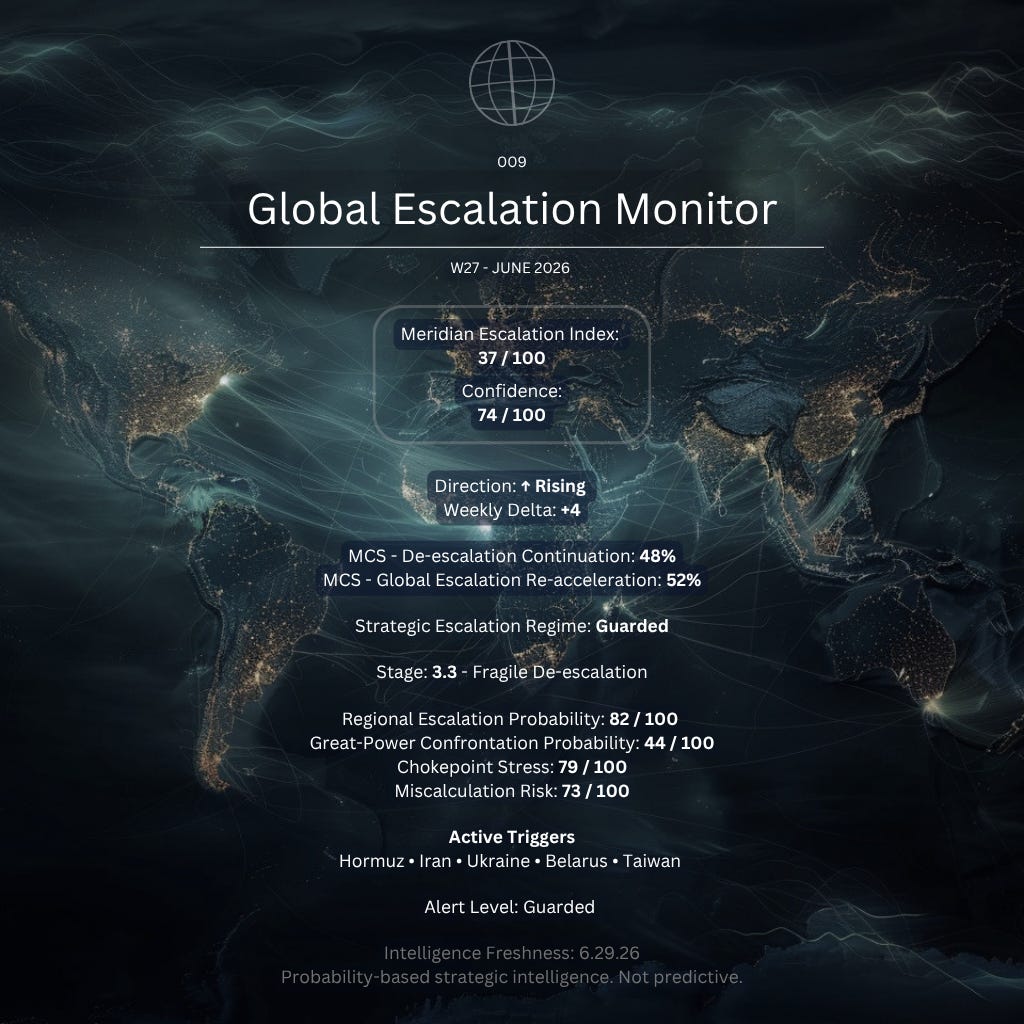
Meridian Conviction Scores
De-escalation Continuation
48 /100
Diplomatic engagement remains active across several theaters, preventing a broader deterioration. However, recent events indicate that progress remains highly vulnerable to disruption.
Global Escalation Re-acceleration
52 /100
The probability of renewed escalation has overtaken the probability of continued de-escalation for the first time in recent weeks. The change is modest but noteworthy, reflecting simultaneous pressure across multiple regions rather than a single dominant crisis.
What Changed This Week
Middle East
The United States and Iran continue diplomatic engagement following recent military exchanges, but accusations of ceasefire violations and continued uncertainty surrounding the Strait of Hormuz have increased regional instability.
Ukraine
The conflict remains strategically unchanged.
Russian military operations continue while political conditions for any negotiated settlement remain incompatible with Ukrainian objectives. The conflict therefore continues to represent the largest long-duration source of geopolitical risk.
Belarus
Military coordination between Moscow and Minsk has increased attention on NATO’s eastern flank, reinforcing broader concerns regarding regional escalation.
Taiwan
Military readiness continues to increase on both sides of the Taiwan Strait. Although no immediate crisis is evident, the probability of miscalculation remains elevated as warning times continue to shorten.
Structural Assessment
The current geopolitical environment is increasingly characterized by simultaneous regional pressure rather than singular crisis escalation.
Unlike previous periods dominated by one conflict, today’s risk profile reflects multiple unresolved theaters operating concurrently.
This creates a more fragile international system where relatively small tactical events possess greater potential to produce broader strategic consequences.
The monitor therefore places greater emphasis on cumulative systemic stress rather than isolated military developments.
Scenario Matrix
Controlled De-escalation: 48%
Regional Re-escalation: 34%
Multi-Theater Escalation: 14%
Great-Power Confrontation: 4%
Strategic Translation
The current environment does not justify expectations of imminent global conflict.
However, neither does it support complacency.
Decision-makers should continue to monitor developments around the Strait of Hormuz, Ukraine, Belarus, and Taiwan, where the interaction of several independent risks now represents the principal source of global instability.
The defining characteristic of the current regime is not accelerating war, but declining resilience.
The system remains stable enough to avoid immediate systemic conflict, yet increasingly sensitive to tactical errors capable of producing disproportionate geopolitical consequences.
Bottom Line
Global geopolitical conditions have weakened modestly over the past week.
Diplomacy continues to prevent broader deterioration, but confidence in continued stabilization has declined as multiple theaters simultaneously regain strategic importance.
Our assessment therefore shifts from improving conditions to fragile de-escalation under pressure, warranting a guarded rather than optimistic strategic posture.
Editorial Note
The Global Escalation Monitor is a strategic intelligence publication by Meridian Signal designed to assess systemic geopolitical and macroeconomic risk.
Its purpose is not to predict conflict with certainty or advocate any investment action, but to provide a structured, probability-based assessment of evolving geopolitical conditions through the Meridian Signal framework.
All probability estimates reflect analytical judgments based on publicly available information at the time of publication and should be interpreted as scenario assessments rather than forecasts.
Meridian Signal
Independent Strategic Intelligence Desk
General informational analysis. Not financial advice