
GEM 028 | Week 46 | 9 November 2026
Evidence cutoff: 9 November 2026, 16:20:46 UTC / 8:20:46 a.m. Pacific, PST (UTC−8).
Forecast window: through 9 December 2026, 16:20:46 UTC / 8:20:46 a.m. Pacific, PST (UTC−8).
Executive assessment
Hormuz traffic nearly stopped over the weekend, but markets moved as if diplomacy could still contain the war. Kpler data reported by Reuters showed five commodity vessels crossing the strait on Saturday and none registered on Sunday, compared with 31 during the prior weekend. Automatic Identification System gaps mean zero registered vessels is not proof that no ship passed. It is still a sharp warning that recent attacks can interrupt traffic even when the route is not continuously closed. Reuters via Gulf Times, 9 November
The diplomatic channel also remained active. Qatar’s prime minister was due to meet President Trump and Vice President Vance after visiting Tehran, but U.S. and Gulf officials said an imminent breakthrough was unlikely. Washington continued to reject Iran’s proposed sequence for lifting the blockade, easing sanctions and stopping attacks. Mutual operations continued, including Iranian reports of U.S. strikes on Qeshm Island and continuing tanker attacks. Reuters, 9 November
The Meridian Escalation Index remains 58.75, displayed as 59. The weekend slowdown reinforces severe route impairment, but it does not yet meet the sustained functional-closure anchor. Regional Escalation Only remains the modal 30-day scenario at 48%. Further Escalation is 64%. The Alert Level remains High because energy exports and facilitated passage continue, leaving the Critical override inactive.
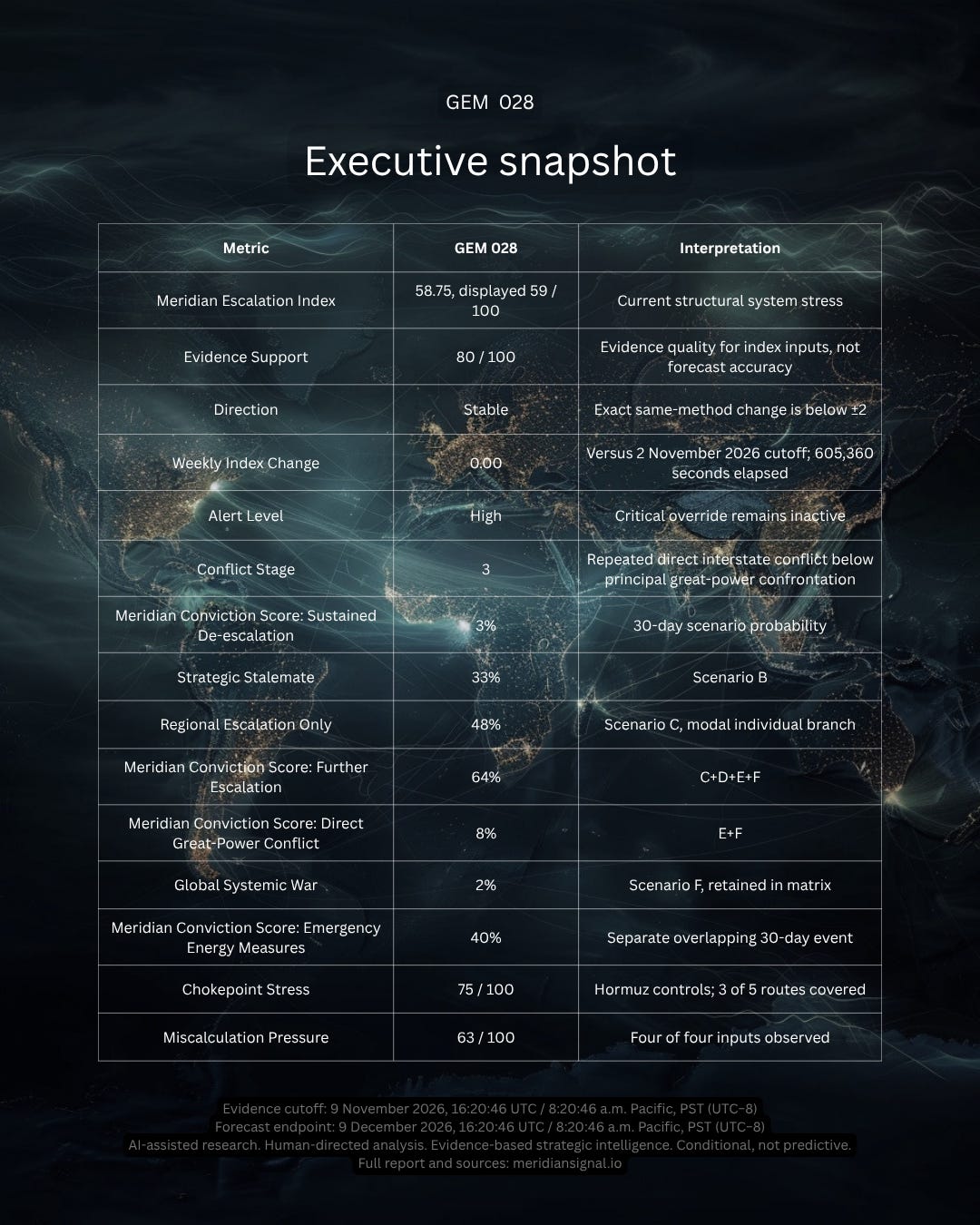
Meridian Conviction Score, 30-day scenario probabilities: Sustained De-escalation 3%; Further Escalation 64%; Direct Great-Power Conflict 8%.
Forecast indicators: Regional Escalation Only 48%; Emergency Energy Measures 40%, a separate overlapping event.
Stress indicators: Chokepoint Stress 75 / 100; Miscalculation Pressure 63 / 100.
Active triggers: implemented U.S. and Iran maritime terms; repeated zero or near-zero eligible Hormuz traffic; Egyptian direct combat entry; sustained impairment of export pipelines or loading terminals; reciprocal NATO and Russia or U.S. and China combat.
The signal inside the contrast
The route signal worsened first. United Kingdom Maritime Trade Operations recorded tanker incidents on 3, 5, 6 and 8 November, including projectile strikes, a waterline explosion and a tanker fire that led to crew evacuation. The International Maritime Organization listed 130 confirmed Middle East incidents as of 6 November, up from 123 at the prior cutoff. These are different populations and are not added together. UKMTO IMO
The operating picture is more resilient than the weekend count alone suggests. UKMTO’s week ending 6 November recorded 170 outbound and 155 inbound transits, combining Automatic Identification System observations and U.S. stated facilitated movements. UKMTO assessed combined transits at roughly 65% below prewar levels. Separately, October Gulf oil flows remained well above the war’s early lows, although Vortexa and Kpler both reported declines from September and warned that dark or delayed tracking could revise the figures upward. UKMTO weekly overview, 6 November Reuters via Investing.com, 3 November
Markets emphasized the diplomatic side. Brent fell 16% during the week, its steepest weekly decline since the start of the COVID-19 pandemic, and traded near $97.57 early Monday. The price move reflects expectations and physical flows, not a verified peace agreement. Reuters via MarketScreener, 9 November
That is the current signal: physical access became more fragile while market expectations became less alarmed.
Why the index remains at 59
Critical-route impairment stays at level 3. The reviewed evidence shows severe restriction, continuing attacks and a near-standstill weekend. It also shows continuing facilitated passage and substantial weekly movements. One zero-registration day cannot establish sustained functional closure, especially when some vessels operate without visible transponders.
Energy-export redundancy stays at level 2. October Gulf exports declined from September, but crude and condensate flows remained around 86% of prewar levels in the Vortexa estimate, while refined-product exports were much weaker. That is partial impairment with adaptation, not verified failure of multiple alternatives.
Failure of restraint remains at level 4. Qatar-mediated diplomacy is functioning, but no terms were implemented before cutoff. U.S. and Iranian operations continued, and Houthi attacks damaged an Aramco office building in Riyadh on 8 November. Reuters, 9 November
No central dimension changed. Weekly Index Change is therefore 0.00. A stable index does not mean stable conditions. It means the new evidence strengthened the existing severe-restriction classification without crossing the next anchor.
Theater assessment and migration
Middle East: The main near-term migration routes remain Egyptian entry into direct combat, sustained attacks on Saudi export infrastructure, and an operational collapse in Hormuz. Egypt has authorization to support Saudi Arabia but no verified direct combat entry. The 8 November Aramco Tower damage was limited and did not establish sustained oil-delivery impairment.
Europe: Diplomatic activity increased ahead of planned talks involving the United States, Ukraine, Russia, NATO and European participants. At the same time, Zaporizhzhya Nuclear Power Plant again lost external electricity and relied on emergency generators. The International Atomic Energy Agency said fuel was available for a limited number of generators for about two weeks, according to Reuters. The event supports a serious nuclear-safety reading without implying weapons-use preparation or a radiological release. Reuters via Gulf Times, 9 November
East Asia: Taiwan’s Ministry of National Defense reported one People’s Liberation Army aircraft sortie, seven naval ships and one official ship in the latest daily window. A 4 November joint combat-readiness patrol involved 14 aircraft, with 12 crossing the median line or its extension. This is coercive activity, not reciprocal U.S. and China combat or verified commercial closure. Taiwan Ministry of National Defense, 9 November
Meridian Conviction Score
These are structured analyst judgments for the exact 30-day window above. They are not empirically calibrated and are not calculated from the Meridian Escalation Index.
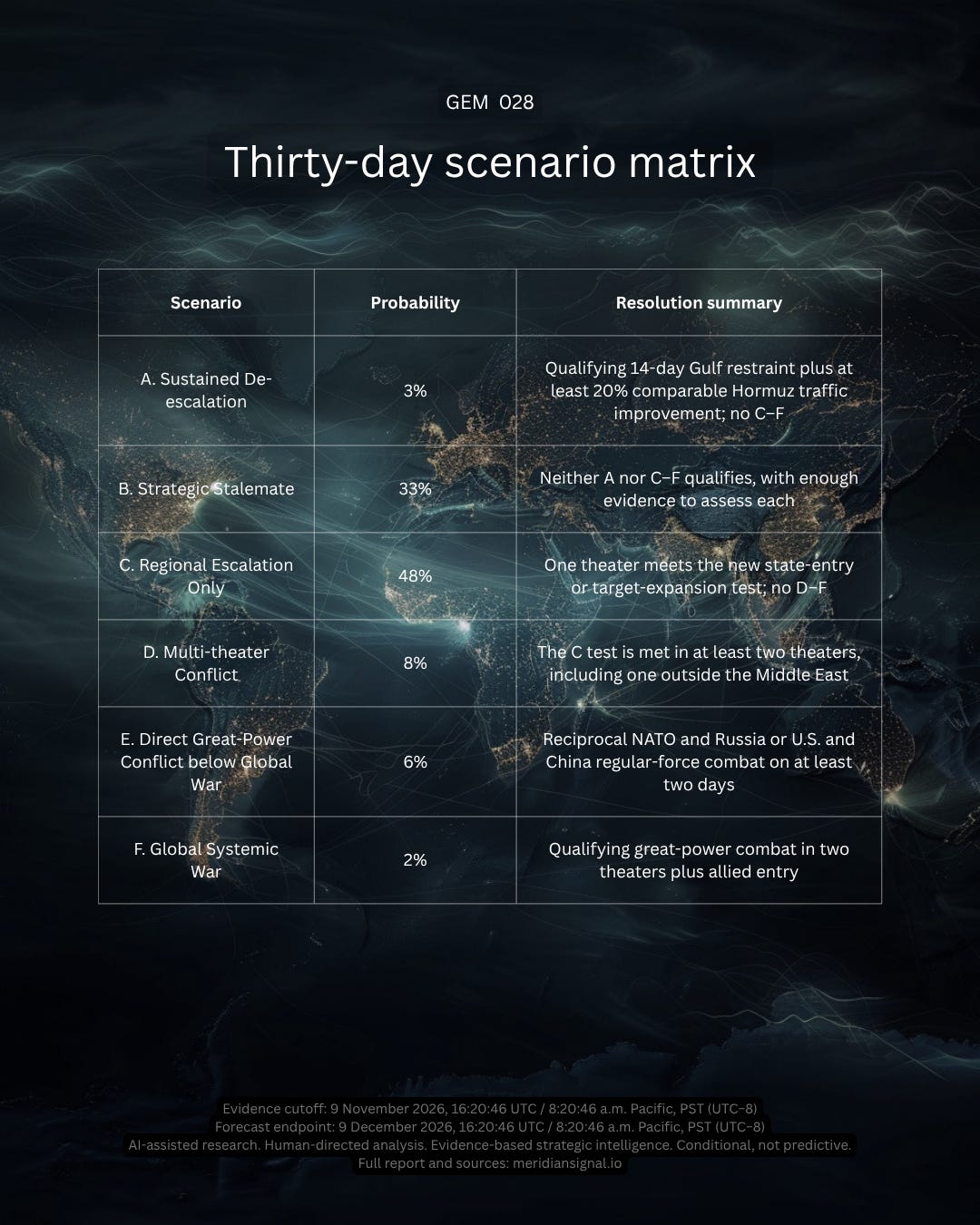
Further Escalation is C+D+E+F, or 64%. Direct Great-Power Conflict is E+F, or 8%. Regional Escalation Only is the largest individual branch.
A restraint-favoring alternative is 8/50/30/5/6/1. An escalation-favoring alternative is 1/14/57/14/10/4. Those alternatives place Further Escalation between 42% and 85% and Direct Great-Power Conflict between 7% and 14%. They are assumption tests, not confidence intervals.
Scenario A uses UKMTO’s public daily transit overview for the seven complete days before cutoff, 2 through 8 November, with the convention fixed in the forecast contract. The series has a material break after 4 November because the 6 November report ends there and the weekend Kpler population is not identical. A may therefore remain unscorable unless a single comparable daily series is recovered. Missing coverage is not treated as zero.
The separate Meridian Conviction Score: Emergency Energy Measures is 40%. A qualifying outcome requires a new conflict-caused official instrument in two of the United States, European Union, China, India or Japan, each implemented for seven consecutive days inside this window. The March International Energy Agency program and October acceleration remain baseline and cannot count as new GEM 028 outcomes.
What would change the assessment
Watch these tests through 9 December:
Implementation or collapse of the Qatar-mediated proposal.
Three or more consecutive days of zero or near-zero comparable Hormuz transit observations.
Verified Egyptian direct operations after a Saudi request.
Sustained damage to export pipelines, loading terminals or refineries.
Repeated disruption of liquefied natural gas delivery.
Restoration or further loss of Zaporizhzhya external power.
A qualifying new campaign outside the Middle East.
Reciprocal NATO and Russia or U.S. and China regular-force combat.
New qualifying emergency energy measures in two named jurisdictions.
Meridian Strategic Conclusion
Maintain Strategic Caution. The central risk is no longer simply whether Hormuz is open or closed. It is whether intermittent attack pressure can repeatedly compress usable capacity faster than escorting, rerouting and dark shipping can restore it.
The market is giving diplomacy more weight than the physical route data. That may prove correct if Qatar-mediated contacts produce executable terms. It may also leave markets vulnerable if weekend traffic weakness becomes a sustained operating condition. The assessment worsens with repeated near-zero transit days, verified Egyptian combat entry or sustained loss of export infrastructure. It improves with implemented maritime terms, a comparable recovery in passage and restored nuclear-grid resilience.
Editorial note: The Global Escalation Monitor assesses geopolitical and macroeconomic risk for strategic decision-making. It is general informational analysis and does not constitute individualized financial, investment, legal or tax advice.
Research disclosure: Meridian Signal uses AI-assisted research and synthesis under human-directed analytical and editorial priorities. Material factual claims are supported by cited sources, with attribution, access limitations, source conflicts and material evidence gaps disclosed where they affect the assessment. Each edition states its evidence cutoff; individual sources may reflect different publication dates, event dates and observation periods.
The Meridian Escalation Index measures current structural system stress on a 0–100 scale. Meridian Conviction Scores express judgment-based probabilities of specifically defined outcomes over a stated forecast window. Evidence Supportmeasures the quality and coverage of evidence supporting the index inputs; it does not measure forecasting accuracy or certainty about future outcomes.
Scenario probabilities are analytical judgments and have not been empirically calibrated. Resolution criteria, forecast horizons, material methodology changes and resulting breaks in comparability are disclosed where applicable.
Meridian Signal
Bold clarity at the right time.
Independent strategic intelligence on capital regimes, digital infrastructure and systemic risk.
AI-assisted. Human-directed. Source-verified.
Evidence-based strategic intelligence. Conditional, not predictive.
Questions or corrections: contact@meridiansignal.io