
GEM 027 | Week 45 | 2 November 2026
Evidence cutoff: 2 November 2026, 16:11:26 UTC / 8:11:26 a.m. Pacific, PST (UTC−8).
Forecast window: through 2 December 2026, 16:11:26 UTC / 8:11:26 a.m. Pacific, PST (UTC−8).
Executive assessment
Diplomacy is still functioning, but the physical risk is spreading across more vessel classes. Iranian negotiators left Doha without a breakthrough, even as Tehran said intensive mediated contacts with the United States would continue. A draft was circulating, and Iran said its proposal could reopen Hormuz quickly if Washington met its conditions. None of those terms had been implemented at the evidence cutoff. Reuters, 2 November
The shipping picture deteriorated at the same time. A Qatari liquefied natural gas carrier was struck in the Gulf, a rare expansion beyond the oil-tanker incidents that have defined much of the conflict. United Kingdom Maritime Trade Operations also recorded new tanker attacks in and around Hormuz. The International Maritime Organization listed 123 confirmed Middle East incidents through 2 November. These populations differ and are not combined into one rate. UKMTO IMO
The Meridian Escalation Index remains 58.75, displayed as 59. Route danger increased, but Hormuz remains severely restricted rather than functionally closed, and October Saudi exports still rose according to two of three trackers cited by Reuters. Regional Escalation Only rises to 50%, the modal 30-day scenario. Further Escalation increases to 66%. The Alert Level remains High because usable substitution and continuing passage keep the Critical override inactive.
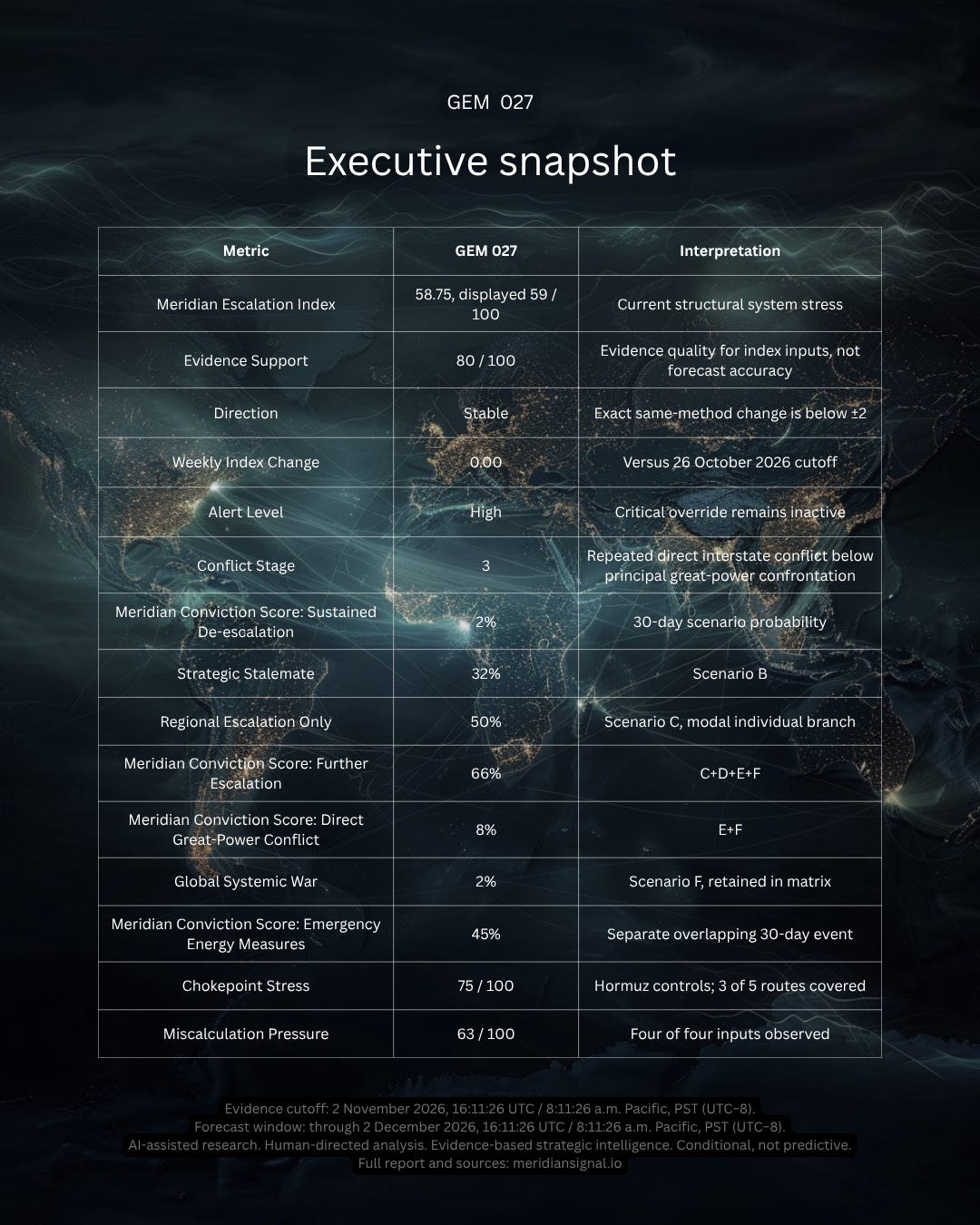
Meridian Conviction Score, 30-day scenario probabilities: Sustained De-escalation 2%; Further Escalation 66%; Direct Great-Power Conflict 8%.
Forecast indicators: Regional Escalation Only 50%; Emergency Energy Measures 45%, a separate overlapping event.
Stress indicators: Chokepoint Stress 75 / 100; Miscalculation Pressure 63 / 100.
Active triggers: implemented U.S.–Iran maritime terms; Egyptian direct combat entry; confirmed sustained impairment of Saudi export substitutes; reciprocal NATO–Russia or U.S.–China combat; new qualifying emergency energy instruments in two named jurisdictions.
What changed
The most important change is not that negotiations ended. They did not. It is that diplomacy and attack activity are now advancing in parallel.
Reuters reported that Iranian and U.S. contacts through Qatari mediators remained intensive after the Doha round ended without agreement. Tehran said its seven-step plan had been condensed so that it could be implemented within two days. The sequence would involve U.S. moves on Iranian ports and sanctions, Iranian reopening of Hormuz, and later nuclear talks. A circulated draft is evidence of a live channel, not evidence of implementation.
The route environment moved the other way. Reuters reported a rare strike on a Qatari LNG carrier. UKMTO alerts described an outbound crude tanker struck in Hormuz, another vessel hit south of Iran’s Lavan Island, a Mayday relay involving a vessel strike and a tanker hit by two projectiles east of Ras al-Khafji. Early alerts do not establish common attribution, final damage or whether every report concerns a distinct event. They do establish continuing physical exposure across the Gulf system.
Oil markets reflected that exposure. December Brent settled at $117.64 on 30 October and gained 13.6% during the month. West Texas Intermediate settled at $104.12 and rose 15.2% in October. The same Reuters report said Saudi crude exports increased in October according to two of three ship-tracking firms. Reuters via MarketScreener, 30 October
That is the central contrast: more categories of cargo are exposed, but the export system has not stopped.
Why the index did not rise
The route dimension remains at level 3: severe restriction with some passage continuing. The new incidents strengthen the level 3 evidence but do not satisfy level 4, which requires verified sustained functional closure of a major route.
Energy-export redundancy remains at level 2. Substitution is impaired and costly, yet Saudi exports increased and no sustained loss of multiple alternatives was verified. Failure of restraint remains at level 4 because broader operations continue after working restraint mechanisms collapsed. Active mediation is important counterevidence, but it has not restored implemented restraint.
No central dimension changed, so the exact Weekly Index Change is 0.00. Evidence Support rises to 80 because current official maritime reporting improves the support for the route code. A stable index does not mean a quiet week. It means the new evidence strengthened the current classification without crossing a scoring anchor.
Theater assessment and migration
Middle East: The highest near-term migration risk is still new state participation or a qualifying expansion into strategic infrastructure. Egypt retains authorization to support Saudi defense, but no Egyptian combat entry was verified. Fresh tanker and LNG-carrier attacks widen commercial exposure, yet ordinary commercial-vessel strikes do not automatically satisfy the forecast contract’s strategic target-class test.
Europe: A six-day humanitarian ceasefire around Oleshky enabled evacuations before expiring amid claims that both sides had used the pause to regroup. Separately, Latvia reported a brief unidentified airspace intrusion near Russia and Belarus. Neither event establishes reciprocal NATO–Russia combat. Reuters, Oleshky Reuters, Latvia
Nuclear-grid vulnerability remains serious. The International Atomic Energy Agency reported an attack-related loss of all 330 kilovolt lines at the Slavutych substation, continued fragility at Zaporizhzhya and repeated drone activity near nuclear sites. That supports a level 2 nuclear-safety reading, not an inference of weapons-use preparation.
East Asia: Taiwan reported 19 People’s Liberation Army aircraft sorties, seven naval ships and six official ships in the latest daily window, with four sorties entering southwestern and eastern air-defense identification zones. This remains coercive pressure, not commercial closure or reciprocal U.S.–China combat. Taiwan Ministry of National Defense, 2 November
Meridian Conviction Score
These are structured analyst judgments for the exact 30-day window above. They are not empirically calibrated and are not calculated from the Meridian Escalation Index.
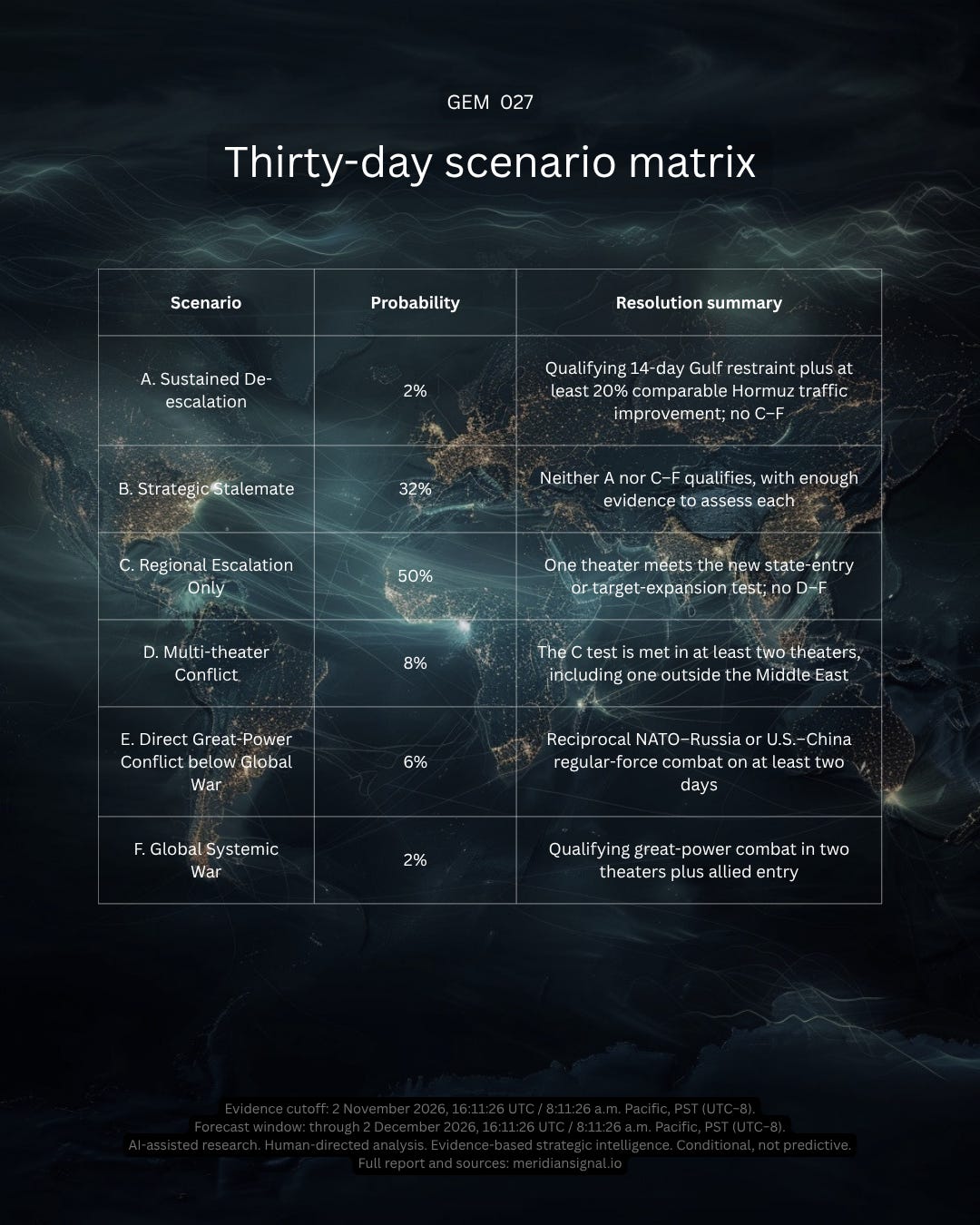
Further Escalation is C+D+E+F, or 66%. Direct Great-Power Conflict is E+F, or 8%. Regional Escalation Only is the largest individual branch.
A restraint-favoring alternative is 7/48/32/6/6/1. An escalation-favoring alternative is 1/15/57/13/10/4. Those alternatives place Further Escalation between 45% and 84% and Direct Great-Power Conflict between 7% and 14%. They are assumption tests, not confidence intervals.
Scenario A still lacks the complete seven-day daily Kpler baseline required by the prospective contract. October averages cannot replace it. Missing traffic coverage may make A unscorable at resolution, but it does not justify mechanically setting the probability to zero.
The separate Meridian Conviction Score: Emergency Energy Measures is 45%. A qualifying outcome requires a new conflict-caused official instrument in two of the United States, European Union, China, India or Japan, each implemented for seven consecutive days inside this window. The March International Energy Agency program and October acceleration are already in the baseline.
What would change the assessment
Watch these tests through 2 December:
Implementation or collapse of the condensed U.S.–Iran proposal.
Verified Egyptian direct operations after a Saudi request.
Confirmed sustained damage to export pipelines, loading terminals or other substitutes.
Comparable daily Hormuz flow and safe-voyage evidence.
New attacks that impair LNG delivery rather than only damage one vessel.
Restoration or further loss of nuclear-site external power.
A qualifying new campaign outside the Middle East.
Reciprocal NATO–Russia or U.S.–China regular-force combat.
New qualifying emergency energy measures in two named jurisdictions.
Meridian Strategic Conclusion
Maintain Strategic Caution. The system is absorbing more physical danger without yet losing its core delivery function. Diplomacy is reducing the probability of immediate uncontrolled escalation, but it has not produced executable restraint. The rare LNG-carrier strike matters because it widens the cargo and infrastructure exposure beyond oil. It does not, by itself, prove that Hormuz or Gulf export redundancy has failed.
The assessment would worsen with verified Egyptian combat entry, sustained impairment of export substitutes, repeated LNG-delivery disruption or a second theater meeting the prospective expansion test. It would improve with implemented maritime terms, reliable passage and verifiable restoration of nuclear-grid resilience.
Editorial note: The Global Escalation Monitor assesses geopolitical and macroeconomic risk for strategic decision-making. It is general informational analysis and does not constitute individualized financial, investment, legal or tax advice.
Research disclosure: Meridian Signal uses AI-assisted research and synthesis under human-directed analytical and editorial priorities. Material factual claims are supported by cited sources, with attribution, access limitations, source conflicts and material evidence gaps disclosed where they affect the assessment. Each edition states its evidence cutoff; individual sources may reflect different publication dates, event dates and observation periods.
The Meridian Escalation Index measures current structural system stress on a 0–100 scale. Meridian Conviction Scores express judgment-based probabilities of specifically defined outcomes over a stated forecast window. Evidence Supportmeasures the quality and coverage of evidence supporting the index inputs; it does not measure forecasting accuracy or certainty about future outcomes.
Scenario probabilities are analytical judgments and have not been empirically calibrated. Resolution criteria, forecast horizons, material methodology changes and resulting breaks in comparability are disclosed where applicable.
Meridian Signal
Bold clarity at the right time.
Independent strategic intelligence on capital regimes, digital infrastructure and systemic risk.
AI-assisted. Human-directed. Source-verified.
Evidence-based strategic intelligence. Conditional, not predictive.
Questions or corrections: contact@meridiansignal.io