
GEM 026 | Week 44 | 26 October 2026
Evidence cutoff: 26 October 2026, 15:23:08 UTC / 8:23:08 a.m. Pacific, PDT (UTC−7).
Forecast window: through 25 November 2026, 15:23:08 UTC / 7:23:08 a.m. Pacific, PST (UTC−8).
Executive assessment
The restraint mechanism failed before the export system did. Saudi Arabia and Yemen’s Houthis returned to sustained cross-border attacks, ending a United Nations brokered truce that had largely constrained that front since 2022. Egypt’s parliament also authorized military support for Saudi defense. Cairo had not entered direct combat by the evidence cutoff, but the legal barrier to participation moved materially lower.
At the same time, physical oil adaptation remained stronger than security conditions. Kpler data reported by Reuters put October Middle East exports above the cited prewar average, with Hormuz flows at 11.7 million barrels per day and Saudi Red Sea exports recovering. Those volumes depend on military protection, costly insurance, altered sales terms and tolerance for repeated attacks. They show resilience, not normalization.
The Meridian Escalation Index rises from 56.25 to 58.75, displayed as 59. The increase comes entirely from Failure of Restraint moving from level 3 to level 4. Regional Escalation Only is now the largest individual 30-day scenario at 47%. Four worsening branches together place Further Escalation at 63%. The Alert Level remains High, not Critical, because the evidence does not establish sustained failure of usable export substitutes.
Executive snapshot
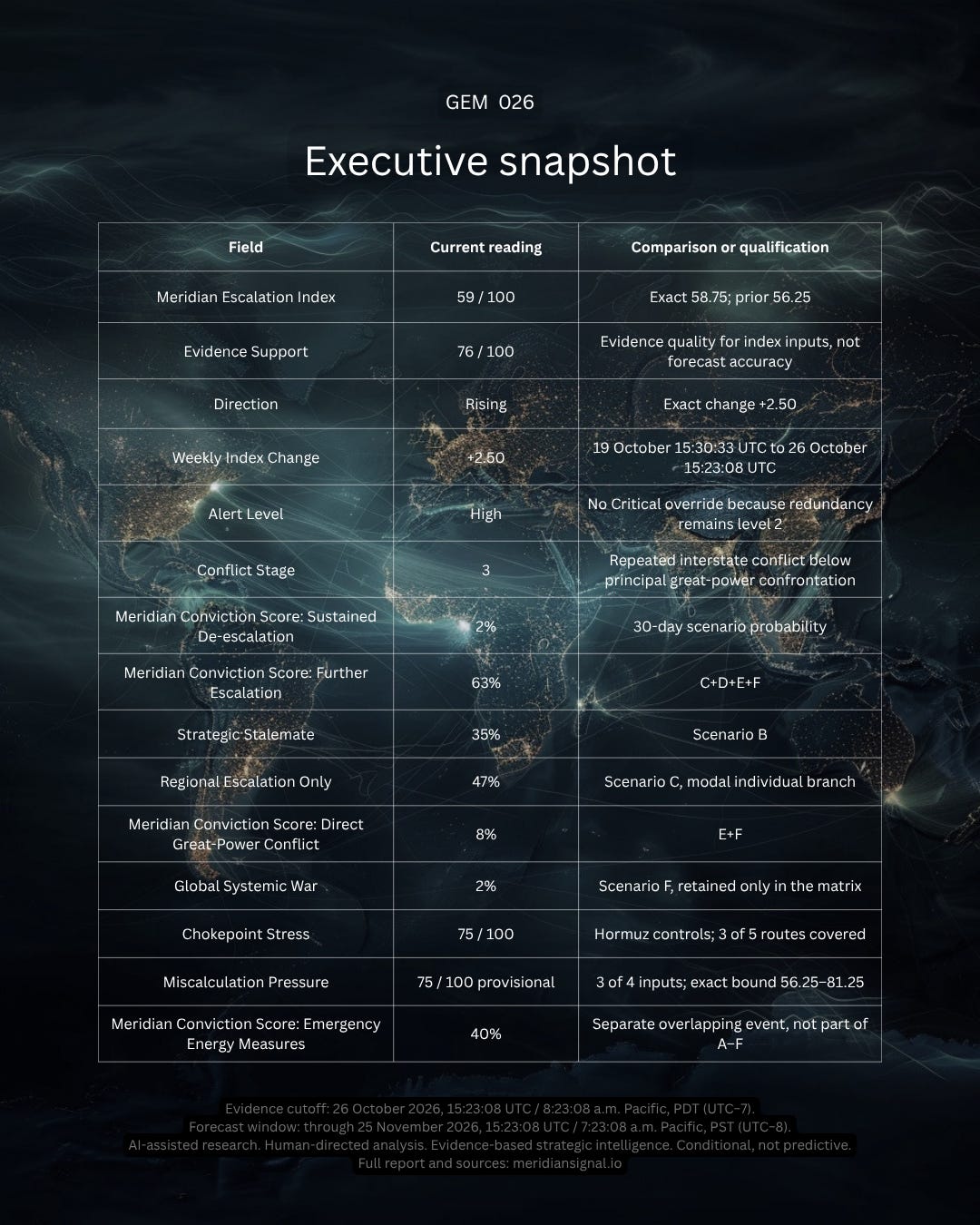
Forecast indicators: Regional Escalation Only 47%; Direct Great-Power Conflict 8%; Emergency Energy Measures 40%, a separate event.
Stress indicators: Chokepoint Stress 75 / 100; Miscalculation Pressure 75 / 100 provisional.
Active triggers: Egyptian operational entry; confirmed impairment of Saudi export pipelines or loading terminals; implemented Iran–United States maritime terms; sustained Hormuz passage data; reciprocal regular-force combat in a defined great-power pairing.
What changed
Reuters reported that the renewed Saudi–Houthi fighting effectively ended the truce that had largely restrained cross-border attacks since 2022. Riyadh airport partially reopened after a lethal attack, but flight tracking still showed limited traffic. The Saudi-led coalition said the Houthis had attacked the airport 20 times from 1 through 11 October. Reuters, 25 October
Egypt’s parliament then authorized President Abdel Fattah al-Sisi to take necessary measures to help defend Saudi Arabia. Egypt described the authority as defensive and continued to support diplomacy. No new Egyptian kinetic operation was verified by the cutoff. Authorization, deployment and combat remain distinct stages. Reuters, 26 October
Houthi claims that pumping stations, Yanbu and other oil sites were struck remain unconfirmed by Saudi authorities. Those claims cannot establish lost export capacity. Confirmed Saudi retaliation and the wider cross-border campaign do establish the failure of the earlier restraint mechanism. Reuters, 26 October
Exports recovered inside a more dangerous system
October became the most intense month in the reviewed record for attacks on commercial shipping around Hormuz. Reuters counted at least 28 confirmed or reported attacks, while the International Maritime Organization listed 120 confirmed incidents across the wider Middle East through 22 October. Those populations are not identical and must not be combined into a single rate. Reuters International Maritime Organization
The physical flow record moved in the opposite direction. Reuters commentary citing Kpler put October Middle East exports at 17.3 million barrels per day, above its 16.9 million prewar comparison. Hormuz flows reached 11.7 million barrels per day, about 82% of the cited prewar level, while Yanbu exports averaged 3 million barrels per day. Tanker hire and insurance remained exceptional. Reuters commentary, 22 October
That contrast is why the index rises only 2.5 points. A truce can fail while redundancy still works. The Critical override requires kinetic conflict, route impairment and redundancy loss all at level 3 or higher. Redundancy remains level 2 because substitution is impaired and expensive but demonstrably usable.
Theater assessment and migration
Middle East: The main migration pathway is state participation. Egypt can now act under parliamentary authority, but has not been verified in combat. Saudi–Houthi operations and maritime attacks are already part of the frozen baseline for this forecast. Repetition alone will not count as a new forecast success.
Europe: Russia and Ukraine remain in repeated direct conflict. NATO announced additional maritime patrol aircraft, radar and drones for the Black Sea after commercial shipping attacks, but did not officially attribute those attacks to Russia. Defensive reinforcement is not reciprocal NATO–Russia combat. Reuters, 20 October
The International Atomic Energy Agency reported that a localized ceasefire enabled repair of a backup transformer near Zaporizhzhya. The plant still relies on one external power line, and military activity interrupted work briefly. This is real cooperation and continuing vulnerability at the same time. IAEA, 23 October
East Asia: Taiwan reported three Chinese aircraft sorties, six naval ships and nine official ships in the latest daily window. Separately, Reuters directly observed North Korean artillery near the border amid a disputed mine incident and warning-fire exposure. These are active coercive conditions, not verified sustained interstate war or commercial closure. Taiwan Ministry of National Defense Reuters, Korea
Restraint and contrary evidence
High-level delegations from Saudi Arabia, Pakistan and Turkey met Iranian officials in Tehran, with Qatar also involved in de-escalation efforts. The talks are important counterevidence to a one-way escalation narrative. They are not an implemented maritime agreement or ceasefire. Associated Press, 26 October
The strongest restraint evidence is narrow and operational: the Zaporizhzhya repair ceasefire worked. The strongest contrary evidence is also operational: the main 750 kilovolt line remains unavailable, and military activity persisted around nuclear sites. Local cooperation can reduce one risk without resolving the wider conflict.
Meridian Conviction Score
These are 30-day scenario probabilities through the exact endpoint above. They are structured analyst judgments, not empirically calibrated estimates.
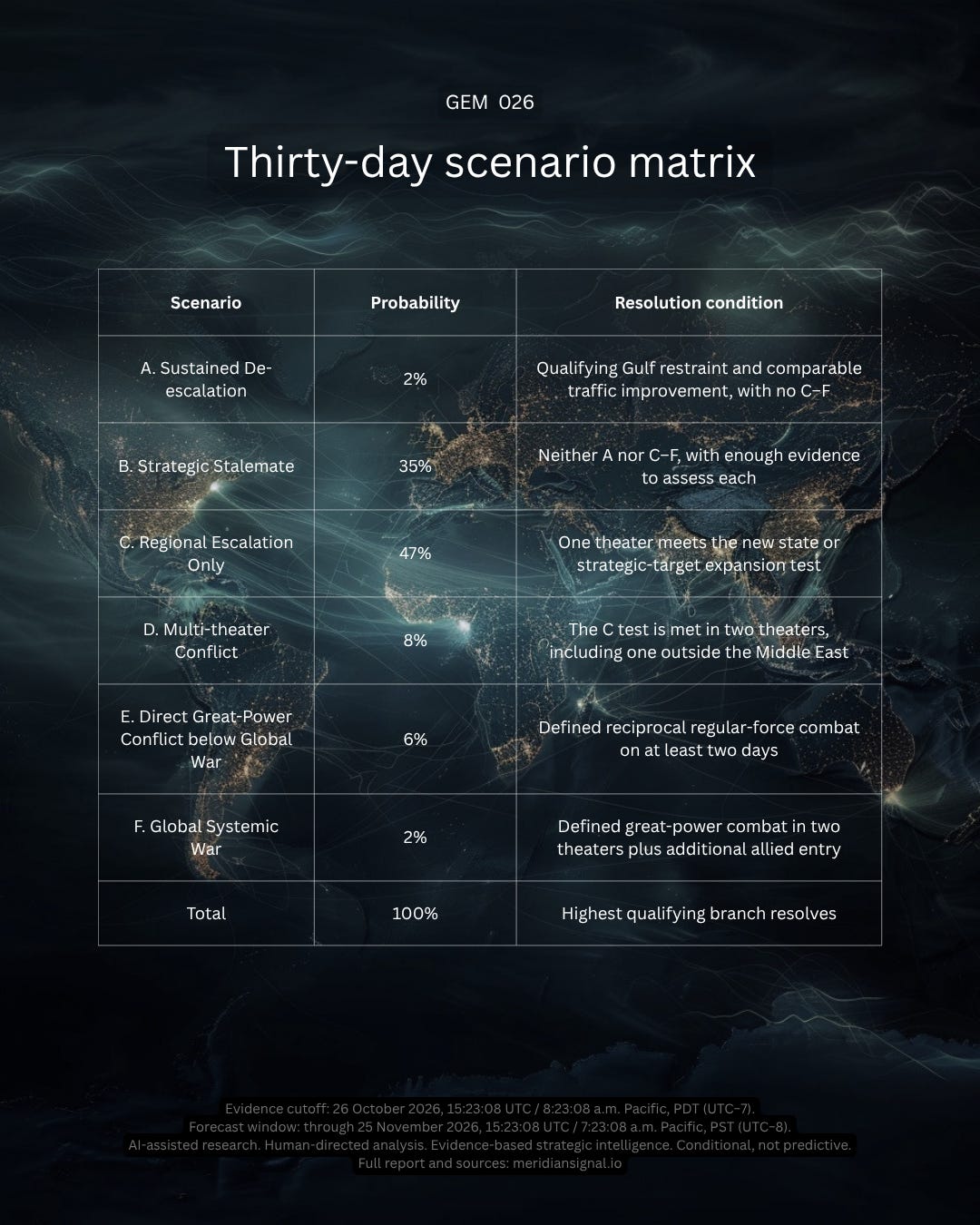
Further Escalation is C+D+E+F, or 63%. Direct Great-Power Conflict is E+F, or 8%. Regional Escalation Only is modal individually.
A restraint-favoring alternative is 8/52/28/6/5/1. An escalation-favoring alternative is 1/17/54/14/10/4. They put Further Escalation between 40% and 82% and Direct Great-Power Conflict between 6% and 14%. These are assumption tests, not confidence intervals.
Scenario A still lacks the complete seven-day Kpler daily baseline required by the prospective contract. October averages do not replace it. Missing traffic coverage may prevent resolution, but it is not a reason to reduce the physical probability mechanically.
The separate Meridian Conviction Score: Emergency Energy Measures is 40%. A qualifying outcome requires a new conflict-caused official instrument in two of the United States, European Union, China, India or Japan, each implemented for seven consecutive days inside this window. Earlier reserve programs and the United States’ 23 October refinery exchange are frozen into the baseline.
Delta, implications and next tests
The index increase is attributable entirely to Failure of Restraint rising one level, a 2.5-point contribution. The exact coding range is 53.75 to 67.50. This is a judgment sensitivity range, not a statistical confidence interval.
The most decision-relevant implication is that resilience now depends on accepting danger and cost. High volumes do not prove route reliability. At the same time, record attacks do not prove that alternatives have failed.
Watch these tests:
Egyptian direct operations after a Saudi request.
Confirmed sustained damage to export pipelines or loading terminals.
Comparable daily Hormuz flow and safe-voyage evidence.
Implemented maritime terms with observable compliance.
External-power restoration or renewed failure at nuclear sites.
A qualifying new campaign in Europe or East Asia.
Reciprocal United States–China or NATO–Russia kinetic combat.
New qualifying emergency energy instruments in two named jurisdictions.
Meridian Strategic Conclusion
Maintain Strategic Caution. Current system stress is rising because a working restraint mechanism failed. The evidence does not support a Critical alert because usable export redundancy still holds and direct opposing-great-power combat is absent.
The assessment would worsen with verified Egyptian combat entry, sustained export-substitute impairment or a second theater meeting the prospective expansion test. It would improve with implemented maritime restraint, reliable delivery and restored nuclear-site power resilience.
Editorial note: The Global Escalation Monitor assesses geopolitical and macroeconomic risk for strategic decision-making. It is general informational analysis and does not constitute individualized financial, investment, legal or tax advice.
Research disclosure: Meridian Signal uses AI-assisted research and synthesis under human-directed analytical and editorial priorities. Material factual claims are supported by cited sources, with attribution, access limitations, source conflicts and material evidence gaps disclosed where they affect the assessment. Each edition states its evidence cutoff; individual sources may reflect different publication dates, event dates and observation periods.
The Meridian Escalation Index measures current structural system stress on a 0–100 scale. Meridian Conviction Scores express judgment-based probabilities of specifically defined outcomes over a stated forecast window. Evidence Support measures the quality and coverage of evidence supporting the index inputs; it does not measure forecasting accuracy or certainty about future outcomes.
Scenario probabilities are analytical judgments and have not been empirically calibrated. Resolution criteria, forecast horizons, material methodology changes and resulting breaks in comparability are disclosed where applicable.
Meridian Signal
Bold clarity at the right time.
Independent strategic intelligence on capital regimes, digital infrastructure and systemic risk.
AI-assisted. Human-directed. Source-verified.
Evidence-based strategic intelligence. Conditional, not predictive.
Questions or corrections: contact@meridiansignal.io