BITCOIN | Weekly Conviction Intelligence Report
Publication Date: July 20, 2026 | Reporting Period: Week 29
Bitcoin is no longer behaving like a market in uncontrolled capitulation.
Institutional demand returned after a severe ETF outflow. Sentiment has recovered from extreme fear. Long term selling pressure appears to be slowing. Bitcoin also regained the $65,000 area and briefly reached a one month high near $65,700.
That is real progress.
But it is not yet the same thing as expansion.
Global liquidity remains only partially supportive. Institutional demand is still concentrated. Mining economics remain pressured. Corporate treasury structures have introduced a new source of potential supply. Most importantly, Bitcoin remains below the holder cost basis that would provide stronger confirmation that the recovery has become structurally durable.
The market is repairing.
The next phase still has to earn its confirmation.
Executive Assessment
Bitcoin entered the week with a more balanced structure than it had during the previous phase of the decline.
The strongest improvement came from institutional flows. U.S. spot Bitcoin ETFs recovered from a sharp July 13 outflow and finished the completed July 13 through July 17 week with approximately $75.5 million in net inflows. The significance is not the absolute amount. The more important signal is that institutional buyers returned across several consecutive sessions after a major withdrawal event.
Price responded by returning above $65,000, but the recovery remains incomplete. Bitcoin is still approximately 48% below its October 2025 all time high near $126,198.
Liquidity conditions have improved modestly, but transmission into Bitcoin remains partial rather than decisive. Treasury adoption remains structurally supportive, yet Strategy’s holdings and financing architecture demonstrate that treasury Bitcoin can no longer be treated as permanently inaccessible supply. Strategy reported 843,775 BTC at the July 19 cutoff.
The correct interpretation is therefore neither aggressive optimism nor renewed pessimism.
It is Cautiously Constructive.
Executive Snapshot
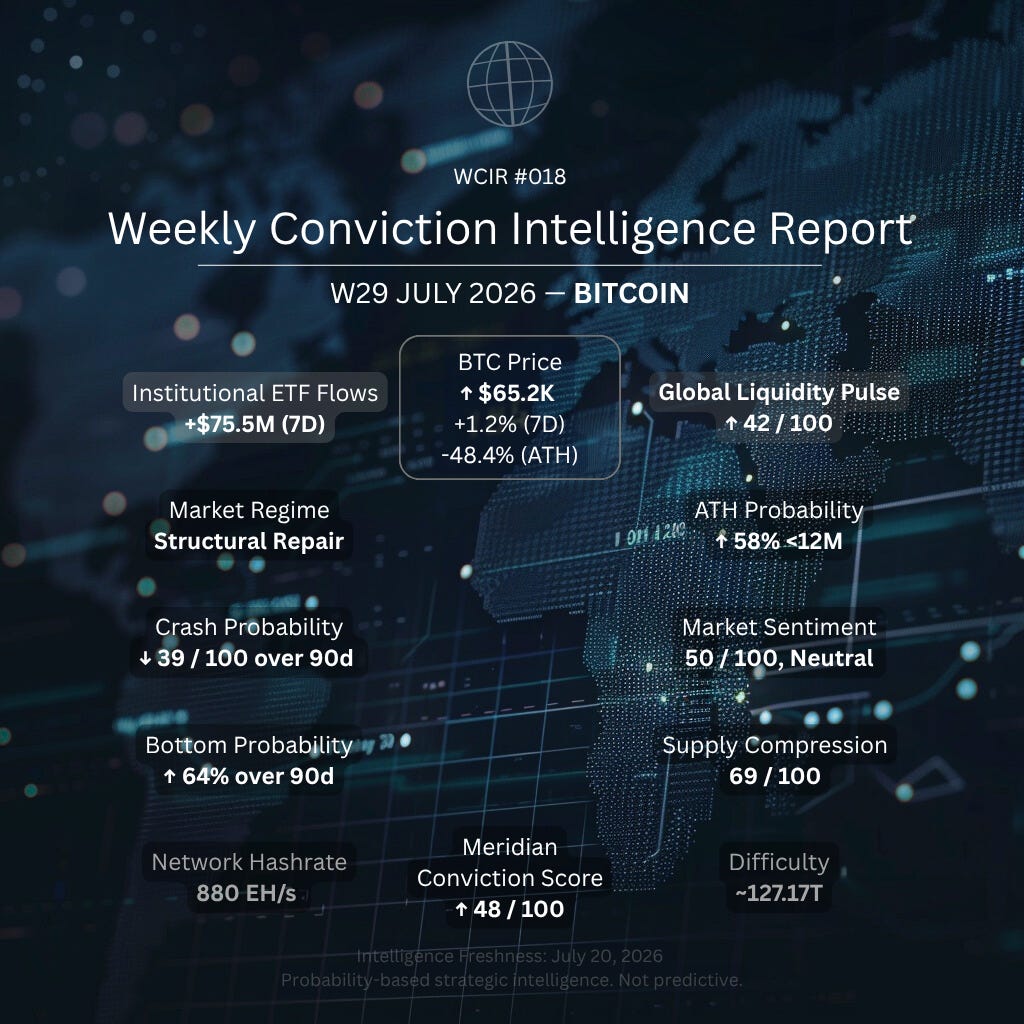
The July 20 daily close was approximately $65,185 on CoinGecko, while intraday pricing reached approximately $65,697. Bitcoin’s current mining difficulty was 127.17T, with block production running slower than the ten minute target during the active adjustment period.
Methodology note: Global Liquidity Pulse, Supply Compression, probability estimates and the Meridian Conviction Score are proprietary Meridian model outputs, not external market statistics.
Meridian Cycle Dashboard
WCIR 018 introduces the first publication version of the Meridian Cycle Dashboard™.
The purpose is not simply to show where Bitcoin trades today.
It is to show whether the underlying thesis is strengthening or weakening through time.
Panel I: Tactical Evolution
WCIR 017 versus WCIR 018
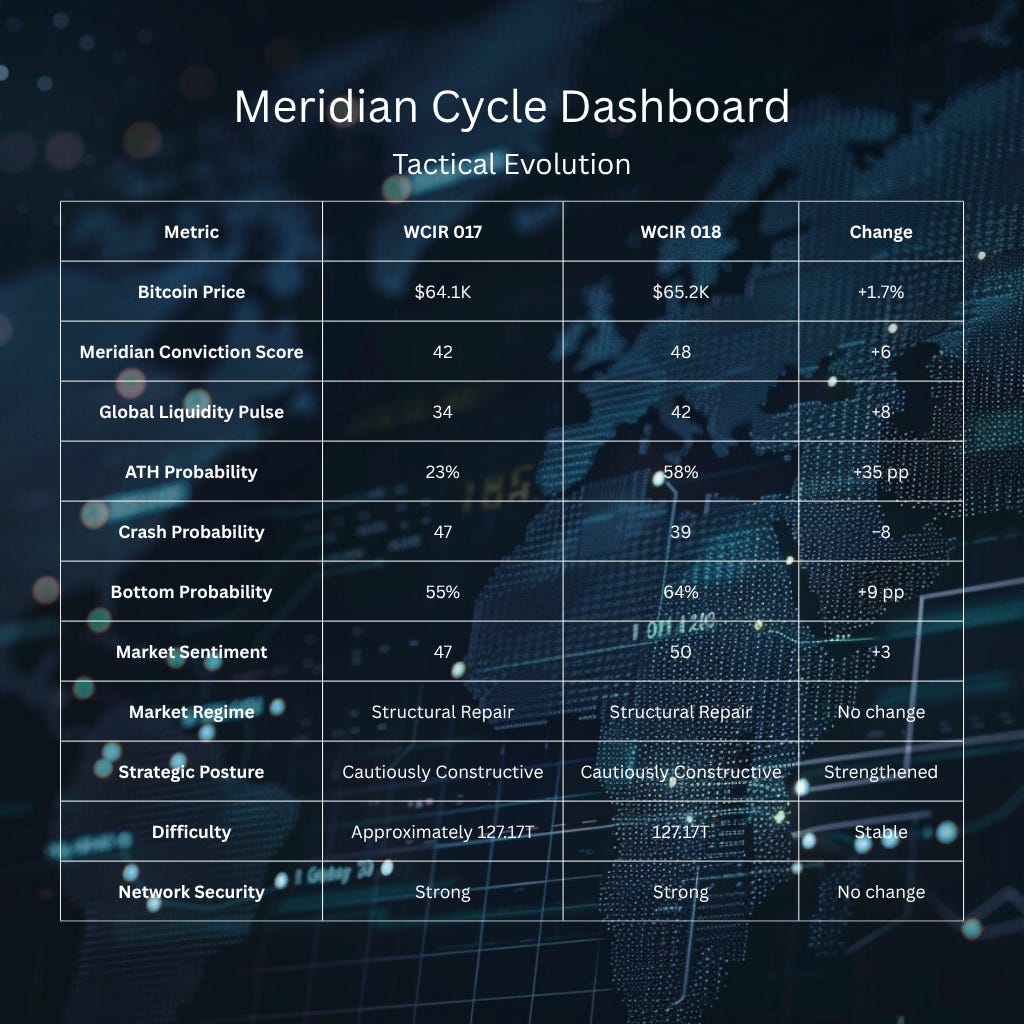
Weekly interpretation
The improvement was broad enough to raise conviction, but not strong enough to change the regime.
Institutional flows improved.
Sentiment normalized.
Bottom confidence increased.
Crash risk declined.
But the market remains in Structural Repair because liquidity transmission, cost basis recovery and sustained spot absorption have not yet provided sufficient confirmation.
Panel II: Structural Cycle Position
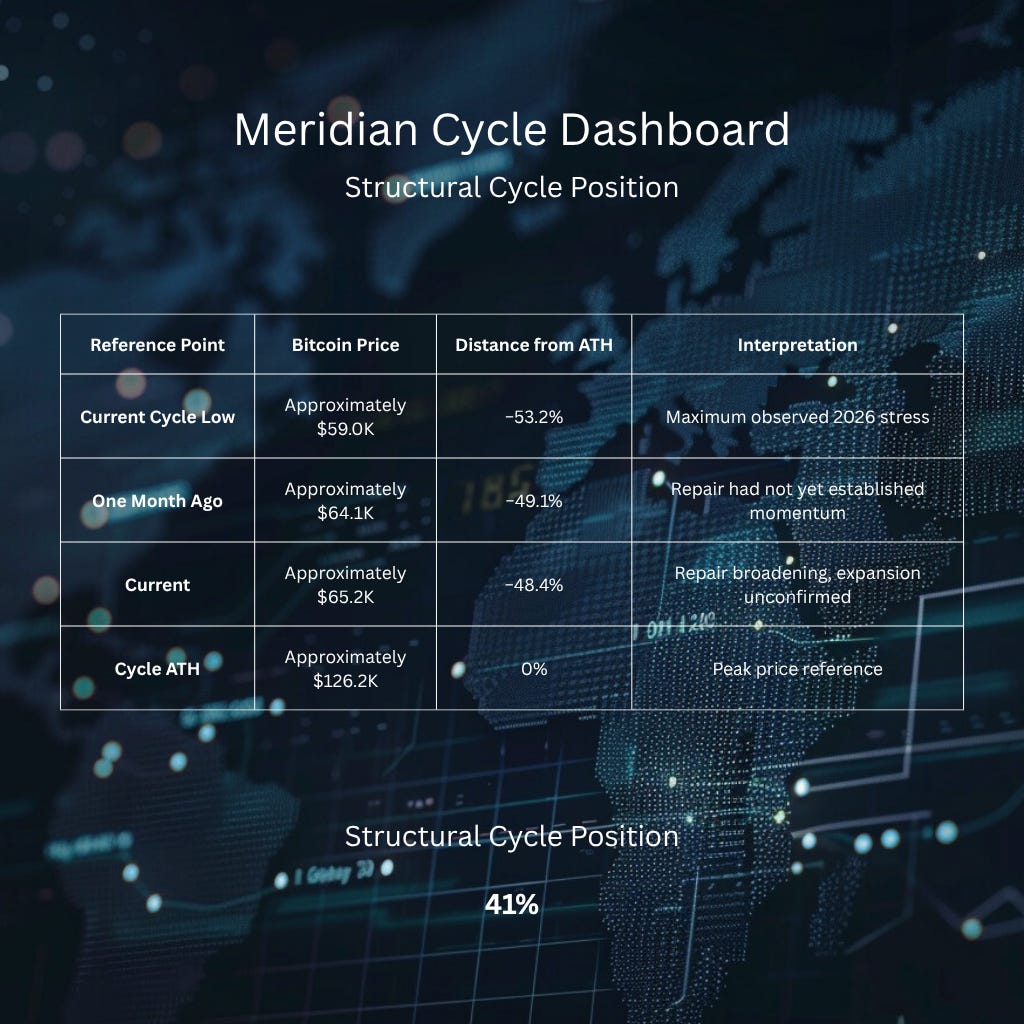
Bitcoin traded near $64,180 on June 20, fell to approximately $59,023 during the June 24 to June 25 liquidation episode, and reached its current all time high near $126,198 in October 2025.
Meridian Cycle Position
Cycle Bottom Cycle ATH
████░░░░░░ 41% Current
This is not calculated from price alone.
It combines:
Market structure
Institutional demand
Liquidity
Supply compression
Sentiment
Network strength
Treasury reflexivity
Regime development
The market has progressed meaningfully beyond acute stress.
It remains materially short of a confirmed expansion regime.
Signal Quality Overlay
Institutional Exposure Quality
55 / 100 | Constructive, but concentrated
ETF demand improved after the July 13 outflow, and the return of buyers across several consecutive sessions is more significant than a single positive day.
The weakness is concentration.
A mature institutional accumulation phase would normally show broader issuer participation, stronger persistence and a clearer relationship between flows and price expansion.
Current institutional demand is credible.
It is not yet dominant.
Treasury Reflexivity
37 / 100 | Negative risk remains elevated
Corporate treasury adoption continues to strengthen Bitcoin’s reserve asset credentials.
But treasury Bitcoin cannot be assumed to remain permanently outside the market.
Strategy reported 843,775 BTC with an average acquisition price of approximately $75,476, above Bitcoin’s current market price. Its holdings declined from 846,000 BTC at June 30 to 843,775 BTC at July 19, illustrating that treasury balances can change when financing and liquidity requirements evolve.
The structural conclusion is important:
Treasury adoption increases long term demand, but treasury financing can create medium term supply.
Liquidity Transmission
40 / 100 | Partial
Broader liquidity conditions became less restrictive, but that improvement has not yet produced decisive Bitcoin demand.
The current transmission chain is:
Banking liquidity
Risk appetite
Institutional allocation
ETF creation
Spot absorption
Price expansion
The system has advanced into institutional allocation and ETF creation.
It has not yet produced persistent spot absorption or a confirmed price expansion.
Meridian Conviction Score
48 / 100
Classification: Transitional
The Conviction Score increased from approximately 42 to 48.
That is a meaningful improvement, but the score remains below the level required for a constructive expansion classification.
What improved
ETF demand recovered.
Bitcoin regained the $65,000 region.
Sentiment returned to neutral.
Bottom confidence improved.
Capitulation pressure slowed.
Capital competition from AI related equities became less one directional, with Bitcoin outperforming semiconductor shares during July.
What weakened
Treasury reflexivity became more visible.
Mining economics remained pressured.
Institutional inflows remained modest and concentrated.
Global liquidity was not yet expansionary.
Bitcoin had not reclaimed the next major structural confirmation zone.
What the score really means
A score of 48 does not mean Bitcoin has a 48% chance of succeeding.
It means the current balance of institutional, macroeconomic, supply, network and market evidence is improving but remains transitional.
The structure is no longer defensive.
It is not yet strong enough to justify aggressive risk taking.
Fresh Intelligence
Confirmed Structural Changes
Institutional buyers returned after stress
The completed ETF week ended positive despite beginning with a major outflow.
That suggests institutional demand was disrupted, not destroyed.
Bitcoin’s financialization continues
Bitcoin is increasingly accessed through ETFs, options, futures, corporate treasury vehicles, preferred securities and collateral structures.
That expands institutional access.
It also increases Bitcoin’s sensitivity to balance sheet pressure, hedging activity, leverage and wrapper mechanics.
Treasury supply became a real variable
Corporate Bitcoin holdings should now be treated as semi illiquid supply.
They are structurally less liquid than exchange inventory, but not permanently unavailable.
Network security remained strong
Bitcoin’s exact hashrate varies by measurement period because it is estimated from recent blocks and difficulty rather than observed directly. Blockchain.com explains that hashrate is an estimate based on block production and network difficulty.
Even with pressure on miners, the network remains exceptionally difficult and expensive to attack.
Tactical Developments
Bitcoin reached a one month high near $65,700 before moderating.
The July 20 reference price closed near $65,185.
Sentiment returned to neutral.
The ETF recovery extended into a second positive week.
The current difficulty cycle remained elevated at 127.17T, while slower block production suggested downward retarget pressure.
Contradictions
Institutional demand improved, but price had not entered expansion.
Supply remained constrained, but treasury and dormant holdings can reenter circulation.
The network remained secure, but miner economics weakened.
Financialization improved access, but increased reflexive risk.
Liquidity improved, but transmission remained partial.
These contradictions explain why the regime improved without changing classification.
Institutional Demand
The ETF recovery is the strongest tactical signal in WCIR 018.
The completed week produced approximately $75.5 million in net inflows. That amount is not large enough to constitute aggressive institutional accumulation, but the internal pattern matters.
Demand recovered after a severe withdrawal.
The market absorbed the shock.
Institutions returned rather than remaining absent.
That is consistent with a repair phase.
For an expansion phase, Meridian would want to see:
Greater issuer breadth
Several weeks of persistent positive flows
Stronger spot market participation
Price holding above structural resistance
ETF demand absorbing available supply without excessive derivatives leverage
We are not there yet.
But the direction improved.
Treasury Reflexivity
Bitcoin treasury adoption has entered a more mature stage.
The initial treasury thesis was simple:
Companies buy Bitcoin and remove supply from the market.
The current reality is more complicated.
Treasury companies fund purchases through equity issuance, debt, preferred securities and other financing mechanisms. Those obligations create recurring claims on cash flow and balance sheet liquidity.
When financing conditions are favorable, treasury vehicles can become powerful Bitcoin buyers.
When financing conditions weaken, the same structures can create selling pressure.
This does not invalidate the treasury thesis.
It changes its risk profile.
Bitcoin held by highly leveraged or financing dependent companies should therefore be treated differently from Bitcoin held by unleveraged long term owners.
Structural Assessment
Liquidity: Restrictive neutral, improving
Liquidity is no longer deteriorating at the same pace.
But Bitcoin has not yet entered an environment of broad monetary expansion.
Institutional Capital: Constructive
Demand returned and displayed some persistence.
Breadth and magnitude remain insufficient for full confirmation.
Supply: Structurally constrained, tactically available
Bitcoin’s fixed issuance and long term holder concentration remain supportive.
Treasury sales, miner pressure, dormant holder activation and ETF redemptions provide possible sources of marginal supply.
Financialization: Advanced
Bitcoin is becoming embedded in institutional portfolios and financial wrappers.
That improves legitimacy and access while increasing market complexity.
Network: Secure, economically pressured
Protocol security remains strong.
Miner profitability and the economics of marginal hashrate remain weaker.
Cross Asset Behavior: Macro sensitive
Bitcoin is still behaving more like an institutional risk and liquidity asset than a reliable short term geopolitical hedge.
Market Regime: Structural Repair
Bitcoin’s internal regime sequence is:
Contraction
Capitulation
Stabilization
Structural Repair
Accumulation
Expansion
The market is currently in Structural Repair.
Probability of the next regime state
Structural Repair continues: 46%
Transition to Accumulation: 27%
Transition directly to Expansion: 14%
Return to Contraction: 13%
Expansion remains possible.
It is not yet the base case.
Probability Framework
These probabilities are proprietary Meridian assessments, based on the evidence available at the July 20 data cutoff.
ATH Probability
58% within 12 months
Event definition: Bitcoin establishes a new price above approximately $126,198.
Evidence coverage: Moderate to high.
Supporting factors:
Institutional access
Structural scarcity
Long term holder concentration
Neutral sentiment
Improving ETF demand
Strong network security
Direct monetary value capture
Limiting factors:
Incomplete liquidity transmission
Treasury reflexivity
Cost basis resistance
Weak miner economics
Macro and geopolitical risk
Crash Probability
39 / 100 over 90 days
This measures the risk of a large and disorderly decline, not an ordinary correction.
Principal risks include:
Renewed ETF outflows
Treasury company selling
Oil driven inflation pressure
A hawkish monetary surprise
A derivatives unwind
A broader equity or credit event
A sustained break below the high $50,000s
Bottom Probability
64% over 90 days
The probability that the current cycle low remains intact has improved because:
Sentiment normalized without becoming euphoric
Long term selling pressure slowed
Institutional demand returned
Bitcoin recovered above $65,000
Network security remained strong
The market absorbed multiple adverse events
The probability is above 50%.
It is not high enough to declare the bottom confirmed.
Expansion Probability
41% within 90 days
Expansion requires more than a temporary price rebound.
It requires sustained institutional absorption, stronger liquidity transmission, an improving holder cost basis and price acceptance above major resistance.
Key Structural Levels
Immediate support
$63,000 to $64,000
This region represents the first test of whether the latest institutional recovery has created a stronger floor.
Secondary support
$60,000 to $62,000
A return to this region would weaken momentum but would not automatically invalidate the repair thesis.
Structural invalidation
Sustained break below approximately $59,000
Bitcoin traded near $59,023 during the June liquidation episode. A sustained break below that area would materially weaken bottom confidence.
Immediate resistance
$65,700 to $66,500
The July 20 high near $65,700 forms the first tactical resistance zone.
Primary confirmation zone
Approximately $69,000
This is the next major structural threshold used by the WCIR model.
A sustained reclaim would indicate stronger absorption of underwater holder supply and a meaningful improvement in market structure.
Expansion zone
$72,000 to $75,000
Price acceptance within this zone, supported by persistent ETF demand and stronger liquidity transmission, would materially raise the probability of an accumulation to expansion transition.
30 Day Scenario Matrix
Base Case: 51%
Bitcoin remains broadly between $61,000 and $72,000.
Structural repair continues.
ETF demand remains positive but uneven.
Liquidity improves gradually.
Bull Case: 27%
Bitcoin holds above $69,000 and tests approximately $72,000 to $78,000.
Institutional demand broadens.
The Meridian Conviction Score moves toward or above 60.
Bear Case: 22%
Bitcoin loses $60,000 and retests the high $50,000s.
ETF flows reverse.
Treasury or miner selling increases.
Macro conditions deteriorate.
Strategic Posture
Cautiously Constructive
This is not a high conviction expansion environment.
It is no longer a purely defensive environment either.
The correct posture is patience with selective exposure.
Do not mistake the absence of collapse for confirmation of expansion.
Do not ignore the fact that several structural indicators improved at the same time.
Meridian Positioning
Long Term Capital
Maintain and selectively accumulate
Bitcoin’s monetary scarcity, network security, collateral potential and direct value capture remain structurally intact.
Medium Term Capital
Accumulate gradually or wait for confirmation
The risk reward is improving.
The regime is still transitional.
Tactical Capital
Avoid chasing resistance
A sustained move above the primary confirmation zone would provide a better structural signal than anticipating the breakout prematurely.
Leveraged Capital
Remain restrained
The market does not yet offer enough confirmation to justify aggressive leverage.
Trigger Map
Upside Confirmation
Bitcoin holds above approximately $69,000
ETF inflows broaden across issuers
Five day ETF demand accelerates materially
Global Liquidity Pulse rises above 50
Spot volume expands without excessive funding
Supply Compression remains above 70
Miner conditions stabilize
Expansion Confirmation
Bitcoin establishes support above $72,000
Holder cost basis becomes support
ETF demand persists for several weeks
Liquidity Transmission rises above 55
BPEM rises above 65
Meridian Conviction Score rises above 60
Downside Warnings
Persistent ETF outflows return
Bitcoin repeatedly fails below confirmation
Price loses $62,000 on expanding volume
Treasury related selling accelerates
Oil and inflation force renewed monetary tightening
Miner distribution increases
Structural Invalidation
Sustained price below approximately $59,000
Weekly ETF outflows exceed approximately $1 billion
Long term holder distribution accelerates
Liquidity Transmission falls below 30
Treasury Reflexivity rises above 65
Meridian Conviction Score falls below 35
Signal Integrity
System Integrity: Pass
Evidence Quality: 82 / 100
Structural Confidence: 72 / 100
Timing Confidence: 61 / 100
Probability Confidence: 64 / 100
Publication Freshness: Current at July 20 cutoff
Known limitations
Exchange supply estimates vary by provider and wallet classification methodology.
Hashrate cannot be observed directly and changes according to the smoothing window used.
ETF data may receive minor revisions.
OTC absorption cannot be measured directly.
Meridian probabilities are calibrated analytical outputs, not guarantees.
Meridian Conviction Score: 48 / 100
Classification: Transitional
Strategic Posture
Cautiously Constructive
Dominant Structural Signal
Institutional demand is improving faster than liquidity transmission.
Primary Risk
Treasury and financial wrapper reflexivity could convert structural holders into financing driven sellers during renewed stress.
Next Confirmation Trigger
A sustained reclaim of approximately $69,000 supported by persistent ETF absorption and stronger spot demand.
Institutional Verdict
Bitcoin’s repair is becoming more credible.
The market absorbed a significant institutional outflow, recovered above $65,000 and finished the completed ETF week with positive net demand. Sentiment returned to neutral. Bottom confidence improved. Network security remained exceptionally strong.
Those are not trivial developments.
But they do not yet constitute expansion.
The current market still depends on partial liquidity transmission, concentrated ETF participation and a price structure that has not reclaimed its next major holder threshold. Treasury adoption remains a long term source of demand, but corporate financing structures have introduced a new source of reflexive supply. Miner economics remain under pressure even while the network itself remains secure.
The correct institutional interpretation is therefore balanced.
The durable Bitcoin thesis continues strengthening beneath the surface.
The tactical market has not yet provided enough evidence to justify aggressive positioning.
The repair is real.
Expansion still requires proof.
Signal Over Noise.
Editorial Note
The Bitcoin Weekly Conviction Intelligence Report (WCIR) is a strategic intelligence publication by Meridian Signal designed to evaluate Bitcoin through the lens of market structure, institutional capital flows, liquidity conditions, supply dynamics, network security, and probabilistic regime analysis.
Its purpose is not to predict short-term price movements or provide investment recommendations, but to assess the quality of Bitcoin’s current structural position, identify meaningful shifts in conviction, and reduce uncertainty for long-term strategic decision-making.
The Meridian Conviction Score, regime classifications, probability framework, strategic posture and positioning conclusions represent analytical judgments derived from the Meridian Signal intelligence framework. They are intended to help readers interpret evolving market conditions rather than forecast outcomes with certainty.
All assessments reflect the information available at the time of publication and may change as new evidence emerges.
Meridian Signal is committed to evaluating structure over price, probabilities over predictions, conviction over emotion, and signal over noise.
Meridian Signal
Independent Strategic Intelligence Desk
General informational analysis. Not financial advice